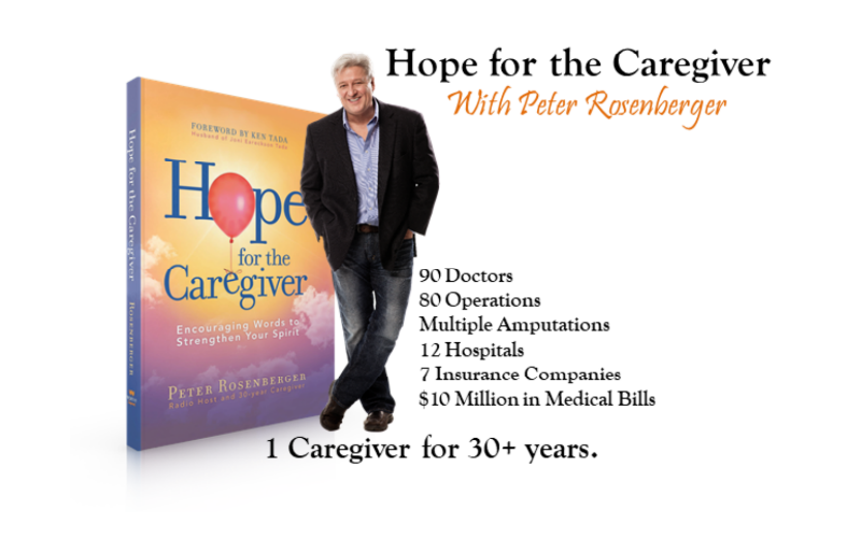
Peter Rosenberger: Welcome to Hope for the Caregiver, here on American Family Radio. This is Peter Rosenberger, and this is the program for you as a family caregiver. There are more than 65 million Americans right now who are doing this. Are you one of them? Well, if so, you're in the right place. If not, you're still in the right place. Because if you love somebody, you're going to most likely be a caregiver. If you live long enough, you're going to need one. You ready for that? How's that going for you? What's going on with you? These are the questions and more that we ask here on this program as we seek to help family caregivers stay calmer, healthier, and dare I say it, even a little bit more joyful. And I have found in my years of doing this, which is now over 40, that healthy caregivers make better caregivers. And so today's a great day to start becoming healthier. But how do you help somebody stay healthy while taking care of somebody who is not? That's a good question, and that's why this program is here. And we're glad you're with us. Hope for the caregiver.com Hope for the caregiver.com. you know, the first time that God said something was not good. No one had sinned, yet. It was before the fall, before all of that mess in Genesis. Go look it up. Genesis 2:18 says it right there in the text. When he looked at Adam, he said, it is not good that the man should be alone. It is not good that the man should be alone. He had said everything else was good, but with that, it wasn't. And this is before sin marred his creation. That says something doesn't. Adam hadn't done anything wrong. He was doing his job. He was naming the animals. I guess that that's what he was doing. I'm not sure exactly what he was doing, but whatever he's doing, God felt that he needed a companion. He needed to help meet. He needed another person. And God knew it and put it in his eternal word. Most of us remember the isolation of Cove And for caregivers, you know, it's kind of like that for us without a pandemic. Isolation is kind of a way of life for so many of us. We. I mean, how many just rough survey, Raise your hands. How many of you ever turn down something like dinner invitation because caregiving challenges are just too difficult? just show of hands. Look at all those hands out there. You've Turned down dinner? Just dinner or a movie or something. Just going over to people's homes. How many of you all have had an invitation to go to someone's home for dinner and you had to ask them, are there stairs? I mean, that's just a part of life for us, isn't it? For so many of us. Now, not every caregiver is dealing with a mobility impairment, of their loved one, but many of us are. And I have had that conversation with people who've asked us over dinner, and they got a lot of stairs. And I'm like, well, thank you, but we can. I appreciate it, but we can't. And sometimes it's, you know, meeting for dinner somewhere, but we're having a kind of a situation, and we have to turn that down. How about going to church on Sunday morning? Is that difficult for you and your loved one? Is that, Is that challenging for you? sometimes. For some, going to church can require more planning than is put into a vacation. I mean, it's just the way it is sometimes for us. And when you get there, do you feel comfortable there at church? Do you feel comfortable there? Does your loved one behave or look in a way that causes a little bit of embarrassment or discomfort or self consciousness that's going on? You know, this happens. Do you feel safe and comfortable at your church? Or is it just easier just to slip in by yourself at the rare blue moon and not try to bring them again? Scripture says, Genesis 2:18, it is not good that the man should be alone. God saw isolation. He saw loneliness. He saw aloneness. Said, this isn't good before the fall. And I often tell people, if you've listened to this program for any length of time, you've heard me say it, that caregivers can feel isolated in a crowded room. And I tell pastors that caregivers can often feel isolated on a crowded pew. I remember one of the absolute loneliest moments of my life as a caregiver, just as a human being was on Easter Sunday at church in Nashville, this very large church. They had a thousand people in there. Everybody's dressed in their finest, huge orchestra, everybody singing Christ the, Lord is risen to glorious service. I mean, if you had to, you know, ranked the top Easter service you could have kind of thing. It was like right up there at the top of it. It was everything that you would want in an Easter service. And I was just. I was just groaning inside. Gracie was very, very, very sick. We lived two miles from the church, and I was able to slip down for service. The kids were away, I think spring, break or something with the grandparents. And I was just by myself and I slipped in and I was so lonely and I was so discouraged. And it was Easter Sunday and everybody's singing about the glorious moment in the Resurrection and I, I couldn't. I couldn't get there. I was. I was so beset with this. In a room full of a thousand people with glorious music going on, I cannot be the only person who's ever experienced something like that. And I'm determined to help speak to that issue to my fellow caregivers and to others so that they will know how to recognize it again. Everything I learn, everything I share here on this program comes from me foraging for all this. I mean, that I've had to just learn this on my own. Trial and error. Nobody really knew what to say to me. They didn't know how to speak into my loneliness, number one. They didn't even come up and address it. Oh, give our best to Gracie. Sorry she couldn't be here, but, you know, that was it. There was no. How are you dealing with this? Do you. Are you able to hold on to this? Or is the resurrection and the good news of the gospel able to penetrate to where you are today? And if not, tell me why not? What can we do? Nobody ever said anything like this. They didn't know what to say. They didn't have the vocabulary. But I do, and that's what I do on this program. And, you know, there's a difference between isolation and solitude. You know, I love a quiet cup of coffee and early in the morning, I get up very early and I get more done by nine o' clock than most people get done all day. And I love being able to get out on horseback in the afternoon. And it can just feel like a holiday for me, just, you know, an hour or two. But solitude gives us room to breathe. Isolation leaves us wondering, is anybody going to pick up the phone if we call? And it's in that kind of quiet, that isolation quiet, that the dark thoughts will multiply. You ever replay a conversation in your head a thousand times that you berate yourself without mercy in the process of that? You ever just sink into despair while you're doing it? And sometimes we just need someone else to come up next to us and say, tell. Tell me what happened. I've been writing about this. You can see it on my substack caregiver.substack.com and I've been. The last couple articles have been pushing Back against fear. And then I talk about a measured temperament when we're advocating for someone that we love. And isolation makes both of those things harder. It's harder to be measured. It's harder to not be gripped with fear when you're isolated, when I'm, when I'm tired or when I'm angry. I need somebody who's going to hear me out and help me separate what I know from what I fear. That's why you hear me ask on this program a lot, Christian, what do you believe? Where do you anchor yourself? And Gracie needs to have me bring a clear mind to the next conversation with her doctor. I can't do that on my own. I usually need help getting there. And for a caregiver, reaching out can be very intimidating. And I get that. I started my caregiver support group out here and I was the only person there for three weeks sitting at the table. I was, I was it. I was the only guy sitting at the table for three weeks. And now we need a bigger table. I started this seven years ago. We need a bigger table now, but there's always room for one more. And if you'll notice, in scripture, God did not tell Adam to get better at being alone. He gave him someone to share his life. You know, a caregiver. M may need a friend, another caregiver, a neighbor or someone from church to listen as we wrestle with the next decision. Or maybe a guy on the radio that talks about his journey over this crazy life that I've had. Our loved ones need advocates, but advocates need people. And it's not good that we're alone. Remember last week and the week before, I was talking about a word from the Lord. Well, I do have a word from the Lord for you. It's right from his text. It says, it's not good that man's alone. God said that and it's written down for all eternity. And guess what? You're not alone. This is Peter Rosenberger. This is Hope for the Caregiver. We'll be right back. Hello, I'm Peter Rosenberger. Did you know that this show is listener supported? Without people like you, this show would not exist. That's why we need you. A generous monthly gift of any amount will help sustain American Family Radio, specifically this show as we reach thousands of people each week with biblical truth. Please consider becoming a monthly financial partner today by visiting afr.netgive that's afr.net give me.
AFA stream is a resource for life changing instruction and information. A source of Wholesome entertainment and relaxation, plus access to some of your favorite AFA shows. You can watch a lot of content for free, or you can become a great commission partner. Then you'll not only open the door to everything AFA Stream has to offer, you'll get benefits like a subscription to the stand and some really nice exclusives. Why not get started today? It's easy. Visit stream.uhafa.net
Kayleigh Bush m My name is Kailee Bush, and I am just your regular small town daddy's girl. Four weeks after I had won the title of Miss North Florida, I was asked to sign a contract. Female means a born female or an individual who has fully completed sex reassignment surgery. I declined to sign, resulting in the loss of my title, any scholarship opportunities.
Peter Rosenberger So we demanded that they rescind it, but unfortunately, they would not.
Kayleigh Bush Today I'm standing to preserve sisterhood, the foundation of, Miss America. But how can it be a sisterhood if the door is open to brothers? I believe that biology is real and that no boy is born in the wrong body. You know, what makes people a leader is them following their convictions boldly and courageously.
Peter Rosenberger She wanted her integrity more than the crown. And she wanted to follow our Lord Jesus Christ more than Miss America. Watch Kaylee's story [email protected] impact Welcome back to Hope for the Caregiver. This is Peter Rosenberger. Glad to have you with us today. Hope for the caregiver.com hopefulthecaregiver.com where I have lots and lots and lots of things for you as a family caregiver. I hope you'll take advantage of it. Been writing things down. I've got a pretty good library. All the archives of it go at my substack. Okay, so I want to be clear, what is Substack? Substack is my online newsletter. So I just put stuff out there. it's easier than a blog, if you will, because I could do video, audio and everything, but it's all very organized. It's out there@caregiver substack.com but you can get there from my [email protected] so, that's just where I put. I've been writing quite a bit. I write for two publications each week, and then sometimes I get three published things in a week. And then, and I do one monthly column. So I've just got a lot of stuff out there. Some of it is exclusive to that organization that, that I write for. And some of it I put out there on My sub stack for listeners to this program and whoever else wants to. And I do this for several reasons. One of them is because I love to write. I do love to put these things down on paper and, well, it's digital paper, but you know what I mean? And organize my thoughts that way. But the main reason is, is because I never had anything like this. And I remember how difficult it was to forage. It was almost like living in a foreign land, and you had to pick up the language from the street kind of thing just by hit or miss. And I thought, this is just difficult. And I thought, there are a lot of people out there who are dealing with dire circumstances that could really use somebody saying things to them clearly. And that's what I do. and I do this through this program and through the podcast, through everything I do, is to say it clearly in a way that caregivers could understand and have those conversation topics, like we've been doing for the last couple of weeks on theology, for example, when people say, you know, I got a word for the. From the Lord for you. And then what do we do with that information? And how do we respond? What is the biblical way to be able to engage with that and that kind of thing? And then the last block where I talked about, you know, the first thing that God said that wasn't good. You know, you don't really think about that until you're in the throes of this. And then all of a sudden you realize, oh, that that's helpful, that's helpful, that's helpful that God knows that it's not good that I'm alone. And building on that even more, once we understand that concept, going back to Genesis, that it's not good that man's alone. But then sin forever separated us from God. But then when God came to us, when he invaded this world in human form, what was his name? Emmanuel. He's literally tabernacling with us. That's what it means. He is with us, God with us. He is in our presence. We're not alone. I mean, that's the whole point of it, to realize, oh, and now we start to see these things. But if we don't have somebody take us by the hand and just walk us through these things, simply not because, you know, we're necessarily stupid or anything. But I'll tell you what I tell a lot of guys that come out here and help me with different projects I've had, you know, when we're doing repairs here at the house, and I'll look at them and I'll say, look, I have a very finite set of skills. I'm an exceptional pianist, and I'm a pretty good writer. And, that's where it stops. So what you're trying to tell me, tell it like you would tell a third grader. You know, bring out the crayons if you have to. Because I. And I'm not that ego driven that I can't look at somebody say, you're going to have to break this down and make it simple for me. Draw me a picture. Help me understand it this way. Don't leave until I. Until you. I got a tractor out here. I've got to learn how to drive. Some of you guys could drive a tractor in your sleep, you know. But me, I've got to go out there and have more tutorials on it. You won't believe the amount of training I had to have on a chainsaw. And I still get nervous when I do it. You know, we all get outside of our comfort zone, and as caregivers, we're being beset with all kinds of things that are coming at us pretty rapidly. And when somebody gives us a piece of advice or gives us instruction or even gives us scripture, how did we apply that? That's what I want to know. What does this look like fleshed out in our life? What does this mean to me as a caregiver? And I go back to my friends who are Bible translators over in Central Africa with Wycliffe Bible translators, and I'm paraphrasing this, so don't hold me to task on this, but basically, you know, when you're with Wycliffe Bible translators or any Bible translators, and you show up to a place and they don't speak the language well, you don't start translating the Bible. Genesis 1 the first day you got to spend time with these people. You got to get to know them. You got to be in the village. You gotta. You gotta immerse yourself in their world to be able to understand how to communicate. And it takes an enormous amount of work to do this. And then you gotta take the complex and make it simple. And that takes work. That takes spending a lot of time with your subject matter. That's why when you see the guys who are really, really good at this sort of thing and the best at what they do, they can make very, very difficult things simpler. So you can understand it, but it takes years of living with something. You know, they say to be an expert, you got to have 10,000 hours of doing something. You've heard that, haven't you? And 10,000 hours of doing, you, know, accomplishment in your field. Well, as a caregiver, if you just count half days for me, I'm well over 188,000 hours. If you just count half days, 12 hour days that I'm on duty as a caregiver, I got to sleep sometime, I guess. But I mean, you know, no matter how you slice it, you're looking at enormous amount of time I've spent. Now that doesn't mean I'm necessarily good. You remember when, when Trump and Hillary Clinton were debating and she said, I've had 30 years of experience. He said, yeah, all bad, you know, that kind of thing. Well, I've had a lot of bad experience too. And I don't look at everything I've done as accomplishment, but I've spent well over 150/180,000 hours contemplating the same topic and wrestling with God in this and trying to understand scripture, asking for guidance in this for a hundred and eighty eight thousand hours when I'm awake. In reality, I think I even dreamed about all this. But you know, you're looking at, I remember talking to a guy one time and I said, you know, we were talking about this issue and I said, think about the last time your wife got sick. How did it affect your work schedule? He said, well, I had to take off some work. And I said, how did it affect your kids? He said, well, it was pretty rough. what about laundry? It backed up. What about cleaning the house? Forget it. What about meals? When I was doing a lot of takeout? So what about your relationship? Any kind of intimacy? He, said, forget it. And I said, and she had what? He said, she had the flu. And I said, how long was she sick? He said, about four or five days. Four or five days? I've had over 15,000 days. Okay, think through that for just a moment. Four or five days and I've had over 15,000 Days as a caregiver where I've had to wrestle with this. Now I have not gotten this right, you know, every time, don't, do not think for one moment. But I've had the opportunity to look at the same mountain for a long time and ask the same questions. And I have to wrestle with those questions. And that's what I've done with this program and writing these things out so that you can hear some of those internal conversations I've had. Like in the last block, when I talked about it's not good. That man's alone. That's. That's an internal conversation I've had for a long time. Because I understand what loneliness feels like. I understand what isolation feels like. And as I mentioned about being at church that Sunday, you know, that's been there, done that. And so I have to come to grips with this. I have to shake hands with this. I have to reconcile with this somehow. Otherwise you end up becoming bitter, despairing, rageful, resentful, all those kinds of things. You can't have these kinds of pressing issues on you and just slough it off. You're going to have to deal with it. And that's what I've done in my writing and everything else. And you get to see how I've dealt with it and how I've made mistakes with it, how I've gotten it wrong many times. And, what I've learned from it. And more importantly, how Scripture has become increasingly prescient in my life, where I'm seeing it now in ways that I didn't see it before. That's why I love these hymns so much. Because these hymn writers, they spent the time with this subject. They spent the time with a lot of sorrow. And they wrote it out in a prose that is so encapsulating of the gospel. That's what. That's what they called hymns. They call it compact theology because it's right there. For example. You know, my, hope is built on nothing less than Jesus, blood and righteousness. Well, in one line, you've got the double imputation of God's grace and redemption to us. Because he not only had the atonement paid for with the blood, the shed blood of Christ, but then he's got his righteousness that is imputed to us so that we not only have the penalty paid, but now we can faultless to stand before the throne. We can't just do that unless there's a righteousness that has been imputed to us. We can't go to the Father without righteousness. And we have none of our own, so we have to be clothed in his righteousness. Do you see that now? So now you got a hymn that is saying this in the first line. And, you could stop there. That's it. I mean, we got it. That's. That's the whole message right there. But. But then they keep going on with the song On Christ the solid rock I stand, all other ground is sinking sand. And so, that's what's come alive to me in this. And I want to share this with as many fellow caregivers who feel so beaten down and so discouraged. And they see all these people going to church and they're having a good time and they're all raising their hands and they're, you know, the Lord's telling them this. Lord said, and you're going home and changing adult diapers. You're going home to somebody who is hovering at death's door. Or you're going home to somebody whose behavior is so erratic and so outrageous that it just tears your heart out. Or you're going back to the hospital again and again and again. And there are, there are people who listen to this program who are in that kind of isolation. They're having dinner with me as they listen to this program. I know that because they've told me. And I want you to know how much I treasure that and how seriously I take it. Because I want you to feel like I'm, right there at the table with you because I know what it's like to sit at a table alone. And I don't want you to have to do that. Even if it's just through a podcast, if through the radio show or the substack or whatever, that you got somebody there that is at least speaking your language. And I know it's not a two way conversation, but I try to make it so that it sounds kind of like that. Okay? And that's what I do. So take advantage of everything that I have out there. Listen, I'll be right back. I've got a really funny story to tell you about what happened last, last weekend. And I'll call this the fourth bus of the apocalypse. I'll be right back and tell you this story.
Hi, this is Jeff Foxworthy. 65 million Americans serve as a caregiver for a sick or disabled loved one. If you're one of them, then listen to my friend Peter Rosenberger's show. He's got redneck tendencies, but he's really good at what he does. Every weekday. Strengthen your family and your faith with Family Talk.
Peter Rosenberger I had the same brain when I was at the bottom of the class that I had at the top of the class. Exactly the same brain, but a different attitude. What does that tell us about our, responsibility to develop the intellect of, the people in our spheres of influence?
Don't miss Family Talk with Dr. James Dobson. Every weekday at 6:30am and 9:30pm Central on AFR. Washington Watch with Tony Perkins takes you behind the headlines and sound bites into conversations with leaders and mentors, newsmakers. And Washington Watch Weekend Edition features content from the best segments of the week. For many years, Washington Watch has provided in depth news coverage and insightful analysis from a Christian perspective. And Washington Watch Weekend Edition is a condensed version of the week's coverage. Washington Watch Weekend edition now at 5:30pm Central Saturdays on American Family Radio.
Abraham Hamilton III I'm Rick Scarborough, and this is my tape. As a pastor, I. I cannot stay silent on the Massachusetts law eliminating term limits, allowing abortion up until the time of birth. Scripture says we are fearfully and wonderfully made known by God before birth. Life is sacred from conception to natural death, not a matter of personal or legal convenience. I grieve for families facing fatal diagnosis or medical emergencies. But the answer to suffering isn't ending a vulnerable life. It's surrounding grieving families with our love and support. Governor Healy called this law a shield. A, shield for whom? Certainly not the unborn child who has no voice and no vote. As believers, we're called to be a voice, standing for life, unashamed in every circumstance, whatever the cost. I'm Rick Scarborough, and that's my take. If you'd like more information on this and other major issues, go to recoveramerica.com.
Peter Rosenberger Welcome back. Hope for the Caregiver. This is Peter Roseberger, and this is the program for you as a family caregiver. Glad to be with you. Hope for the caregiver.com hope for the caregiver.com I like to go and speak at events and places. I enjoy it. I've enjoyed it for years. And it is such a treat to be able to do those things. And I recently got to do that at Easterseals in West Georgia. I flew down to Atlanta, drove to Columbus and, Georgia and did the event. It was, it was a lot of fun. Got to spend an extra day down there and see our grandchildren. And that was great as well. Everything went swimmingly. it was a little bit unnerving after being in Montana for so long to show up at the Atlanta airport and then try to take the Skytrain to rent a car and drive through Atlanta traffic. And I didn't realize how sequestered I was out here in Montana because I saw more people, from the gate to the rental car that I see normally in months out here in Montana. So it was, it was a little bit jarring. I guess I've officially left city life after leaving Nashville, so many years ago. But anyway, we had, it was a great time. Enjoyed it immensely. Got to the airport, plenty of Time to fly back. And this time I'm going to go through, through Denver and head up to Bozeman. Everything was fine. I'm sitting there waiting at the gate, and we get on the plane, we're sitting there for some time, and then all of a sudden the pilot comes on. we're gonna. Good afternoon, ladies and gentlemen. This is, your pilot, speaking. we're going to have to, go back to the gate because we were already out getting ready to get head to, to take off. And we're going to have to, go back to the gate. you know how pilots talk. And we had to get more fuel because there is a storm in Denver and they're going to route us around and come at it from the west side. And so we're going to have to spend more time in the air, and that's fine. I'm looking at my time frames of my connection and I think I've got plenty of time and it's going to be okay. It's all good. So I'm relaxing. In fact, I was dozing off. And then, pilot comes back on and, we're going to have to go, down, but we're going to be a little bit longer time in the air, but we, we're gonna work to make some shortcuts and we're gonna get you there as quickly as possible. Thank you for your patience. So the flight went fine and dozed off and I can sleep. The moment, you know, we leave the gate, I'm asleep. So then, we get in the air and we're getting updates and turns out Denver is going to shut down. The storm just doesn't want to leave and it's going to shut down. And so we're, we've been in the air for some time and looks like this is not going to happen. And they take us to Grand Junction, Colorado, which is not Denver, by the way. And so we're, we're there and we're on the tarmac for another hour or so while they're trying to figure out what to do. The Grand Junction is a small airport. Everybody's shutting down. And the pilot comes back on again. this is your pilot speaking. And, we're going to have to make some changes because our flight attendants and our flight crew, they are timed out. And so everybody was timing out. They couldn't work past a certain time. And everybody was timing out, the flight attendants, the pilots, and quite frankly, the passengers were timing out at this point. So we sat there for over an hour in the plane waiting for them to figure out what they're going to do. They let us out into the terminal, which is a odd word. sometimes when you think about that, if flying so safe, why is the first word you see terminal? But that's a different conversation. And it turns out they're going to bring some buses because there's no hotels in Grand Junction, they couldn't put us up. And so they're going to bring three big tour buses and we're going to take bus rides from Grand Junction to Denver. Yeah, it's 250 miles away now. By the time we get off the plane, it's roughly about, you know, 9:30 or so. At, 10 the buses are coming. We kind of take a few moments. Everybody, I was kind of amazed because everybody rushed immediately to the little desk deli place they had. They didn't have any hot food left, but they had a lot of cold food. Everybody's woofing down food. And I thought, you're getting ready to take a four hour bus ride minimum. And there's no restrooms on these buses. Now you want to think through what you're doing. Well, they didn't, but that's okay. That's not my problem. And so the buses show up and everybody rushes to the first bus. Then the second bus shows up, everybody rushes to that. The ones that are left, I wait around to do the third bus because I knew that time it would be less full. That decision proved to be right, but not necessarily the best decision. And so we, we get on the bus and we're going down the highway there and there's some, there's a group of people in the front and they were so loud. I mean by this time it's 10:30, 11 at night. I'm tired and, and I've been going all day and I was just tired. I wanted just to doze off on the bus. And these people just couldn't help themselves. They just talked and talked and talked and talked and talked. And I think I actually offended someone when I said, y' all are loud. And then I had a lady behind me and she had her baby and I helped her get the baby into the seat. She had a little thing and I'm trying to be helpful. And then I had an older lady sitting beside me and just a delightful lady. And. But the lady behind me was a bit loud and boisterous and I was hoping the baby wouldn't wake up, which the baby didn't thankfully, but. But at one point, the bus slowed down, and we pulled over, and this lady behind me was leaning forward, and she yelled out, what's wrong? Well, I'm just like, you know, I was dozing off. I do not like to be woken up. You can ask Gracie that. I do not like to be woken up abruptly. And I said, well, that was right in my ear. And, the bus pulled over, and the guy got out, opened up the hood of the bus. Well, you know, at one in the morning, that is not a good sign. So turns out there's a computer problem and it's shutting down something. But he thinks he's fixed it. And we get on our way, and he said, we're gonna. We're gonna soldier through this thing. Well, by the time we get a little bit down the road, maybe another 30 minutes or so, we're in Glenwood, Colorado, someplace. We haven't gotten to the Rockies yet, where we got to go over. I, hear it's a beautiful drive. But we hadn't got there yet, and quite frankly, I didn't care. I live in a beautiful place, and I was just wanted to get home to that beautiful place. And it's at night. You can't see anything. Anyway, well, 30 minutes after we had stopped, guess what? And he pulls over to this gas station, and it's throttling down, and there's nothing we can do. And he says, we're gonna have to call another bus. So he's gonna have to call another bus. It's, you know, again, about 1:30 in the morning. Been a long day. So we started off with three, and now they're gonna send the fourth bus of the apocalypse. And so we have to wait. Well, it occurred to me that we got this guy in the front, that the airport crew had to help put him on the plane because he. He had a disability. There's something wrong with his foot. He had a wheelchair and so forth, and they physically carried him, put him on the bus with the airport crew. And. And we're going to train, change buses. Now we're out in the middle of nowhere. At least it looks that way. And what are we going to do about this? Are, the passengers going to. To do something about it, or is this on us to do this? And being the caregiver that I am, I immediately recognize that this is a problem. And so I. I told the driver, I said, you might want to call the local ambulance. Paramedic groups that come over here, they have equipment they could transfer him over to the next bus. Instead of making weary travelers try to figure this out and kind of, you know, oh, we'll figure it out along the way. Well, that. How many of you all know that's not a good thing when you're dealing with a mobility impairment to get a bunch of tired strangers to help carry your loved ones? You know, I mean, if you got to do it, you got to do it. But let's. Let's not put ourselves in that situation. I mean, you're one accident away from this thing, going to the emergency room or the courtroom. And the driver looked at me and said, well, you know, that's a pretty good idea. And I said, well, every now and then I have one. And, people were talking about, okay, what are we going to do when we get to Denver? And somebody suggested, well, we could, you know, do this. We could do this. And then somebody else said, well, we could pray for the sweet embrace of death. Okay, that was me. But still, somebody said it. And. And so we're out there waiting, about an hour and a half for the next bus to come. And then when they were getting about 45 minutes out or so, I told the driver, let me know, and I'll call. And I did call the local dispatch. They sent. They sent everybody. I mean, I. Evidently, these guys had nothing to do in the middle of the night. So they said everybody. And I was very grateful. They're very nice and kind. And I'm standing outside, and there's a very dark river right by the gas station. And I assumed at this point it was the river sticks, you know, because what else could it be? At that point, I'm looking at this thing to see if I can see Carol on the ferry driver. Because I figured the ferry over the river sticks would be more dependable than this bus. But eventually we got it. We got the guy transferred safely. Everybody got on, and then the bus lurched forward. And it. Every curve, every pothole, it just let you just. It was just awful. And I was able to doze off just a hair, but I'd kind of wake up every time he turned the curve and hit a pothole or hit the little ridges on the side of the road to let you know that you're on the side of the road, which is comforting. But we finally, at dawn, we see the airport, and we perk up. We shouldn't have. Because as he's pulling down the ramp to let us off down below, he hits the sign that says, if you hit this side, you're Too tall kind of thing. You know, he hits it, and so we're stuck there. He can't go any further, so he has to back up. you know, unfortunately, it was Sunday morning, so it was not rush hour or anything else, but he had to back up that ramp at the airport to let us out. And people were, like, pleading, we could see the airport. Can we just get out and walk? And one person even whimpered, okay, that was me too. But, you know, we finally got there. They got us rerouted, and I got home and so forth. But I learned something that night about life, about pulling together. I won't tell you the name of the airline. It rhymes with reunited. which we were not with our luggage, schedule, and even our optimism. But, we did eventually get home. the people that promised to take care of us. This is something we might want to remember during election season. The people that promised. There was a promissory note of, we're going to get you to where you need to be. But they were nowhere to be seen at 2 in the morning by the River Styx. I mean, they weren't there. And so I. Because I been doing this for so long, I recognized that this could be a real problem. And I came up with an alternative solution. And we pulled together. We didn't leave anybody behind. There was Nobody doing a TikTok video. There was nobody that was, getting into a brawl. There was some language that probably wouldn't have been acceptable over the airport PA system. But, all in all, we kind of pulled together, realized that sometimes the people that make all the best promises are nowhere to be found when there's a real problem. And we got to learn to do things ourselves as caregivers. We understand that. So I got home safely. I was a bit tired. I had a lot of coffee, to get things done as I kind of got back in the swing of things. And it was, it was certainly an interesting time. it was a great trip, but that made a memorable journey. And I thought, well, my fellow caregivers would understand this better than probably most. So I thought I'd share that with you. listen, we got more to go. We'll be right back. This is Peter Rosenberger. This is Hope for the caregiver. Hopeforthecaregiver.com May your trust travels be less problematic than mine, and may you never take the fourth bus of the apocalypse. We'll be right back. I'll never forget walking into the hospital room after Gracie had her second amputation. Both legs are gone now. And she looked at me, she said, I know what I'm going to do. And I was kind of startled. What are you going to do? She said, I'm going to help provide prosthetic limbs to my fellow amputees and tell them about Jesus. And I said, well, baby, can we get out of the hospital first? She never let it go. And for almost 20 years, we've been working out of Ghana, West Africa. We treat patients all over there from other countries that come there. We send supplies, we send teams, we sponsor patients. We work with a prison where inmates volunteer to disassemble, use prosthetic limbs so we could recycle the parts. All of this because Gracie trusted God with her heartache. We've got a huge shipment of supplies that is being loaded up right now to go out soon. Would you help us do it? Standingwithhope.com giving standingwithhope.com giving there's prosthetic feet, knees, pylons, sleeves, adapters, all kinds of connectors. All of these things we are sending over there so that people can walk. We're going to point them to Christ. Help us out. Standingwithope.com giving
Jeff Chamblee this is Jon MacArthur with more portraits of grace. Joy is a special privilege of every believer because it's independent of circumstances. You might suffer untold heartache or persecution for your faith in Christ, but in the midst of the severest trials, God wants you to know profound joy. That's why Peter said, to the degree that you share the sufferings of Christ, keep on rejoicing so that also at the revelation of his glory, you may rejoice with exaltation. Peter also encourages us to greatly rejoice in the fact that our inheritance is under divine protection. So God grants deep spiritual joy to those who trust in him and look beyond their temporary trials to the glory of their eternal inheritance. Let that be your focus. Well, this is Jon MacArthur praying that you're continuing to be portraits of grace.
Peter Rosenberger Welcome back to Hope for the Caregiver. This is Peter Roseberger. Glad to be with you. Hope for the caregiver.com hopeforthecaregiver.com well, I hope that you don't take a bus trip, like, sometimes. I will add this one little note. When I got to the Denver airport, you take the train below the terminal and you take it to each of the concourses. But I was going to be on a concourse, and they had a mechanism where I could walk to that. And I walked. I didn't take the train because I'd already had planes. Trains I mean, planes and automobiles. And I thought. I just didn't want to take a chance. So I hiked and I got in my steps and that was okay. I was pretty loaded up on coffee at that point. So it all worked out. So I. But I hope you don't have to do that. The only. There's two good pieces of, things that I was particularly grateful for. One of them that Gracie was not with me because if she had, if I wouldn't have been able to put her on the bus and I would have had to probably spend a fortune to get some type of Uber or limousine, service or something for her to take her to the Denver airport. And that would have cost a fortune to do that. To do 250 miles in the middle of the night. And the other thing, I'm grateful that I wasn't in another country, because I've been stranded in another country before. Again, I wasn't with Gracie when that happened, but I was stranded over there in Ghana. once for three days. There was a baggage handler strike. This is back when they didn't used to have a direct flight, when we went over there and when we first started doing our prosthetic limb outreach, we had to go through Europe and cut down. And I had gone through Heathrow and we were with British Air, and they had a baggage handler strike and we were stuck there for three days in Ghana. And it was not cool. And so anyway, that was, that was my journey. I hope that you don't have one like that, but I bet you every one of you got some kind of travel story that was just a nightmare. And particularly when you're a caregiver and you've got something going on. And I'm glad I was able to be there for that guy to make sure that he didn't get manhandled in, you know, changing buses and so forth. But these are things people just don't think about until you have to live with this kind of stuff. And so anyway, that's it. All right, so our hymn, we're going to transition to our hymn that every caregiver ought to know. And by the way, I do thank you. The supplies got there to Ghana. We're getting ready to ship the Bibles and the, the hymn books next, this coming week. And so I just wanted to let you know that they have their pallet of supplies. Thank you all for, for those who, who got involved with this. And I'm very, very, very grateful and there will be more Supplies going out. We ship supplies regularly. We purchase things on the ground there. And you can help us continue doing that. We're going to send the hymnals and the. The Bibles out next week, and then, we'll have more things going as well. So whatever way you want to get involved, if maybe this. This program has been just a real answer to prayer for you, that you felt like you were all alone, and then something's come along here on this program that's really helped penetrate into that isolation that we talked about in the first block. Thank you for getting involved. Thank you for, for supporting this and for sharing it with others. We have, clergy that share this out with people in their church. We have doctors that are sharing this out to caregivers of their patients. We have counselors that are sharing this program. So thank you for all of that. I am very, very grateful. As I said in the second block, the reason I do this is because I didn't have anything like this. I had to forage along, and I still. There's still nothing like this. I listen to my own show. I read my own book. And by me writing all the articles that I write, it helps me remind myself of these things that I've learned over a lifetime. And so thank you for helping us share this remembrance. Remembering. Remembering. You hear that a lot in scripture. Remember these things. And I have to remind myself of these things. The steadfast love of the Lord never ceases. His mercies never come to an end. They are new every morning. Great is thy faithfulness. And I have to remind myself of this. And so thank you for helping me get this message out to others. And you can see all of that and more at standingwithhope.com giving standingwithhope.com giving all right, let's go to our hymn that Every Caregiver Ought to Know. It's a series we've been doing. I alluded to this message of this hymn earlier on in the program, but I want to go back to one of the most beautiful hymns. I just love this hymn. And it's. There are some hymns that sound as though they were written for a cathedral. And. And then you learn one may have been written during a stop in the Caribbean on the way home from a difficult missionary journey. Well, this is one of those hymns. Jesus, thy blood and righteousness comes to us from Count Nicholas Ludwig von Zinzendorf. Now, can you spell all that? I think his name is longer than the title of the song. He was born in Germany in 1700, grew up in, as you can imagine, a noble family, studied law and could have spent his whole life in government. But he opened up his estate to Christians who had fled persecution and built a settlement near Hearn Hut. I don't know what that is. They were Moravians, descended of a, Christian movement whose roots went back to Jean Huss long before Luther. So, this was not a little endeavor that they did. I mean, they weren't sitting around, huddled around. They were, I mean, they were pretty boisterous. They worshiped, prayed, sang, and they began sitting missionaries well beyond Europe. And in 1732, the Moravians traveled to St. Thomas in the Caribbean. I mean, think about that journey for a minute. they wanted to bring the gospel to enslaved Africans who were living under Danish colonial rule at the time. And this, wasn't a picturesque drop for a missionary story. This was. I mean, these people were living in bondage. And Zinzendorf sailed there himself, and by the time he did there, the mission was in trouble, and some of the plantation owners feared what might happen when enslaved people gathered, heard the gospel and worshiped together. They, I think they were worried that there was going to be an uprising. So the local government was not too keen on this. So Zinzendorf gets there and he finds out that some of his colleagues, the missionaries that were there, were in prison as Mathaus Frundlich and his wife Rebecca. They had been in prison for months, but he had left Europe before he even knew this. Remember, we can't even fathom that, because I can FaceTime while on a horse in Montana to the clinic in Ghana. I mean, we live in such a different world. And so he got there, he put pressure on, on the local government to release him. They were released the next day, and he, as he was going home, he wrote this hymn. He didn't write it in English. Jon Wesley gave us those words, but he originally had, in The German hymn, 33 Stanzas, Jesus, that blood and righteousness my beauty are my glorious dress. And Wesley translated 24 of them and published his version in 1740 under the title the Believers Triumph. But evidently that title didn't stick. And most of the hymnals only give us a couple of verses today. But, let's go over here to the caregiver keyboard and we'll, we'll play this a little bit. It's a wonderful hymn. Remember, this was not written in a nice church or in a palace or even a nice setting. He was coming back from a missionary trip to St. Thomas. The conditions were probably you know, kind of weird. This is early 1700s, so who knows where he stopped off with the islands when they were getting more fresh water, whatever. But evidently this was on his mind on, this double amputation. Jesus, thy blood and righteousness. Jesus, thy blood and righteousness. Righteousness, my beauty. O' er my glorious dress. With flaming words in these arrayed with joy shall I. I lift up my head and I. I just love that first line. Jesus, thy blood and righteousness. My beauty are my glorious dress. If you remember nothing else, just that line alone. Jesus, thy blood and righteousness. Because doctrinally, what it's saying there is, look, I recognize that you atone for my sin and that you've covered me with your righteousness. And that is. That is, Redemption 101. Bold shall I stand in thy great day. For who sought to my charge shall lay fully absolved through these I am from sin and fear, from guilt and shame. What a text. Lord, I believe thy precious blood, which at the mercy seat of God forever doth for sinners plead for me, even for my soul was shed. And it's really in the first verse. Jesus, thy, blood and righteousness. My beauty or my glorious dress. This is what we're clothed in. Midst flaming worlds. In these, you know, I'm a raid. And with joy I shall lift up my head. What does that sound like when you say, I lift up my head? You ever heard that in Scripture? How about Psalm 3? But thou, O Lord, art a shield for me. My glory and the lifter of my head. My glory and the lifter of my head. You remember that? Old course. Let's see how that goes. Remember that. My glory and the lifter of my head. Psalm 27. 6. And now shall mine head be lifted up above mine enemies around me. Psalm 145. 14. The Lord upholdeth all that fall and raises up all those that be bowed down. Psalm 146. The same thing. So many more. Luke 21:28. And when these things begin to come to pass, then look up and lift up your heads, for your redemption draweth nigh. How many of you all feel bowed down today? Bowed down. I mean, you just feel the weight of it. Then this hymn is for you, Jesus. Thy blood and righteousness, my beauty or my glorious dress. Mid flaming worlds in these arrayed with joy shall I lift up my head. A hymn that every caregiver ought to know. This is Peter Rosenberger. This is Hope for the caregiver. Hopeforthecaregiver.com thanks so much for spending the time with me today. We'll see you next time.
Peter Rosenberger: Welcome to Hope for the Caregiver, here on American Family Radio. This is Peter Rosenberger, and this is the program for you as a family caregiver. There are more than 65 million Americans right now who are doing this. Are you one of them? Well, if so, you're in the right place. If not, you're still in the right place. Because if you love somebody, you're going to most likely be a caregiver. If you live long enough, you're going to need one. You ready for that? How's that going for you? What's going on with you? These are the questions and more that we ask here on this program as we seek to help family caregivers stay calmer, healthier, and dare I say it, even a little bit more joyful. And I have found in my years of doing this, which is now over 40, that healthy caregivers make better caregivers. And so today's a great day to start becoming healthier. But how do you help somebody stay healthy while taking care of somebody who is not? That's a good question, and that's why this program is here. And we're glad you're with us. Hope for the caregiver.com Hope for the caregiver.com. you know, the first time that God said something was not good. No one had sinned, yet. It was before the fall, before all of that mess in Genesis. Go look it up. Genesis 2:18 says it right there in the text. When he looked at Adam, he said, it is not good that the man should be alone. It is not good that the man should be alone. He had said everything else was good, but with that, it wasn't. And this is before sin marred his creation. That says something doesn't. Adam hadn't done anything wrong. He was doing his job. He was naming the animals. I guess that that's what he was doing. I'm not sure exactly what he was doing, but whatever he's doing, God felt that he needed a companion. He needed to help meet. He needed another person. And God knew it and put it in his eternal word. Most of us remember the isolation of Cove And for caregivers, you know, it's kind of like that for us without a pandemic. Isolation is kind of a way of life for so many of us. We. I mean, how many just rough survey, Raise your hands. How many of you ever turn down something like dinner invitation because caregiving challenges are just too difficult? just show of hands. Look at all those hands out there. You've Turned down dinner? Just dinner or a movie or something. Just going over to people's homes. How many of you all have had an invitation to go to someone's home for dinner and you had to ask them, are there stairs? I mean, that's just a part of life for us, isn't it? For so many of us. Now, not every caregiver is dealing with a mobility impairment, of their loved one, but many of us are. And I have had that conversation with people who've asked us over dinner, and they got a lot of stairs. And I'm like, well, thank you, but we can. I appreciate it, but we can't. And sometimes it's, you know, meeting for dinner somewhere, but we're having a kind of a situation, and we have to turn that down. How about going to church on Sunday morning? Is that difficult for you and your loved one? Is that, Is that challenging for you? sometimes. For some, going to church can require more planning than is put into a vacation. I mean, it's just the way it is sometimes for us. And when you get there, do you feel comfortable there at church? Do you feel comfortable there? Does your loved one behave or look in a way that causes a little bit of embarrassment or discomfort or self consciousness that's going on? You know, this happens. Do you feel safe and comfortable at your church? Or is it just easier just to slip in by yourself at the rare blue moon and not try to bring them again? Scripture says, Genesis 2:18, it is not good that the man should be alone. God saw isolation. He saw loneliness. He saw aloneness. Said, this isn't good before the fall. And I often tell people, if you've listened to this program for any length of time, you've heard me say it, that caregivers can feel isolated in a crowded room. And I tell pastors that caregivers can often feel isolated on a crowded pew. I remember one of the absolute loneliest moments of my life as a caregiver, just as a human being was on Easter Sunday at church in Nashville, this very large church. They had a thousand people in there. Everybody's dressed in their finest, huge orchestra, everybody singing Christ the, Lord is risen to glorious service. I mean, if you had to, you know, ranked the top Easter service you could have kind of thing. It was like right up there at the top of it. It was everything that you would want in an Easter service. And I was just. I was just groaning inside. Gracie was very, very, very sick. We lived two miles from the church, and I was able to slip down for service. The kids were away, I think spring, break or something with the grandparents. And I was just by myself and I slipped in and I was so lonely and I was so discouraged. And it was Easter Sunday and everybody's singing about the glorious moment in the Resurrection and I, I couldn't. I couldn't get there. I was. I was so beset with this. In a room full of a thousand people with glorious music going on, I cannot be the only person who's ever experienced something like that. And I'm determined to help speak to that issue to my fellow caregivers and to others so that they will know how to recognize it again. Everything I learn, everything I share here on this program comes from me foraging for all this. I mean, that I've had to just learn this on my own. Trial and error. Nobody really knew what to say to me. They didn't know how to speak into my loneliness, number one. They didn't even come up and address it. Oh, give our best to Gracie. Sorry she couldn't be here, but, you know, that was it. There was no. How are you dealing with this? Do you. Are you able to hold on to this? Or is the resurrection and the good news of the gospel able to penetrate to where you are today? And if not, tell me why not? What can we do? Nobody ever said anything like this. They didn't know what to say. They didn't have the vocabulary. But I do, and that's what I do on this program. And, you know, there's a difference between isolation and solitude. You know, I love a quiet cup of coffee and early in the morning, I get up very early and I get more done by nine o' clock than most people get done all day. And I love being able to get out on horseback in the afternoon. And it can just feel like a holiday for me, just, you know, an hour or two. But solitude gives us room to breathe. Isolation leaves us wondering, is anybody going to pick up the phone if we call? And it's in that kind of quiet, that isolation quiet, that the dark thoughts will multiply. You ever replay a conversation in your head a thousand times that you berate yourself without mercy in the process of that? You ever just sink into despair while you're doing it? And sometimes we just need someone else to come up next to us and say, tell. Tell me what happened. I've been writing about this. You can see it on my substack caregiver.substack.com and I've been. The last couple articles have been pushing Back against fear. And then I talk about a measured temperament when we're advocating for someone that we love. And isolation makes both of those things harder. It's harder to be measured. It's harder to not be gripped with fear when you're isolated, when I'm, when I'm tired or when I'm angry. I need somebody who's going to hear me out and help me separate what I know from what I fear. That's why you hear me ask on this program a lot, Christian, what do you believe? Where do you anchor yourself? And Gracie needs to have me bring a clear mind to the next conversation with her doctor. I can't do that on my own. I usually need help getting there. And for a caregiver, reaching out can be very intimidating. And I get that. I started my caregiver support group out here and I was the only person there for three weeks sitting at the table. I was, I was it. I was the only guy sitting at the table for three weeks. And now we need a bigger table. I started this seven years ago. We need a bigger table now, but there's always room for one more. And if you'll notice, in scripture, God did not tell Adam to get better at being alone. He gave him someone to share his life. You know, a caregiver. M may need a friend, another caregiver, a neighbor or someone from church to listen as we wrestle with the next decision. Or maybe a guy on the radio that talks about his journey over this crazy life that I've had. Our loved ones need advocates, but advocates need people. And it's not good that we're alone. Remember last week and the week before, I was talking about a word from the Lord. Well, I do have a word from the Lord for you. It's right from his text. It says, it's not good that man's alone. God said that and it's written down for all eternity. And guess what? You're not alone. This is Peter Rosenberger. This is Hope for the Caregiver. We'll be right back. Hello, I'm Peter Rosenberger. Did you know that this show is listener supported? Without people like you, this show would not exist. That's why we need you. A generous monthly gift of any amount will help sustain American Family Radio, specifically this show as we reach thousands of people each week with biblical truth. Please consider becoming a monthly financial partner today by visiting afr.netgive that's afr.net give me.
AFA stream is a resource for life changing instruction and information. A source of Wholesome entertainment and relaxation, plus access to some of your favorite AFA shows. You can watch a lot of content for free, or you can become a great commission partner. Then you'll not only open the door to everything AFA Stream has to offer, you'll get benefits like a subscription to the stand and some really nice exclusives. Why not get started today? It's easy. Visit stream.uhafa.net
Kayleigh Bush m My name is Kailee Bush, and I am just your regular small town daddy's girl. Four weeks after I had won the title of Miss North Florida, I was asked to sign a contract. Female means a born female or an individual who has fully completed sex reassignment surgery. I declined to sign, resulting in the loss of my title, any scholarship opportunities.
Peter Rosenberger So we demanded that they rescind it, but unfortunately, they would not.
Kayleigh Bush Today I'm standing to preserve sisterhood, the foundation of, Miss America. But how can it be a sisterhood if the door is open to brothers? I believe that biology is real and that no boy is born in the wrong body. You know, what makes people a leader is them following their convictions boldly and courageously.
Peter Rosenberger She wanted her integrity more than the crown. And she wanted to follow our Lord Jesus Christ more than Miss America. Watch Kaylee's story [email protected] impact Welcome back to Hope for the Caregiver. This is Peter Rosenberger. Glad to have you with us today. Hope for the caregiver.com hopefulthecaregiver.com where I have lots and lots and lots of things for you as a family caregiver. I hope you'll take advantage of it. Been writing things down. I've got a pretty good library. All the archives of it go at my substack. Okay, so I want to be clear, what is Substack? Substack is my online newsletter. So I just put stuff out there. it's easier than a blog, if you will, because I could do video, audio and everything, but it's all very organized. It's out there@caregiver substack.com but you can get there from my [email protected] so, that's just where I put. I've been writing quite a bit. I write for two publications each week, and then sometimes I get three published things in a week. And then, and I do one monthly column. So I've just got a lot of stuff out there. Some of it is exclusive to that organization that, that I write for. And some of it I put out there on My sub stack for listeners to this program and whoever else wants to. And I do this for several reasons. One of them is because I love to write. I do love to put these things down on paper and, well, it's digital paper, but you know what I mean? And organize my thoughts that way. But the main reason is, is because I never had anything like this. And I remember how difficult it was to forage. It was almost like living in a foreign land, and you had to pick up the language from the street kind of thing just by hit or miss. And I thought, this is just difficult. And I thought, there are a lot of people out there who are dealing with dire circumstances that could really use somebody saying things to them clearly. And that's what I do. and I do this through this program and through the podcast, through everything I do, is to say it clearly in a way that caregivers could understand and have those conversation topics, like we've been doing for the last couple of weeks on theology, for example, when people say, you know, I got a word for the. From the Lord for you. And then what do we do with that information? And how do we respond? What is the biblical way to be able to engage with that and that kind of thing? And then the last block where I talked about, you know, the first thing that God said that wasn't good. You know, you don't really think about that until you're in the throes of this. And then all of a sudden you realize, oh, that that's helpful, that's helpful, that's helpful that God knows that it's not good that I'm alone. And building on that even more, once we understand that concept, going back to Genesis, that it's not good that man's alone. But then sin forever separated us from God. But then when God came to us, when he invaded this world in human form, what was his name? Emmanuel. He's literally tabernacling with us. That's what it means. He is with us, God with us. He is in our presence. We're not alone. I mean, that's the whole point of it, to realize, oh, and now we start to see these things. But if we don't have somebody take us by the hand and just walk us through these things, simply not because, you know, we're necessarily stupid or anything. But I'll tell you what I tell a lot of guys that come out here and help me with different projects I've had, you know, when we're doing repairs here at the house, and I'll look at them and I'll say, look, I have a very finite set of skills. I'm an exceptional pianist, and I'm a pretty good writer. And, that's where it stops. So what you're trying to tell me, tell it like you would tell a third grader. You know, bring out the crayons if you have to. Because I. And I'm not that ego driven that I can't look at somebody say, you're going to have to break this down and make it simple for me. Draw me a picture. Help me understand it this way. Don't leave until I. Until you. I got a tractor out here. I've got to learn how to drive. Some of you guys could drive a tractor in your sleep, you know. But me, I've got to go out there and have more tutorials on it. You won't believe the amount of training I had to have on a chainsaw. And I still get nervous when I do it. You know, we all get outside of our comfort zone, and as caregivers, we're being beset with all kinds of things that are coming at us pretty rapidly. And when somebody gives us a piece of advice or gives us instruction or even gives us scripture, how did we apply that? That's what I want to know. What does this look like fleshed out in our life? What does this mean to me as a caregiver? And I go back to my friends who are Bible translators over in Central Africa with Wycliffe Bible translators, and I'm paraphrasing this, so don't hold me to task on this, but basically, you know, when you're with Wycliffe Bible translators or any Bible translators, and you show up to a place and they don't speak the language well, you don't start translating the Bible. Genesis 1 the first day you got to spend time with these people. You got to get to know them. You got to be in the village. You gotta. You gotta immerse yourself in their world to be able to understand how to communicate. And it takes an enormous amount of work to do this. And then you gotta take the complex and make it simple. And that takes work. That takes spending a lot of time with your subject matter. That's why when you see the guys who are really, really good at this sort of thing and the best at what they do, they can make very, very difficult things simpler. So you can understand it, but it takes years of living with something. You know, they say to be an expert, you got to have 10,000 hours of doing something. You've heard that, haven't you? And 10,000 hours of doing, you, know, accomplishment in your field. Well, as a caregiver, if you just count half days for me, I'm well over 188,000 hours. If you just count half days, 12 hour days that I'm on duty as a caregiver, I got to sleep sometime, I guess. But I mean, you know, no matter how you slice it, you're looking at enormous amount of time I've spent. Now that doesn't mean I'm necessarily good. You remember when, when Trump and Hillary Clinton were debating and she said, I've had 30 years of experience. He said, yeah, all bad, you know, that kind of thing. Well, I've had a lot of bad experience too. And I don't look at everything I've done as accomplishment, but I've spent well over 150/180,000 hours contemplating the same topic and wrestling with God in this and trying to understand scripture, asking for guidance in this for a hundred and eighty eight thousand hours when I'm awake. In reality, I think I even dreamed about all this. But you know, you're looking at, I remember talking to a guy one time and I said, you know, we were talking about this issue and I said, think about the last time your wife got sick. How did it affect your work schedule? He said, well, I had to take off some work. And I said, how did it affect your kids? He said, well, it was pretty rough. what about laundry? It backed up. What about cleaning the house? Forget it. What about meals? When I was doing a lot of takeout? So what about your relationship? Any kind of intimacy? He, said, forget it. And I said, and she had what? He said, she had the flu. And I said, how long was she sick? He said, about four or five days. Four or five days? I've had over 15,000 days. Okay, think through that for just a moment. Four or five days and I've had over 15,000 Days as a caregiver where I've had to wrestle with this. Now I have not gotten this right, you know, every time, don't, do not think for one moment. But I've had the opportunity to look at the same mountain for a long time and ask the same questions. And I have to wrestle with those questions. And that's what I've done with this program and writing these things out so that you can hear some of those internal conversations I've had. Like in the last block, when I talked about it's not good. That man's alone. That's. That's an internal conversation I've had for a long time. Because I understand what loneliness feels like. I understand what isolation feels like. And as I mentioned about being at church that Sunday, you know, that's been there, done that. And so I have to come to grips with this. I have to shake hands with this. I have to reconcile with this somehow. Otherwise you end up becoming bitter, despairing, rageful, resentful, all those kinds of things. You can't have these kinds of pressing issues on you and just slough it off. You're going to have to deal with it. And that's what I've done in my writing and everything else. And you get to see how I've dealt with it and how I've made mistakes with it, how I've gotten it wrong many times. And, what I've learned from it. And more importantly, how Scripture has become increasingly prescient in my life, where I'm seeing it now in ways that I didn't see it before. That's why I love these hymns so much. Because these hymn writers, they spent the time with this subject. They spent the time with a lot of sorrow. And they wrote it out in a prose that is so encapsulating of the gospel. That's what. That's what they called hymns. They call it compact theology because it's right there. For example. You know, my, hope is built on nothing less than Jesus, blood and righteousness. Well, in one line, you've got the double imputation of God's grace and redemption to us. Because he not only had the atonement paid for with the blood, the shed blood of Christ, but then he's got his righteousness that is imputed to us so that we not only have the penalty paid, but now we can faultless to stand before the throne. We can't just do that unless there's a righteousness that has been imputed to us. We can't go to the Father without righteousness. And we have none of our own, so we have to be clothed in his righteousness. Do you see that now? So now you got a hymn that is saying this in the first line. And, you could stop there. That's it. I mean, we got it. That's. That's the whole message right there. But. But then they keep going on with the song On Christ the solid rock I stand, all other ground is sinking sand. And so, that's what's come alive to me in this. And I want to share this with as many fellow caregivers who feel so beaten down and so discouraged. And they see all these people going to church and they're having a good time and they're all raising their hands and they're, you know, the Lord's telling them this. Lord said, and you're going home and changing adult diapers. You're going home to somebody who is hovering at death's door. Or you're going home to somebody whose behavior is so erratic and so outrageous that it just tears your heart out. Or you're going back to the hospital again and again and again. And there are, there are people who listen to this program who are in that kind of isolation. They're having dinner with me as they listen to this program. I know that because they've told me. And I want you to know how much I treasure that and how seriously I take it. Because I want you to feel like I'm, right there at the table with you because I know what it's like to sit at a table alone. And I don't want you to have to do that. Even if it's just through a podcast, if through the radio show or the substack or whatever, that you got somebody there that is at least speaking your language. And I know it's not a two way conversation, but I try to make it so that it sounds kind of like that. Okay? And that's what I do. So take advantage of everything that I have out there. Listen, I'll be right back. I've got a really funny story to tell you about what happened last, last weekend. And I'll call this the fourth bus of the apocalypse. I'll be right back and tell you this story.
Hi, this is Jeff Foxworthy. 65 million Americans serve as a caregiver for a sick or disabled loved one. If you're one of them, then listen to my friend Peter Rosenberger's show. He's got redneck tendencies, but he's really good at what he does. Every weekday. Strengthen your family and your faith with Family Talk.
Peter Rosenberger I had the same brain when I was at the bottom of the class that I had at the top of the class. Exactly the same brain, but a different attitude. What does that tell us about our, responsibility to develop the intellect of, the people in our spheres of influence?
Don't miss Family Talk with Dr. James Dobson. Every weekday at 6:30am and 9:30pm Central on AFR. Washington Watch with Tony Perkins takes you behind the headlines and sound bites into conversations with leaders and mentors, newsmakers. And Washington Watch Weekend Edition features content from the best segments of the week. For many years, Washington Watch has provided in depth news coverage and insightful analysis from a Christian perspective. And Washington Watch Weekend Edition is a condensed version of the week's coverage. Washington Watch Weekend edition now at 5:30pm Central Saturdays on American Family Radio.
Abraham Hamilton III I'm Rick Scarborough, and this is my tape. As a pastor, I. I cannot stay silent on the Massachusetts law eliminating term limits, allowing abortion up until the time of birth. Scripture says we are fearfully and wonderfully made known by God before birth. Life is sacred from conception to natural death, not a matter of personal or legal convenience. I grieve for families facing fatal diagnosis or medical emergencies. But the answer to suffering isn't ending a vulnerable life. It's surrounding grieving families with our love and support. Governor Healy called this law a shield. A, shield for whom? Certainly not the unborn child who has no voice and no vote. As believers, we're called to be a voice, standing for life, unashamed in every circumstance, whatever the cost. I'm Rick Scarborough, and that's my take. If you'd like more information on this and other major issues, go to recoveramerica.com.
Peter Rosenberger Welcome back. Hope for the Caregiver. This is Peter Roseberger, and this is the program for you as a family caregiver. Glad to be with you. Hope for the caregiver.com hope for the caregiver.com I like to go and speak at events and places. I enjoy it. I've enjoyed it for years. And it is such a treat to be able to do those things. And I recently got to do that at Easterseals in West Georgia. I flew down to Atlanta, drove to Columbus and, Georgia and did the event. It was, it was a lot of fun. Got to spend an extra day down there and see our grandchildren. And that was great as well. Everything went swimmingly. it was a little bit unnerving after being in Montana for so long to show up at the Atlanta airport and then try to take the Skytrain to rent a car and drive through Atlanta traffic. And I didn't realize how sequestered I was out here in Montana because I saw more people, from the gate to the rental car that I see normally in months out here in Montana. So it was, it was a little bit jarring. I guess I've officially left city life after leaving Nashville, so many years ago. But anyway, we had, it was a great time. Enjoyed it immensely. Got to the airport, plenty of Time to fly back. And this time I'm going to go through, through Denver and head up to Bozeman. Everything was fine. I'm sitting there waiting at the gate, and we get on the plane, we're sitting there for some time, and then all of a sudden the pilot comes on. we're gonna. Good afternoon, ladies and gentlemen. This is, your pilot, speaking. we're going to have to, go back to the gate because we were already out getting ready to get head to, to take off. And we're going to have to, go back to the gate. you know how pilots talk. And we had to get more fuel because there is a storm in Denver and they're going to route us around and come at it from the west side. And so we're going to have to spend more time in the air, and that's fine. I'm looking at my time frames of my connection and I think I've got plenty of time and it's going to be okay. It's all good. So I'm relaxing. In fact, I was dozing off. And then, pilot comes back on and, we're going to have to go, down, but we're going to be a little bit longer time in the air, but we, we're gonna work to make some shortcuts and we're gonna get you there as quickly as possible. Thank you for your patience. So the flight went fine and dozed off and I can sleep. The moment, you know, we leave the gate, I'm asleep. So then, we get in the air and we're getting updates and turns out Denver is going to shut down. The storm just doesn't want to leave and it's going to shut down. And so we're, we've been in the air for some time and looks like this is not going to happen. And they take us to Grand Junction, Colorado, which is not Denver, by the way. And so we're, we're there and we're on the tarmac for another hour or so while they're trying to figure out what to do. The Grand Junction is a small airport. Everybody's shutting down. And the pilot comes back on again. this is your pilot speaking. And, we're going to have to make some changes because our flight attendants and our flight crew, they are timed out. And so everybody was timing out. They couldn't work past a certain time. And everybody was timing out, the flight attendants, the pilots, and quite frankly, the passengers were timing out at this point. So we sat there for over an hour in the plane waiting for them to figure out what they're going to do. They let us out into the terminal, which is a odd word. sometimes when you think about that, if flying so safe, why is the first word you see terminal? But that's a different conversation. And it turns out they're going to bring some buses because there's no hotels in Grand Junction, they couldn't put us up. And so they're going to bring three big tour buses and we're going to take bus rides from Grand Junction to Denver. Yeah, it's 250 miles away now. By the time we get off the plane, it's roughly about, you know, 9:30 or so. At, 10 the buses are coming. We kind of take a few moments. Everybody, I was kind of amazed because everybody rushed immediately to the little desk deli place they had. They didn't have any hot food left, but they had a lot of cold food. Everybody's woofing down food. And I thought, you're getting ready to take a four hour bus ride minimum. And there's no restrooms on these buses. Now you want to think through what you're doing. Well, they didn't, but that's okay. That's not my problem. And so the buses show up and everybody rushes to the first bus. Then the second bus shows up, everybody rushes to that. The ones that are left, I wait around to do the third bus because I knew that time it would be less full. That decision proved to be right, but not necessarily the best decision. And so we, we get on the bus and we're going down the highway there and there's some, there's a group of people in the front and they were so loud. I mean by this time it's 10:30, 11 at night. I'm tired and, and I've been going all day and I was just tired. I wanted just to doze off on the bus. And these people just couldn't help themselves. They just talked and talked and talked and talked and talked. And I think I actually offended someone when I said, y' all are loud. And then I had a lady behind me and she had her baby and I helped her get the baby into the seat. She had a little thing and I'm trying to be helpful. And then I had an older lady sitting beside me and just a delightful lady. And. But the lady behind me was a bit loud and boisterous and I was hoping the baby wouldn't wake up, which the baby didn't thankfully, but. But at one point, the bus slowed down, and we pulled over, and this lady behind me was leaning forward, and she yelled out, what's wrong? Well, I'm just like, you know, I was dozing off. I do not like to be woken up. You can ask Gracie that. I do not like to be woken up abruptly. And I said, well, that was right in my ear. And, the bus pulled over, and the guy got out, opened up the hood of the bus. Well, you know, at one in the morning, that is not a good sign. So turns out there's a computer problem and it's shutting down something. But he thinks he's fixed it. And we get on our way, and he said, we're gonna. We're gonna soldier through this thing. Well, by the time we get a little bit down the road, maybe another 30 minutes or so, we're in Glenwood, Colorado, someplace. We haven't gotten to the Rockies yet, where we got to go over. I, hear it's a beautiful drive. But we hadn't got there yet, and quite frankly, I didn't care. I live in a beautiful place, and I was just wanted to get home to that beautiful place. And it's at night. You can't see anything. Anyway, well, 30 minutes after we had stopped, guess what? And he pulls over to this gas station, and it's throttling down, and there's nothing we can do. And he says, we're gonna have to call another bus. So he's gonna have to call another bus. It's, you know, again, about 1:30 in the morning. Been a long day. So we started off with three, and now they're gonna send the fourth bus of the apocalypse. And so we have to wait. Well, it occurred to me that we got this guy in the front, that the airport crew had to help put him on the plane because he. He had a disability. There's something wrong with his foot. He had a wheelchair and so forth, and they physically carried him, put him on the bus with the airport crew. And. And we're going to train, change buses. Now we're out in the middle of nowhere. At least it looks that way. And what are we going to do about this? Are, the passengers going to. To do something about it, or is this on us to do this? And being the caregiver that I am, I immediately recognize that this is a problem. And so I. I told the driver, I said, you might want to call the local ambulance. Paramedic groups that come over here, they have equipment they could transfer him over to the next bus. Instead of making weary travelers try to figure this out and kind of, you know, oh, we'll figure it out along the way. Well, that. How many of you all know that's not a good thing when you're dealing with a mobility impairment to get a bunch of tired strangers to help carry your loved ones? You know, I mean, if you got to do it, you got to do it. But let's. Let's not put ourselves in that situation. I mean, you're one accident away from this thing, going to the emergency room or the courtroom. And the driver looked at me and said, well, you know, that's a pretty good idea. And I said, well, every now and then I have one. And, people were talking about, okay, what are we going to do when we get to Denver? And somebody suggested, well, we could, you know, do this. We could do this. And then somebody else said, well, we could pray for the sweet embrace of death. Okay, that was me. But still, somebody said it. And. And so we're out there waiting, about an hour and a half for the next bus to come. And then when they were getting about 45 minutes out or so, I told the driver, let me know, and I'll call. And I did call the local dispatch. They sent. They sent everybody. I mean, I. Evidently, these guys had nothing to do in the middle of the night. So they said everybody. And I was very grateful. They're very nice and kind. And I'm standing outside, and there's a very dark river right by the gas station. And I assumed at this point it was the river sticks, you know, because what else could it be? At that point, I'm looking at this thing to see if I can see Carol on the ferry driver. Because I figured the ferry over the river sticks would be more dependable than this bus. But eventually we got it. We got the guy transferred safely. Everybody got on, and then the bus lurched forward. And it. Every curve, every pothole, it just let you just. It was just awful. And I was able to doze off just a hair, but I'd kind of wake up every time he turned the curve and hit a pothole or hit the little ridges on the side of the road to let you know that you're on the side of the road, which is comforting. But we finally, at dawn, we see the airport, and we perk up. We shouldn't have. Because as he's pulling down the ramp to let us off down below, he hits the sign that says, if you hit this side, you're Too tall kind of thing. You know, he hits it, and so we're stuck there. He can't go any further, so he has to back up. you know, unfortunately, it was Sunday morning, so it was not rush hour or anything else, but he had to back up that ramp at the airport to let us out. And people were, like, pleading, we could see the airport. Can we just get out and walk? And one person even whimpered, okay, that was me too. But, you know, we finally got there. They got us rerouted, and I got home and so forth. But I learned something that night about life, about pulling together. I won't tell you the name of the airline. It rhymes with reunited. which we were not with our luggage, schedule, and even our optimism. But, we did eventually get home. the people that promised to take care of us. This is something we might want to remember during election season. The people that promised. There was a promissory note of, we're going to get you to where you need to be. But they were nowhere to be seen at 2 in the morning by the River Styx. I mean, they weren't there. And so I. Because I been doing this for so long, I recognized that this could be a real problem. And I came up with an alternative solution. And we pulled together. We didn't leave anybody behind. There was Nobody doing a TikTok video. There was nobody that was, getting into a brawl. There was some language that probably wouldn't have been acceptable over the airport PA system. But, all in all, we kind of pulled together, realized that sometimes the people that make all the best promises are nowhere to be found when there's a real problem. And we got to learn to do things ourselves as caregivers. We understand that. So I got home safely. I was a bit tired. I had a lot of coffee, to get things done as I kind of got back in the swing of things. And it was, it was certainly an interesting time. it was a great trip, but that made a memorable journey. And I thought, well, my fellow caregivers would understand this better than probably most. So I thought I'd share that with you. listen, we got more to go. We'll be right back. This is Peter Rosenberger. This is Hope for the caregiver. Hopeforthecaregiver.com May your trust travels be less problematic than mine, and may you never take the fourth bus of the apocalypse. We'll be right back. I'll never forget walking into the hospital room after Gracie had her second amputation. Both legs are gone now. And she looked at me, she said, I know what I'm going to do. And I was kind of startled. What are you going to do? She said, I'm going to help provide prosthetic limbs to my fellow amputees and tell them about Jesus. And I said, well, baby, can we get out of the hospital first? She never let it go. And for almost 20 years, we've been working out of Ghana, West Africa. We treat patients all over there from other countries that come there. We send supplies, we send teams, we sponsor patients. We work with a prison where inmates volunteer to disassemble, use prosthetic limbs so we could recycle the parts. All of this because Gracie trusted God with her heartache. We've got a huge shipment of supplies that is being loaded up right now to go out soon. Would you help us do it? Standingwithhope.com giving standingwithhope.com giving there's prosthetic feet, knees, pylons, sleeves, adapters, all kinds of connectors. All of these things we are sending over there so that people can walk. We're going to point them to Christ. Help us out. Standingwithope.com giving
Jeff Chamblee this is Jon MacArthur with more portraits of grace. Joy is a special privilege of every believer because it's independent of circumstances. You might suffer untold heartache or persecution for your faith in Christ, but in the midst of the severest trials, God wants you to know profound joy. That's why Peter said, to the degree that you share the sufferings of Christ, keep on rejoicing so that also at the revelation of his glory, you may rejoice with exaltation. Peter also encourages us to greatly rejoice in the fact that our inheritance is under divine protection. So God grants deep spiritual joy to those who trust in him and look beyond their temporary trials to the glory of their eternal inheritance. Let that be your focus. Well, this is Jon MacArthur praying that you're continuing to be portraits of grace.
Peter Rosenberger Welcome back to Hope for the Caregiver. This is Peter Roseberger. Glad to be with you. Hope for the caregiver.com hopeforthecaregiver.com well, I hope that you don't take a bus trip, like, sometimes. I will add this one little note. When I got to the Denver airport, you take the train below the terminal and you take it to each of the concourses. But I was going to be on a concourse, and they had a mechanism where I could walk to that. And I walked. I didn't take the train because I'd already had planes. Trains I mean, planes and automobiles. And I thought. I just didn't want to take a chance. So I hiked and I got in my steps and that was okay. I was pretty loaded up on coffee at that point. So it all worked out. So I. But I hope you don't have to do that. The only. There's two good pieces of, things that I was particularly grateful for. One of them that Gracie was not with me because if she had, if I wouldn't have been able to put her on the bus and I would have had to probably spend a fortune to get some type of Uber or limousine, service or something for her to take her to the Denver airport. And that would have cost a fortune to do that. To do 250 miles in the middle of the night. And the other thing, I'm grateful that I wasn't in another country, because I've been stranded in another country before. Again, I wasn't with Gracie when that happened, but I was stranded over there in Ghana. once for three days. There was a baggage handler strike. This is back when they didn't used to have a direct flight, when we went over there and when we first started doing our prosthetic limb outreach, we had to go through Europe and cut down. And I had gone through Heathrow and we were with British Air, and they had a baggage handler strike and we were stuck there for three days in Ghana. And it was not cool. And so anyway, that was, that was my journey. I hope that you don't have one like that, but I bet you every one of you got some kind of travel story that was just a nightmare. And particularly when you're a caregiver and you've got something going on. And I'm glad I was able to be there for that guy to make sure that he didn't get manhandled in, you know, changing buses and so forth. But these are things people just don't think about until you have to live with this kind of stuff. And so anyway, that's it. All right, so our hymn, we're going to transition to our hymn that every caregiver ought to know. And by the way, I do thank you. The supplies got there to Ghana. We're getting ready to ship the Bibles and the, the hymn books next, this coming week. And so I just wanted to let you know that they have their pallet of supplies. Thank you all for, for those who, who got involved with this. And I'm very, very, very grateful and there will be more Supplies going out. We ship supplies regularly. We purchase things on the ground there. And you can help us continue doing that. We're going to send the hymnals and the. The Bibles out next week, and then, we'll have more things going as well. So whatever way you want to get involved, if maybe this. This program has been just a real answer to prayer for you, that you felt like you were all alone, and then something's come along here on this program that's really helped penetrate into that isolation that we talked about in the first block. Thank you for getting involved. Thank you for, for supporting this and for sharing it with others. We have, clergy that share this out with people in their church. We have doctors that are sharing this out to caregivers of their patients. We have counselors that are sharing this program. So thank you for all of that. I am very, very grateful. As I said in the second block, the reason I do this is because I didn't have anything like this. I had to forage along, and I still. There's still nothing like this. I listen to my own show. I read my own book. And by me writing all the articles that I write, it helps me remind myself of these things that I've learned over a lifetime. And so thank you for helping us share this remembrance. Remembering. Remembering. You hear that a lot in scripture. Remember these things. And I have to remind myself of these things. The steadfast love of the Lord never ceases. His mercies never come to an end. They are new every morning. Great is thy faithfulness. And I have to remind myself of this. And so thank you for helping me get this message out to others. And you can see all of that and more at standingwithhope.com giving standingwithhope.com giving all right, let's go to our hymn that Every Caregiver Ought to Know. It's a series we've been doing. I alluded to this message of this hymn earlier on in the program, but I want to go back to one of the most beautiful hymns. I just love this hymn. And it's. There are some hymns that sound as though they were written for a cathedral. And. And then you learn one may have been written during a stop in the Caribbean on the way home from a difficult missionary journey. Well, this is one of those hymns. Jesus, thy blood and righteousness comes to us from Count Nicholas Ludwig von Zinzendorf. Now, can you spell all that? I think his name is longer than the title of the song. He was born in Germany in 1700, grew up in, as you can imagine, a noble family, studied law and could have spent his whole life in government. But he opened up his estate to Christians who had fled persecution and built a settlement near Hearn Hut. I don't know what that is. They were Moravians, descended of a, Christian movement whose roots went back to Jean Huss long before Luther. So, this was not a little endeavor that they did. I mean, they weren't sitting around, huddled around. They were, I mean, they were pretty boisterous. They worshiped, prayed, sang, and they began sitting missionaries well beyond Europe. And in 1732, the Moravians traveled to St. Thomas in the Caribbean. I mean, think about that journey for a minute. they wanted to bring the gospel to enslaved Africans who were living under Danish colonial rule at the time. And this, wasn't a picturesque drop for a missionary story. This was. I mean, these people were living in bondage. And Zinzendorf sailed there himself, and by the time he did there, the mission was in trouble, and some of the plantation owners feared what might happen when enslaved people gathered, heard the gospel and worshiped together. They, I think they were worried that there was going to be an uprising. So the local government was not too keen on this. So Zinzendorf gets there and he finds out that some of his colleagues, the missionaries that were there, were in prison as Mathaus Frundlich and his wife Rebecca. They had been in prison for months, but he had left Europe before he even knew this. Remember, we can't even fathom that, because I can FaceTime while on a horse in Montana to the clinic in Ghana. I mean, we live in such a different world. And so he got there, he put pressure on, on the local government to release him. They were released the next day, and he, as he was going home, he wrote this hymn. He didn't write it in English. Jon Wesley gave us those words, but he originally had, in The German hymn, 33 Stanzas, Jesus, that blood and righteousness my beauty are my glorious dress. And Wesley translated 24 of them and published his version in 1740 under the title the Believers Triumph. But evidently that title didn't stick. And most of the hymnals only give us a couple of verses today. But, let's go over here to the caregiver keyboard and we'll, we'll play this a little bit. It's a wonderful hymn. Remember, this was not written in a nice church or in a palace or even a nice setting. He was coming back from a missionary trip to St. Thomas. The conditions were probably you know, kind of weird. This is early 1700s, so who knows where he stopped off with the islands when they were getting more fresh water, whatever. But evidently this was on his mind on, this double amputation. Jesus, thy blood and righteousness. Jesus, thy blood and righteousness. Righteousness, my beauty. O' er my glorious dress. With flaming words in these arrayed with joy shall I. I lift up my head and I. I just love that first line. Jesus, thy blood and righteousness. My beauty are my glorious dress. If you remember nothing else, just that line alone. Jesus, thy blood and righteousness. Because doctrinally, what it's saying there is, look, I recognize that you atone for my sin and that you've covered me with your righteousness. And that is. That is, Redemption 101. Bold shall I stand in thy great day. For who sought to my charge shall lay fully absolved through these I am from sin and fear, from guilt and shame. What a text. Lord, I believe thy precious blood, which at the mercy seat of God forever doth for sinners plead for me, even for my soul was shed. And it's really in the first verse. Jesus, thy, blood and righteousness. My beauty or my glorious dress. This is what we're clothed in. Midst flaming worlds. In these, you know, I'm a raid. And with joy I shall lift up my head. What does that sound like when you say, I lift up my head? You ever heard that in Scripture? How about Psalm 3? But thou, O Lord, art a shield for me. My glory and the lifter of my head. My glory and the lifter of my head. You remember that? Old course. Let's see how that goes. Remember that. My glory and the lifter of my head. Psalm 27. 6. And now shall mine head be lifted up above mine enemies around me. Psalm 145. 14. The Lord upholdeth all that fall and raises up all those that be bowed down. Psalm 146. The same thing. So many more. Luke 21:28. And when these things begin to come to pass, then look up and lift up your heads, for your redemption draweth nigh. How many of you all feel bowed down today? Bowed down. I mean, you just feel the weight of it. Then this hymn is for you, Jesus. Thy blood and righteousness, my beauty or my glorious dress. Mid flaming worlds in these arrayed with joy shall I lift up my head. A hymn that every caregiver ought to know. This is Peter Rosenberger. This is Hope for the caregiver. Hopeforthecaregiver.com thanks so much for spending the time with me today. We'll see you next time.
(00:00) Introduction
(02:15) The Importance of Companionship
(10:45) Personal Experiences of Isolation
(20:30) The Difference Between Isolation and Solitude
(30:00) Practical Advice for Caregivers
(40:15) Conclusion
 Live
Live
Did you know American Family Radio is listener-supported? Your monthly financial support will allow us to continue upholding Godly values through our numerous channels, like American Family Radio, One Million Moms, The Stand magazine, and many more.
Become a Great Commission Partner TODAY to help AFR transform culture by rebuilding the family. When you donate today, you’ll get access to: