School choice has become a thing with new laws and a social movement
Kevin Freeman: You know, parents have a lot of things that they need to consider raising their children these days, and there's no more important decision that you can make than what do you do about education? When I was a kid, there really weren't that many choices. There were a few private schools, but the vast majority of students attended public school. That's changed in recent years. School choice has become a thing with new laws and a social movement. In the Freeman home. The education expert that we had is my wife Marnie, and she's here with me today. Welcome, Marnie.
Marnie Freeman: Thank you. It was fun. And you're the principal of our school.
Kevin Freeman: I was the principal. You were the teacher on most of the subject. I did get education. I got driver's ed, and a few others. But schooling sure has changed since we were kids. There's an emerging school choice movement and there's good parts to it and bad parts to it. but I've got Americans for Prosperity. I pulled it up States with School Choice A comprehensive guide to education freedom in 2026. When you look at that, it says the old one size fits all model is being replaced one state at a time. Traditional American K12 education model is failing kids by not preparing them to leverage their unique gifts and contribute to society. That's what I loved about what you did with our girls, is you found they're bent.
Marnie Freeman: Yes.
Kevin Freeman: What they were leaning towards and you concentrated their education that way. Not ignoring the classics.
Marnie Freeman: No, absolutely. They actually had a classical, education. Part of it was Classical Conversations. Oh, it was amazing.
Kevin Freeman: Yeah, Classical Conversations. I know you're excited. We have the CEO of Classical Conversations coming on Pirate Money radio today. it is Robert Bortons. Is mom invented. I don't know how you describe it, but created this. We've known her for a while and here I'm going to read, built on family, Built for families. Classical Conversations, a proven Christian homeschool program created by parents for parents. We do this through a Christ centered and family friendly approach to homeschooling that makes everything biblical and hospitable. Focused on three simple key areas. Classical, Christian and community. The three C's of education are the home education covers K through 4 to college credit. Includes college degree opportunities for parents as well. We believe that you are the best educator for your student. This is straight from their website. And we make the homeschool journey doable. They did that, right?
Marnie Freeman: They did that. They're genius. And plus they've taken that biblical mandate like he said. and I've heard him say is that it's your job to raise your kids and educate them. That's what God mandates for you to do.
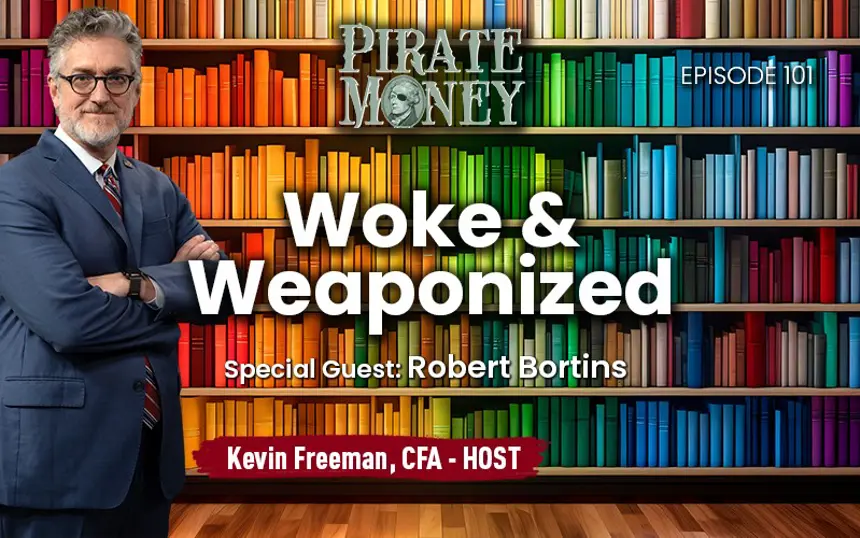
Kevin Freeman: All right, let's get into it. Let's invite Robert Bortons into the Pirate Money radio, program. Ah, you, along with your good friend Alex Newman, who is a good friend of our program, Ray wrote this new book, Woke and Weaponized. Welcome Robert.
Robert Bortins: Kevan, thanks for having me on the show. And yeah, I love the pirate money.
Marnie Freeman: We love the pirate money too.
Kevin Freeman: Argh.
Less than 3% of American children have a biblical worldview
All right, so we've got this new book out, Woke and Weaponized How Karl Marx Won the Battle for American Education. I want to stop there. Oh my gosh, what does that mean? We lost out to the commie.
Robert Bortins: Yeah, we lost out to the communists. So we talk about this in chapters two and three. But let's just look at it statistically, Kevan, only a third of American children can read at grade level. We're spending somewhere between 18 and $20,000 a year, per student in the public school system on education. we have, according to Barna, less than 3% of children have a biblical worldview. And less than half of children, I believe now are raised in a one, single income home without a father. And here's, here's a quote, from a guy named Robert Owen. He actually preceded Karl Marx, he preceded Dewey, he preceded Horace Mann, but he was a collectivist industrial reformer in Indiana in the 1820s. He founded a commune and he said that we needed communism or collectivism because there is a trinity of the most monstrous evil that could be combined to inflict mental and physical evil upon his, his whole race. And he identified this evil as private property, Christianity and marriage. And so since the introduction of the public school system in 1900 to the 1950s throughout the United States, along with two world wars, we no longer have a Christian society, we no longer have marriage and we no longer have literacy. And so that's why we say Carl Marx won the battle for American education.
Kevin Freeman: Well, I've got the book here, the Naked Communist, that was written in the 50s by Cleon Skousen. They talk about the 45 goals of the Communist Party USA. One of them m was to capture the education systems. But Ronnie, did you just hear what Robert just said? They, they hate private property. We just taught a course, Life, Liberty
Marnie Freeman: and the Pursuit of Happiness. But it was originally property, which is
Kevin Freeman: the, like John Locke. Life, Liberty, property God created property. God created individual stewardship of property and then he made us stewards of it. For, you know, that is the rock bottom bedrock of economics. From a biblical standpoint, it's also capitalist economics. But that is. And Robert, you're telling me that Karl Marx and his predecessors wanted to eliminate property?
Robert Bortins: Yeah, because they wanted to eliminate Christianity. And they wanted instead of people to look for, for God to be their provider. They wanted the state to be their provider. Because if the state was their provider, then they could mold society after their own worldview. And of course, what did, we say was the very first temptation to Adam and Eve? Did God really say what was the temptations that the devil gave to Jesus after his 40 days of fasting? Look at all these things. I'll take care of you. You don't have to worry about God. And so our humanity, I mean, just look at the Israelites in the desert. They'd have God in front of them in a cloud. And as soon as God left, they're making and idols. And so it's just in our nature to want to make ourselves God instead of following the rules that God has. But Jesus said, build on a rock, don't build on shifting sands. And our society is built on a shifting sand. Right now in our public school system,
Marnie Freeman: well, it's all about the degradation of the family, hence the degradation of society. And that's what classical conversations is doing, is trying to rebuild all that from the Christian worldview, which is the best of the best. It's a biblical serving Jesus.
Kevin Freeman: You start off with the notion God created the heavens and the earth and no he didn't. And God made them male and female. No he didn't. There are 72 types, maybe 107,000 types. well, God made marriage between one man and one. No, he didn't. I mean it's everything from Genesis to Revelation. The satanic, communist worldview. I've got Marx and Satan here by Richard Wurmbrand. Talking about it is the devil and Karl Marx by Paul, Paul Kengor. Bottom line is it's an attempt to deny truth. I mean, who's the science here? Neil Degrasse Tyson. I'm sorry. If you're listening, I hope you are Neil Degrasse Tyson. I want to tell you XX is female, XY chromosome is male. And that's the science. I don't care what you know about the cosmos. If you don't understand that, you don't understand biology.
Marnie Freeman: Well, I like what classical conversations are doing. And you Know, fighting back on, you know, this woke and weaponized, you know, terrible stuff. So truth, goodness and beauty, pursued through classical education. That's how CEC is transforming families and renewing culture. So thank you. And fighting back.
Kevin Freeman: Well, you helped us raise our kids.
The more centralized education becomes, the more expensive
But I want to ask this question. I open up the beginning of your book, Robert, and it's got, in the preface, it's got what looks like a multi hour test for eighth graders from 1895. Can you describe a little bit about what an eighth grader knew in 1895?
Robert Bortins: Yeah. So we picked this test out because this was really before the prolification of public schools in the United States. And so when people say, oh, my great grandmother only had an 8th grade education, I'm always like, do you know what that means? It means she had a better education than your master's degree in feminist literature. Like she was more intelligent. And so, yeah, we have talk, about grammar, arithmetic, U.S. history, time and geography. And so there's about, 70 questions or so. It takes about five, five, six hours. And they ask things like, find the cost of 2,000 6,720 pounds of coal at 6 tons per coal. What, is the cost of 40 boards 12 inches wide and 16ft long at 220 cents per inch? give nine rules for the use of capital letters. give the epochs into which US History is divided. I mean a master's degree student doesn't even know what epoch means anymore. And this is what the 8th graders were supposed to answer from memory. you know, and part of this kind of multi, day, multi day task. That'd be akin naming. Go ahead.
Marnie Freeman: Be akin to, what our founders knew at the time. They were genius.
Robert Bortins: Our founders were geniuses. And the fact of the matter is, 98 of farmers could read the letters that they wrote. They would be able to read the Federalist Papers, they could read Shakespeare. These simple farmers, versus now our most educated people. I mean there's high schools that don't even read a single book cover to cover anymore. In the United States we have, you can just Google any sort of educational outcome and it's in the pits. And so the more centralized education has become, the more collectivist it has become, the more expensive it has become. And the results have decreased. And we see that in every single collectivist society, whether it's collectivizing health care costs, whether it's collectivizing insurance, whether it's collectivizing, college costs, that all of these things drive up prices and reduce the quality of, the product that's being developed. And so.
Marnie Freeman: And it's a terrible quality.
Kevin Freeman: It is. All right, we're talking with Robert Wharton. So we're talking about classical conversation, but especially the new book, Woke and Weaponized that he wrote with Alex Newman. We've, got some big questions I'm going to be asking you from the eighth, ah, grade test from 1895 when we get back right after this break.
Robert Bortins says our education system has adopted Karl Marx and communism
Mike Carter: Welcome back to Pirate Money Radio with your host, Kevan Freeman.
Kevin Freeman: You know, I thought the education system, when I was growing up, I thought it was pretty good. But, in eighth grade, I'm not certain that I was able to explain why the Atlantic coast was colder than the Pacific in the same latitude, or describe the process by which the water of the ocean returns to the sources of the rivers, or describe the movement of the earth. That's just one part of the geography section of the eighth grade. This is what you had to pass to get out of eighth grade, which is amazing. it did ask the question, what is climate upon? What does climate depend on? And we've got Robert Bortons, the author of this book, along with Alex Newman. And Marty and I were talking to him. They understood climate. An eighth grader did. Now climate's being used as a hammer to take property from one person and give it to another person in what is the great climate scam. This book is amazing. As I flip through it, you've described, Robert, how, our education system has adopted Karl Marx and communism and why we must win this back for America to succeed.
Robert Bortins: Yeah. In chapter five we talk about Horse man, which I think there's like a hundred high schools in the US named after him. And what he wrote in 1867 was, we who are engaged in the sacred cause of education are entitled to look upon all parents as having given hostages to our cause. And what was that cause? the collectivist worldview. And so that's really, really, what's been going on, ever since, since the public school got started. Like, people don't understand. Like people were privately educated in the United States and we had like 98% literacy rate up into 19, hundred and then really 1950. And it really wasn't until the end of this or during the Second World War that public school almost became, synonymous with being an American. And so it's really only been about five or six generations. And each single generation forgets things the other generation knew. And so it's. Things go slowly until they move quickly and all right, you see that in the stock market, right? A product or a stock will be going sideways for a long time, and then suddenly it shoots up 10 or 20% in a day because suddenly everybody realizes the value that's there. Well, it's been the exact opposite with our public school system. We've had this history of freedom and individual, ruggedness, and that's been passed on through each generation. But each generation has kind of forgotten some of the past one. And that's why we get someone like Mandami as, you know, mayor of NewSong York City, as he touts the warmth of collectivism, which, believe it or not, it's not very warm.
Kevin Freeman: Yes. No, and I'm going to jump on that because Mamdani also gave a great, speech, great meaning, scary, frightening, horrifying speech in which he said to the NewSong Yorkers and to the Jewish community in NewSong York with a lot of Jewish people supporting him, and he said, we must welcome the Islamic stranger as Medina welcomed Muhammad. You know, he didn't go on and say that when Muhammad went to Medina, which is in Saudi Arabia, he literally got the communities fighting each other until he killed them all and beheaded personally participated in the beheading of 600 of them. So there wasn't a Jew left in the city. And yet, if you don't have a deep conversation, if you don't know your history, what did you find in our curriculum about how great Muhammad was?
Marnie Freeman: Well, one. One page it said how great he was, the good things he was doing. And two pages later, And this was not our curriculum. It was from a school that we were look, you know, looking at, right? And, you know, he slaughtered, you know, thousands of people, including Jews. And I was like. And then it talked about how great of a guy he was. And I'm like, we are having none of this. None of this. And so it just was. It was all kinds of, wrong. And it wasn't just Jews. He was slaughtering everyone who was not on his program.
Kevin Freeman: If you don't submit, you must be killed or pay a tax. Those are your choices. Death and taxes are the two choices given to you if you reject Islam. And they're inevitable. But there's a biblical worldview. But, you know, a lot of this does come down to money. And there are only three things you can do with your money. You can give it, you can spend it, or you can invest it. Here at Pirate Money Radio, we work to explain solutions that support all three areas in a way that promotes liberty, security, and values. Patriot Mobile, it's a mobile phone company. They support the Pirate Money radio program. Patriot Mobile uses US carriers including AT&T, Verizon and T Mobile, and operates on both Apple and Android phones. More information about the economic war room and Patriot Mobile is [email protected] AFR that's PirateMoneyRadio.com AFR. Marnie, hold up. That book, you've got a book there. What's the title of it? What's it say?
Marnie Freeman: Free to Be Wise. Patriot Mobile came out with it about how to use technology wisely for children. It's really good.
Kevin Freeman: It's a good book. And Robert Bortons has got a great program in Classical Conversations, and he has a great book called Woke and Weaponized. We'll be diving deeper into this when we come back right after this break with Robert Borden's Classical Conversations.
Mike Carter: Pirate Money Radio, helping you give, spend and invest in ways that align with liberty, security and values.
Robert Bortins says government schools have become laboratories for Marxist indoctrination
Welcome back with your host, Kevan Freeman.
Kevin Freeman: You know, if you're wondering why it is that, that our society is struggling and why young people are turning to communism and why they don't see a future and a hope in America, they want to fundamentally change America, the reason is the education system. I don't think there's any better explanation for it. I think it was Abraham Lincoln who talked, you want to know what's going to happen in society, you look at what's being taught in the classrooms. the philosophy of the schoolroom in one generation will be the philosophy of government in the next. We have one of the authors of Woke and Weaponized, Robert Bordens, who is also the CEO of Classical Conversations, that's fighting back about against this. Robert, your book discusses how government schools have become laboratories for Marxist indoctrination. Can you share some examples, about critical race theory or any other progressive ideology and how it clashes with biblical teachings?
Robert Bortins: Yeah, so, so they're trying to, again, it's all about worldview formation and, you know, like we said in that last, that, that these are hostages to our cause. And so for like critical race theory, they're trying to take these ideas that like, root themselves in Christian and Judeo values and just Change them by 1 or 2 degrees. So like equity, right? It sounds good. Not really a Christian value, but it's a close derivative of it. And so what they use social emotional learning for, they're basically what they're trying to do is use the same techniques that we, use to train animals because they view just children as animals, as a way of manipulating children's behavior so that they act properly in society as well as so that they will be conditioned to believe whatever, authority figures will tell them. And so it's not about developing personal autonomy or critical thinking skills. It's all about creating, an atmosphere inside of the school system where the, the plebes, the people who are going to be the workers, won't question what management or what the civil authorities are telling them. And of course, we saw the result of that in, Covid, where if you raised your hand and said, hey, maybe this is not a good idea, maybe the science actually says masks don't work. Because we have 11 studies that say that, why do we think masks are going to work now when there's not been any studies that say that, suddenly you're canceled. Right. And so social, emotional learning is, this ideology that tries to replace man as a center of the universe instead of God, which is exactly what Satan tried to do in the Garden of Eden.
Kevin Freeman: You know, I've got to share a personal story from this. It just popped in my head in first grade, I loved school. I was a nerd. I did love school in elementary school, and I had a great teacher. I loved her, Mrs. Talley. But in math class in first grade, and we were advanced, she taught us, that five divided by zero was five. And I went home and told my mom, guess what I learned. And mom said, no, that's not true. That's not right. I said, Mrs. Talley says it's right, and she's a professional teacher. And I argued with my mom, and I had this big debate with my mom. You know how I am, Marnie. And then I go to class the next day, and Mrs. Talley says, you know, I told you something that was right.
Robert Bortins: Wrong.
Kevin Freeman: I said five divided by zero was five. It's not. You can't divide by zero. Oh. Oh. And I had to go back and apologize to my mom. But that was proof that as a young person that we want to believe and respect authority. And we saw the teacher as a greater authority than our parents. Mom was right.
Marnie Freeman: Absolutely.
Kevin Freeman: The teacher was wrong.
Marnie Freeman: Yes. I mean, that's with everything. And they're not going with the mission of, CC knowing God and making him known. I mean, it. It's incredible, the authority we cede to the teachers. And as a kid, that's what we think.
Kevin Freeman: Yeah. And you're.
Robert Bortins: Yeah, well, the.
Kevin Freeman: Go ahead.
Robert Bortins: Oh, in the book, we point out that that the Soviet Union personally and intentionally chose teachers colleges to infiltrate the US because they knew they didn't have the military might to, combat the United States on a military front. And so they knew they needed to, success to successfully merge the USSR in the United States, as the Ford foundation president said was their goal. That they had to do that through the teachers unions so that in the teachers colleges so they could create authority figures for a very good return on investment that would then infiltrate, the rest of the education big, ed establishment.
Kevin Freeman: Well, in no way am I saying that Mrs. M. Talley was a communist. She was a great teacher, loved her very much. But it does go to this point. They will teach us things that are false in order to take control. I've got the book According to Plan, which is built on an Orwellian theme. Winston. Two plus two equals five. The state says it's five, but there is an absolute truth. Classical Conversations puts forth that absolute truth. I watched my kids learn it and sing it, which is an amazing thing. We're talking with Robert Borden. We'll talk more about Classical Conversations and Woke and Weaponized when we come back right after this break. I want to know some of those songs, Robert. We'll talk about them soon.
Children learn by singing songs, not memorization
Mike Carter: Welcome to Pirate Money Radio with your host, Kevan Freeman, helping you unpack the economic headlines and providing real money solutions.
Kevin Freeman: Yeah, Marnie, you're with me. Do you remember when our girls were doing classical conversation? They were singing all the Presidents.
Marnie Freeman: All the Presidents. And then, Robert, get this timeline. This is my timeline, which is funny,
Kevin Freeman: but we had classical, conversations. One of the leaders here in our area was Elise, who was an American Airlines pilot, one of the pioneering pilots.
Marnie Freeman: A female pilot.
Kevin Freeman: Female pilots for American. One of the mission. And we got to go to a retirement ceremony which was fun and we celebrated that. But, Robert, our girls were singing those songs and they learned the presidents that way were geography.
Marnie Freeman: I mean Latin. Everything was, to music and it was fantastic.
Kevin Freeman: Kids their age didn't know any of those things, but they learn them by song. I want to know the science behind that, why people do that. And then I've got to brag on our girls. They set the standard in college.
Marnie Freeman: They did. They were educating their peers.
Kevin Freeman: Four point all the way through from one of our daughters at Liberty University, the other one just excelling. And they're like, how do you know that? How did you learn to understand and write papers?
Marnie Freeman: They were teaching their peers to write well and to do and to Annotate and do all these things that they had learned from very, very young age. And they also learned to critically think. And I think that they've had to also share, how to critically think with some of their peers.
Kevin Freeman: Is there science, Robert, behind this idea of singing the songs? Because one of my dear friends, Ms. Joy, would say, name the sermons that you've heard and tell me what you learned. And, well, name the songs you sang. And do you know the words? And they know the words to the hymns?
Marnie Freeman: Yeah.
Kevin Freeman: Is there science there?
Robert Bortins: Yeah. Yeah. So the brain science is actually catching up with the Bible and classical education, showing that, the more that you involve, your five senses and learning something, the greater that that idea, is going to stick with you and you're going to create neurological pathways. And so, people always, oh, memorization. Rope. Memorization is so boring. I mean, you guys can testify, singing the songs are not boring. They can either memorize the lyrics to spongebob squarepants or whatever pop hits out there, that, Disney's pushing, or they can memorize the presidents, they can memorize a history timeline. And so, we love to get all five, of the senses going in classical conversations to helping them learn. And they don't need to know the specifics, but once they get older and their brain continues to develop and they develop those dialectic logical skills, those rhetorical skills, these things that they memorize when they're children, stick with them and they're able to recall it and pull it back as well as they've trained their brain to memorize and to learn. And so that makes it so learning other things that, are very hard for most people, come much easier because your brain has actually been trained on the, tools of learning through our classical conversations, methodologies.
Marnie Freeman: It does all come together for them. We saw it happen. I mean, they got to dress up, they got to bake, they got to make plays, they got to, learn Latin, which is the base of just pretty much everything. And one thing that I really, really appreciated in those very, very younger years, they were taught to speak from a stage in front of everybody. And so when they're older, they have no fear of boldly speaking or boldly debating or just the critical thinking skills, the speaking skills, the debate skills, where fantastic.
Kevin Freeman: Well, I remember when we got married and we were talking about different things we can do, you know, what's our investing plan and all the different plans that we had. And you brought to me, Marnie, you said, you know, we need to talk about we need to make some decisions about education.
Marnie Freeman: Right.
Kevin Freeman: And my initial response was, what do you mean decisions? We live in, we live in this town and this is the school district and this is the elementary school. And he was like, no, no, no, no, we need to make some. I'm so grateful for you having done that research.
Marnie Freeman: Well, we did the research, but that was after you said, marnie, I think we should homeschool. And I'm like, hold on, what?
Kevin Freeman: All right, you blame me and I blame you. And really I'm giving you credit because I think you're a genius for putting. Robert, go ahead. you confront this every day. Tell people how they can find classical conversations, and so forth and why it's so important.
Robert Bortins: Yeah, just like you shouldn't passively expect your retirement fund to get there, you shouldn't passively expect the world to educate your kids. And so go into classical conversations dot com, put in your zip code. We're going to put you in touch with the real human, not AI bots. they're going to work you through, homeschooling in your area, connect you with some local communities, answer any questions that you have. So we have about 2, 000 communities in the United States. We're in all 50 states. So there should be one within an hour of you, if not within five minutes. And if there's not one, we'd love to help you get one started. So classicalconversations.com is the website.
Kevin Freeman: You know what's great? there's a wedding in Alaska that's coming up from one of our friends from Classical Conversations. Some of the greatest friendships that we have have come from that. You know, people say, well, you won't get any socialization for your kids. No, it's the exact opposite with classical, you actually build deep and meaningful, long lasting friendships and relationships.
Marnie Freeman: Yes. I mean, the kids that we were raising up that time are now getting married, having babies, working successfully, being creative and critical thinkers. It is amazing to watch. And yes, those are some of our deepest friendships.
Kevin Freeman: I remember when I came home from a conference and I said, Marnie, you will not believe who I met. I met Lee Wardens, he did like a rock star.
Classical Conversations gives you the curriculum so you don't have to worry
In our home and in homes across the country, if you know what classical, conversational and how it's freed people up, it gives you the curriculum so you don't have to worry. Well, how would I do? I remember Mike Ferris, when I said homeschooling and Mike Ferris, you said, well, how will we pick curriculum it's so hard. I don't know what we're going to do. But Classical Conversations has it for you. Tell us more about the program.
Robert Bortins: Yeah, so we do two things. One, we have a full K12 program. We actually have college classes now as well. We got moms getting their master's degrees, through our partnerships. And so, basically, this is what I'm saying. Like, a lot of us played Oregon Trail growing up. Classical Conversations has taken thousands, tens of thousands of people to Oregon. And we hire homeschooling moms who are empty nesters to help cultivate and curate our curriculum. And so they've been there and done that. They're providing literally thousands of years of wisdom that are being poured into our curriculum. This is the exact opposite of most curriculums. I mean, the public school curriculums are being written with people who don't have kids, don't like kids, and they're just doing it, to manipulate, the next generation into believing their worldview. you know, so that's a very unique thing about Classical Conversations, but the most unique thing is our communities. So we actually get together once a week to do academics in a community. Typically groups of 8 to 12 kids in a classroom typically have about 50 to 60 kids, per community. And they are getting together weekly to go over academics, you know, all the course subjects with the trained parent, tutor. So that tutor is not just there to help your kids out, but to help answer questions for the moms and dads and to cultivate that community. And so, our tagline this upcoming year is, Homeschool with the Human. Our previous homeschool, tagline was Homeschool with a Friend. And, that's what really it is about. It's about building relationships. And that's what the Bible is all about. Right? We want to have a good relationship with our friends, we have good relationships with our church leaders, with our children and with Jesus. And so, you know, the devil, his entire life has tried to destroy relationships. And it's us as Christians need to be building them up. And so that's what we try to do at Classical Conversations.
Robert Bortins warns parents about school choice options that can be bad
Kevin Freeman: Well, I love classical conversation, but I want to warn parents especially that with all of these new school choice options that are being created, some of them are, can be very, very good and they're parent driven because God gave the authority to parents to educate the kids. but some of them can be very, very bad. And you turn your kids over and put them on an AI program of some kind. Without a human and what you're going to get is not good for your children. In fact, a lot of money is being spent on things like we hear about some schools are teaching Sharia law, for example, which is antithetical to Christianity. And we're funding our own demise. If we're taking that public school money out and we're placing it in places that are bad. School choice can be a bad thing. If it's a bad choice.
Marnie Freeman: That's right, that's right. It can be a good thing. But also, you know, some people are on it gives the government a little bit more look see into a person's private home. Children educating.
Kevin Freeman: Well, we saw the public school, we got to look see. And during COVID Yes, parents all over God, I mean that has got to been a boost for Classical Conversations when parents saw exactly what their kids were being taught in the public schools. Right Robert?
Robert Bortins: Yeah, I mean we saw a huge, huge growth that, that next year because of our community aspect in like states like California, we're shutting down our communities left and right. so that, that hurt us that, that first year. But yeah, we came back with a vengeance. And yeah, the amount of inquiries and parents that are choosing homeschooling and Classical Conversations continues to grow. And it's been that's been, that was the one blessing from COVID is that it exposed the monster underneath the water that was wrecking our kids futures, that is inside the public school system.
Kevin Freeman: Well, we're so grateful for what you did to help us in raising our children. and we're so grateful for the really this all comes from God. If you go to the basis of Classical Conversations or any good educate, we teach truth. Truth emanates only from God. And I think that a well educated young person is going to find God and give their life to the Lord. So thank you so much for what you're doing. We've got more segments, more to come. We're going to dive even deeper in Woke and Weaponized when we come back. Back with Robert Hortons, when we come back right after this break. We'll be right back.
Glint allows users to access their gold holdings for everyday purchases
Mike Carter: Welcome back to Pirate Money Radio with your host, Kevan Bremen.
Kevin Freeman: Yeah, we're talking with Robert Borden's, one of the co authors of Woke and Weaponized along with Alex Newman, another good friend of this program. I've got Marnie Freeman here with me and so I'm grateful to both of them but I'm also grateful that the support for this program comes from Glint A, financial technology service offering a debit card and mobile app that enables users to access their gold holdings for everyday purchases. With Glint, users maintain ownership of allocated physical gold, which is stored in managed vaults. At the time of a transaction, gold is sold in real time to cover the purchase amount in local currency. Glint offers an alternative way to store and use the value. Combining gold and silver with modern payment infrastructure, Glint clients can monitor their gold balance, view transaction history, and manage their account through the Glint app, available on major mobile platforms. More details about how vaulted physical gold can be used as money are [email protected] Gold247 Again, that's glintpay.com Goal247, Glint providing access to gold for modern spending.
Robert Bortins: 1895 exam taught kids about monetary system
And you know, Marnie, what this reminds me of, we're reading this 1895 exam for 8th graders here in the book Woke and Weaponized that, our guest Robert Bortons has co. Authored. but it reminds me of a book around 1895. It came a little after that by Lewis Carroll, who wrote, No, actually, L. Frank Baum. Lewis Carroll wrote Alice in Wonderland. L. Frank Baum wrote the wizard of Oz. And how is that, beyond what kids study today?
Marnie Freeman: Oh, well, it's a whole allegory on money or monetary allegory. And so that's how they taught the wizard of Oz book, is how they taught kids about the monetary system. It's actually really good.
Kevin Freeman: The wizard, of ounce Oz.
Marnie Freeman: The wizard of Ounce Oz.
Kevin Freeman: I don't know.
Marnie Freeman: The yellow brick, which are gold. Yellow brick road.
Kevin Freeman: And what color slippers did Dorothy?
Marnie Freeman: We all think it was red, but they were silver.
Kevin Freeman: Silver slippers.
Marnie Freeman: So a bimetal system.
Kevin Freeman: I don't know if you knew this, Robert, but originally L. Frank Baum wrote that as an economic allegory at the turn of the century. And he was following the yellow brick road. It was Dorothy woke up in an economy she didn't recognize. Everything was crazy because there was a fiat money system and they thought the answers were in the Emerald City. And so she traveled with her companion, the Cowardly lion, the Scarecrow, the Tin man, and her little dog, Toto. Cowardly lion was William Jennings Bryan, the politician who wasn't getting the gold standard. adding silver to the gold standard. the Scarecrow was a farmer, the Tin man was a factory worker, and Toto was the teetotaler party. And they were accosted by the Wicked Witch of the east, which was the bankers. And who did she send out?
Marnie Freeman: The flying monkeys?
Kevin Freeman: Who are the lawyers Yes, M. And so she stops by the Emerald City, which is the greenback. Unbacked paper money, fiat currency. And did she find any power behind the curtain?
Marnie Freeman: None.
Kevin Freeman: None. The wizard had no really power. The central banks had no real power. You had the answer all along, Dorothy. It's gold and silver. They were teaching very detailed economic concepts in a children's book and the kids got it.
Marnie Freeman: But kids today, now we think of wicked. So wicked is that's what we're doing
Kevin Freeman: version of the wizard of Oz. Anyway, you're teaching in Classical Conversations, classical things, and describe some of the things that kids will learn at an early age.
Robert Bortins: Yeah, as you mentioned, like we do public speaking, like starting in kindergarten. And of course more Americans are afraid of dying than they are of public speaking or public speaking than they are of dying. we teach Latin for all 12 years. we do things like science fair. we do things like they draw the globe from memory. That's a thing that they do in seventh grade. And they draw cities, they draw the mountains, lakes, rivers, the boundaries. And they draw beautiful maps. They do things like mock trial, they do, debate, they do poetry jams. They do a, senior thesis. And so what, they're going back. They're reading things like the Federalist Papers, they're preparing like the Constitution and the Magna Carta, so they're reading original source documents and of course they're reading great, ah, literature along the way and of course practicing science and math. And so we like to say that we're trying to raise scientists, we're trying to raise mathematicians, and we don't want any realm that God gave us as humans should not be locked to us. So if we're prince and princesses in the kingdom of God, we should be able to have keys to every single room that God, put in the house for us to explore.
Kevin Freeman: Is this an affordable program? I mean, man, that sounds like I'm paying the top dollar for the world's best education. What's it keep.
Robert Bortins: Yeah, I keep trying to get them to raise the prices. so just, just Roughly, it's about $800 a year for third through second kindergarten through third grade, about 15, $1600 a year for fourth through sixth, and then about less than $2000 a year each year, seventh through 12th.
Kevin Freeman: We're going to cover more of this with Robert Wartons when we come back. Check out classical conversations.com for more information. And we will be right back after this break.
Robert Bortins: Foreign.
Mike Carter: Helping you give, spend and invest in ways that align with liberty, security and values.
Robert Bortins says personal responsibility is key to improving education
Welcome back with your host Kevan Freeman.
Kevin Freeman: Yeah. And I'm joined by Marnie Freeman, Robert Borden, the CEO of Classical Conversations, but, but also the author of a new book along with Alex Newman, Woke and How Karl Marx Won the Battle for American Education and How We Can Win It Back. And here's Sean Rhyen, former Navy seal. Sean hosted the Sean Rhyen show right on the COVID I mean man, this is big time. If you're a parent, read this book.
Marnie Freeman: Yeah, I mean it's mind warping the things you'll find out in it.
Kevin Freeman: Well here's what I found and tell me if I'm wrong. The lessons I got here is our education system was hijacked by a demonic influence, through Karl Marx and communists and really demon led people. and the education should be much better than it is today. And oh by the way, there is a way out. Can you describe for us Robert, what's the way out?
Robert Bortins: Yeah, the way out is personal responsibility. I love this idea of investing. There's no bigger investment you can make than in your children's education, as a parent. And so it's not just up on you. I mean churches should be starting education scholarship funds. They should be starting or helping to support local Christian private schools. they should be opening their doors to homeschooling co ops or university model schools so that they can fill their building. Right. God doesn't want church buildings empty five days a week just because you're in there Sundays and Wednesdays. so it's businesses, they should be starting education funds for their employees so their employees can you know, send their kids to private schools or homeschool their own kids. And so it starts with like anything personal, ah, responsibility. And that's where God, God put it. I mean God's very clear in the Bible as you guys mentioned, that it's the parents responsibility to educate their kids. Of course you can outsource that or get other people to help you with that. But ultimately you become like your mentors. Right? Jesus said a student's going to become like their mentors. That's why these AI and computer you know, screens are so dangerous. Do we want our kids to become like a plastic box or like you know, Apple's worldview or Microsoft's Bill Gates worldview? Of course we don't. And so it starts with personal responsibility. It starts with you know, churches, helping families like they ought to do, and for local businesses to start stepping up and helping, out. Because these are going to be your customers and these are going to be your future employees. And so it would not be wise to continue to let them go to the failing, public school system. And so, yeah, those are a couple of ideas. We got two chapters at the back of the book that lay out, all sorts of different ideas. That's one of the unique things about our book. There's been so many that I've talked about the dangers of the public school system and the worldview that it's founded upon, and we've expanded upon that in the book. But, one of the things I'm most proud of is the last couple chapters really lay out what churches can be doing, what local communities can be doing, and what individual families can be doing to get their kids out of the system.
Marnie Freeman: It's actually very doable. You just have to work through that. And thank you for the ideas in the book.
Kevin Freeman: Yeah, well, one of the concerns that I have, and we've just got a couple of minutes before we got to, go, but, I'm worried about a Christian leering center and if you know what I mean by that. A lot of scams, a lot of people trying to take the money, they get in for the money and they don't give a boot. Biblical worldview. And I'm worried about some of these school choice issues.
Robert Bortins: Yeah, so we talked a lot about school choice, where that actually came from. What's the world view behind it, why it's a collectivist worldview and not a Christian worldview. And you know, I'm for choice. I'm for people having different opportunities. but the state sanctioning of, our tax dollars going elsewhere is, is not just a slippery slope hope. It's a proven detriment, to, society. And they've. We have a whole chapter on Sweden which had school choice for 19 years. And then they outlawed homeschooling and they outlawed every single curriculum except for the state sanctioned one. And it was because everyone was relying on the state dollars to fund it. And it wasn't relying on personal charity or personal hard work. And so, yeah, there's a lot of, issues with it. And we lay them out. We lay out good school choice policy in the book and bad school choice policy. So. So it's not that we're against the state, altogether, but we think there's better ways to create a free society than some of these ideas that are being tried. And yeah, in the state of Texas, they're funding Muslim leering centers, with conservative dollars right now, and, Islamic terrorist, institutions.
Kevin Freeman: Yeah. So there's two dangers. One, no strings attached, which is a, danger, because then you can end up educating in bad things or too many strings attached. The point is, it's a parent's responsibility. God's given you that responsibility. All right, we're going to have to end here for our viewers on Real Life Network. We'll cover more of this on American Family Radio when we come back after a break. But thank you so much, Robert. Hang on for our, bonus segment, if you're on AFR.
Robert Bortins: Foreign.
Kevin Freeman: One of the things that bothers me about public education is bureaucracy
Mike Carter: Welcome back to Pirate Money Radio with your host, Kevan Freeman.
Kevin Freeman: Yeah. And I'm joined by Marnie Freeman and Robert Bordens, the author of the book Woke and Weaponized and the CEO of Classical Conversation. I want to start with you, Marnie. what are your thoughts? You read through the book while we were traveling. What do you feel?
Marnie Freeman: Well, I just think there's a lot downloaded there that people may not know. And I, mean, we're all pretty educated, but there is definitely meat in there and some ideas, some solutions to stop it, you know, to stop this from happening. I also want to say that I had some great teachers when I was growing up in public school, but I learned. I didn't learn anything. But there were some good people in those schools. And so maybe we can draw those teachers out to come help us to do classical conversations. But.
Robert Bortins: Yeah, yeah, yeah. So I just want to point out that my wife was a public school teacher for 10 years before we got engaged and got married. And she loved her kids. It doesn't matter how good the teachers are. The system is not designed to benefit humanity. I mean, Kevan, would you invest in a company where one manager managed 300 people? No, that'd be insanity. But my wife saw 300 students a day. Like, your heart just can't be big enough to love that many kids per day.
Marnie Freeman: Thank you for that point. And you're right. So thank you for your wife wanting to implant into the kids.
Kevin Freeman: And, you know, speaking of the money and the investment and so forth, one of the things that bothers me about public education is it used to be, oh, it's for the kids. We gotta put more money for the kids. But that is all it's doing is building a bureaucracy. And so much of the money's not going to the teacher or to the classroom or to the kids. Education it's going to, this hierarchy that is a bureaucracy that is administratively pouring out a non biblical worldview, we're wasting, it's for the children.
Marnie Freeman: Well, I think we can all, we've all determined this is a bad investment.
Kevin Freeman: It is. It's like lottery system. Oh, well, we have to have a lottery so we have more money for education, which means more administrators and so forth. And they build these big education. Classical conversations has proven that you don't have to own a lot of real estate and have this massive hierarchy to educate your children. All right, Robert, we've got just a minute or so left. Give us what gives you hope and what's your favorite scripture?
Robert Bortins: I know what gives me hope is, I know the ending of the story. We win. and so I think parents are waking up, to this. I think pastors are finally waking up. Until the pastors wake up, I don't know how much hope we have have as a society, but they're starting to wake up. And, man, favorite Bible verse there. There's just so many of them. but, you know,
Kevin Freeman: how about train up a child in the way you should go? That's one of my favorites.
Robert Bortins: Yeah, train up the child the way they should go. I try to think of not one of our cliche ones that we use all the time. Seek first the kingdom of God and everything else will be added unto you. I know that's one. One that we heard growing up. It is my favorite verse because we just seek after the wrong things as humans. and you just read it over and over again in the Bible. You see it over and over again in history. When we seek the things that, feed the flesh, we become men without chest, as C.S. lewis says, and we abandon our God who loves us and sent our kid his son to die for us and raise again three days later. And so, ultimately, if we pursue Christ with all of our heart, soul and mind, that we will have good outcomes.
Kevin Freeman: That's right. Well, thank you so much, Robert Bortins, for being with us. I recommend your book Woken Weaponized. Pray for America. Pray for a return to God's principles this year. Listen wherever you get your podcasts. It's Kevan Freeman and Marnie Freeman joined by Robert Bortins for Pirate Money Radio.