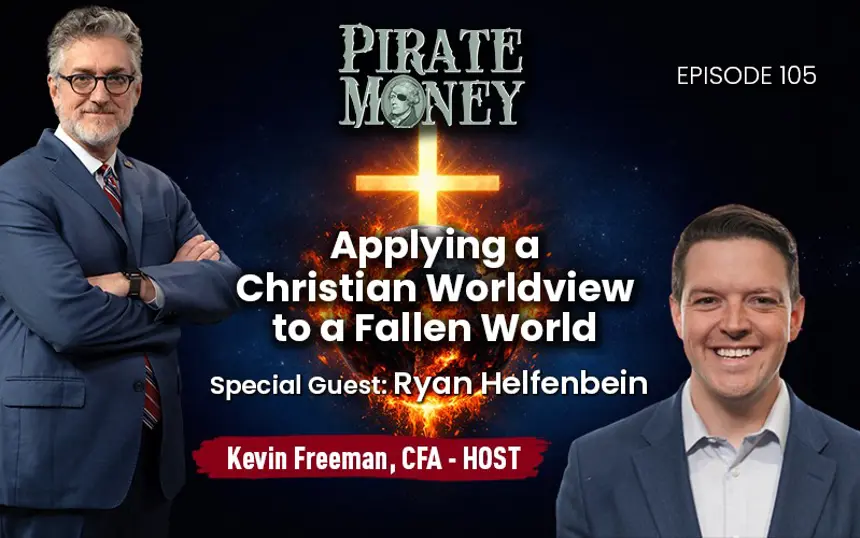
evin Freeman: Hey, does the world seem so crazy that it's gotta be that Jesus is coming back any minute? If you grew up in the faith like I did, you no doubt read the Left behind series by Tim LaHaye. Uh, things get really bad, and then there's a Rapture, and the non believers are left behind to deal with the Antichrist. But what if we have the timeline wrong, as so many have throughout history? Maybe the struggles in our lives are not signs of the end of planet Earth. Uh, and this comes from someone who's writing his next book with the title the Four Horsemen of the American Apocalypse in our six trials by Fire. Now, I'm not saying Jesus is not coming back tomorrow. He might. And that's good news. What I am saying is we just don't know. I imagine living in Europe in 1941 felt like the end was nigh. There have been predictions of the second coming, uh, that have, well, come and gone throughout history. The problem with eschatology, and that is the study of the end times, is that some people get so fixated on looking for the end that they forget to live and be about the Lord's business. We should be looking for his return. That's clear from Matthew 24:42. But we're also commanded to be about his business, regardless. That's Luke 12. How do we strike the right balance as believers? I was recently having a conversation on this subject with a dear friend, Rhyen Helfenbein of Liberty University. Rhyen's vice president of communications and public engagement for the school and also executive director of the Standing for Freedom Center. And he's the guest today in the studio of Pirate Money Radio.
Ryan Helfenbein: Kevan, great to be with you.
Kevin Freeman: Welcome back.
Ryan Helfenbein: Uh, it's great to be back in the Lone Star State. This is where my roots are. This is where I began out in West Texas.
Kevin Freeman: I saw you blame it all on your roots. You showed up in Boots.
Ryan Helfenbein: I did. Got boots. I've got ostrich boots today. So good to be on with you.
Kevin Freeman: All right, so, uh, we just had you in the economical room on our sister show. It's a TV show on Blaze, uh, and other outlets. And we were talking about the five eyes, the first four of which are Iran, Israel, immigration, and Islam. And we'll get to the fifth one, but I want to touch on all those. But I want to start with the idea of a Christian worldview and the dynamic balance between looking heavenward and living biblically in the here and now. What does it mean to have a biblical or Christian worldview?
Ryan Helfenbein: Yeah, I love it. You just rephrased the question in a beautiful way. And I love that you said biblical because I think that is really, really important. It's not just enough. This was something that even Dr. John MacArthur, the late, great John, uh, MacArthur said to me one time. It's not enough to say Christian worldview, but to have a biblical worldview that we understand that God has revealed his truth in his word. It, uh, is not about our truth, your truth, my truth, relative truth, but the absolute truth and the absolute authority. And who better than the voice of God? And so all scriptures God breathed, it's useful for teaching, rebuking, correcting and training in righteousness so that the man or woman of God may be thoroughly equipped for every good work. It starts with the Bible. And so really how the Bible shapes our view of the universe. What has God said about it? How did it begin? What happened in the fall? Uh, answering the question, what's wrong with us? Is there any hope? Meaning how do we get saved? And then what is the future? How's it all going to end? Those four questions the Bible addresses and nothing else can address it, not any economic theory or political theory. It has to go back to the word of God first.
Kevin Freeman: Okay, so let's go with that and let's talk about that's been true throughout history. So at least dealing with the last 2,000 years. Right. Uh, so here we are in 1776. How would a biblical worldview be different from a non biblical worldview?
Ryan Helfenbein: Well, you know, interestingly enough, 70, 1776 was juxtaposed almost immediately contrasted with the French Revolution, which was a godless revolution. And it was a revolution that was steeped in and, uh, humanism and in secularism and trying to redefine the calendar. This is going to be the age of reason. Uh, we're ushering in a whole new era and egalitarian. All of a sudden. We're going to, we're going to take down the hierarchy. We're going to, we're going to strangle, uh, the king with the guts of the priests. Uh, that's, that's exactly what was being said around that time. That was the French Revolution. The American Revolution was a godly revolution. It was a revolution where there was a formal declaration that was declared and these men signed away their lives. They were making declaration to the world and to the king that our ultimate sovereign is God. It was kind of Like a Martin Luther moment, here I stand. God help me, I can do no other. And, and, and 54 of the 56 signers of the Declaration, they were Christians, lay leaders, pastors, uh, people that were involved in the church. But they ultimately made that declaration clear. And they were following in the same tradition of 1688, the Glorious Revolution, which gave us the English Bill of Rights and ultimately said, look, you know, we recognize that tyrants must be opposed, that ultimately obedience to God means resistance of tyrants, because tyrants are operating outside of God's authority. King George III was a tyrant. And so, uh, 1776 was a revolution that was orderly.
Kevin Freeman: They were making a moral argument, though. You read the Declaration. Here are the moral violations. Because our rights come from God, they don't come from government. And you violated these moral things, and therefore we stand up against that. Whereas the French Revolution was literally. You guys have treated me poorly. You're the oppressors, I'm the oppressed.
Ryan Helfenbein: Yeah.
Kevin Freeman: I'm taking back what's mine.
Ryan Helfenbein: Yes.
Kevin Freeman: Do we see that, that contrast happening in modern times?
Ryan Helfenbein: What's interesting, what you just said, the oppressor, oppressed. Ironically enough, it predates Hegel and it predates Karl Marx. But they borrowed from the French Revolution to define this dialectic, which later became the application of Marxism. So Marxism looked and said, hey, we have an early model for what we want. And the Russian Revolution, the Chinese Revolution took and stole from the French Revolution. So that's why you're seeing a constant repeat, repeat, repeat, repeat. Ask me that question again, though. You just asked me a question.
Kevin Freeman: Yeah, no, the. The question is, do we see that happening in modern times?
Ryan Helfenbein: Of course we do. We're seeing it everywhere. And so, you know, I'm seeing it obviously on social media. Um, we're seeing, uh, in the whole free Palestine, from the river to the sea. Uh, we're seeing it on college campuses. Uh, we're seeing it in the 1619 project. The whole thing about critical race theory, it's all of this dogma of Marxism rehashed and reintroduced. Here's the difference, though. In the Russian Revolution, the Russian Revolution was all about the economics of production and economics of labor, who owns the means of production and all of that. The revolution that we're seeing today is cultural, and it's far more maist. Uh, this is the thing about MA. He wanted to lead a cultural revolution first, where he was able to strip the people, tear them away from the four olds. Um, and so that would be old customs and culture and religion and all of those, those practices strip them away so that they were uh, a people, almost like a cut flower generation. They were people that were severed from the ro. They didn't know what their identity was as Chinese people. He does that. So then they have no ability to decipher between right and wrong, who we are as a people. And then he was able to install or instill within them the Marxist software.
Kevin Freeman: Well, and that Marxist software is basically, uh, it's saying that we, uh, are going to decide for you and your family what's best. You're going to have one child. That's best for society. Uh, that contrasts with what God's word says. And basically it says human life is just a cog in a machine, that there's nothing. Again, it goes to the moral argument of the founders here. Life, liberty and the pursuit of happiness, which is individual. To the collectivist where we're on top. That's the pigs of Animal Farm. We're on top and we're going to decide what's best for our farm. Yeah, and that always fails. It always degenerates into selfishness and all of the ills that we see in society.
Ryan Helfenbein: You know, it's interesting about that one child policy. I have four children. I have three beautiful girls. I have one handsome, uh, son. And in a Chinese culture those three girls would be dead under the one child policy. The one child policy led to the abortion of over 100 million girls estimated in China alone. And it's because in that society only men ultimately have those rights. In a communist society, ironically enough, which is supposed to champion equality and egalitarianism and all of those things. But nothing could be further from the truth. Women do are not seen, uh, as having any value in a Chinese culture.
Kevin Freeman: Actually they are seen as having value in that they're an asset for another family. That's the argument is why am I raising an asset for another family? The son would stay and take care of me.
Ryan Helfenbein: Right.
Kevin Freeman: But my daughter will marry into some other family and be an asset for that family.
Ryan Helfenbein: Totally.
Kevin Freeman: Treating them not as individuals, but treating them as cogs in a machine. They're still, they're still somewhat valuable cogs, but they'd be somebody else's exact valuable cog.
Ryan Helfenbein: But that led to the abortion of over 100 million girls.
Kevin Freeman: And it will lead to the end of China.
Ryan Helfenbein: Yes.
Kevin Freeman: Uh, China's demographics are terrible. I think the 0.8 is their replacement birth rate. I think by the end of this century they'll be smaller, uh, than the United States in population and all of that Chinese miracle will have been lost on one decision to have a one child policy.
Ryan Helfenbein: It's evil, it's wicked. And so this is where centralized command control, this idea where the government ultimately is the arbiter of human rights and the government decides that doesn't work.
Kevin Freeman: It does not work. Yeah, we're talking with Rhyen Helfenbein from Liberty University. We're talking about a biblical world and we're talking about how we can stand with that biblical worldview in a changing world today. We'll be right back.
Kevin Freeman: Yeah, we're talking with Rhyen Helfenbein of Liberty University. We're talking about, uh, really, uh, contrasting worldviews, a sinful worldview versus a biblical worldview. And a lot of times it's going to come down to money. I mean, the Lord was pretty clear when he said, uh, you have to be faithful with your unrighteous man. And if you're not, nobody's going to trust you with true riches. There are only three things you can do with your money. You can give it, you can spend it, or you can invest it. Uh, I guess you could worship it, but don't do that. Here at Pirate Money Radio, we work to explain solutions that support all three areas in a way that promotes liberty, security and values. Patriot mobile mobile phone company, uh, supports the pirate money radio program. They use U.S. carriers, including AT&T, Verizon and T Mobile, and operates on both Apple and Android phones. More information about the economic war room and Patriot Mobile is [email protected] AFR that's PirateMoneyRadio.com AFR and if we're being faithful with our unrighteous mammon and we're putting things in proper biblical perspective like a biblical worldview requires, then things can work out for family. Uh, whether they work out exactly as we want to this side of heaven or, uh, not. I'm not sure about that. Sometimes good people, bad things happen to.
Ryan Helfenbein: That's exactly right. I mean, that goes back to understanding the nature of evil and how it operates in the world. But ultimately, let me say this. Proverbs says if you follow this pattern of living, if you follow wisdom, if you fear God first and then order your steps accordingly, yes, there are general blessings and it falls on the, on the just and the unjust. Kevan, there. There are people who don't know Jesus Christ as Savior and Lord, but if they will order their steps and they will ultimately pattern their life in Such a way, uh, uh, wisdom operating the world. Yeah, they're general blessings and benefits that they will receive for doing that. And that's, that's. That's some. That's the way that God has orchestrated his universe.
Kevin Freeman: And if the entire culture, uh, a society does that and orders according to God's will, then you'll have an abundance of those blessings that will fall on the evil as well as the good.
Ryan Helfenbein: And we had that for several centuries in the United States. We had a Christian culture. And this is the one thing that Richard Dawkins has talked about multiple times. He's seeing the fall of Britain. He's seeing the Islamification of his country, mass immigration, paper citizens. And he's saying, I want to hear bells. I want to hear church bells. I want to hear Christian, uh, hymns. I want Christmas. I want a Christmas tree. He's talking about the fruits of a Christian culture, a Christian society. The United States has enjoyed that for well over two centuries. But that is starting to fall, uh, because of secularism and because of pluralism. And we have to get that back.
Kevin Freeman: Well, let's do a contrast, a quick contrast between the riders and pushing for change in Iran with the, um, groups that have gathered here, the no Kings groups and everything else. You would think, uh, that it would be the opposite, but in Iran, they're demanding freedom, and here almost demanding to submit themselves again to slavery.
Ryan Helfenbein: Yeah, it's ironic, isn't it? I mean, the no Kings protests, many of them have no idea what's happening. It's an operation. Right. And so if you ask them, what are you protesting against? Well, I'm protesting against the tyranny of Donald Trump. Okay. What has he done? Well, I don't know. I don't know. But I'm pro. This app is telling me I need to show up this location. And by the way, I'll get paid this amount of money for showing up. And I'm just protesting. They have no clue. But if you look at Iran, it is a Persian culture. Look, not even though it's a theocracy and the seminaries run the state. These are citizens that have cultural memory. This, uh, this revolution happened 47 years ago. There are generations that are still trying to resist, uh, this theocracy. And there are Christians and there are Christians in mass. They have been persecuted, yes, under Islam and under. Under, uh, the Shia, uh, clerics. But they are trying to stand and stay strong.
Kevin Freeman: And they're not, as many of them are new Christians. Many of them have come to Christ during the. The Reign, that's right. Of, uh, Shia Islam. And we're watching and seeing people, house churches and such, knowing that they could be killed at any moment and yet being courageous and standing up. This is an evil regime. Put to death the wrestler who stood. You know, this is amazing. And yet the far left in America has sided with Iran, um, simply because it, uh, opposing Donald Trump.
Ryan Helfenbein: That's 100% right. I just want to say this. One of the greatest experiences I ever had in my life was meeting Iranian pastors in another country. Wow. What courage and what conviction.
Kevin Freeman: All right, so we're talking with Rhyen Helfenbein, Liberty University. We've got so much more to share. Stay tuned with us because we're going to dive into Israel, Iran, young people protecting America, all of these things. And you need to hear it. We'll be right back.
Mike Carter: Pirate money radio, helping you give, spend and invest in ways that align with liberty, security and values. Welcome back.
Kevin Freeman: And let's talk liberty, security and values. We're talking about contrast, French Revolution. Ah, American, um, revolution. We're talking about non biblical worldview versus a secular, actually just almost an evil worldview versus a biblical worldview. And anything outside a biblical worldview will devolve into evil. It is not. I love that you mentioned the atheists that wish we had Christmas bells and so forth. You don't get that without heart change.
Ryan Helfenbein: That's right.
Kevin Freeman: And I don't think they understand that you don't get that. But Charlie Kirk understood. He was one of our mutual friends. Let's talk Charlie Kirk just for a minute. Uh, you know, one of the first times I met you at Liberty. Shortly thereafter, we're sitting on stage for convocation. How many students go to convocation?
Ryan Helfenbein: Over 10,000 students. Weekly, twice a week.
Kevin Freeman: Yeah, it was huge. And we're both on the same stage. You're on the Charlie Kirk side and I've got, uh, ah, Robert Epstein on the other side. But, um, bottom line, Charlie Kirk understood this. He understood the difference between a biblical worldview. And he went to campus after campus after campus and he got up and spoke the truth.
Ryan Helfenbein: He believed in the streams of liberty, that ultimately, if you're drinking from the waters of liberty, you're going to want to know its source. Where is the source of that liberty? And it's Jesus Christ. I mean, at the end of the day, that's what it is. And so he was addressing and answering questions. They would ask all kinds of political question questions about identity, sexual identity. Who am I? What am I? The whole trans Thing, he was using a cultural and political apologetic to ultimately lead them to Jesus Christ. And so I will just say, this is my challenge to Christians today. A lot of them say, well, how do you do both? And, uh, I'm like, how do you not? They need an answer. Give them an answer for the questions that they have, and then you can lead them back to Christ. So he had a no holds barred approach in terms of how he would approach college students in addressing those things. And that authenticity is what won them to Christ.
Kevin Freeman: It did. But you worked with him very closely for a number of years. And I worked with him and, uh, not nearly as closely, but near the end of his life, right before he passed. And I'm not outing myself here. Candace Owens has put my name out there, uh, as being in that infamous chat, talking about, uh, Charlie. He had a very nuanced understanding of Israel. Yes, he did explain where he was going.
Ryan Helfenbein: Yeah, I think Charlie. And again, not trying to put any words in his mouth, but the things that he said publicly, he was very clearly a staunch supporter of the Israeli people, of the Jewish people. He loved Israel, the Holy Land, and
Kevin Freeman: stood against, uh, anti. Semitism.
Ryan Helfenbein: It stood against anti, Semitism, stood against Hamas and against the terrorists, where he had a healthy perspective. And I think we're all this way as Americans. We understand this. He said, look, I don't have carte blanche, blanket, uh, you know, approval for any government, not even my own government. And so I feel that he felt the same way about the Israeli government. Not to cast any shade, but just to say, hey, it's healthy to ask questions and to be skeptical. Yes, I support Israel the state, and yes, I right to exist. And they are the bulwark of freedom, of Western civilizational freedom in the Middle East. He recognized all of that as a strategic, uh, alliance with the United States. He recognized all that. But he says, yeah, there are going to be times where the Israeli government does things. And I want to know, I want to know why. How did that happen? Was that a mistake? Did you do that on purpose? And he would, he would ask those questions, and he was very public about that.
Kevin Freeman: Well, you know, I'm going through the Bible, as I do every year, going through in one year. And I'm now up the point where you read about the judges and then the kings that come in. There's not been a Israeli government that has been, or Jewish or whatever government that's ever been perfect. I mean, Moses made mistakes.
Ryan Helfenbein: Yes.
Kevin Freeman: Abraham made mistakes. Uh, uh, Solomon, David, uh, Josiah, you name it. Walking through. None of them were perfect.
Ryan Helfenbein: Right. And God's judgment always began with the household of God first. And that's one of the things. When he said, I'm appointing you to be a royal priesthood, a nation of priests. You will be my special envoy to the world. And the reason he said that is because ultimately that Abrahamic promise was fulfilled in Jesus Christ. They were to be a witness to the nations. And so God absolutely tested Israel and even at times judged Israel. And he used other nations to do it.
Kevin Freeman: Yeah, there's no question. And Israel's important ally in the Middle East. Yes, I'll say that again. We've got all this controversy, Candace and Joe and Tucker and all these people. Israel is an important ally in the Middle East.
Ryan Helfenbein: Yes. Indispensable in the Middle East.
Kevin Freeman: Indispensable. All right, we're talking with Rhyen Helvenbein. Hm. We're on the five eyes. We've gotten through two of them, which is Iran and Israel. We're going to cover the other eyes and then see where you should be involved when we come back right after this break.
Mike Carter: Welcome to Pirate Money Radio with your host, Kevan Friedman, helping you unpack the economic headlines and providing real money solutions.
Kevin Freeman: You know, we've talked economic headlines a lot, and part of the economic headlines is dealing with the threats to our world. If you didn't think Iran was an issue, then look at the stock market, the oil markets, the gold markets, and you see, oh, actually, Iran has an impact on all of those. Absolutely does. And so does the culture, and so does so many other things that we're talking about. If you want to make sense of your money, you really have to understand the threats that we're facing in the world. And so I've got a new book coming out, uh, which is the Four Horsemen of the American Apocalypse and Our Six Trials by Fire. And that gets into the money. But the four horsemen are, number one, red communism. Number two, green Islam. Number three, blue globalism. Number four, traitors and cowards, which is yellow. I've got with me Rhyen Helfenbein from Liberty University. And I wanna talk. Rhyen, if we could. Let's talk a little bit about the threat, the green threat, Islam. That's the next I on our list. Yeah. Uh, we're seeing it emerge in. In Europe in a really frightening way almost.
Ryan Helfenbein: You know, it is emerging in a frightening way. And this is kind of the residue or the residual of old colonial power. You know, this is where the empires resided. And so in many ways, when you're looking at, you know, Germany and France and Britain. It first started with immigration, of which
Kevin Freeman: is our third eye, actually.
Ryan Helfenbein: Yeah, yeah. And so that happened. But then there was also, for the last 20 years or so, there were these, these various refugee encampments. There was a refugee crisis, uh, as you would see, some of these nations collapse, uh, and this instability, uh, and whether it be in North Africa or the Middle east or Syria, they, um, were. The United nations and NATO were moving large bodies of people en masse and in many ways were not vetting them. The United States also accepted a huge number of, of refugees. And this is one of those things with these NGOs, organizations that were receiving U.S. aid, including many Christian organizations, Christian organizations that were incentivized through federal monies to bring immigrants into the United States. And we were not thinking critically about this. We were not thinking critically about vetting. We were not thinking critically about assimilate, uh, assimilation and naturalization of these. Would these make good citizens? At the time? And I think we think with our heart first. A lot of times we were thinking no. But they're in crisis and they need help and we need to bring them in. But here's the problem it requires. I go back to the founding and the framing of our constitution of our, of our, um, American republic. And in all of that, John Adams. Our constitution is written for a moral and religious people. It is wholly inadequate to the government of any other. When he was talking about a religious people, he was talking about a Christian people. And that's very, very important. Even if they are not religiously Christian in terms of they're going to church on a Sunday, they have to accept certain Christian cultural values. That is the only way it works. And there has always been, since the founding of our republic, there have been certain worldviews, ideologies and religions that have been incompatible. Paganism off the chart right there. You don't allow human sacrif. Right. But Islam, it has been one of those things. Islam is not merely a religion. It is a militant ideology that is by design, structurally within the tenets of their belief system, is non assimilating. They are not here to assimilate. They are ultimately here to dominate. And I don't say that as some kind of a slur. I don't say that to preserve, uh, you know, to promote this fake term, Islamic Islamophobia. Islamophobia is this idea of an irrational fear of something that's not real. No, we need to think of this thing critically and to take Islam at face value. Based on what they're saying about themselves and their intents.
Kevin Freeman: Right. And you're not talking about individual people.
Ryan Helfenbein: No.
Kevin Freeman: You're talking about an ideology.
Ryan Helfenbein: I'm talking about an ideology. And I want to be very, very clear. Islam is not an ethnic group. Islam. Islam is no discriminator of persons or ethnicity or nations. Islam will kill the same way. Whether you're right, white, yellow, red, black,
Kevin Freeman: it doesn't matter if you do not submit.
Ryan Helfenbein: If you do not submit, Islam will absolutely crush you.
Kevin Freeman: I want to go to something you said. It was interesting because you said we have, you know, we sometimes, uh, take action based on our hearts, right?
Ryan Helfenbein: Yes.
Kevin Freeman: But others sometimes take action based on their money desires or their evil desires in some case. Just imagine this. There's a small church, and the church has some, you know, has a nice, uh, pile of money that's been saved up for the. For the widows and the orphans. And it's sitting there in the church and somebody knocks on the door and says, hey, can I come in for the night? And, you know, of course, you know, we love you. Of course we'll be warm, be filled, but come in, we'll feed you and everything else. But what if a gang of them show up and their intention is nothing other than to rob the church?
Ryan Helfenbein: Right.
Kevin Freeman: Would it be wise to let them in? No, no, of course not.
Ryan Helfenbein: Right.
Kevin Freeman: And so this mass immigration, America's built on immigration, built on cultures from all around the world. And, you know, diversity can be a strength if you assimilate.
Ryan Helfenbein: That's right. Well, let me be clear about one thing, because you're absolutely right. We've written, even at the Standing for Freedom Center, a document called the Biblical Case for Mass M Deportation. Here's why we wrote this. We wanted to go back and we wanted to look at the history of immigration in our country. Uh, yeah, we're a nation of immigrants, but we need to be very, very clear. Up until about 1924 and in 1924, we put a moratorium on immigration. Up until 1924, we were importing and we were immigrating people from European nations and Christian nations, Catholic, Protestant, but people that had an assimilating ideology. They had a similar belief system already. They had the software already downloaded of Western civilization. And they were looking for a better government. They were looking for a better society. They were looking for better opportunity. And these were immigrants from all over Europe, from Slavic nations, Polish nation, Polish, Hungary, Germany, France, England, all of them iron.
Kevin Freeman: Uh, Ireland.
Ryan Helfenbein: Uh, and at that time, our biggest issue was how were the Catholics gonna assimilate with Protestants nowadays? We think that's easy. What fundamentally changed, though? It was in the 1960s. This was under Lyndon Baines Johnson. They fundamentally changed it. And they were looking for immigrants from anywhere, uh, around the world. As our population after the baby boomer generation began to suddenly dip slightly, dip, all of a sudden they were saying, how are we going to replace all of these people? We need more workers. So they were looking at getting workers from the third world, and they changed that. So all of a sudden, um, this chain migration patterns were started as early as the 1960s. And then in the 1990s, we had a visa lottery program we created. We went to non traditional nations and many Muslim nations where we started to say, hey, we wanna diversify. Diversity is our strength. This, uh, literally was in the 90s. And so since the 1990s, we have imported over 2 million Muslims from around the world, right?
Kevin Freeman: And we have chain migrations. So that if you get one member of a family, you can bring others in. And if that were happening naturally, uh, it would be one thing. But if it were chosen to be hijra as a weapon, here's how we go colonized, you know, all these young people, and you've got a bunch of them at Liberty University. Uh, and, and they're like, we, we need to be open and, and, and learning and everything else. But here's the thing. If you have hijra, then they're colonizers.
Ryan Helfenbein: That's exactly right.
Kevin Freeman: And that's the history of Islam. And yet we oppose colonization. That's kind of the spread ideology of young people. Colonization is bad, right?
Ryan Helfenbein: Yes. I. So I want to get back and I want to reaffirm one thing. You and I both, we have a biblical worldview view. Every man, woman and child created in the image of God. We're not talking about people, we're talking about an ideology. An ideology. Um, but the ideology, it's like a parasite. So you bring this ideology into the country en masse, right? Uncritical, not vetting properly. And then all of a sudden there's an explosion. And there has been in the past two decades an explosion of jihadi terrorism on American soil. It's metastasized. It is not something that originates from the United States. It is a 7th century militant ideology that comes from the Middle East. It is not American in origin. It's very un American. And so I just want to be really, really clear. This is not about trying to. It's not about racism or prejudice. It is about thinking critically about, about these things and not leading with our hearts. God says also to worship him with all of our minds as well, you
Kevin Freeman: know, but I get what you just said and I think it's true. But critical thinking seems to be absent. Yes, in a certain. I cannot believe I loved watching Tucker Carlsen, but when I see him say things that we need to stop paying our bills and stop paying, uh, you know, don't pay your credit card bills. Or when he says, you know, I've been to Sharia adherent countries and they're safer than, than Western civilization. I really question are people thinking critically? And here's the frightening thing is young people today are being fed a lot of that garbage that is on TikTok and Instagram and other places that just doesn't align with biblical truth or reality in any way that we know it. That's why we've got Rhyen Helfenbein of Liberty University who deals with the young people every day, but also understands the truth of a biblical worldview. We'll be right back.
Kevin Freeman: Yeah, we're going a little beyond just money today. We're talking a biblical worldview. And you know, money is just a tool. It's something God has given us to use to make an efficient society. It is not, uh, an end in itself. Even though a lot of people think making money is the highest and best calling, it's absolutely not the highest and best calling. Uh, you know, at Liberty University, kids, uh, attend college there to learn to get a profession and hopefully make some good money in life. But they also still are hopefully there to get a biblical worldview.
Ryan Helfenbein: That's right. We are training champions for Christ. And I think that's really, really important. And you're absolutely right. We don't need to take just a utilitarian approach. It's important that education, maths, it has to math. Well, uh, if I'm giving this much, uh, in terms of economic value, if I'm exchanging these dollars, what am I getting in return? And so part of that is, yes, a job, uh, that's important, that's critical. But the other part of that is, are you going to know and hear and receive the gospel of Jesus Christ? You're going to have a preach to you, you're going to be discipled, you're going to have Bible study every week. And we are creating, and I think this is really important when, when students go there into any profession, whether it be law or business or education or science, math, it doesn't matter. Are they going to be well trained in a biblical worldview? That's fundamental.
Kevin Freeman: It absolutely is fundamental. And you know, money's important. I don't want to discount it. In fact, support for this program comes from Glint. It's a financial technology service offering a debit card and mobile app that enables users to access gold holdings for everyday purchases. With Glint, users maintain ownership of allocated physical gold, which is stored in a managed vault. At the time of a transaction, gold is sold in real time to cover the purchase amount in local currency. Glint offers an alternative way to store and use the value. Combining gold and silver with modern payment infrastructure, Glint clients can monitor their goal balance, view transaction history and manage their account through the Glint app, available on major mobile platforms. More details about how vaulted physical gold can be used as money are [email protected] Gold247 Again, that's glintpay.com Gold247 Glint provides access to gold for m modern spending and money matters. It's important. If you don't have it, you notice that you don't have it. Uh, but, but it can't be so important that it overrides our sensibilities. And I want to go back to the idea of this mass immigration. The NGOs, the NGOs, non governmental organizations, many of which are affiliated with churches. They are, and they have in exchange for money from the government, bringing in a lot of people that don't necessarily align with our worldviews.
Ryan Helfenbein: That's right. I wanna be clear too. There is a heart behind this that is good. It was intended, you know, uh, in the beginning that these, many of these organizations I think are just now realizing it's kind of like, you know, 20 years ago we had this China doctrine, you know, of, you know, global trade was going to liberate the world. That as China became more affluent that eventually they would adopt Western values. How naive that view was. Okay. It's the same naivety that went into nation building that we were going to build, you know, the next American republic in the middle of Afghanistan. Ridiculous. Obviously we know that. So there are a lot of people who are coming around to the idea of, wait a second, this is an uncritical way to approach immigration. We need to think more critically, we need to be more serious and more honest that uh, that, that it is a privilege to come to the United States. Not everyone can be a US citizen, nor should they be a US citizen. And a piece of paper doesn't just make you assimilate or Naturalize. There have been many shootings recently. Jihadi ATT is clear what the motivation is. And many of these are now citizens. They're not just H1BS. These are people that have come in and have, have been granted citizenship. They were able to pass a simple test, knowing who the, what the three branches of government are. And. But that does not all of a sudden make them American.
Kevin Freeman: No. And you see the pattern from Europe, and you see the decline of European civil society, which at one point the British, uh, share the gospel more than any other nation on earth. And yet you see the pattern there where it's become more and more increasingly an Islamic country.
Ryan Helfenbein: Yes.
Kevin Freeman: And in America, we don't want to see that. We want to stand for individual liberty. We want to stand. It really requires a Christian biblical worldview to be a successful American.
Ryan Helfenbein: It does. Look at Britain as a warning sign. This is what I want to say to my American brothers and sisters who, uh, love and follow Jesus Christ. Look at Britain. Britain was the breadbasket of biblical worldview, Biblical doctrine of the modern missions movement. Around the world, uh, many other nations know Christ because of British missionaries. That's a warning.
Kevin Freeman: It is a warning, but it's also an opportunity because the United States is not lost. Britain is not lost. Jesus is the answer. And we can pray and believe in, uh, a revival and an awakening.
Mike Carter: Pirate Money Radio, helping you give, spend, and invest in ways that align with liberty, security, and values. Welcome back with your host, Kevan Freeman.
Kevin Freeman: Right. And we're speaking with Rhyen Helfenbein from Liberty University and the Standing for Freedom Center. I've known you, Rhyen, a long time. I want to give you the opportunity right here. What is your message to America? What would you say to the United States as a whole?
Ryan Helfenbein: I think this is something that Jesus said to his disciples. And it's very clear, you know, unless you repent, you will likewise perish. And I think that's really important. Fundamental. Um, I'm reminded of Romans chapter 11 that the, the calling, the gift and calling of the Lord is, is irrevocable. One of the things that we saw with an unbelieving Israel is that some of those branches that were unbelieving, rejected Christ, were broken off from that branch. And what the warning that Paul gave to the church is, ultimately, there is no boasting. If God did not spare the natural branches, he's not going to spare you. So we need to get with it in the United States. We need to recognize as Christians that we have a responsibility and a duty first to God. But also to the place where he planted us. Love your neighbor, but, uh, love God, right? And serve Him. Love, uh, him with all your heart, soul, mind and strength. But then love your neighbor as yourself. And so that second duty means we have got to get involved.
Kevin Freeman: So let's talk about the immigrant there. We have a lot of people in this nation that have entered, um, maybe through nefarious purposes, but on the other hand, uh, not individually, but collectively, that this idea of hijra. On the other hand, those people need Jesus too.
Ryan Helfenbein: They do.
Kevin Freeman: God loves them too.
Ryan Helfenbein: Yes, he does. And Jesus Christ is the hope of the nations. And so, uh, there are many Muslims who have come to faith through, uh, the sharing of the gospel through the intentional. I want to be clear, the intentional. It doesn't happen by accident. You actually have to go share your faith as a Christian. The intentional sharing of the gospel has led to many Muslims coming to faith in Jesus Christ. Now, that is not an immigration strategy. I want to be very clear. That is not what the government does. That is what we do as the church of the Lord Jesus Christ. That's our responsibility. So the government's responsibility is to wield the sword and, and the church's responsibility is to wield the sword of the Lord, the Bible, the gospel. And so there are lots of resources out there for how to witness, how to share the gospel, uh, with Muslims to deal with an apologetic methodology for speaking to Muslims about the Christian faith. We have to do that.
Kevin Freeman: Well, there are things that are being taught about the Christian faith that just simply aren't true. We believe God is one. There is only one God. Uh, and when people understand that, and in fact, people don't recognize that Islam and Muhammad in the early teachings were actually a Christian heresy.
Ryan Helfenbein: Yes.
Kevin Freeman: And if we can share the truth of the gospel and we say, no, God did not come down and have sex with Mary, which is literally what they're being told. I shared the gospel with a Muslim man, and he said, I don't understand how that worked. And I said, that's not how it happened. Happened.
Ryan Helfenbein: Right.
Kevin Freeman: And, you know, we've got this, this whole issue on both sides because we've got, uh, Talarico here in Texas.
Ryan Helfenbein: Right.
Kevin Freeman: Claiming. Claiming, you know, abortion is godly. No, the biblical worldview overrides all of this. And the best place to get the biblical worldview is the Bible.
Ryan Helfenbein: You got to read your Bible. Yeah. There's no shortcutting that. You have to read your Bible and to be prepared to give an answer for the hope that you have doing so with gentleness and respect. That's what Peter said said in 1st Peter 3:15. That is a great verse to live by. Um, but yeah, whether it be, whether it be a progressive so called Christian right, this James Talarico is running for Senate in Texas. God is non binary. Mary was pro choice, right? In Luke 138, he's claiming that, uh, the mother Mary had to consent to whether she would be a vessel or not to bring the Lord into the world. No, that was declared to her by the angel Gabriel and she ultimately yielded to the Lord and submitted to him. But no, this was not a choice in the matter. God had chosen Mary. That's how it was going to happen. But yes, as Christians, we have to recognize the truth is on our side. At the end of the day, these arguments make sense. We just need to, we need to read the word and to preach the word. Read the word and preach the word. It will make sense in the end. It does make sense.
Kevin Freeman: All right, so you've got the Standing for Freedom Center. How do people follow you and how do people get involved?
Ryan Helfenbein: Yeah, so, so, uh, go to our website, standing for freedom.com, sign up for our newsletter. We send it out every week. But, uh, we've got articles, we've got a Theology of Politics series. This is how Christians can engage in a biblical worldview about cultural and political topics. Theology of politics, go to standingforfreedom.com all
Kevin Freeman: right, some of you are leaving now and we want to say you God Bless from, uh, Pirate Money Radio. But if you're following on podcast or American family radio, stay tuned. And if you're not able to see it, go to our podcast, PirateMoneyRadio.com.
Mike Carter: Welcome back to Pirate Money Radio with your host, Kevan Freeman.
Kevin Freeman: And I'm joined by Rhyen Helfenbein of Liberty University and the Standing for Freedom Center. Rhyen, um, we've covered a lot of topics and there's some scary things happening in the world and there's some encouraging things. But what gives you hope? Where does your hope come from?
Ryan Helfenbein: Well, I'm just reminded of what Jesus, uh, said in John chapter 10. You know, in this world you have trouble, right? Uh, but fear not, for I have overcome the world. Christ is an over. He has overcome. He has the victory. We're just, we're coming right on the heels. This is Easter is right here. A Palm Sunday is coming up. Easter. And recognizing that the tomb is empty, Jesus said it is finished. That means the work has been completed. We all, we have to do is receive it. The work that Jesus Christ did on that cross, cross and coming out of that tomb that he has defeated sin, death and the devil. And ultimately our victory is in him. We are not losers. We are more than conquerors through him who has conquered. And so as Christians, I think we need a better theology of victory. We just do. I think one of the things is this kind of eschatological pessimism. That's a term, this, this whole lens of end times pessimism has been a, has been a rot in the church. And what do I mean by that? It is constant. Lose, leave, lose, leave, lose, leave. We continue to abandon things that we have lost rather than taking the approach that Jesus Christ has conquered. And ultimately he has a vision to go, to tell and to establish and to build. Uh, he said to Peter, upon this rock, I will build my church and the gates of hell will not prevail against it. That sounds to me like not a defensive thing, but ultimately an offensive thing. It is an offensive command to go out that gives me hope. But we need to, we need to adopt a better theology of victory. I think that is so important for the church today.
Kevin Freeman: Well, Jesus addressed this when he said, will your master find you doing what I told you to do? Basically. What did he. He told us Luke 12. So we are to look for his coming.
Ryan Helfenbein: Yes.
Kevin Freeman: And we're closer than we've ever been in history.
Ryan Helfenbein: Yes.
Kevin Freeman: By definition, the timeline, we were closer than ever in history. But it could be 10,000 years.
Ryan Helfenbein: That's right. One thing just to be reminded too. In the church of Thessalonica, uh, were literally people sitting on the roof waiting for Jesus to return. Paul rebuked them for their laziness. They were lazy. And I think, uh, American Christians are lazy. Today there are many American Christians that have been caught up in waiting for Christ, Christ to return and doing nothing else. We need to get with it. It is a call to action. Go and share the gospel and the love of Jesus Christ with others. Go. Work hard. Yes. Build, multiply. Make money and give it away. Build the kingdom. Have a theology of victory. Know that you have a purpose for living. Know that you, uh, that God wants you to grow things, Grow something, something. Build something and establish it and defend it.
Kevin Freeman: As John Wesley said, make all you can, save all you can and invest all you can, and then give all you can. That's what we're here talking about at Pirate Money Radio. So if you have questions, if you have prayer needs, if you have comments, email [email protected] and pray for America, pray for the world to return to biblical worldview this year. Uh, listen wherever you get your podcasts, Apple, Spotify and so forth. Share this with your friends and check out piratemoneyradio.com it's Kevan Freeman joined by Rhyen Helfenbein for Pirate Money Radio.
evin Freeman: Hey, does the world seem so crazy that it's gotta be that Jesus is coming back any minute? If you grew up in the faith like I did, you no doubt read the Left behind series by Tim LaHaye. Uh, things get really bad, and then there's a Rapture, and the non believers are left behind to deal with the Antichrist. But what if we have the timeline wrong, as so many have throughout history? Maybe the struggles in our lives are not signs of the end of planet Earth. Uh, and this comes from someone who's writing his next book with the title the Four Horsemen of the American Apocalypse in our six trials by Fire. Now, I'm not saying Jesus is not coming back tomorrow. He might. And that's good news. What I am saying is we just don't know. I imagine living in Europe in 1941 felt like the end was nigh. There have been predictions of the second coming, uh, that have, well, come and gone throughout history. The problem with eschatology, and that is the study of the end times, is that some people get so fixated on looking for the end that they forget to live and be about the Lord's business. We should be looking for his return. That's clear from Matthew 24:42. But we're also commanded to be about his business, regardless. That's Luke 12. How do we strike the right balance as believers? I was recently having a conversation on this subject with a dear friend, Rhyen Helfenbein of Liberty University. Rhyen's vice president of communications and public engagement for the school and also executive director of the Standing for Freedom Center. And he's the guest today in the studio of Pirate Money Radio.
Ryan Helfenbein: Kevan, great to be with you.
Kevin Freeman: Welcome back.
Ryan Helfenbein: Uh, it's great to be back in the Lone Star State. This is where my roots are. This is where I began out in West Texas.
Kevin Freeman: I saw you blame it all on your roots. You showed up in Boots.
Ryan Helfenbein: I did. Got boots. I've got ostrich boots today. So good to be on with you.
Kevin Freeman: All right, so, uh, we just had you in the economical room on our sister show. It's a TV show on Blaze, uh, and other outlets. And we were talking about the five eyes, the first four of which are Iran, Israel, immigration, and Islam. And we'll get to the fifth one, but I want to touch on all those. But I want to start with the idea of a Christian worldview and the dynamic balance between looking heavenward and living biblically in the here and now. What does it mean to have a biblical or Christian worldview?
Ryan Helfenbein: Yeah, I love it. You just rephrased the question in a beautiful way. And I love that you said biblical because I think that is really, really important. It's not just enough. This was something that even Dr. John MacArthur, the late, great John, uh, MacArthur said to me one time. It's not enough to say Christian worldview, but to have a biblical worldview that we understand that God has revealed his truth in his word. It, uh, is not about our truth, your truth, my truth, relative truth, but the absolute truth and the absolute authority. And who better than the voice of God? And so all scriptures God breathed, it's useful for teaching, rebuking, correcting and training in righteousness so that the man or woman of God may be thoroughly equipped for every good work. It starts with the Bible. And so really how the Bible shapes our view of the universe. What has God said about it? How did it begin? What happened in the fall? Uh, answering the question, what's wrong with us? Is there any hope? Meaning how do we get saved? And then what is the future? How's it all going to end? Those four questions the Bible addresses and nothing else can address it, not any economic theory or political theory. It has to go back to the word of God first.
Kevin Freeman: Okay, so let's go with that and let's talk about that's been true throughout history. So at least dealing with the last 2,000 years. Right. Uh, so here we are in 1776. How would a biblical worldview be different from a non biblical worldview?
Ryan Helfenbein: Well, you know, interestingly enough, 70, 1776 was juxtaposed almost immediately contrasted with the French Revolution, which was a godless revolution. And it was a revolution that was steeped in and, uh, humanism and in secularism and trying to redefine the calendar. This is going to be the age of reason. Uh, we're ushering in a whole new era and egalitarian. All of a sudden. We're going to, we're going to take down the hierarchy. We're going to, we're going to strangle, uh, the king with the guts of the priests. Uh, that's, that's exactly what was being said around that time. That was the French Revolution. The American Revolution was a godly revolution. It was a revolution where there was a formal declaration that was declared and these men signed away their lives. They were making declaration to the world and to the king that our ultimate sovereign is God. It was kind of Like a Martin Luther moment, here I stand. God help me, I can do no other. And, and, and 54 of the 56 signers of the Declaration, they were Christians, lay leaders, pastors, uh, people that were involved in the church. But they ultimately made that declaration clear. And they were following in the same tradition of 1688, the Glorious Revolution, which gave us the English Bill of Rights and ultimately said, look, you know, we recognize that tyrants must be opposed, that ultimately obedience to God means resistance of tyrants, because tyrants are operating outside of God's authority. King George III was a tyrant. And so, uh, 1776 was a revolution that was orderly.
Kevin Freeman: They were making a moral argument, though. You read the Declaration. Here are the moral violations. Because our rights come from God, they don't come from government. And you violated these moral things, and therefore we stand up against that. Whereas the French Revolution was literally. You guys have treated me poorly. You're the oppressors, I'm the oppressed.
Ryan Helfenbein: Yeah.
Kevin Freeman: I'm taking back what's mine.
Ryan Helfenbein: Yes.
Kevin Freeman: Do we see that, that contrast happening in modern times?
Ryan Helfenbein: What's interesting, what you just said, the oppressor, oppressed. Ironically enough, it predates Hegel and it predates Karl Marx. But they borrowed from the French Revolution to define this dialectic, which later became the application of Marxism. So Marxism looked and said, hey, we have an early model for what we want. And the Russian Revolution, the Chinese Revolution took and stole from the French Revolution. So that's why you're seeing a constant repeat, repeat, repeat, repeat. Ask me that question again, though. You just asked me a question.
Kevin Freeman: Yeah, no, the. The question is, do we see that happening in modern times?
Ryan Helfenbein: Of course we do. We're seeing it everywhere. And so, you know, I'm seeing it obviously on social media. Um, we're seeing, uh, in the whole free Palestine, from the river to the sea. Uh, we're seeing it on college campuses. Uh, we're seeing it in the 1619 project. The whole thing about critical race theory, it's all of this dogma of Marxism rehashed and reintroduced. Here's the difference, though. In the Russian Revolution, the Russian Revolution was all about the economics of production and economics of labor, who owns the means of production and all of that. The revolution that we're seeing today is cultural, and it's far more maist. Uh, this is the thing about MA. He wanted to lead a cultural revolution first, where he was able to strip the people, tear them away from the four olds. Um, and so that would be old customs and culture and religion and all of those, those practices strip them away so that they were uh, a people, almost like a cut flower generation. They were people that were severed from the ro. They didn't know what their identity was as Chinese people. He does that. So then they have no ability to decipher between right and wrong, who we are as a people. And then he was able to install or instill within them the Marxist software.
Kevin Freeman: Well, and that Marxist software is basically, uh, it's saying that we, uh, are going to decide for you and your family what's best. You're going to have one child. That's best for society. Uh, that contrasts with what God's word says. And basically it says human life is just a cog in a machine, that there's nothing. Again, it goes to the moral argument of the founders here. Life, liberty and the pursuit of happiness, which is individual. To the collectivist where we're on top. That's the pigs of Animal Farm. We're on top and we're going to decide what's best for our farm. Yeah, and that always fails. It always degenerates into selfishness and all of the ills that we see in society.
Ryan Helfenbein: You know, it's interesting about that one child policy. I have four children. I have three beautiful girls. I have one handsome, uh, son. And in a Chinese culture those three girls would be dead under the one child policy. The one child policy led to the abortion of over 100 million girls estimated in China alone. And it's because in that society only men ultimately have those rights. In a communist society, ironically enough, which is supposed to champion equality and egalitarianism and all of those things. But nothing could be further from the truth. Women do are not seen, uh, as having any value in a Chinese culture.
Kevin Freeman: Actually they are seen as having value in that they're an asset for another family. That's the argument is why am I raising an asset for another family? The son would stay and take care of me.
Ryan Helfenbein: Right.
Kevin Freeman: But my daughter will marry into some other family and be an asset for that family.
Ryan Helfenbein: Totally.
Kevin Freeman: Treating them not as individuals, but treating them as cogs in a machine. They're still, they're still somewhat valuable cogs, but they'd be somebody else's exact valuable cog.
Ryan Helfenbein: But that led to the abortion of over 100 million girls.
Kevin Freeman: And it will lead to the end of China.
Ryan Helfenbein: Yes.
Kevin Freeman: Uh, China's demographics are terrible. I think the 0.8 is their replacement birth rate. I think by the end of this century they'll be smaller, uh, than the United States in population and all of that Chinese miracle will have been lost on one decision to have a one child policy.
Ryan Helfenbein: It's evil, it's wicked. And so this is where centralized command control, this idea where the government ultimately is the arbiter of human rights and the government decides that doesn't work.
Kevin Freeman: It does not work. Yeah, we're talking with Rhyen Helfenbein from Liberty University. We're talking about a biblical world and we're talking about how we can stand with that biblical worldview in a changing world today. We'll be right back.
Kevin Freeman: Yeah, we're talking with Rhyen Helfenbein of Liberty University. We're talking about, uh, really, uh, contrasting worldviews, a sinful worldview versus a biblical worldview. And a lot of times it's going to come down to money. I mean, the Lord was pretty clear when he said, uh, you have to be faithful with your unrighteous man. And if you're not, nobody's going to trust you with true riches. There are only three things you can do with your money. You can give it, you can spend it, or you can invest it. Uh, I guess you could worship it, but don't do that. Here at Pirate Money Radio, we work to explain solutions that support all three areas in a way that promotes liberty, security and values. Patriot mobile mobile phone company, uh, supports the pirate money radio program. They use U.S. carriers, including AT&T, Verizon and T Mobile, and operates on both Apple and Android phones. More information about the economic war room and Patriot Mobile is [email protected] AFR that's PirateMoneyRadio.com AFR and if we're being faithful with our unrighteous mammon and we're putting things in proper biblical perspective like a biblical worldview requires, then things can work out for family. Uh, whether they work out exactly as we want to this side of heaven or, uh, not. I'm not sure about that. Sometimes good people, bad things happen to.
Ryan Helfenbein: That's exactly right. I mean, that goes back to understanding the nature of evil and how it operates in the world. But ultimately, let me say this. Proverbs says if you follow this pattern of living, if you follow wisdom, if you fear God first and then order your steps accordingly, yes, there are general blessings and it falls on the, on the just and the unjust. Kevan, there. There are people who don't know Jesus Christ as Savior and Lord, but if they will order their steps and they will ultimately pattern their life in Such a way, uh, uh, wisdom operating the world. Yeah, they're general blessings and benefits that they will receive for doing that. And that's, that's. That's some. That's the way that God has orchestrated his universe.
Kevin Freeman: And if the entire culture, uh, a society does that and orders according to God's will, then you'll have an abundance of those blessings that will fall on the evil as well as the good.
Ryan Helfenbein: And we had that for several centuries in the United States. We had a Christian culture. And this is the one thing that Richard Dawkins has talked about multiple times. He's seeing the fall of Britain. He's seeing the Islamification of his country, mass immigration, paper citizens. And he's saying, I want to hear bells. I want to hear church bells. I want to hear Christian, uh, hymns. I want Christmas. I want a Christmas tree. He's talking about the fruits of a Christian culture, a Christian society. The United States has enjoyed that for well over two centuries. But that is starting to fall, uh, because of secularism and because of pluralism. And we have to get that back.
Kevin Freeman: Well, let's do a contrast, a quick contrast between the riders and pushing for change in Iran with the, um, groups that have gathered here, the no Kings groups and everything else. You would think, uh, that it would be the opposite, but in Iran, they're demanding freedom, and here almost demanding to submit themselves again to slavery.
Ryan Helfenbein: Yeah, it's ironic, isn't it? I mean, the no Kings protests, many of them have no idea what's happening. It's an operation. Right. And so if you ask them, what are you protesting against? Well, I'm protesting against the tyranny of Donald Trump. Okay. What has he done? Well, I don't know. I don't know. But I'm pro. This app is telling me I need to show up this location. And by the way, I'll get paid this amount of money for showing up. And I'm just protesting. They have no clue. But if you look at Iran, it is a Persian culture. Look, not even though it's a theocracy and the seminaries run the state. These are citizens that have cultural memory. This, uh, this revolution happened 47 years ago. There are generations that are still trying to resist, uh, this theocracy. And there are Christians and there are Christians in mass. They have been persecuted, yes, under Islam and under. Under, uh, the Shia, uh, clerics. But they are trying to stand and stay strong.
Kevin Freeman: And they're not, as many of them are new Christians. Many of them have come to Christ during the. The Reign, that's right. Of, uh, Shia Islam. And we're watching and seeing people, house churches and such, knowing that they could be killed at any moment and yet being courageous and standing up. This is an evil regime. Put to death the wrestler who stood. You know, this is amazing. And yet the far left in America has sided with Iran, um, simply because it, uh, opposing Donald Trump.
Ryan Helfenbein: That's 100% right. I just want to say this. One of the greatest experiences I ever had in my life was meeting Iranian pastors in another country. Wow. What courage and what conviction.
Kevin Freeman: All right, so we're talking with Rhyen Helfenbein, Liberty University. We've got so much more to share. Stay tuned with us because we're going to dive into Israel, Iran, young people protecting America, all of these things. And you need to hear it. We'll be right back.
Mike Carter: Pirate money radio, helping you give, spend and invest in ways that align with liberty, security and values. Welcome back.
Kevin Freeman: And let's talk liberty, security and values. We're talking about contrast, French Revolution. Ah, American, um, revolution. We're talking about non biblical worldview versus a secular, actually just almost an evil worldview versus a biblical worldview. And anything outside a biblical worldview will devolve into evil. It is not. I love that you mentioned the atheists that wish we had Christmas bells and so forth. You don't get that without heart change.
Ryan Helfenbein: That's right.
Kevin Freeman: And I don't think they understand that you don't get that. But Charlie Kirk understood. He was one of our mutual friends. Let's talk Charlie Kirk just for a minute. Uh, you know, one of the first times I met you at Liberty. Shortly thereafter, we're sitting on stage for convocation. How many students go to convocation?
Ryan Helfenbein: Over 10,000 students. Weekly, twice a week.
Kevin Freeman: Yeah, it was huge. And we're both on the same stage. You're on the Charlie Kirk side and I've got, uh, ah, Robert Epstein on the other side. But, um, bottom line, Charlie Kirk understood this. He understood the difference between a biblical worldview. And he went to campus after campus after campus and he got up and spoke the truth.
Ryan Helfenbein: He believed in the streams of liberty, that ultimately, if you're drinking from the waters of liberty, you're going to want to know its source. Where is the source of that liberty? And it's Jesus Christ. I mean, at the end of the day, that's what it is. And so he was addressing and answering questions. They would ask all kinds of political question questions about identity, sexual identity. Who am I? What am I? The whole trans Thing, he was using a cultural and political apologetic to ultimately lead them to Jesus Christ. And so I will just say, this is my challenge to Christians today. A lot of them say, well, how do you do both? And, uh, I'm like, how do you not? They need an answer. Give them an answer for the questions that they have, and then you can lead them back to Christ. So he had a no holds barred approach in terms of how he would approach college students in addressing those things. And that authenticity is what won them to Christ.
Kevin Freeman: It did. But you worked with him very closely for a number of years. And I worked with him and, uh, not nearly as closely, but near the end of his life, right before he passed. And I'm not outing myself here. Candace Owens has put my name out there, uh, as being in that infamous chat, talking about, uh, Charlie. He had a very nuanced understanding of Israel. Yes, he did explain where he was going.
Ryan Helfenbein: Yeah, I think Charlie. And again, not trying to put any words in his mouth, but the things that he said publicly, he was very clearly a staunch supporter of the Israeli people, of the Jewish people. He loved Israel, the Holy Land, and
Kevin Freeman: stood against, uh, anti. Semitism.
Ryan Helfenbein: It stood against anti, Semitism, stood against Hamas and against the terrorists, where he had a healthy perspective. And I think we're all this way as Americans. We understand this. He said, look, I don't have carte blanche, blanket, uh, you know, approval for any government, not even my own government. And so I feel that he felt the same way about the Israeli government. Not to cast any shade, but just to say, hey, it's healthy to ask questions and to be skeptical. Yes, I support Israel the state, and yes, I right to exist. And they are the bulwark of freedom, of Western civilizational freedom in the Middle East. He recognized all of that as a strategic, uh, alliance with the United States. He recognized all that. But he says, yeah, there are going to be times where the Israeli government does things. And I want to know, I want to know why. How did that happen? Was that a mistake? Did you do that on purpose? And he would, he would ask those questions, and he was very public about that.
Kevin Freeman: Well, you know, I'm going through the Bible, as I do every year, going through in one year. And I'm now up the point where you read about the judges and then the kings that come in. There's not been a Israeli government that has been, or Jewish or whatever government that's ever been perfect. I mean, Moses made mistakes.
Ryan Helfenbein: Yes.
Kevin Freeman: Abraham made mistakes. Uh, uh, Solomon, David, uh, Josiah, you name it. Walking through. None of them were perfect.
Ryan Helfenbein: Right. And God's judgment always began with the household of God first. And that's one of the things. When he said, I'm appointing you to be a royal priesthood, a nation of priests. You will be my special envoy to the world. And the reason he said that is because ultimately that Abrahamic promise was fulfilled in Jesus Christ. They were to be a witness to the nations. And so God absolutely tested Israel and even at times judged Israel. And he used other nations to do it.
Kevin Freeman: Yeah, there's no question. And Israel's important ally in the Middle East. Yes, I'll say that again. We've got all this controversy, Candace and Joe and Tucker and all these people. Israel is an important ally in the Middle East.
Ryan Helfenbein: Yes. Indispensable in the Middle East.
Kevin Freeman: Indispensable. All right, we're talking with Rhyen Helvenbein. Hm. We're on the five eyes. We've gotten through two of them, which is Iran and Israel. We're going to cover the other eyes and then see where you should be involved when we come back right after this break.
Mike Carter: Welcome to Pirate Money Radio with your host, Kevan Friedman, helping you unpack the economic headlines and providing real money solutions.
Kevin Freeman: You know, we've talked economic headlines a lot, and part of the economic headlines is dealing with the threats to our world. If you didn't think Iran was an issue, then look at the stock market, the oil markets, the gold markets, and you see, oh, actually, Iran has an impact on all of those. Absolutely does. And so does the culture, and so does so many other things that we're talking about. If you want to make sense of your money, you really have to understand the threats that we're facing in the world. And so I've got a new book coming out, uh, which is the Four Horsemen of the American Apocalypse and Our Six Trials by Fire. And that gets into the money. But the four horsemen are, number one, red communism. Number two, green Islam. Number three, blue globalism. Number four, traitors and cowards, which is yellow. I've got with me Rhyen Helfenbein from Liberty University. And I wanna talk. Rhyen, if we could. Let's talk a little bit about the threat, the green threat, Islam. That's the next I on our list. Yeah. Uh, we're seeing it emerge in. In Europe in a really frightening way almost.
Ryan Helfenbein: You know, it is emerging in a frightening way. And this is kind of the residue or the residual of old colonial power. You know, this is where the empires resided. And so in many ways, when you're looking at, you know, Germany and France and Britain. It first started with immigration, of which
Kevin Freeman: is our third eye, actually.
Ryan Helfenbein: Yeah, yeah. And so that happened. But then there was also, for the last 20 years or so, there were these, these various refugee encampments. There was a refugee crisis, uh, as you would see, some of these nations collapse, uh, and this instability, uh, and whether it be in North Africa or the Middle east or Syria, they, um, were. The United nations and NATO were moving large bodies of people en masse and in many ways were not vetting them. The United States also accepted a huge number of, of refugees. And this is one of those things with these NGOs, organizations that were receiving U.S. aid, including many Christian organizations, Christian organizations that were incentivized through federal monies to bring immigrants into the United States. And we were not thinking critically about this. We were not thinking critically about vetting. We were not thinking critically about assimilate, uh, assimilation and naturalization of these. Would these make good citizens? At the time? And I think we think with our heart first. A lot of times we were thinking no. But they're in crisis and they need help and we need to bring them in. But here's the problem it requires. I go back to the founding and the framing of our constitution of our, of our, um, American republic. And in all of that, John Adams. Our constitution is written for a moral and religious people. It is wholly inadequate to the government of any other. When he was talking about a religious people, he was talking about a Christian people. And that's very, very important. Even if they are not religiously Christian in terms of they're going to church on a Sunday, they have to accept certain Christian cultural values. That is the only way it works. And there has always been, since the founding of our republic, there have been certain worldviews, ideologies and religions that have been incompatible. Paganism off the chart right there. You don't allow human sacrif. Right. But Islam, it has been one of those things. Islam is not merely a religion. It is a militant ideology that is by design, structurally within the tenets of their belief system, is non assimilating. They are not here to assimilate. They are ultimately here to dominate. And I don't say that as some kind of a slur. I don't say that to preserve, uh, you know, to promote this fake term, Islamic Islamophobia. Islamophobia is this idea of an irrational fear of something that's not real. No, we need to think of this thing critically and to take Islam at face value. Based on what they're saying about themselves and their intents.
Kevin Freeman: Right. And you're not talking about individual people.
Ryan Helfenbein: No.
Kevin Freeman: You're talking about an ideology.
Ryan Helfenbein: I'm talking about an ideology. And I want to be very, very clear. Islam is not an ethnic group. Islam. Islam is no discriminator of persons or ethnicity or nations. Islam will kill the same way. Whether you're right, white, yellow, red, black,
Kevin Freeman: it doesn't matter if you do not submit.
Ryan Helfenbein: If you do not submit, Islam will absolutely crush you.
Kevin Freeman: I want to go to something you said. It was interesting because you said we have, you know, we sometimes, uh, take action based on our hearts, right?
Ryan Helfenbein: Yes.
Kevin Freeman: But others sometimes take action based on their money desires or their evil desires in some case. Just imagine this. There's a small church, and the church has some, you know, has a nice, uh, pile of money that's been saved up for the. For the widows and the orphans. And it's sitting there in the church and somebody knocks on the door and says, hey, can I come in for the night? And, you know, of course, you know, we love you. Of course we'll be warm, be filled, but come in, we'll feed you and everything else. But what if a gang of them show up and their intention is nothing other than to rob the church?
Ryan Helfenbein: Right.
Kevin Freeman: Would it be wise to let them in? No, no, of course not.
Ryan Helfenbein: Right.
Kevin Freeman: And so this mass immigration, America's built on immigration, built on cultures from all around the world. And, you know, diversity can be a strength if you assimilate.
Ryan Helfenbein: That's right. Well, let me be clear about one thing, because you're absolutely right. We've written, even at the Standing for Freedom Center, a document called the Biblical Case for Mass M Deportation. Here's why we wrote this. We wanted to go back and we wanted to look at the history of immigration in our country. Uh, yeah, we're a nation of immigrants, but we need to be very, very clear. Up until about 1924 and in 1924, we put a moratorium on immigration. Up until 1924, we were importing and we were immigrating people from European nations and Christian nations, Catholic, Protestant, but people that had an assimilating ideology. They had a similar belief system already. They had the software already downloaded of Western civilization. And they were looking for a better government. They were looking for a better society. They were looking for better opportunity. And these were immigrants from all over Europe, from Slavic nations, Polish nation, Polish, Hungary, Germany, France, England, all of them iron.
Kevin Freeman: Uh, Ireland.
Ryan Helfenbein: Uh, and at that time, our biggest issue was how were the Catholics gonna assimilate with Protestants nowadays? We think that's easy. What fundamentally changed, though? It was in the 1960s. This was under Lyndon Baines Johnson. They fundamentally changed it. And they were looking for immigrants from anywhere, uh, around the world. As our population after the baby boomer generation began to suddenly dip slightly, dip, all of a sudden they were saying, how are we going to replace all of these people? We need more workers. So they were looking at getting workers from the third world, and they changed that. So all of a sudden, um, this chain migration patterns were started as early as the 1960s. And then in the 1990s, we had a visa lottery program we created. We went to non traditional nations and many Muslim nations where we started to say, hey, we wanna diversify. Diversity is our strength. This, uh, literally was in the 90s. And so since the 1990s, we have imported over 2 million Muslims from around the world, right?
Kevin Freeman: And we have chain migrations. So that if you get one member of a family, you can bring others in. And if that were happening naturally, uh, it would be one thing. But if it were chosen to be hijra as a weapon, here's how we go colonized, you know, all these young people, and you've got a bunch of them at Liberty University. Uh, and, and they're like, we, we need to be open and, and, and learning and everything else. But here's the thing. If you have hijra, then they're colonizers.
Ryan Helfenbein: That's exactly right.
Kevin Freeman: And that's the history of Islam. And yet we oppose colonization. That's kind of the spread ideology of young people. Colonization is bad, right?
Ryan Helfenbein: Yes. I. So I want to get back and I want to reaffirm one thing. You and I both, we have a biblical worldview view. Every man, woman and child created in the image of God. We're not talking about people, we're talking about an ideology. An ideology. Um, but the ideology, it's like a parasite. So you bring this ideology into the country en masse, right? Uncritical, not vetting properly. And then all of a sudden there's an explosion. And there has been in the past two decades an explosion of jihadi terrorism on American soil. It's metastasized. It is not something that originates from the United States. It is a 7th century militant ideology that comes from the Middle East. It is not American in origin. It's very un American. And so I just want to be really, really clear. This is not about trying to. It's not about racism or prejudice. It is about thinking critically about, about these things and not leading with our hearts. God says also to worship him with all of our minds as well, you
Kevin Freeman: know, but I get what you just said and I think it's true. But critical thinking seems to be absent. Yes, in a certain. I cannot believe I loved watching Tucker Carlsen, but when I see him say things that we need to stop paying our bills and stop paying, uh, you know, don't pay your credit card bills. Or when he says, you know, I've been to Sharia adherent countries and they're safer than, than Western civilization. I really question are people thinking critically? And here's the frightening thing is young people today are being fed a lot of that garbage that is on TikTok and Instagram and other places that just doesn't align with biblical truth or reality in any way that we know it. That's why we've got Rhyen Helfenbein of Liberty University who deals with the young people every day, but also understands the truth of a biblical worldview. We'll be right back.
Kevin Freeman: Yeah, we're going a little beyond just money today. We're talking a biblical worldview. And you know, money is just a tool. It's something God has given us to use to make an efficient society. It is not, uh, an end in itself. Even though a lot of people think making money is the highest and best calling, it's absolutely not the highest and best calling. Uh, you know, at Liberty University, kids, uh, attend college there to learn to get a profession and hopefully make some good money in life. But they also still are hopefully there to get a biblical worldview.
Ryan Helfenbein: That's right. We are training champions for Christ. And I think that's really, really important. And you're absolutely right. We don't need to take just a utilitarian approach. It's important that education, maths, it has to math. Well, uh, if I'm giving this much, uh, in terms of economic value, if I'm exchanging these dollars, what am I getting in return? And so part of that is, yes, a job, uh, that's important, that's critical. But the other part of that is, are you going to know and hear and receive the gospel of Jesus Christ? You're going to have a preach to you, you're going to be discipled, you're going to have Bible study every week. And we are creating, and I think this is really important when, when students go there into any profession, whether it be law or business or education or science, math, it doesn't matter. Are they going to be well trained in a biblical worldview? That's fundamental.
Kevin Freeman: It absolutely is fundamental. And you know, money's important. I don't want to discount it. In fact, support for this program comes from Glint. It's a financial technology service offering a debit card and mobile app that enables users to access gold holdings for everyday purchases. With Glint, users maintain ownership of allocated physical gold, which is stored in a managed vault. At the time of a transaction, gold is sold in real time to cover the purchase amount in local currency. Glint offers an alternative way to store and use the value. Combining gold and silver with modern payment infrastructure, Glint clients can monitor their goal balance, view transaction history and manage their account through the Glint app, available on major mobile platforms. More details about how vaulted physical gold can be used as money are [email protected] Gold247 Again, that's glintpay.com Gold247 Glint provides access to gold for m modern spending and money matters. It's important. If you don't have it, you notice that you don't have it. Uh, but, but it can't be so important that it overrides our sensibilities. And I want to go back to the idea of this mass immigration. The NGOs, the NGOs, non governmental organizations, many of which are affiliated with churches. They are, and they have in exchange for money from the government, bringing in a lot of people that don't necessarily align with our worldviews.
Ryan Helfenbein: That's right. I wanna be clear too. There is a heart behind this that is good. It was intended, you know, uh, in the beginning that these, many of these organizations I think are just now realizing it's kind of like, you know, 20 years ago we had this China doctrine, you know, of, you know, global trade was going to liberate the world. That as China became more affluent that eventually they would adopt Western values. How naive that view was. Okay. It's the same naivety that went into nation building that we were going to build, you know, the next American republic in the middle of Afghanistan. Ridiculous. Obviously we know that. So there are a lot of people who are coming around to the idea of, wait a second, this is an uncritical way to approach immigration. We need to think more critically, we need to be more serious and more honest that uh, that, that it is a privilege to come to the United States. Not everyone can be a US citizen, nor should they be a US citizen. And a piece of paper doesn't just make you assimilate or Naturalize. There have been many shootings recently. Jihadi ATT is clear what the motivation is. And many of these are now citizens. They're not just H1BS. These are people that have come in and have, have been granted citizenship. They were able to pass a simple test, knowing who the, what the three branches of government are. And. But that does not all of a sudden make them American.
Kevin Freeman: No. And you see the pattern from Europe, and you see the decline of European civil society, which at one point the British, uh, share the gospel more than any other nation on earth. And yet you see the pattern there where it's become more and more increasingly an Islamic country.
Ryan Helfenbein: Yes.
Kevin Freeman: And in America, we don't want to see that. We want to stand for individual liberty. We want to stand. It really requires a Christian biblical worldview to be a successful American.
Ryan Helfenbein: It does. Look at Britain as a warning sign. This is what I want to say to my American brothers and sisters who, uh, love and follow Jesus Christ. Look at Britain. Britain was the breadbasket of biblical worldview, Biblical doctrine of the modern missions movement. Around the world, uh, many other nations know Christ because of British missionaries. That's a warning.
Kevin Freeman: It is a warning, but it's also an opportunity because the United States is not lost. Britain is not lost. Jesus is the answer. And we can pray and believe in, uh, a revival and an awakening.
Mike Carter: Pirate Money Radio, helping you give, spend, and invest in ways that align with liberty, security, and values. Welcome back with your host, Kevan Freeman.
Kevin Freeman: Right. And we're speaking with Rhyen Helfenbein from Liberty University and the Standing for Freedom Center. I've known you, Rhyen, a long time. I want to give you the opportunity right here. What is your message to America? What would you say to the United States as a whole?
Ryan Helfenbein: I think this is something that Jesus said to his disciples. And it's very clear, you know, unless you repent, you will likewise perish. And I think that's really important. Fundamental. Um, I'm reminded of Romans chapter 11 that the, the calling, the gift and calling of the Lord is, is irrevocable. One of the things that we saw with an unbelieving Israel is that some of those branches that were unbelieving, rejected Christ, were broken off from that branch. And what the warning that Paul gave to the church is, ultimately, there is no boasting. If God did not spare the natural branches, he's not going to spare you. So we need to get with it in the United States. We need to recognize as Christians that we have a responsibility and a duty first to God. But also to the place where he planted us. Love your neighbor, but, uh, love God, right? And serve Him. Love, uh, him with all your heart, soul, mind and strength. But then love your neighbor as yourself. And so that second duty means we have got to get involved.
Kevin Freeman: So let's talk about the immigrant there. We have a lot of people in this nation that have entered, um, maybe through nefarious purposes, but on the other hand, uh, not individually, but collectively, that this idea of hijra. On the other hand, those people need Jesus too.
Ryan Helfenbein: They do.
Kevin Freeman: God loves them too.
Ryan Helfenbein: Yes, he does. And Jesus Christ is the hope of the nations. And so, uh, there are many Muslims who have come to faith through, uh, the sharing of the gospel through the intentional. I want to be clear, the intentional. It doesn't happen by accident. You actually have to go share your faith as a Christian. The intentional sharing of the gospel has led to many Muslims coming to faith in Jesus Christ. Now, that is not an immigration strategy. I want to be very clear. That is not what the government does. That is what we do as the church of the Lord Jesus Christ. That's our responsibility. So the government's responsibility is to wield the sword and, and the church's responsibility is to wield the sword of the Lord, the Bible, the gospel. And so there are lots of resources out there for how to witness, how to share the gospel, uh, with Muslims to deal with an apologetic methodology for speaking to Muslims about the Christian faith. We have to do that.
Kevin Freeman: Well, there are things that are being taught about the Christian faith that just simply aren't true. We believe God is one. There is only one God. Uh, and when people understand that, and in fact, people don't recognize that Islam and Muhammad in the early teachings were actually a Christian heresy.
Ryan Helfenbein: Yes.
Kevin Freeman: And if we can share the truth of the gospel and we say, no, God did not come down and have sex with Mary, which is literally what they're being told. I shared the gospel with a Muslim man, and he said, I don't understand how that worked. And I said, that's not how it happened. Happened.
Ryan Helfenbein: Right.
Kevin Freeman: And, you know, we've got this, this whole issue on both sides because we've got, uh, Talarico here in Texas.
Ryan Helfenbein: Right.
Kevin Freeman: Claiming. Claiming, you know, abortion is godly. No, the biblical worldview overrides all of this. And the best place to get the biblical worldview is the Bible.
Ryan Helfenbein: You got to read your Bible. Yeah. There's no shortcutting that. You have to read your Bible and to be prepared to give an answer for the hope that you have doing so with gentleness and respect. That's what Peter said said in 1st Peter 3:15. That is a great verse to live by. Um, but yeah, whether it be, whether it be a progressive so called Christian right, this James Talarico is running for Senate in Texas. God is non binary. Mary was pro choice, right? In Luke 138, he's claiming that, uh, the mother Mary had to consent to whether she would be a vessel or not to bring the Lord into the world. No, that was declared to her by the angel Gabriel and she ultimately yielded to the Lord and submitted to him. But no, this was not a choice in the matter. God had chosen Mary. That's how it was going to happen. But yes, as Christians, we have to recognize the truth is on our side. At the end of the day, these arguments make sense. We just need to, we need to read the word and to preach the word. Read the word and preach the word. It will make sense in the end. It does make sense.
Kevin Freeman: All right, so you've got the Standing for Freedom Center. How do people follow you and how do people get involved?
Ryan Helfenbein: Yeah, so, so, uh, go to our website, standing for freedom.com, sign up for our newsletter. We send it out every week. But, uh, we've got articles, we've got a Theology of Politics series. This is how Christians can engage in a biblical worldview about cultural and political topics. Theology of politics, go to standingforfreedom.com all
Kevin Freeman: right, some of you are leaving now and we want to say you God Bless from, uh, Pirate Money Radio. But if you're following on podcast or American family radio, stay tuned. And if you're not able to see it, go to our podcast, PirateMoneyRadio.com.
Mike Carter: Welcome back to Pirate Money Radio with your host, Kevan Freeman.
Kevin Freeman: And I'm joined by Rhyen Helfenbein of Liberty University and the Standing for Freedom Center. Rhyen, um, we've covered a lot of topics and there's some scary things happening in the world and there's some encouraging things. But what gives you hope? Where does your hope come from?
Ryan Helfenbein: Well, I'm just reminded of what Jesus, uh, said in John chapter 10. You know, in this world you have trouble, right? Uh, but fear not, for I have overcome the world. Christ is an over. He has overcome. He has the victory. We're just, we're coming right on the heels. This is Easter is right here. A Palm Sunday is coming up. Easter. And recognizing that the tomb is empty, Jesus said it is finished. That means the work has been completed. We all, we have to do is receive it. The work that Jesus Christ did on that cross, cross and coming out of that tomb that he has defeated sin, death and the devil. And ultimately our victory is in him. We are not losers. We are more than conquerors through him who has conquered. And so as Christians, I think we need a better theology of victory. We just do. I think one of the things is this kind of eschatological pessimism. That's a term, this, this whole lens of end times pessimism has been a, has been a rot in the church. And what do I mean by that? It is constant. Lose, leave, lose, leave, lose, leave. We continue to abandon things that we have lost rather than taking the approach that Jesus Christ has conquered. And ultimately he has a vision to go, to tell and to establish and to build. Uh, he said to Peter, upon this rock, I will build my church and the gates of hell will not prevail against it. That sounds to me like not a defensive thing, but ultimately an offensive thing. It is an offensive command to go out that gives me hope. But we need to, we need to adopt a better theology of victory. I think that is so important for the church today.
Kevin Freeman: Well, Jesus addressed this when he said, will your master find you doing what I told you to do? Basically. What did he. He told us Luke 12. So we are to look for his coming.
Ryan Helfenbein: Yes.
Kevin Freeman: And we're closer than we've ever been in history.
Ryan Helfenbein: Yes.
Kevin Freeman: By definition, the timeline, we were closer than ever in history. But it could be 10,000 years.
Ryan Helfenbein: That's right. One thing just to be reminded too. In the church of Thessalonica, uh, were literally people sitting on the roof waiting for Jesus to return. Paul rebuked them for their laziness. They were lazy. And I think, uh, American Christians are lazy. Today there are many American Christians that have been caught up in waiting for Christ, Christ to return and doing nothing else. We need to get with it. It is a call to action. Go and share the gospel and the love of Jesus Christ with others. Go. Work hard. Yes. Build, multiply. Make money and give it away. Build the kingdom. Have a theology of victory. Know that you have a purpose for living. Know that you, uh, that God wants you to grow things, Grow something, something. Build something and establish it and defend it.
Kevin Freeman: As John Wesley said, make all you can, save all you can and invest all you can, and then give all you can. That's what we're here talking about at Pirate Money Radio. So if you have questions, if you have prayer needs, if you have comments, email [email protected] and pray for America, pray for the world to return to biblical worldview this year. Uh, listen wherever you get your podcasts, Apple, Spotify and so forth. Share this with your friends and check out piratemoneyradio.com it's Kevan Freeman joined by Rhyen Helfenbein for Pirate Money Radio.
A clear, practical discussion on balancing watchfulness for Christ’s return with faithful living today, grounded in Scripture. Kevin Freeman and Liberty University’s Ryan Helfenbein contrast America’s founding moral framework with the French Revolution’s secular humanism and today’s cultural Marxism. They examine Maoist tactics, the one-child policy’s tragic legacy, and why centralized control undermines human dignity. Actionable takeaways for stewarding money and values with a biblical worldview.
 Live
Live
Did you know American Family Radio is listener-supported? Your monthly financial support will allow us to continue upholding Godly values through our numerous channels, like American Family Radio, One Million Moms, The Stand magazine, and many more.
Become a Great Commission Partner TODAY to help AFR transform culture by rebuilding the family. When you donate today, you’ll get access to: