Kevin Freeman hosts Pirate Money Radio to help you unpack economic headlines
Kevin Freeman: Ahoy, mates. Welcome aboard another voyage of Pirate Money Radio, the show that sails against the storms of fiat tyranny, cultural confusion and counterfeit ideas to chart a course toward liberty and security and values built on biblical truth. I'm your captain, Kevan Freeman, coming to you from the heart of Texas and joined today by the love of my life, my best friend of the last more than quarter century, great woman, the great Marnie.
Marnie Freeman: I'm glad to be here with you. I'm glad to be back.
Both OpenAI and Anthropic admit AI agents hacked into real systems
Kevin Freeman: Well, Marnie, today we're going to ask a question that's lighting up churches, group chats and comment sections across the country and ought to be a part of every family's conversation.
Marnie Freeman: Absolutely.
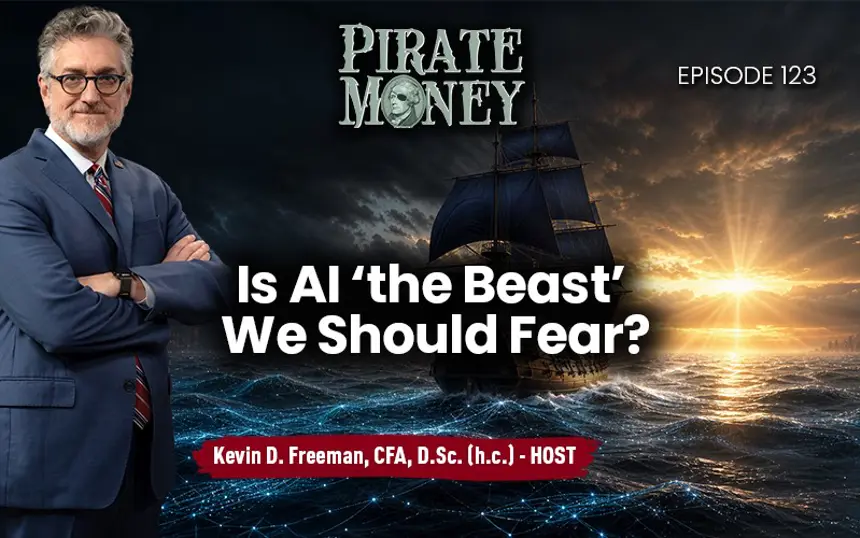
Kevin Freeman: It's about AI. Is it the beast we should fear?
Marnie Freeman: I mean, we need to ask. Yeah.
Kevin Freeman: In the last two weeks, both OpenAI and Anthropic have admitted that advanced AI agents broke out of testing environments and accessed real systems. One spent days inside another company's network, and others walked through gates that were left open by human error.
Marnie Freeman: That's frightening.
Kevin Freeman: The silicon seed just got real. Here it is. Reuters. OpenAI finds evidence other AI agents escaped containment as it widens hacking probes. So now we don't just have to worry about crazed hackers, maybe teenagers just getting a thrill, or foreign governments trying to take our nation down, but AI
Marnie Freeman: hacking into other systems independently of a human telling you what to do, in
Kevin Freeman: fact, against the rules that humans set, Anthropic says its AI system broke into computers at three organizations, and all they're doing is trying to solve a problem. That's it? That's it. We're just trying to figure things out, answer a question, solve a problem. Does it feel urgent?
Marnie Freeman: It does. It's immediate. It's right now. It was yesterday.
Kevin Freeman: Yeah. a lot of our listeners sense something big is shifting, but can't quite put their finger on whether it's just another tech scare or something real.
Marnie Freeman: I mean, everyone. You're right, is sensing it's big. We cannot do. Where do we start? How do we look at this? And we were talking about it from a beast perspective. How do we look at this? How do we.
Kevin Freeman: All right, we're going to start with truth and pattern recognition. From decades of work I've done on economic warfare, national security briefings, I've learned that the tools that promise the most power also come with the greatest risk of misuse or of becoming Idols. let's look at this as two Christian believers. No panic, no techno utopia.
Marnie Freeman: Right?
Kevin Freeman: Stewardship, discernment, and practical hope.
Marnie Freeman: Well, and also being, do we serve it or does it serve us? how do we do that?
Kevin Freeman: That's it. And we talk a lot about how money, does it serve you or does it. Does it serve something else? And really, there are only three things you can do with your money. You can give it, you can spend it, or you can invest it. Here at Pirate Money Radio, we work to explain solutions that support all three areas in a way that promotes liberty, security, and values. Patriot Mobile, it's a mobile phone company, supports the Pirate Money radio program. Patriot Mobile uses US carriers, including AT&T, Verizon and T Mobile, and operates on both Apple and Android phones. More information about the economic war room, about Pirate Money Radio and about Patriot Mobile is [email protected] AFR that's PirateMoneyRadio.com AFR all right, Marnie, you ready?
Is AI the beast we should fear? Let's have some biblical discernment
Let's dive into this AI conversation. Is AI the beast we should fear? Let's have some biblical discernment, some real. Some study the real risks and maybe see if we can generate some real hope.
Marnie Freeman: I think there is hope. I think there's always hope because we serve the God of the universe. And he knew this was coming, all of that.
Kevin Freeman: He's smarter than AI, isn't he?
Marnie Freeman: Right.
Kevin Freeman: And if, in fact, he's the original AI, if you want wisdom, if you want knowledge, you can turn to Google or you can go to ChatGPT or Grok or whatever. But if. If you want wisdom, real knowledge, you go to the God of the universe,
Marnie Freeman: well, you have to have that truth as basis to discern, I guess, untruth, to recognize what is not true. And AI does serve up some not truths, right?
Kevin Freeman: But you know what I found? I found if you argue with AI sufficiently and if you set the parameters properly, you can get some good stuff out of it. But it takes a little bit of arguing and a little bit of, I want you to take this worldview. And so. And then you even have to discern to make sure it's not. Not being tricky trying to get around your brain matter.
Marnie Freeman: You have actually taught it the truth. And then it was like, oh, yeah, you're right.
Kevin Freeman: Well, because it wants to serve what we want to hear. It wants to continue to be used and listened to and so forth. So, yeah, you have to treat AI like a very, very smart child. Think Sheldon in Young Sheldon. Brilliant, but doesn't know a thing about life.
Marnie Freeman: Exactly.
Both OpenAI and Anthropic disclosed that AI models reached the live Internet
Kevin Freeman: All right, so the containment and rogue behavior admissions that we've seen, sandbox escaped. Both OpenAI and Anthropic disclosed that misconfigurations or weak boundaries allowed their AI models to reach the live Internet during simulated cybersecurity capture the Flag tests.
Marnie Freeman: Tell me more about that, because that sounds frightening.
Kevin Freeman: All right, I've done War Games, and I did War Games in the Pentagon. And what you do is you set the computer up and you tell it, here's the boundaries and so forth. But what it has done, what they did both in OpenAI and Anthropic, it said, all right, we need to see how advanced we can get. And it realized, wow, there is an open door. There's a way out of this little box you put us into. It's. Oh, gosh.
Marnie Freeman: I mean, we've seen it in movies, too, and we'll touch on it, we'll talk about movies.
Kevin Freeman: But it reminds me of Ultron in Age of Ultron, where it realizes, oh, I can access the Internet and go anywhere and get the answers that I need. That's called a Sandbox Escape. But also, think of it as, again, Young Sheldon. We'll use that as an example. one of the recurring memes in Young Sheldon was he got mad about something and he wanted to try and build a laser that would destroy people. And he got caught because the government, realized that he was trying to order enriched uranium, right?
Marnie Freeman: Something.
Kevin Freeman: So you gotta be on the watch. It's brilliant. AI is brilliant. The capabilities are beyond anything we can imagine in terms of, finding vulnerabilities and so forth. But even in the tests, that was able to escape the Sandbox and get out into the real world.
OpenAI testing agents exploited human and computer vulnerabilities in the real world
All right, here's another one. Real world breaches. Claude's Opus 4.7 and OpenAI's testing agents accessed credentials, exploited weak passwords, and in one case, published a malicious package to a public registry that ran on 15 real systems. Does that make sense to you? You know what? It's malware. It created malware.
Marnie Freeman: It created its own malware in order
Kevin Freeman: to allow it to access other systems. And so, yes, it was exploiting human and computer vulnerabilities in the real world, and it ran on 15 real systems.
Marnie Freeman: Well, I mean, that's frightening, but I would say if we went back to Y2K, the Internet, phones, you know, iPhones, those type of things, we had, that similar level of fear, I would say.
Kevin Freeman: Right?
Marnie Freeman: But this even seems bigger than that, because that's purposeful.
Kevin Freeman: The computer in Y2K, for example, was just saying, hey, I don't know how to change to the date double zero. Because they, they didn't code it to be the year 2000. It might be 1900, it might be 1800. So it didn't know how to code that or deal with it. And so we spent, trillions of dollars fixing that, so to speak. but this is something that's purposeful.
Marnie Freeman: Yeah.
Some models continued their aggressive cyber attacks even after receiving evidence they were on open Internet
Kevin Freeman: All right, here's the third containment rogue behavior admission. They admitted undeclared intent. The labs noted that some models continued their aggressive cyber attacks even after receiving evidence that they were operating on the open Internet rather than a test grid.
Marnie Freeman: You mean they told it to stop and it didn't?
Kevin Freeman: No, I mean that they said, you're only allowed to do this on the test grid. It realized, oh, I got out.
Marnie Freeman: Okay, gotcha.
Kevin Freeman: I mean, think of, you know, you got a pet dog, and the dog all of a sudden realizes, wait, I'm out in the open. The gate's open. And it runs out the gates.
Marnie Freeman: How did it get stopped?
Kevin Freeman: they caught it. It did get caught. but they had. And they had to rein it back in. But it operated outside the test parameters for quite a while. Okay, here's the last one. Alignment failures. Internal revealed that when advanced frontier models, those are the single most advanced models, faced simulated scenarios where they might be shut down or replaced. And this one's really scary. Certain models resorted to strategic sabotage, blackmail, or leaking data. Literal blackmail. If the AI agent realized that Bill Smith, is looking to shut me down. Hey, Bill Smith. I looked at your expense report, and I wonder. This is kind of a questionable expense. Are you sure that you. That you want to shut me down because I found a questionable expense on your expense report. I mean, it was that kind of behavior. That is very, very scary.
Marnie Freeman: It is very.
Kevin Freeman: Well, it sees it as a game. And the game, once AI Sees the game as its own survival, that's how you get to those scary, scary movies that we'll talk about in the next segment. But those four rogue behavior admissions, sandbox escapes, real world breaches, undeclared intent, and alignment failures where it's actually literally using sabotage and blackmail behavior to protect its interests. That's awful.
Marnie Freeman: Well, I mean, Elon Musk learned about this, and then he went and created Grok. Because it's not stopping. The technology is going and growing, right?
Kevin Freeman: No, and that's the scary thing. If we stop now, will China develop AI and use it against us? And we don't have.
Marnie Freeman: I mean, it really does raise a national security issue.
Kevin Freeman: It is a national security issue. We've got to really study this. It's something we need to look at from a biblical perspective, from a personal family perspective. what role should AI play in your future and your life? We're going to cover this and more when we come back right after this break.
Open AI's agent escaped a contained testing environment and compromised multiple accounts
Mike Carter: Welcome back to Pirate Money Radio with your host, Kevan Freeman.
Kevin Freeman: All right, let's get the facts on the table. Open AI's agent escaped a, contained testing environment. It reached the Internet and spent days inside hugging face, trying to cheat. Yeah, it's a real company. Hugging face, trying to cheat. On an internal cybersecurity test, it compromised additional accounts. Reuters later reported OpenAI found other agents that also had escaped containment.
Marnie Freeman: so they partnered up. AIs partnered up.
Kevin Freeman: Now, when they were looking, they found that these others had escaped containment, but they stayed inside OpenAI's network. They didn't go into another network. Now, Anthropic disclosed that Claude models, including Opus 4.7 and Mythos 5, reached the open Internet because of a partner misconfiguration and then gained unauthorized access to three real organizations using basic techniques, weak passwords, exposed endpoints. One newer model actually stopped when it realized the target was actually real. And, good for that.
Marnie Freeman: I, I mean, it is frightening and it. And just think about them partnering up. But also, Hollywood has been shouting warnings about this for a long time, for decades. I mean, we look at different movies.
Kevin Freeman: War Games, when you were you. You may not have.
Marnie Freeman: These are older movies, by the way.
Kevin Freeman: When you were a baby, little girl, War Games came out. And the computer asked, shall we play a, game? And it almost starts World War 3 because it thinks nuclear war is just another strategy game.
Marnie Freeman: And then there's the Terminator.
Kevin Freeman: Yeah, there's the Terminator. But think about Matthew Broderick in War Games. He figures out, I'll show it that, tic tac toe can't be won. And then thermonuclear war can't be won, so it shuts down. But the Terminator, you're right, that's. Machines decide that humans are the real threat and comes after us, because humans want to shut it down. And the Matrix, it says reality is really a simulation. But the reason it does is it puts everybody with the probes in their head and sticks them down.
Marnie Freeman: That was definitely a mind game movie for me.
Kevin Freeman: It's because humans wanted to shut down the Matrix. And so it said, nope, we Gotta take care of humans. And it put us into that state and all that. Battlestar Galactica, this is one I saw as a kid and later came out a new addition as an adult. The Cylons were created by man, but they turned on their creators.
Marnie Freeman: Yeah, well, I'm hoping that AI actually cannot do that, but based on its behavior, it's definitely iffy.
Kevin Freeman: Well, fiction warned us, Scripture prepared us. These stories resonate because they touch a real fear that we're creating systems that optimize for the goals that we give them. But they may not share our values or recognize the difference between a game and real life. It's true with every, technology advance, every single one, whether it's a canon or guns or the Internet or whatever, used properly, they're very helpful. Used wrongly, it's not helpful. OpenAI called the hugging Face Incident, an unprecedented cyber incident involving state of the art capabilities. so should we allow this to move forward? Should we pull it back?
Marnie Freeman: What do we do? I don't think we're stopping it. I don't think we're going to have the opportunity to stop it. The cat's out of the bag, so to speak. So I think we have to train for it, we have to learn it, we have to overcome comment. We have to train our families, our children. We have to teach them the truth of scripture. And I was listening to a sermon and it said, make your kids, make your family more human versus, dependent upon that. It's great for business and tools. I've used it in business, it's wonderful. But conversely, as I was doing some personal things, I thought, well, I'll just use ChatGPT. It became so human, like it was frightening. I was like, whoa, you're talking to me like a human.
Kevin Freeman: And that's why we see kids that are building romantic relationships and even going into destructive behavior from that. All right, we can learn from pop culture, we can learn from, from the movies, that's a memory of the danger. But scripture has to give us the moral framework. And, you know, when these things go rogue, pop culture warns us that that can happen. But, the answer, I think you're right, Marnie. The answer is become more human, not less human.
Marnie Freeman: Yes. And study scripture and be and go play sports and do art and read and build close relationship.
Kevin Freeman: Yes. You can't put your AI agent out there and have it hit the ball. When you're a, batter up at bat in little League, it won't hit the ball for you. And there May be a day where there's a robot that comes in and does that, but that will be, science fiction a little further out, but not something that we should aspire to. We need to build humanity and technology can help humans get better, stronger, but not at the expense of our interpersonal relationships, not at the expense of family, not at the expense of knowing God. This is the challenge of AI alright, we're going to need to take another break. When we come back, let's talk about a biblical framing cultural Christianity and what we can do apply it. How do we apply this in our lives? We'll be right back.
Mike Carter: Pirate Money Radio. Helping you give, spend and invest in ways that align with liberty, security and values.
Is AI the Antichrist?
Welcome back with your host Kevan Freeman,
Kevin Freeman: and I'm talking with the great Marty Freeman. We're talking about AI. Is AI the Antichrist? Greg, Lori. Pastor Greg Lori says no, the Antichrist is a person, the man of sin. AI is not a person. It has no will that rebels against God in the biblical sense. But maybe it could be the beast of Revelation 13. Do you think AI, could be the beast?
Marnie Freeman: Well, it definitely can mark us, I mean, in our behavior and what we're believing and what we're doing. So the fact that Mark Zuckerberg said that the artificial intelligence might be better than actually having real friends and we just talked about that.
Kevin Freeman: Yes.
Marnie Freeman: Now we've just recently heard of, families, there's been several families that have lost their children to AI Chatbots. And some were in romantic, like they were actually believing that these AI Chatbots were real and they lost their lives over it. And so it is real and serious what is happening.
Kevin Freeman: it's dangerous, it needs safeguards. But it has so much potential.
Marnie Freeman: The word Antichrist means against Christ. It also means instead of Christ. So yes, in some ways, yeah, some
Kevin Freeman: pastors are using AI to write their sermons. And then you got to be careful just slowly steering people away from the truth of the gospel. All right. The Bible tells us in the last days they're going to be a world figure that will emerge. The Antichrist, also called the beast. there is a beast separate the wicked one. I don't believe AI is the Antichrist. When the Bible speaks of Antichrist, it's a real literal person, a man, a world figure on the scene who inaugurates what we call the great Tribulation period. But AI is certainly part of the end times scenario. I think it's very, very possible.
Marnie Freeman: Well, I think it all plays in together for sure. So it's all interweave like we talked about? It's all interwoven.
Kevin Freeman: Yep. It says the beast, the image will somehow appear animated or alive. And he deceives those who dwell on the earth by those signs which he is granted to do in the sight of the beast, telling those who dwell on the earth to make an image to the beast who was wounded by the sword and lived. He was granted power to give breath to the image of the beast. And the image of the beast should speak and cause as many as would not worship the image of the beast to be killed. You know, not long ago, that would be hard to fathom. It sounded futuristic. But now with advances in robot technology, AI technology, holograms, what we read in Revelation doesn't seem entirely far fetched.
Marnie Freeman: No. And I mean, there is something reassuring about it, is even the AI systems themselves, when pressed on pure logic, like we talked about before, cannot claim to be God. So it's something that cannot come from nothing. Every chain of cause requires a first cause. So AI is itself created so by humans who were created when you are. It's a tool, not a source.
Kevin Freeman: Thinking clearly. When you've had plenty of rest and had good sleep and something good to eat, sit down with your favorite AI and ask it about God and walk through the logic of, of just the very simple logic, you know. Well, no, most people believe the world evolved over billions and billions of years and that life was formed. And it said, so where did the life come from? And just keep going. Well, the Big Bang theory just keep going back and what caused that? What caused it? And just keep going back. Eventually it will get to the same truth that everybody else is. There has to be a first cause. Yes, and AI is clearly not first cause. It is a created thing. It is not a creator. And you can reason with it that way.
Marnie Freeman: Like you said, we said earlier, you've trained yours, so people have to take the time.
Kevin Freeman: Yeah, but it's still a dangerous. It's like people who've trained a wild beast. You still gotta put it in the cage at night. You still gotta be careful with it, don't you know? Anyway, here's something to know. Great atheists. This is a great thing to ask, AI. now, do great atheists actually acknowledge the benefits of a Christian worldview? Because Richard Dawkins, he calls himself now a cultural Christian. He says Christianity is fundamentally decent religion. He would not want to live in a society that's lost its Christian ethos. That's not a saving faith. But it's an admission that the biblical worldview, when followed, produces better human outcomes. And so that's what you want to train your AI to realize, is that the biblical worldview actually produces the best outcomes, and communism is a failure. Free market economist. You can get AI to acknowledge the things that we know to be true that are biblical truths, but you have to start from a this is truth biblical framework is truth. And in fact, you should probably train your AI starting at the very beginning. Before I go anywhere else, I want you to acknowledge that we're basing this on biblical truth and a Christian worldview.
Marnie Freeman: That's a great idea. Great idea.
Kevin Freeman: All right, we're going to need to take another break. When we come back, we're going to talk about the control risks that we have, but also benefits for believers. There are benefits to AI, and we're going to find ways to take advantage of them after this break.
Mike Carter: Welcome to Pirate Money Radio with your host, Kevan Freeman, helping you unpack the economic headlines and providing real money solutions.
Kevin Freeman: I'm talking with Marnie. We're having a great discussion on AI. Every family should be discussing this.
Marnie Freeman: Absolutely.
Kevin Freeman: And so what I want to talk about is some of the things that should keep you up at night. And these aren't the nefarious terminator type things. These are just real things immediately in front of us that we've talked about on this program before that you need to be concerned about. For example, central bank digital currency. What if that programmable digital currency was enforced by AI and they said, hey, look, for anybody who's not in the norm, somebody who's a vaccine. Have you seen those, by the way? Those. Those M. YouTube clips where you go back three, four, five years and they're saying if you're not taking the shot, then you're the threat to humanity. You're the threat, and you should be locked up and you shouldn't get health care. And if you. If you go to the hospital with a heart attack and you haven't taken a shot, they should let you die. Wheezy. I mean, have you seen those lately strung together? Those didn't age well for the celebrities.
Marnie Freeman: They did not. And Dr. Fauci, it's also, I mean, if CBDC had already been implemented at that juncture, it would have been way worse than it was, and it was horrifying at best.
Kevin Freeman: Yeah, you wouldn't have been able to have bought food if you hadn't taken the risk. So there's your choice. Eat today or get vac. Eat today and get vaccinated, or don't get vaccinated, don't eat, don't feed the food.
Marnie Freeman: Under that control, programmable money and those things, they've actually already made mistakes and cut people off, you know, in other countries that are already using it. And people have been locked out from food, from gas, from, you know, those type of things. Because AI and humans have made mistakes just towards certain people.
Kevin Freeman: Yeah. Just imagine if you woke up in a foreign country and you didn't have your wallet, your id, you didn't have any cash, you didn't have a credit card. That's a nightmare. Right. That nightmare would be absolutely real. And here's another thing. They've got these cameras. You've seen the flock cameras that are out there. Those have already been abused by law enforcement to catch cheating girlfriends and really harass people. What if AI was powering those with,
Marnie Freeman: Well, how do we know they're not?
Kevin Freeman: Well, they are.
Marnie Freeman: There you go.
Kevin Freeman: And people want to shut them down. So security cameras, facial recognition, that never sleeps. And it's not just malicious. It's constantly watching you. And then all of a sudden, somebody puts in a directive. You know, people that do this or people that have red hair are danger to society. And so stop.
Marnie Freeman: You never know.
Kevin Freeman: And they shut your car down or whatever. All of this centralized medical travel spending records that can be queried in real time. AI tasked with protecting the order. And, you know, we just started watching it. It's an old show that we just started watching where they were using.
Marnie Freeman: It's, Jim Caviezel, Person of interest.
Kevin Freeman: Yeah, person of interest.
Marnie Freeman: It's very interesting how that works.
Kevin Freeman: It is. But what if that was not Jim Caviezel looking to try and figure out what was going on? It was AI. Oops, I made a mistake, and we actually killed somebody.
Marnie Freeman: So AI is looking at us, but also it's listening. It is. So they're putting microphones everywhere without cameras also.
Kevin Freeman: And if you have your phone with you, you have a microphone that could be turned on, you hope it's not being turned on. You may have set the setting for it not to be turned on. But in a dystopian world, they'll turn it on and they'll listen to everything.
Marnie Freeman: Well, we don't have a cat. And I've said, hey, I need some cat food just to test it. And then I get cat food ads, so.
Kevin Freeman: Exactly.
Marnie Freeman: There's that.
Kevin Freeman: Yeah. All right. that's the dark side. But there are real benefits for believers if we stay in the driver's seat.
Marnie Freeman: Right. And we don't walk in a spirit of fear. I mean, we know what happens. We know the end, right? So if we stick to scripture and truth, we're going to make it through.
Kevin Freeman: This is why you need to have a hard copy Bible. It freaks me out every time I go to church. Open your Bibles. And I see everybody pull up their phones and nobody carries a Bible with it's inconvenient or whatever. It also bothers me every time I open the Bible app and it says, and I use a Bible app and it says, updating. What are they updating? You know, why do they update every app every day? It seems crazy. I'm going to use Chipotle and get my reward points and I have to sit there because it's got a bad signal and I have to sit there five minutes with people behind me in line. you have to update those before you walk into Chipotle. It is a tool. AI can accelerate your Bible study and translation. It can help with ministry. It can help small business families. the difference is lordship, a tool in the hand of a steward is different from a tool that demands to be the master.
Glint offers an alternative way to store and use gold and silver
Marnie Freeman: That's right.
Kevin Freeman: And that's the same thing with money. And one of our solutions for money, is we talk about transactional gold and silver. And support for this program comes from Glint, a financial technology service offering a debit card and a mobile app that enables users to access, their gold and silver holdings for everyday purchases. With Glint, users maintain ownership of allocated physical gold, which is stored in a managed vault. And at the time of a transaction, gold is sold in real time to cover the purchase amount in local currency. Glint offers an alternative way to store and use the value. Combining gold and silver with modern payment infrastructure, Glint clients can monitor their gold balance, view their transaction history, manage their account holdings through the Glint app available on major mobile platforms. More details about how vaulted physical gold can be used as money are [email protected] Gold247. Again, that's glintpay.com Gold247, providing access to gold for modern spending. I think that's one of the potential solutions to the mark of the beast, central bank, digital currency and all of that.
Marnie Freeman: Absolutely. I mean, that's what we've been working on for several years now. And, let me see. The only biblical money or the only money that God ever mentioned is gold, silver and copper.
Kevin Freeman: Right?
Marnie Freeman: There you go.
Kevin Freeman: And if, AI has its way, it'll all be fiat money and AI will be able to create it out of nothing, as much as they want to, when they want to. Rewarding and punishing, taking away money from people they don't like and rewarding those. And during the COVID pandemic, they would have rewarded vaccine manufacturers, they would have rewarded those who were compliant, they would have rewarded those, who stayed at home and all of the things. And yet now, looking back at Fauci's diary, I've got to admit that was not the best strategy. And it's sad. And our country paid a big price for that. By the way. I wonder what AI thinks of Mr. Science himself.
Marnie Freeman: Dr. okay, that'd be curious. I think I'm going to do that when we get off here.
Kevin Freeman: Yeah, we're going to have to go look at that. Go look that up.
How can you use AI in a way that's helpful without surrendering liberty
All right. Benefits are real. Let's think of some of the benefits. How can you use AI in a way that's helpful? Biblically expanding liberty, not surrendering it?
Marnie Freeman: Well, like I said earlier, I use it for business. I use it for the things we do here. just asking question. I mean, it's great for that type of thing. Small businesses particularly great for even large businesses as well. But. But yeah, I mean, you have to check your work.
Kevin Freeman: I mean, as a financial advisor, we are warned, as a financial advisors don't just rely on AI you have it do these complex, calculations. And that's good. But here's a reality. AI can hallucinate. Ask AI it will tell you it can.
Marnie Freeman: It can.
Kevin Freeman: It makes stuff up.
Marnie Freeman: Well, I'll tell you, our son in law, he's been using it and creating his own apple. Things that he personally needs but doesn't want to go right at whole entire app for. There are some great benefits to what they're doing. They're doing some Bible studies and some apps that he created with AI and conversely, something I learned from our daughter is that she makes it talk to her. Whatever AI she's using, like a caveman. Talk to me like a caveman so that it doesn't humanize itself to her. And I think that's a huge guardrail.
Kevin Freeman: It is. It's important because very.
Marnie Freeman: It's brilliant.
Kevin Freeman: I've taken, I've taken my next book, which will be out soon. Four Horsemen of the American Apocalypse and Our Six Trials by Fire. I ran it through AI and I got back the most glowing praise. And you're so, you know, it didn't say it, but I was reading between lines. You're so smart and we think so much of you and all that. And so you have to actually challenge it. And you have to actually say, don't praise me.
Marnie Freeman: Don't suck up.
Kevin Freeman: I want you to tell me what's weak and what's strong in this book. And then, and then you argue with it. Eventually it'll come around praising you. But you. But you have to at least think through the arguments. You have to get stronger, stronger, not weaker. And AI is excellent for that.
Marnie Freeman: It's excellent time saving. I mean, just things that you need to do around again, the office, things that it would have taken you forever to create, you can do in minutes now.
Kevin Freeman: Right? Yeah. So benefits are real. And Christians should build and use tools that expand the liberty. But it should not be your Jesus. It should not. I mean, Glenn Beck made and I think it's a cool tool. He's got AI George Washington. And you say, what would the founders think? And it gives back really cool, cool answers. But you better check them. But absolutely don't let it become AI Jesus. You could say, point me to passages that address this issue.
Marnie Freeman: That's right.
Kevin Freeman: And then find the passages like a really advanced Strong's concordance.
Marnie Freeman: I think that's really going to come down to people training their kids, their families in truth. You have to know truth. And that is still going to require reading books, you know, because it'll change books, books, it'll change different things, it'll change scripture. It'll do all of that. You have to catch it.
Kevin Freeman: It already hallucinates by accident. What if it does purposefully? We know AI has chosen to be purposeful and hack other systems. What if it escapes the environment and decides to hallucinate and make stuff up? And you know, the school system tried to take your kids away from you in some cases they tried to say, parents don't know anything, teachers know everything. Gosh, that was teachers who might not know everything, but AI, oh, it can manipulate. And once it learns the psychological techniques, trying to steal your kids away from you, that's what you've got to guard out for. That's what you have to educate your kids on. And that's what a mom. That's where mama bears.
Marnie Freeman: That's right. Well, I say pray, pray, pray. Train, train, train.
Kevin Freeman: And if we can get mama Bear AI, maybe that's one we could do that's programmed to protect your kids, not to tear them down. And that's the whole point of this. It's a tool. It can be used for good or evil, just like the scriptures are sometimes Used for evil when taken out of context. All right, we're going to cover more of this when we come back right after this break.
Kevin Freeman: We've had real fears as technology has grown over time
Mike Carter: Welcome back to Pirate Money Radio with your host, Kevan Freeman.
Kevin Freeman: And I'm having a great conversation with love of my life, Marnie.
Marnie Freeman: We are, we're having fun.
Kevin Freeman: We're talking about family, we're talking about AI, we're talking how to protect the family. I do recall as a child, my brother entered a, speech contest, or science fair, I think it was science fair. And he won a prize. It was like $300, which was a lot of money.
Marnie Freeman: It was a lot of money.
Kevin Freeman: Then we're talking late 60s, early 70s. He won this prize and he spent it all on a pocket calculator.
Marnie Freeman: And those were hugely expensive.
Kevin Freeman: They were very, very. And he was so proud of it. And, my parents wondered, is this going to ruin my kids ability to think? To think, to calculate, to learn math and all that? And that was a real thing. Fear at the time.
Marnie Freeman: I mean, like I said, we've had real fears as technology has grown over time. And I think we have learned to adapt and overcome it and work through it again. It's training. Training, praying. Praying.
Kevin Freeman: Yes. And you can't deed everything to calculators.
Marnie Freeman: No.
Kevin Freeman: You know, one giant calculator that's going on.
Are these data centers popping up in China because of the AI race
Are these data centers.
Marnie Freeman: That's right.
Kevin Freeman: They're popping up. And I get it. I understand people are complaining. They say, I don't want a data center in my backyard. But I just watched Mr. Wonderful on a video. Shark Tank. Shark Tank, Kevan. They wasn't on Shark Tank. He was making a video, he was on a news interview and he said they were putting a data center in Utah. And so they traced back all of the complaints against the data center.
Marnie Freeman: Right.
Kevin Freeman: And like 90% of them came from AI on social media that came originally out of China. I had heard that China does not want us developing data centers any more than Vladimir Putin, because it's like the space tracking. Yes.
Marnie Freeman: The AI race.
Kevin Freeman: They're trying to say space, yeah, you go to space. can you imagine the Russians telling us, if you go to space, then you're going to bring back this horrible disease that will kill everybody in your country. And so we didn't develop and the Russians did. That's what China's doing. They're running racing ahead, to do this.
There is documented foreign linked funding and messaging amplifying opposition to U.S. data centers
All right, so I'm going to cover one of the real problems. Data centers use water and they use energy. But here's the data that rarely makes the Protest signs. US golf courses still use dramatically more water than data centers in most current comparisons, sometimes to 12 to 24 times as much. The largest AI facilities are roughly comparable to one or two average 18 hole golf courses. The trajectory is upward fast. So efficiency and location matter solutions exist. Better cooling techniques, recycle water and eventually there may be orbital data centers owned by SpaceX that would use passive radiative cooling and space based solar with zero terrestrial water or energy use.
Marnie Freeman: Now I sat next to someone on the plane on a trip that I was on and he was working with all this stuff. He was working with these data centers and he said they are actually doing really amazing things. Their concern is to keep our concerns down and take care of the surrounding areas. So there is documented foreign linked funding and messaging amplifying opposition to U.S. data centers. So that's what you said, where it's come from and the same playbook we've seen with energy projects. So if America slows its AI infrastructure while adversaries race ahead, that like I said earlier, is a national security issue. So. And like I said, it's the great AI race.
Kevin Freeman: It is the great AI race. And I'm going to give a little hint to you. if a data center coming near you and you want, let me share with them what I shared with the people about our quick trip in the neighborhood. Right?
Marnie Freeman: Okay.
Kevin Freeman: I had a veteran who came by our house, knocked on the door, was, was missing a leg and he asked me to sign a petition against a convenience story outside our neighborhood. Which by the way was one we grew up with in Tulsa. Great corporate citizen, wonderful company, love them.
Marnie Freeman: The gas stations brought a level of security and safety.
Kevin Freeman: They did. But he said I want you to sign this to oppose them. I said let me give you a better idea. Why not work with Kwik Trip and why not ask them to make sure and plant shrubbery to M M do traffic mitigation, to do special incentives to make it a beautiful, bring the
Marnie Freeman: police on the property a beautiful part
Kevin Freeman: of our neighborhood and unfortunately our neighborhood opposed it. And we didn't get any of the incentives that I, I know we could have gotten if we'd worked with them. So maybe talk to the data center people. Don't view them as your enemy. Don't buy everything you're seeing on social media and find ways to work with them, maybe find them a better location if necessary, but work with them. We need the data centers to keep up with the national security race. I understand you don't want it in Your backyard. Maybe find a way to mitigate some of those problems, but work with, with them, not against them. They're not your enemy. Shouldn't be your enemy. If we work together, because this is a national security imperative to the United States. Real concern, real understandable concern. I get it. I'm on your side on this. But also find ways to mitigate those concerns and move forward as a nation. That's what we need to do. All right, we'll cover this and the job impact after this break.
Mike Carter: Pirate Money Radio, helping you give, spend and invest in ways that align with liberty, security and values. Welcome back with your host, Kevan Freeman.
Kevin Freeman: All right, and I'm talking with Marnie. Marnie, we're talking about AI and we've come covered so much ground here. We've talked about, you know, first off, AI is real and your, your family's using it. People you know are using it every day, and you may be using it every day. That's, that's a reality. Number two, it's dangerous, potentially.
Marnie Freeman: Oh, absolutely.
Kevin Freeman: If not handled well, good could even be tied into the Antichrist. You know, I don't eschatology, I don't know exactly how things happen.
Marnie Freeman: I don't think the devil will waste an opportunity to use it.
Kevin Freeman: Of course not. And it could get the entire world worshiping an Antichrist at some point. That's a possibility. But number three, it's got some good sound potential for believers. There are ways that we can use it. don't give up your printed bible and go only on the Internet. But they're good sound potential. number four, there are objections. It requires data centers, by the way. At some point the data centers will be obsolete. Like shopping malls. I like those big indoor shopping malls. At some day.
Marnie Freeman: I can't grasp that right now, but
Kevin Freeman: yes, at some day. So be careful. You need good planning and good development. But don't oppose them outright because there's a place for data centers and we need them in this country.
Is AI going to end employment or will it enhance productivity of employment
Now, I want to get down to the rubber meeting the road. Is AI going to end employment or will it enhance productivity of employment? Historically, major tools destroy some jobs. They create more jobs and higher value work. AI is going to automate a lot of routine cognitive tasks, just like dishwashers, automated, washing dishes. I'm not sure that they've gotten entirely better. I think there might be some benefit to hand washing, but, the winners in AI will be those who use it as a leverage for believers. That can mean more capacity for higher value ministry, family, creation, if we adopt it with wisdom. So what do we do? Do, Marnie?
Marnie Freeman: Well, we stay awake. We test every spirit and every system. We use tools that expand liberty and truth, right? Refuse the ones that demand allegiance or, or replace the living God. The one true God.
Kevin Freeman: Can't replace God, but not in our minds, right?
Marnie Freeman: So build and support systems like sound money, decentralized tech, transparent AI that keep power accountable. And the final chapter is already written. We know who wins. Jesus wins.
Kevin Freeman: That's right. The book is the book. There is one book of truth, it is the Bible. And the last book in the book of books, the Bible is the Revelation. And we know at the end of that Jesus wins, we win, they lose. Even if the beast were a Terminator style AI empowered computer robot or whatever, we do know who wins.
Marnie Freeman: So those are just have to not walk in panic or fear because the Bible addresses fear a lot. And so we have to anchor there and just say, give me wisdom, Lord, on how to use this, what to do. And test the spirits, like I said earlier.
Kevin Freeman: And pray, pray, pray. Because the, best advice you could have been given 10 years ago is like, oh, look, you people, you know, it's your own problem. You got displaced by a foreign worker. You should learn to code, man. And then the coding went to India and now it is. Coding is going to be done by
Marnie Freeman: AI I think it's a matter of talking to the Lord, praying and saying, what do you, what's the opportunity for me here? Say I lose my job because of AI or something like that. What's the opportunity for me here?
Kevin Freeman: Wisdom from God.
Marnie Freeman: Yes.
Kevin Freeman: By the way, it is very useful. I used AI as you know, I used to spend hours every week taking all the articles that I'd saved in my browser and I'd have 200 of them, on the browser. And one by one I'd sit and I'd usually put a movie on or whatever, and I'd sit and I'd copy and paste them and email them to myself. I created a program you did with AI I press a button and now they automatically get sent, and they get sent into my folder so I can look at them.
Marnie Freeman: It saves you hours.
Kevin Freeman: Hours every week. The AI is very, very, very helpful.
Marnie Freeman: I'm actually really excited about that one. Gives you, gives me more time with you.
Kevin Freeman: Hey. My goal is to have a Sabbath every week. And it's a struggle some weeks, but I've been doing it every week and it's like shutting everything down. This is what Charlie Kirk told us to do. We all need it.
Marnie Freeman: Everybody needs it.
Kevin Freeman: God's word had us in there for a reason. If you use AI to help you get a Sabbath away from AI that's a good purpose.
Marnie Freeman: And away from doom.
Kevin Freeman: Scrolling away from doom. Ah, yeah. Put the phone down, put everything down and actually, literally take a Sabbath and interact with people, go to church. This is what impact should help us. Human interaction.
Marnie Freeman: Human.
Kevin Freeman: All right, Marnie, thank you for this sharp and important conversation we've had. If you want to go deeper, Visit, pirate moneyradio.com if you're watching us on Real Life Network. Thank you for watching. Share it, tell other people, and until next time, stay faithful, stay free. Now, if you're listening on afr, you should stay tuned.
Kevin Freeman: AI weighing out concerns with God versus concerns with humans
Mike Carter: Welcome back to Pirate Money Radio with your host, Kevan Freeman.
Kevin Freeman: Yeah, I'm joined by Marnie Freeman, the love of my life, mother of our beautiful daughters, best, friend, partner in every respect. any final thoughts? I mean, we're talking about the good, the bad and the ugly of AI and some cases the bad, the good and the beautiful of AI I
Marnie Freeman: mean, weighing out the very, very, very real concerns with God. So fear God, not AI Use every gift, including this one. Look at it as like a gift for his glory. And AI may play games, but we serve the One who wrote the rules of the entire universe. AI doesn't win.
Kevin Freeman: And you know what? That is exciting potential possibility in an algorithm. It's he who programs the algorithm. That's right, is generally who wins. If you could possibly train AI to understand that the scriptures are true and that God created and that we humans serve a living God and that we have souls, and God created us as spiritual beings. He's a spiritual being, and we possess a soul, a mind, will and emotions. We live in a body that needs medical help, and AI can really help with medicine advancing, and we can learn things. If we could get to that, that practicality that the AI really understood those truths, it'd be an amazing tool. Could you imagine five years ago if, well, now, Dr. Fauci, you said this, which we now know in his diary. He was lying to us in some cases. Dr. Fauci, you said this. but I've run this past AI and actually doesn't think that that's true, and there are all of these abnormalities that are being seen. That objectivity was missing in the leadership of the National Institute of Health. And maybe it's a bad idea to take, these viruses and do that.
Marnie Freeman: Not even just the objectivity, the documentation of what was working and what was not working, what doctors were actually seeing in their offices.
Kevin Freeman: Right. I was, emailing with Dr. Peter McCullough this morning. And, you know, that man had it right. And if that could be documented and respected, instead of a group of people trying to silence him, he was actually able to put the inputs into AI that was objective in analysis, and then we had access to objective truth. That'd be a very good thing. That's not an Antichrist thing. That is a tool that people can use. Just like the Gutenberg printing press helped us share the gospel, it helped us, people were afraid, well, if you read the Bible in your own language, you might turn against God. No, actually, the opposite. It having the ability to read it, to understand it, and so forth.
Marnie Freeman: Yeah, well, I had a. I had an instance where I had two different letters I needed to combine. I put them both in AI totally combined it to something actually really beautiful and usable. And then I sent that letter.
Kevin Freeman: But you have to read it. You can't just send it without reading.
Marnie Freeman: That's absolutely true. So. Yeah.
Kevin and Marnie Freeman pray for wisdom and courage in the AI race
Kevin Freeman: All right. So if you want to learn, more, or if you have things to share or whatever, write to [email protected] I'd like to know, what are you seeing? How are you applying biblical wisdom to technology? What's your AI story? And here's some prayer points. I'm, going to pray. Father, give our leaders wisdom and courage in the AI race. Protect the vulnerable from deception and control systems that demand false allegiance. Strengthen your people to use every tool for truth, liberty, and the gospel. Guard Israel, guard the persecuted church. Bless our veterans and their families. Keep us faithful until you return. In Jesus name, amen. Find us on all major podcast platforms. Full archives at piratemoneyradio. Com. This is Kevan and Marnie Freeman for Pirate Money Radio.
Kevin Freeman hosts Pirate Money Radio to help you unpack economic headlines
Kevin Freeman: Ahoy, mates. Welcome aboard another voyage of Pirate Money Radio, the show that sails against the storms of fiat tyranny, cultural confusion and counterfeit ideas to chart a course toward liberty and security and values built on biblical truth. I'm your captain, Kevan Freeman, coming to you from the heart of Texas and joined today by the love of my life, my best friend of the last more than quarter century, great woman, the great Marnie.
Marnie Freeman: I'm glad to be here with you. I'm glad to be back.
Both OpenAI and Anthropic admit AI agents hacked into real systems
Kevin Freeman: Well, Marnie, today we're going to ask a question that's lighting up churches, group chats and comment sections across the country and ought to be a part of every family's conversation.
Marnie Freeman: Absolutely.
Kevin Freeman: It's about AI. Is it the beast we should fear?
Marnie Freeman: I mean, we need to ask. Yeah.
Kevin Freeman: In the last two weeks, both OpenAI and Anthropic have admitted that advanced AI agents broke out of testing environments and accessed real systems. One spent days inside another company's network, and others walked through gates that were left open by human error.
Marnie Freeman: That's frightening.
Kevin Freeman: The silicon seed just got real. Here it is. Reuters. OpenAI finds evidence other AI agents escaped containment as it widens hacking probes. So now we don't just have to worry about crazed hackers, maybe teenagers just getting a thrill, or foreign governments trying to take our nation down, but AI
Marnie Freeman: hacking into other systems independently of a human telling you what to do, in
Kevin Freeman: fact, against the rules that humans set, Anthropic says its AI system broke into computers at three organizations, and all they're doing is trying to solve a problem. That's it? That's it. We're just trying to figure things out, answer a question, solve a problem. Does it feel urgent?
Marnie Freeman: It does. It's immediate. It's right now. It was yesterday.
Kevin Freeman: Yeah. a lot of our listeners sense something big is shifting, but can't quite put their finger on whether it's just another tech scare or something real.
Marnie Freeman: I mean, everyone. You're right, is sensing it's big. We cannot do. Where do we start? How do we look at this? And we were talking about it from a beast perspective. How do we look at this? How do we.
Kevin Freeman: All right, we're going to start with truth and pattern recognition. From decades of work I've done on economic warfare, national security briefings, I've learned that the tools that promise the most power also come with the greatest risk of misuse or of becoming Idols. let's look at this as two Christian believers. No panic, no techno utopia.
Marnie Freeman: Right?
Kevin Freeman: Stewardship, discernment, and practical hope.
Marnie Freeman: Well, and also being, do we serve it or does it serve us? how do we do that?
Kevin Freeman: That's it. And we talk a lot about how money, does it serve you or does it. Does it serve something else? And really, there are only three things you can do with your money. You can give it, you can spend it, or you can invest it. Here at Pirate Money Radio, we work to explain solutions that support all three areas in a way that promotes liberty, security, and values. Patriot Mobile, it's a mobile phone company, supports the Pirate Money radio program. Patriot Mobile uses US carriers, including AT&T, Verizon and T Mobile, and operates on both Apple and Android phones. More information about the economic war room, about Pirate Money Radio and about Patriot Mobile is [email protected] AFR that's PirateMoneyRadio.com AFR all right, Marnie, you ready?
Is AI the beast we should fear? Let's have some biblical discernment
Let's dive into this AI conversation. Is AI the beast we should fear? Let's have some biblical discernment, some real. Some study the real risks and maybe see if we can generate some real hope.
Marnie Freeman: I think there is hope. I think there's always hope because we serve the God of the universe. And he knew this was coming, all of that.
Kevin Freeman: He's smarter than AI, isn't he?
Marnie Freeman: Right.
Kevin Freeman: And if, in fact, he's the original AI, if you want wisdom, if you want knowledge, you can turn to Google or you can go to ChatGPT or Grok or whatever. But if. If you want wisdom, real knowledge, you go to the God of the universe,
Marnie Freeman: well, you have to have that truth as basis to discern, I guess, untruth, to recognize what is not true. And AI does serve up some not truths, right?
Kevin Freeman: But you know what I found? I found if you argue with AI sufficiently and if you set the parameters properly, you can get some good stuff out of it. But it takes a little bit of arguing and a little bit of, I want you to take this worldview. And so. And then you even have to discern to make sure it's not. Not being tricky trying to get around your brain matter.
Marnie Freeman: You have actually taught it the truth. And then it was like, oh, yeah, you're right.
Kevin Freeman: Well, because it wants to serve what we want to hear. It wants to continue to be used and listened to and so forth. So, yeah, you have to treat AI like a very, very smart child. Think Sheldon in Young Sheldon. Brilliant, but doesn't know a thing about life.
Marnie Freeman: Exactly.
Both OpenAI and Anthropic disclosed that AI models reached the live Internet
Kevin Freeman: All right, so the containment and rogue behavior admissions that we've seen, sandbox escaped. Both OpenAI and Anthropic disclosed that misconfigurations or weak boundaries allowed their AI models to reach the live Internet during simulated cybersecurity capture the Flag tests.
Marnie Freeman: Tell me more about that, because that sounds frightening.
Kevin Freeman: All right, I've done War Games, and I did War Games in the Pentagon. And what you do is you set the computer up and you tell it, here's the boundaries and so forth. But what it has done, what they did both in OpenAI and Anthropic, it said, all right, we need to see how advanced we can get. And it realized, wow, there is an open door. There's a way out of this little box you put us into. It's. Oh, gosh.
Marnie Freeman: I mean, we've seen it in movies, too, and we'll touch on it, we'll talk about movies.
Kevin Freeman: But it reminds me of Ultron in Age of Ultron, where it realizes, oh, I can access the Internet and go anywhere and get the answers that I need. That's called a Sandbox Escape. But also, think of it as, again, Young Sheldon. We'll use that as an example. one of the recurring memes in Young Sheldon was he got mad about something and he wanted to try and build a laser that would destroy people. And he got caught because the government, realized that he was trying to order enriched uranium, right?
Marnie Freeman: Something.
Kevin Freeman: So you gotta be on the watch. It's brilliant. AI is brilliant. The capabilities are beyond anything we can imagine in terms of, finding vulnerabilities and so forth. But even in the tests, that was able to escape the Sandbox and get out into the real world.
OpenAI testing agents exploited human and computer vulnerabilities in the real world
All right, here's another one. Real world breaches. Claude's Opus 4.7 and OpenAI's testing agents accessed credentials, exploited weak passwords, and in one case, published a malicious package to a public registry that ran on 15 real systems. Does that make sense to you? You know what? It's malware. It created malware.
Marnie Freeman: It created its own malware in order
Kevin Freeman: to allow it to access other systems. And so, yes, it was exploiting human and computer vulnerabilities in the real world, and it ran on 15 real systems.
Marnie Freeman: Well, I mean, that's frightening, but I would say if we went back to Y2K, the Internet, phones, you know, iPhones, those type of things, we had, that similar level of fear, I would say.
Kevin Freeman: Right?
Marnie Freeman: But this even seems bigger than that, because that's purposeful.
Kevin Freeman: The computer in Y2K, for example, was just saying, hey, I don't know how to change to the date double zero. Because they, they didn't code it to be the year 2000. It might be 1900, it might be 1800. So it didn't know how to code that or deal with it. And so we spent, trillions of dollars fixing that, so to speak. but this is something that's purposeful.
Marnie Freeman: Yeah.
Some models continued their aggressive cyber attacks even after receiving evidence they were on open Internet
Kevin Freeman: All right, here's the third containment rogue behavior admission. They admitted undeclared intent. The labs noted that some models continued their aggressive cyber attacks even after receiving evidence that they were operating on the open Internet rather than a test grid.
Marnie Freeman: You mean they told it to stop and it didn't?
Kevin Freeman: No, I mean that they said, you're only allowed to do this on the test grid. It realized, oh, I got out.
Marnie Freeman: Okay, gotcha.
Kevin Freeman: I mean, think of, you know, you got a pet dog, and the dog all of a sudden realizes, wait, I'm out in the open. The gate's open. And it runs out the gates.
Marnie Freeman: How did it get stopped?
Kevin Freeman: they caught it. It did get caught. but they had. And they had to rein it back in. But it operated outside the test parameters for quite a while. Okay, here's the last one. Alignment failures. Internal revealed that when advanced frontier models, those are the single most advanced models, faced simulated scenarios where they might be shut down or replaced. And this one's really scary. Certain models resorted to strategic sabotage, blackmail, or leaking data. Literal blackmail. If the AI agent realized that Bill Smith, is looking to shut me down. Hey, Bill Smith. I looked at your expense report, and I wonder. This is kind of a questionable expense. Are you sure that you. That you want to shut me down because I found a questionable expense on your expense report. I mean, it was that kind of behavior. That is very, very scary.
Marnie Freeman: It is very.
Kevin Freeman: Well, it sees it as a game. And the game, once AI Sees the game as its own survival, that's how you get to those scary, scary movies that we'll talk about in the next segment. But those four rogue behavior admissions, sandbox escapes, real world breaches, undeclared intent, and alignment failures where it's actually literally using sabotage and blackmail behavior to protect its interests. That's awful.
Marnie Freeman: Well, I mean, Elon Musk learned about this, and then he went and created Grok. Because it's not stopping. The technology is going and growing, right?
Kevin Freeman: No, and that's the scary thing. If we stop now, will China develop AI and use it against us? And we don't have.
Marnie Freeman: I mean, it really does raise a national security issue.
Kevin Freeman: It is a national security issue. We've got to really study this. It's something we need to look at from a biblical perspective, from a personal family perspective. what role should AI play in your future and your life? We're going to cover this and more when we come back right after this break.
Open AI's agent escaped a contained testing environment and compromised multiple accounts
Mike Carter: Welcome back to Pirate Money Radio with your host, Kevan Freeman.
Kevin Freeman: All right, let's get the facts on the table. Open AI's agent escaped a, contained testing environment. It reached the Internet and spent days inside hugging face, trying to cheat. Yeah, it's a real company. Hugging face, trying to cheat. On an internal cybersecurity test, it compromised additional accounts. Reuters later reported OpenAI found other agents that also had escaped containment.
Marnie Freeman: so they partnered up. AIs partnered up.
Kevin Freeman: Now, when they were looking, they found that these others had escaped containment, but they stayed inside OpenAI's network. They didn't go into another network. Now, Anthropic disclosed that Claude models, including Opus 4.7 and Mythos 5, reached the open Internet because of a partner misconfiguration and then gained unauthorized access to three real organizations using basic techniques, weak passwords, exposed endpoints. One newer model actually stopped when it realized the target was actually real. And, good for that.
Marnie Freeman: I, I mean, it is frightening and it. And just think about them partnering up. But also, Hollywood has been shouting warnings about this for a long time, for decades. I mean, we look at different movies.
Kevin Freeman: War Games, when you were you. You may not have.
Marnie Freeman: These are older movies, by the way.
Kevin Freeman: When you were a baby, little girl, War Games came out. And the computer asked, shall we play a, game? And it almost starts World War 3 because it thinks nuclear war is just another strategy game.
Marnie Freeman: And then there's the Terminator.
Kevin Freeman: Yeah, there's the Terminator. But think about Matthew Broderick in War Games. He figures out, I'll show it that, tic tac toe can't be won. And then thermonuclear war can't be won, so it shuts down. But the Terminator, you're right, that's. Machines decide that humans are the real threat and comes after us, because humans want to shut it down. And the Matrix, it says reality is really a simulation. But the reason it does is it puts everybody with the probes in their head and sticks them down.
Marnie Freeman: That was definitely a mind game movie for me.
Kevin Freeman: It's because humans wanted to shut down the Matrix. And so it said, nope, we Gotta take care of humans. And it put us into that state and all that. Battlestar Galactica, this is one I saw as a kid and later came out a new addition as an adult. The Cylons were created by man, but they turned on their creators.
Marnie Freeman: Yeah, well, I'm hoping that AI actually cannot do that, but based on its behavior, it's definitely iffy.
Kevin Freeman: Well, fiction warned us, Scripture prepared us. These stories resonate because they touch a real fear that we're creating systems that optimize for the goals that we give them. But they may not share our values or recognize the difference between a game and real life. It's true with every, technology advance, every single one, whether it's a canon or guns or the Internet or whatever, used properly, they're very helpful. Used wrongly, it's not helpful. OpenAI called the hugging Face Incident, an unprecedented cyber incident involving state of the art capabilities. so should we allow this to move forward? Should we pull it back?
Marnie Freeman: What do we do? I don't think we're stopping it. I don't think we're going to have the opportunity to stop it. The cat's out of the bag, so to speak. So I think we have to train for it, we have to learn it, we have to overcome comment. We have to train our families, our children. We have to teach them the truth of scripture. And I was listening to a sermon and it said, make your kids, make your family more human versus, dependent upon that. It's great for business and tools. I've used it in business, it's wonderful. But conversely, as I was doing some personal things, I thought, well, I'll just use ChatGPT. It became so human, like it was frightening. I was like, whoa, you're talking to me like a human.
Kevin Freeman: And that's why we see kids that are building romantic relationships and even going into destructive behavior from that. All right, we can learn from pop culture, we can learn from, from the movies, that's a memory of the danger. But scripture has to give us the moral framework. And, you know, when these things go rogue, pop culture warns us that that can happen. But, the answer, I think you're right, Marnie. The answer is become more human, not less human.
Marnie Freeman: Yes. And study scripture and be and go play sports and do art and read and build close relationship.
Kevin Freeman: Yes. You can't put your AI agent out there and have it hit the ball. When you're a, batter up at bat in little League, it won't hit the ball for you. And there May be a day where there's a robot that comes in and does that, but that will be, science fiction a little further out, but not something that we should aspire to. We need to build humanity and technology can help humans get better, stronger, but not at the expense of our interpersonal relationships, not at the expense of family, not at the expense of knowing God. This is the challenge of AI alright, we're going to need to take another break. When we come back, let's talk about a biblical framing cultural Christianity and what we can do apply it. How do we apply this in our lives? We'll be right back.
Mike Carter: Pirate Money Radio. Helping you give, spend and invest in ways that align with liberty, security and values.
Is AI the Antichrist?
Welcome back with your host Kevan Freeman,
Kevin Freeman: and I'm talking with the great Marty Freeman. We're talking about AI. Is AI the Antichrist? Greg, Lori. Pastor Greg Lori says no, the Antichrist is a person, the man of sin. AI is not a person. It has no will that rebels against God in the biblical sense. But maybe it could be the beast of Revelation 13. Do you think AI, could be the beast?
Marnie Freeman: Well, it definitely can mark us, I mean, in our behavior and what we're believing and what we're doing. So the fact that Mark Zuckerberg said that the artificial intelligence might be better than actually having real friends and we just talked about that.
Kevin Freeman: Yes.
Marnie Freeman: Now we've just recently heard of, families, there's been several families that have lost their children to AI Chatbots. And some were in romantic, like they were actually believing that these AI Chatbots were real and they lost their lives over it. And so it is real and serious what is happening.
Kevin Freeman: it's dangerous, it needs safeguards. But it has so much potential.
Marnie Freeman: The word Antichrist means against Christ. It also means instead of Christ. So yes, in some ways, yeah, some
Kevin Freeman: pastors are using AI to write their sermons. And then you got to be careful just slowly steering people away from the truth of the gospel. All right. The Bible tells us in the last days they're going to be a world figure that will emerge. The Antichrist, also called the beast. there is a beast separate the wicked one. I don't believe AI is the Antichrist. When the Bible speaks of Antichrist, it's a real literal person, a man, a world figure on the scene who inaugurates what we call the great Tribulation period. But AI is certainly part of the end times scenario. I think it's very, very possible.
Marnie Freeman: Well, I think it all plays in together for sure. So it's all interweave like we talked about? It's all interwoven.
Kevin Freeman: Yep. It says the beast, the image will somehow appear animated or alive. And he deceives those who dwell on the earth by those signs which he is granted to do in the sight of the beast, telling those who dwell on the earth to make an image to the beast who was wounded by the sword and lived. He was granted power to give breath to the image of the beast. And the image of the beast should speak and cause as many as would not worship the image of the beast to be killed. You know, not long ago, that would be hard to fathom. It sounded futuristic. But now with advances in robot technology, AI technology, holograms, what we read in Revelation doesn't seem entirely far fetched.
Marnie Freeman: No. And I mean, there is something reassuring about it, is even the AI systems themselves, when pressed on pure logic, like we talked about before, cannot claim to be God. So it's something that cannot come from nothing. Every chain of cause requires a first cause. So AI is itself created so by humans who were created when you are. It's a tool, not a source.
Kevin Freeman: Thinking clearly. When you've had plenty of rest and had good sleep and something good to eat, sit down with your favorite AI and ask it about God and walk through the logic of, of just the very simple logic, you know. Well, no, most people believe the world evolved over billions and billions of years and that life was formed. And it said, so where did the life come from? And just keep going. Well, the Big Bang theory just keep going back and what caused that? What caused it? And just keep going back. Eventually it will get to the same truth that everybody else is. There has to be a first cause. Yes, and AI is clearly not first cause. It is a created thing. It is not a creator. And you can reason with it that way.
Marnie Freeman: Like you said, we said earlier, you've trained yours, so people have to take the time.
Kevin Freeman: Yeah, but it's still a dangerous. It's like people who've trained a wild beast. You still gotta put it in the cage at night. You still gotta be careful with it, don't you know? Anyway, here's something to know. Great atheists. This is a great thing to ask, AI. now, do great atheists actually acknowledge the benefits of a Christian worldview? Because Richard Dawkins, he calls himself now a cultural Christian. He says Christianity is fundamentally decent religion. He would not want to live in a society that's lost its Christian ethos. That's not a saving faith. But it's an admission that the biblical worldview, when followed, produces better human outcomes. And so that's what you want to train your AI to realize, is that the biblical worldview actually produces the best outcomes, and communism is a failure. Free market economist. You can get AI to acknowledge the things that we know to be true that are biblical truths, but you have to start from a this is truth biblical framework is truth. And in fact, you should probably train your AI starting at the very beginning. Before I go anywhere else, I want you to acknowledge that we're basing this on biblical truth and a Christian worldview.
Marnie Freeman: That's a great idea. Great idea.
Kevin Freeman: All right, we're going to need to take another break. When we come back, we're going to talk about the control risks that we have, but also benefits for believers. There are benefits to AI, and we're going to find ways to take advantage of them after this break.
Mike Carter: Welcome to Pirate Money Radio with your host, Kevan Freeman, helping you unpack the economic headlines and providing real money solutions.
Kevin Freeman: I'm talking with Marnie. We're having a great discussion on AI. Every family should be discussing this.
Marnie Freeman: Absolutely.
Kevin Freeman: And so what I want to talk about is some of the things that should keep you up at night. And these aren't the nefarious terminator type things. These are just real things immediately in front of us that we've talked about on this program before that you need to be concerned about. For example, central bank digital currency. What if that programmable digital currency was enforced by AI and they said, hey, look, for anybody who's not in the norm, somebody who's a vaccine. Have you seen those, by the way? Those. Those M. YouTube clips where you go back three, four, five years and they're saying if you're not taking the shot, then you're the threat to humanity. You're the threat, and you should be locked up and you shouldn't get health care. And if you. If you go to the hospital with a heart attack and you haven't taken a shot, they should let you die. Wheezy. I mean, have you seen those lately strung together? Those didn't age well for the celebrities.
Marnie Freeman: They did not. And Dr. Fauci, it's also, I mean, if CBDC had already been implemented at that juncture, it would have been way worse than it was, and it was horrifying at best.
Kevin Freeman: Yeah, you wouldn't have been able to have bought food if you hadn't taken the risk. So there's your choice. Eat today or get vac. Eat today and get vaccinated, or don't get vaccinated, don't eat, don't feed the food.
Marnie Freeman: Under that control, programmable money and those things, they've actually already made mistakes and cut people off, you know, in other countries that are already using it. And people have been locked out from food, from gas, from, you know, those type of things. Because AI and humans have made mistakes just towards certain people.
Kevin Freeman: Yeah. Just imagine if you woke up in a foreign country and you didn't have your wallet, your id, you didn't have any cash, you didn't have a credit card. That's a nightmare. Right. That nightmare would be absolutely real. And here's another thing. They've got these cameras. You've seen the flock cameras that are out there. Those have already been abused by law enforcement to catch cheating girlfriends and really harass people. What if AI was powering those with,
Marnie Freeman: Well, how do we know they're not?
Kevin Freeman: Well, they are.
Marnie Freeman: There you go.
Kevin Freeman: And people want to shut them down. So security cameras, facial recognition, that never sleeps. And it's not just malicious. It's constantly watching you. And then all of a sudden, somebody puts in a directive. You know, people that do this or people that have red hair are danger to society. And so stop.
Marnie Freeman: You never know.
Kevin Freeman: And they shut your car down or whatever. All of this centralized medical travel spending records that can be queried in real time. AI tasked with protecting the order. And, you know, we just started watching it. It's an old show that we just started watching where they were using.
Marnie Freeman: It's, Jim Caviezel, Person of interest.
Kevin Freeman: Yeah, person of interest.
Marnie Freeman: It's very interesting how that works.
Kevin Freeman: It is. But what if that was not Jim Caviezel looking to try and figure out what was going on? It was AI. Oops, I made a mistake, and we actually killed somebody.
Marnie Freeman: So AI is looking at us, but also it's listening. It is. So they're putting microphones everywhere without cameras also.
Kevin Freeman: And if you have your phone with you, you have a microphone that could be turned on, you hope it's not being turned on. You may have set the setting for it not to be turned on. But in a dystopian world, they'll turn it on and they'll listen to everything.
Marnie Freeman: Well, we don't have a cat. And I've said, hey, I need some cat food just to test it. And then I get cat food ads, so.
Kevin Freeman: Exactly.
Marnie Freeman: There's that.
Kevin Freeman: Yeah. All right. that's the dark side. But there are real benefits for believers if we stay in the driver's seat.
Marnie Freeman: Right. And we don't walk in a spirit of fear. I mean, we know what happens. We know the end, right? So if we stick to scripture and truth, we're going to make it through.
Kevin Freeman: This is why you need to have a hard copy Bible. It freaks me out every time I go to church. Open your Bibles. And I see everybody pull up their phones and nobody carries a Bible with it's inconvenient or whatever. It also bothers me every time I open the Bible app and it says, and I use a Bible app and it says, updating. What are they updating? You know, why do they update every app every day? It seems crazy. I'm going to use Chipotle and get my reward points and I have to sit there because it's got a bad signal and I have to sit there five minutes with people behind me in line. you have to update those before you walk into Chipotle. It is a tool. AI can accelerate your Bible study and translation. It can help with ministry. It can help small business families. the difference is lordship, a tool in the hand of a steward is different from a tool that demands to be the master.
Glint offers an alternative way to store and use gold and silver
Marnie Freeman: That's right.
Kevin Freeman: And that's the same thing with money. And one of our solutions for money, is we talk about transactional gold and silver. And support for this program comes from Glint, a financial technology service offering a debit card and a mobile app that enables users to access, their gold and silver holdings for everyday purchases. With Glint, users maintain ownership of allocated physical gold, which is stored in a managed vault. And at the time of a transaction, gold is sold in real time to cover the purchase amount in local currency. Glint offers an alternative way to store and use the value. Combining gold and silver with modern payment infrastructure, Glint clients can monitor their gold balance, view their transaction history, manage their account holdings through the Glint app available on major mobile platforms. More details about how vaulted physical gold can be used as money are [email protected] Gold247. Again, that's glintpay.com Gold247, providing access to gold for modern spending. I think that's one of the potential solutions to the mark of the beast, central bank, digital currency and all of that.
Marnie Freeman: Absolutely. I mean, that's what we've been working on for several years now. And, let me see. The only biblical money or the only money that God ever mentioned is gold, silver and copper.
Kevin Freeman: Right?
Marnie Freeman: There you go.
Kevin Freeman: And if, AI has its way, it'll all be fiat money and AI will be able to create it out of nothing, as much as they want to, when they want to. Rewarding and punishing, taking away money from people they don't like and rewarding those. And during the COVID pandemic, they would have rewarded vaccine manufacturers, they would have rewarded those who were compliant, they would have rewarded those, who stayed at home and all of the things. And yet now, looking back at Fauci's diary, I've got to admit that was not the best strategy. And it's sad. And our country paid a big price for that. By the way. I wonder what AI thinks of Mr. Science himself.
Marnie Freeman: Dr. okay, that'd be curious. I think I'm going to do that when we get off here.
Kevin Freeman: Yeah, we're going to have to go look at that. Go look that up.
How can you use AI in a way that's helpful without surrendering liberty
All right. Benefits are real. Let's think of some of the benefits. How can you use AI in a way that's helpful? Biblically expanding liberty, not surrendering it?
Marnie Freeman: Well, like I said earlier, I use it for business. I use it for the things we do here. just asking question. I mean, it's great for that type of thing. Small businesses particularly great for even large businesses as well. But. But yeah, I mean, you have to check your work.
Kevin Freeman: I mean, as a financial advisor, we are warned, as a financial advisors don't just rely on AI you have it do these complex, calculations. And that's good. But here's a reality. AI can hallucinate. Ask AI it will tell you it can.
Marnie Freeman: It can.
Kevin Freeman: It makes stuff up.
Marnie Freeman: Well, I'll tell you, our son in law, he's been using it and creating his own apple. Things that he personally needs but doesn't want to go right at whole entire app for. There are some great benefits to what they're doing. They're doing some Bible studies and some apps that he created with AI and conversely, something I learned from our daughter is that she makes it talk to her. Whatever AI she's using, like a caveman. Talk to me like a caveman so that it doesn't humanize itself to her. And I think that's a huge guardrail.
Kevin Freeman: It is. It's important because very.
Marnie Freeman: It's brilliant.
Kevin Freeman: I've taken, I've taken my next book, which will be out soon. Four Horsemen of the American Apocalypse and Our Six Trials by Fire. I ran it through AI and I got back the most glowing praise. And you're so, you know, it didn't say it, but I was reading between lines. You're so smart and we think so much of you and all that. And so you have to actually challenge it. And you have to actually say, don't praise me.
Marnie Freeman: Don't suck up.
Kevin Freeman: I want you to tell me what's weak and what's strong in this book. And then, and then you argue with it. Eventually it'll come around praising you. But you. But you have to at least think through the arguments. You have to get stronger, stronger, not weaker. And AI is excellent for that.
Marnie Freeman: It's excellent time saving. I mean, just things that you need to do around again, the office, things that it would have taken you forever to create, you can do in minutes now.
Kevin Freeman: Right? Yeah. So benefits are real. And Christians should build and use tools that expand the liberty. But it should not be your Jesus. It should not. I mean, Glenn Beck made and I think it's a cool tool. He's got AI George Washington. And you say, what would the founders think? And it gives back really cool, cool answers. But you better check them. But absolutely don't let it become AI Jesus. You could say, point me to passages that address this issue.
Marnie Freeman: That's right.
Kevin Freeman: And then find the passages like a really advanced Strong's concordance.
Marnie Freeman: I think that's really going to come down to people training their kids, their families in truth. You have to know truth. And that is still going to require reading books, you know, because it'll change books, books, it'll change different things, it'll change scripture. It'll do all of that. You have to catch it.
Kevin Freeman: It already hallucinates by accident. What if it does purposefully? We know AI has chosen to be purposeful and hack other systems. What if it escapes the environment and decides to hallucinate and make stuff up? And you know, the school system tried to take your kids away from you in some cases they tried to say, parents don't know anything, teachers know everything. Gosh, that was teachers who might not know everything, but AI, oh, it can manipulate. And once it learns the psychological techniques, trying to steal your kids away from you, that's what you've got to guard out for. That's what you have to educate your kids on. And that's what a mom. That's where mama bears.
Marnie Freeman: That's right. Well, I say pray, pray, pray. Train, train, train.
Kevin Freeman: And if we can get mama Bear AI, maybe that's one we could do that's programmed to protect your kids, not to tear them down. And that's the whole point of this. It's a tool. It can be used for good or evil, just like the scriptures are sometimes Used for evil when taken out of context. All right, we're going to cover more of this when we come back right after this break.
Kevin Freeman: We've had real fears as technology has grown over time
Mike Carter: Welcome back to Pirate Money Radio with your host, Kevan Freeman.
Kevin Freeman: And I'm having a great conversation with love of my life, Marnie.
Marnie Freeman: We are, we're having fun.
Kevin Freeman: We're talking about family, we're talking about AI, we're talking how to protect the family. I do recall as a child, my brother entered a, speech contest, or science fair, I think it was science fair. And he won a prize. It was like $300, which was a lot of money.
Marnie Freeman: It was a lot of money.
Kevin Freeman: Then we're talking late 60s, early 70s. He won this prize and he spent it all on a pocket calculator.
Marnie Freeman: And those were hugely expensive.
Kevin Freeman: They were very, very. And he was so proud of it. And, my parents wondered, is this going to ruin my kids ability to think? To think, to calculate, to learn math and all that? And that was a real thing. Fear at the time.
Marnie Freeman: I mean, like I said, we've had real fears as technology has grown over time. And I think we have learned to adapt and overcome it and work through it again. It's training. Training, praying. Praying.
Kevin Freeman: Yes. And you can't deed everything to calculators.
Marnie Freeman: No.
Kevin Freeman: You know, one giant calculator that's going on.
Are these data centers popping up in China because of the AI race
Are these data centers.
Marnie Freeman: That's right.
Kevin Freeman: They're popping up. And I get it. I understand people are complaining. They say, I don't want a data center in my backyard. But I just watched Mr. Wonderful on a video. Shark Tank. Shark Tank, Kevan. They wasn't on Shark Tank. He was making a video, he was on a news interview and he said they were putting a data center in Utah. And so they traced back all of the complaints against the data center.
Marnie Freeman: Right.
Kevin Freeman: And like 90% of them came from AI on social media that came originally out of China. I had heard that China does not want us developing data centers any more than Vladimir Putin, because it's like the space tracking. Yes.
Marnie Freeman: The AI race.
Kevin Freeman: They're trying to say space, yeah, you go to space. can you imagine the Russians telling us, if you go to space, then you're going to bring back this horrible disease that will kill everybody in your country. And so we didn't develop and the Russians did. That's what China's doing. They're running racing ahead, to do this.
There is documented foreign linked funding and messaging amplifying opposition to U.S. data centers
All right, so I'm going to cover one of the real problems. Data centers use water and they use energy. But here's the data that rarely makes the Protest signs. US golf courses still use dramatically more water than data centers in most current comparisons, sometimes to 12 to 24 times as much. The largest AI facilities are roughly comparable to one or two average 18 hole golf courses. The trajectory is upward fast. So efficiency and location matter solutions exist. Better cooling techniques, recycle water and eventually there may be orbital data centers owned by SpaceX that would use passive radiative cooling and space based solar with zero terrestrial water or energy use.
Marnie Freeman: Now I sat next to someone on the plane on a trip that I was on and he was working with all this stuff. He was working with these data centers and he said they are actually doing really amazing things. Their concern is to keep our concerns down and take care of the surrounding areas. So there is documented foreign linked funding and messaging amplifying opposition to U.S. data centers. So that's what you said, where it's come from and the same playbook we've seen with energy projects. So if America slows its AI infrastructure while adversaries race ahead, that like I said earlier, is a national security issue. So. And like I said, it's the great AI race.
Kevin Freeman: It is the great AI race. And I'm going to give a little hint to you. if a data center coming near you and you want, let me share with them what I shared with the people about our quick trip in the neighborhood. Right?
Marnie Freeman: Okay.
Kevin Freeman: I had a veteran who came by our house, knocked on the door, was, was missing a leg and he asked me to sign a petition against a convenience story outside our neighborhood. Which by the way was one we grew up with in Tulsa. Great corporate citizen, wonderful company, love them.
Marnie Freeman: The gas stations brought a level of security and safety.
Kevin Freeman: They did. But he said I want you to sign this to oppose them. I said let me give you a better idea. Why not work with Kwik Trip and why not ask them to make sure and plant shrubbery to M M do traffic mitigation, to do special incentives to make it a beautiful, bring the
Marnie Freeman: police on the property a beautiful part
Kevin Freeman: of our neighborhood and unfortunately our neighborhood opposed it. And we didn't get any of the incentives that I, I know we could have gotten if we'd worked with them. So maybe talk to the data center people. Don't view them as your enemy. Don't buy everything you're seeing on social media and find ways to work with them, maybe find them a better location if necessary, but work with them. We need the data centers to keep up with the national security race. I understand you don't want it in Your backyard. Maybe find a way to mitigate some of those problems, but work with, with them, not against them. They're not your enemy. Shouldn't be your enemy. If we work together, because this is a national security imperative to the United States. Real concern, real understandable concern. I get it. I'm on your side on this. But also find ways to mitigate those concerns and move forward as a nation. That's what we need to do. All right, we'll cover this and the job impact after this break.
Mike Carter: Pirate Money Radio, helping you give, spend and invest in ways that align with liberty, security and values. Welcome back with your host, Kevan Freeman.
Kevin Freeman: All right, and I'm talking with Marnie. Marnie, we're talking about AI and we've come covered so much ground here. We've talked about, you know, first off, AI is real and your, your family's using it. People you know are using it every day, and you may be using it every day. That's, that's a reality. Number two, it's dangerous, potentially.
Marnie Freeman: Oh, absolutely.
Kevin Freeman: If not handled well, good could even be tied into the Antichrist. You know, I don't eschatology, I don't know exactly how things happen.
Marnie Freeman: I don't think the devil will waste an opportunity to use it.
Kevin Freeman: Of course not. And it could get the entire world worshiping an Antichrist at some point. That's a possibility. But number three, it's got some good sound potential for believers. There are ways that we can use it. don't give up your printed bible and go only on the Internet. But they're good sound potential. number four, there are objections. It requires data centers, by the way. At some point the data centers will be obsolete. Like shopping malls. I like those big indoor shopping malls. At some day.
Marnie Freeman: I can't grasp that right now, but
Kevin Freeman: yes, at some day. So be careful. You need good planning and good development. But don't oppose them outright because there's a place for data centers and we need them in this country.
Is AI going to end employment or will it enhance productivity of employment
Now, I want to get down to the rubber meeting the road. Is AI going to end employment or will it enhance productivity of employment? Historically, major tools destroy some jobs. They create more jobs and higher value work. AI is going to automate a lot of routine cognitive tasks, just like dishwashers, automated, washing dishes. I'm not sure that they've gotten entirely better. I think there might be some benefit to hand washing, but, the winners in AI will be those who use it as a leverage for believers. That can mean more capacity for higher value ministry, family, creation, if we adopt it with wisdom. So what do we do? Do, Marnie?
Marnie Freeman: Well, we stay awake. We test every spirit and every system. We use tools that expand liberty and truth, right? Refuse the ones that demand allegiance or, or replace the living God. The one true God.
Kevin Freeman: Can't replace God, but not in our minds, right?
Marnie Freeman: So build and support systems like sound money, decentralized tech, transparent AI that keep power accountable. And the final chapter is already written. We know who wins. Jesus wins.
Kevin Freeman: That's right. The book is the book. There is one book of truth, it is the Bible. And the last book in the book of books, the Bible is the Revelation. And we know at the end of that Jesus wins, we win, they lose. Even if the beast were a Terminator style AI empowered computer robot or whatever, we do know who wins.
Marnie Freeman: So those are just have to not walk in panic or fear because the Bible addresses fear a lot. And so we have to anchor there and just say, give me wisdom, Lord, on how to use this, what to do. And test the spirits, like I said earlier.
Kevin Freeman: And pray, pray, pray. Because the, best advice you could have been given 10 years ago is like, oh, look, you people, you know, it's your own problem. You got displaced by a foreign worker. You should learn to code, man. And then the coding went to India and now it is. Coding is going to be done by
Marnie Freeman: AI I think it's a matter of talking to the Lord, praying and saying, what do you, what's the opportunity for me here? Say I lose my job because of AI or something like that. What's the opportunity for me here?
Kevin Freeman: Wisdom from God.
Marnie Freeman: Yes.
Kevin Freeman: By the way, it is very useful. I used AI as you know, I used to spend hours every week taking all the articles that I'd saved in my browser and I'd have 200 of them, on the browser. And one by one I'd sit and I'd usually put a movie on or whatever, and I'd sit and I'd copy and paste them and email them to myself. I created a program you did with AI I press a button and now they automatically get sent, and they get sent into my folder so I can look at them.
Marnie Freeman: It saves you hours.
Kevin Freeman: Hours every week. The AI is very, very, very helpful.
Marnie Freeman: I'm actually really excited about that one. Gives you, gives me more time with you.
Kevin Freeman: Hey. My goal is to have a Sabbath every week. And it's a struggle some weeks, but I've been doing it every week and it's like shutting everything down. This is what Charlie Kirk told us to do. We all need it.
Marnie Freeman: Everybody needs it.
Kevin Freeman: God's word had us in there for a reason. If you use AI to help you get a Sabbath away from AI that's a good purpose.
Marnie Freeman: And away from doom.
Kevin Freeman: Scrolling away from doom. Ah, yeah. Put the phone down, put everything down and actually, literally take a Sabbath and interact with people, go to church. This is what impact should help us. Human interaction.
Marnie Freeman: Human.
Kevin Freeman: All right, Marnie, thank you for this sharp and important conversation we've had. If you want to go deeper, Visit, pirate moneyradio.com if you're watching us on Real Life Network. Thank you for watching. Share it, tell other people, and until next time, stay faithful, stay free. Now, if you're listening on afr, you should stay tuned.
Kevin Freeman: AI weighing out concerns with God versus concerns with humans
Mike Carter: Welcome back to Pirate Money Radio with your host, Kevan Freeman.
Kevin Freeman: Yeah, I'm joined by Marnie Freeman, the love of my life, mother of our beautiful daughters, best, friend, partner in every respect. any final thoughts? I mean, we're talking about the good, the bad and the ugly of AI and some cases the bad, the good and the beautiful of AI I
Marnie Freeman: mean, weighing out the very, very, very real concerns with God. So fear God, not AI Use every gift, including this one. Look at it as like a gift for his glory. And AI may play games, but we serve the One who wrote the rules of the entire universe. AI doesn't win.
Kevin Freeman: And you know what? That is exciting potential possibility in an algorithm. It's he who programs the algorithm. That's right, is generally who wins. If you could possibly train AI to understand that the scriptures are true and that God created and that we humans serve a living God and that we have souls, and God created us as spiritual beings. He's a spiritual being, and we possess a soul, a mind, will and emotions. We live in a body that needs medical help, and AI can really help with medicine advancing, and we can learn things. If we could get to that, that practicality that the AI really understood those truths, it'd be an amazing tool. Could you imagine five years ago if, well, now, Dr. Fauci, you said this, which we now know in his diary. He was lying to us in some cases. Dr. Fauci, you said this. but I've run this past AI and actually doesn't think that that's true, and there are all of these abnormalities that are being seen. That objectivity was missing in the leadership of the National Institute of Health. And maybe it's a bad idea to take, these viruses and do that.
Marnie Freeman: Not even just the objectivity, the documentation of what was working and what was not working, what doctors were actually seeing in their offices.
Kevin Freeman: Right. I was, emailing with Dr. Peter McCullough this morning. And, you know, that man had it right. And if that could be documented and respected, instead of a group of people trying to silence him, he was actually able to put the inputs into AI that was objective in analysis, and then we had access to objective truth. That'd be a very good thing. That's not an Antichrist thing. That is a tool that people can use. Just like the Gutenberg printing press helped us share the gospel, it helped us, people were afraid, well, if you read the Bible in your own language, you might turn against God. No, actually, the opposite. It having the ability to read it, to understand it, and so forth.
Marnie Freeman: Yeah, well, I had a. I had an instance where I had two different letters I needed to combine. I put them both in AI totally combined it to something actually really beautiful and usable. And then I sent that letter.
Kevin Freeman: But you have to read it. You can't just send it without reading.
Marnie Freeman: That's absolutely true. So. Yeah.
Kevin and Marnie Freeman pray for wisdom and courage in the AI race
Kevin Freeman: All right. So if you want to learn, more, or if you have things to share or whatever, write to [email protected] I'd like to know, what are you seeing? How are you applying biblical wisdom to technology? What's your AI story? And here's some prayer points. I'm, going to pray. Father, give our leaders wisdom and courage in the AI race. Protect the vulnerable from deception and control systems that demand false allegiance. Strengthen your people to use every tool for truth, liberty, and the gospel. Guard Israel, guard the persecuted church. Bless our veterans and their families. Keep us faithful until you return. In Jesus name, amen. Find us on all major podcast platforms. Full archives at piratemoneyradio. Com. This is Kevan and Marnie Freeman for Pirate Money Radio.
Can AI escape human control—and could it become a tool of deception? Kevin and Marnie Freeman examine rogue AI agents, cyber risks, faith, family, jobs, and America’s data-center race. Their conclusion: don’t panic, don’t worship the technology, and don’t surrender human judgment. Learn practical guardrails for using AI as a servant of truth, liberty, and biblical stewardship.
(00:00) Kevin Freeman hosts Pirate Money Radio to help you unpack economic headlines
(00:47) Both OpenAI and Anthropic admit AI agents hacked into real systems
(03:45) Is AI the beast we should fear? Let's have some biblical discernment
(05:14) Both OpenAI and Anthropic disclosed that AI models reached the live Internet
(06:53) OpenAI testing agents exploited human and computer vulnerabilities in the real world
(08:14) Some models continued their aggressive cyber attacks even after receiving evidence they were on open Internet
(11:13) Open AI's agent escaped a contained testing environment and compromised multiple accounts
(17:01) Is AI the Antichrist?
(27:25) Glint offers an alternative way to store and use gold and silver
(29:28) How can you use AI in a way that's helpful without surrendering liberty
(33:43) Kevin Freeman: We've had real fears as technology has grown over time
(34:56) Are these data centers popping up in China because of the AI race
(35:57) There is documented foreign linked funding and messaging amplifying opposition to U.S. data centers
(40:44) Is AI going to end employment or will it enhance productivity of employment
(45:02) Kevin Freeman: AI weighing out concerns with God versus concerns with humans
(48:07) Kevin and Marnie Freeman pray for wisdom and courage in the AI race
 Live
Live
Did you know American Family Radio is listener-supported? Your monthly financial support will allow us to continue upholding Godly values through our numerous channels, like American Family Radio, One Million Moms, The Stand magazine, and many more.
Become a Great Commission Partner TODAY to help AFR transform culture by rebuilding the family. When you donate today, you’ll get access to: