Kevin Freeman: Pirate Money Radio tackles generational conversations ahead of 250th birthday
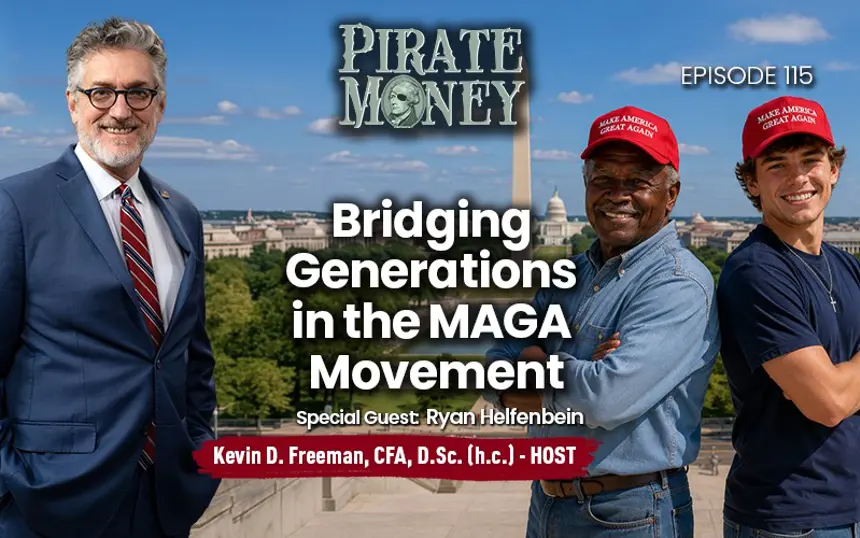
Kevin Freeman: Ahoy, mates. Welcome aboard another voyage of Pirate Money Radio, the show that sails against the storms of fiat tyranny, cultural confusion and division to chart a course toward liberty, security and values built upon biblical truth. I'm your captain, Kevan Freeman, author of Pirate Money, coming to you from the heart of Texas as we sail towards America's 250th birthday. In this episode, we're tackling an important conversation. The differences between Boomer Maga and younger maga, how to find common ground, minister from a Christian perspective and work together for the future of our nation. We've got a great guest, but first let me bring on my long term friend, business partner of 25 years, and today's co host, Mike Carter.
Mike Carter: Kevan, great to be here today. I notice you really get into this pirate theme. The Ahoy, the captain. I know we're going to talk about some generational differences today, but, if you're the captain, I hope I'm not Tenille. Do you remember that?
Kevin Freeman: No, no, we're not.
Mike Carter: Let's make sure we're, we're straight on there.
Kevin Freeman: Yeah. No, the producer says in my ear. Maybe you're Gilligan.
Mike Carter: That hurts.
Kevin Freeman: Yeah, we're all business partners and man, boy, that was harsh, Russell.
Mike Carter: All right, well, well, I know we're going to talk about, generational conversations and how we can stand stronger together. And it's great to have Rhyen here today, but, we won't give you any kind of character type. Rhyen, you're the expert on, standing for freedom. So great to have you here today.
Ryan Helfenbein: Yeah.
Kevin Freeman: And whether you're a boomer, Gen X, millennial or Gen Z, we all want to see America return to her foundations. That's why we're thrilled to have a strong voice who works daily with young people at one of America's largest Christian universities.
What are some of the real tensions between generations in the conservative movement
Mike, before we bring him on though, what are some of the real tensions you're seeing between the generations and the broader conservative movement, have you noticed, picked up this boomer versus younger?
Mike Carter: Yeah, I mean, we're certainly see some of that as it relates to Israel. We see, I think I see a mindset that's a little bit different, from one generation to another. But, I think everybody has some common traits in that we all want to make a difference, we all want to do good. I think on the conservative side, we all want to see America better. We what we're seeing in the polls today on the Democrat side, it's a little bit concerning. People are not proud about America. They don't want to celebrate the 250th anniversary. And I hate for there to be a generational divide of people not understanding that to be a big issue. It's not the unity that we had in 1976. Do you remember that?
Kevin Freeman: Yeah.
Mike Carter: So, a lot of everybody, Democrats and Republicans, proud, now it's kind of like, just depressing.
Kevin Freeman: Yeah, well, true, sadly.
Kevin and Mike welcome Ryan Helfenbein from Give Me Liberty podcast
but speaking of someone who can help bring generations together effectively, we have a special guest sailing with us. He's the vice president. You've already teased him. He's the Vice President of Communications and Public engagement at Liberty University. He's the executive director of the Standing for Freedom center and the host of the Give Me Liberty podcast, our dear friend, Rhyen Helfenbein. Rhyen, welcome aboard the pirate ship. You've been equipping the next generation.
Ryan Helfenbein: Ahoy, Kevan and Mike.
Kevin Freeman: Oh, so glad to have you.
Ryan Helfenbein: Ahoy. It's great to be on with you both. And, that's it.
Ryan Helfenbein: There's apparent division between young and old Americans
I love the theme this morning. what. What more appropriate way, honestly, as we evaluate our 250 years as an. As a nation, we're certainly going to celebrate that. but also just to take an appraisal of what's happening, there's an apparent division, and I will say, we'll talk about this a little bit, but horseshoe theory, I think it's. I think it's real. And that is that there are ideas that have been kind of leftist ideas that have been smuggled into the fake right and are being promoted among the fake right. But these are not conservative principles. And we certainly, need to be aware of those things.
Kevin Freeman: We do. And, you know, I want to just pause for a moment and think about this. Someone that was born at the time that Ben Franklin, when he was in his 80s, it's the constitutional Convention, and they were born that year, could have been alive and passing wisdom to someone born, during literally the Civil War, who could have then that person been alive and passing wisdom to someone born during World War II, who could be alive today, passing wisdom to young people. America is only like three of those 80 years, plus, like, Franklin was in his 80s. If you're 83 and a third years old, it only takes three of them, to get through the entire history of the United States. And there's a lot of wisdom from older people. I'm not sure that I understood that when I was younger. But, there's a lot of wisdom. But there's a lot of wisdom from younger people too, that older people, things change and we need to learn from that. So bridging that divide is important and it's important for the future of our economy. It's important what we do with our money. And there are only three things you can do with your money. You can give it, you can spend it, or you can invest it. Here at Pirate Money Radio, we work to explain solutions that support all three areas in a way that promotes liberty, security and values. Those are the three things I hope young and old are working towards. But Patriot Mobile is a mobile phone company, supports the Pirate Money radio program. Patriot Mobile uses US carriers including AT&T, Verizon and T Mobile, and operates on both Apple and Android phones. More information about the economic war room and Patriot Mobile is [email protected] that's PirateMoneyRadio.com AFR Now, Rhyen, you have, one of the most powerful positions if you're able to influence young people with liberty, security and values. And that's what the standing for Freedom center does with biblical worldview. How do you see the generational unity in the MAGA movement fitting into this bigger picture?
Ryan Helfenbein: You know, I do see that you're going to have unity around these sort of America first principles, things that are going to help to not only secure our country, build a better economy, but also cast a vision for a better future for building families. One of the leading concerns that young people had, young men, especially in the last election, the 2024 election, repelling Republic polling, Republican men under the age of 35 was having a family that came more than economic security, that came more than any of the other political concerns. Can I find a spouse who is not the same sex that I could marry and start a family with and have children and live in a country that is still free and affordable and. But mainly it was the question of marriage. And if you looked at Republican women, marriage and family rated number six of all of the concerns that Republican women had. So there's, there's a gap. And if you polled liberal women, marriage, family was number 13 on their list of concerns. we are dealing with a population right now where the vast majority of people under the age of 40 are single and not married. And this is huge. Elon Musk has said this. We're going to have a demographic collapse if we're not careful. We've got to, obviously we've got to address the immigration issue, the crisis that we have before us with all kinds of foreign born, immigrants in the United States. What do we do about this? But then also recognizing that Roe versus Wade, and then now in the post dobbs era, mifepristone ru 486. We have killed something like 70 million Americans. We have replaced them with foreign born peoples made in the image of God, certainly deserving of dignity, but they are not loyal. They have not assimilated many of them into the United States. And, we've Balkanized this country. So we've killed our children in America and we've replaced them with foreigners. And so all of this is culminating at the same time. But to your broader question, young people, definitely want to have the American dream, starting with a family. That is chief among those concerns.
Kevin Freeman: You know, as you say, that I look in my own life, I've got a daughter that just got married and another daughter that's planning to get married this year. And marriage is high on their priority list, which gets a little expensive if you, you and I both been through this, Mike.
Mike Carter: That was quite an event you had.
Kevin Freeman: It was a beautiful wedding. And spiritual. Beautiful and fun. And you rarely get that, all three in a wedding. But I've got Charlie Kirk's book here, Right Wing Revolution. He was in this studio, you know, a year to the, you know, almost exactly a year to the day before he was killed. And Charlie, made the point you, you should get married young. You should have more kids than you think you can afford and all of that. And, and that's beginning to become pop in America again. But you mentioned demographics. India and China, two of the two largest nations, they're both having a demographic crisis. They're not having many babies. and we're seeing a collapse, in the demographic future for those two countries. We're not seeing it and feeling it as much in the United States, at least in the broad population numbers, because a lot of people are coming here, and so that's masking this underlying. But they're coming from India and China in some cases where they're losing population. Population, yeah.
Mike Carter: And they're coming with a different set of values and not that assimilation. And that's creating, I think, some of this division and confusion we're seeing out there.
Kevin Freeman: Yeah, so. So we've got 58 seconds left before we hit it. Ryan, what are your thoughts? How do, how do we fix this? don't give me the, the full answer. Just tease it, because we'll have to come back after the break.
Ryan Helfenbein: Well, I think it's a combination of things, but I do think one, one of the biggest policies, in this whole demographic collapse issue honestly has to do with the trafficking of the chemical abortion pill. And I know that's among other concerns. But if we dealt with that, and we can talk about it when we come back. But if we dealt with that, I certainly believe that we could address the issue of this collapsing generation.
Kevin Freeman: All right, so we're dealing with a lot of heavy issues here. We're talking about the difference between younger and, and boomer maga. but we're also dealing with the future of America. We're facing our 250th. Will we have 250 more? We'll find out when we come back right after this break.
Ryan Helfenbein: More abortions today due to chemical abortion trafficking
Mike Carter: Welcome back to Pirate Money Radio with your host, Kevan Freeman.
Kevin Freeman: Yeah, we're talking with the great Rhyen Helfenbein from Liberty University. And, Mike is here in studio with me. And Mike, a little dire at the
Mike Carter: end of that, you know, that response surprised me, from Rhyen. The chemical, what did you call it? The chemical abortion trafficking.
Ryan Helfenbein: A chemical abortion. That's right. So right now in the state of Texas, it's illegal to have an abortion unless you have been prescribed mifepristone and a telehealth doctor or an unlicensed medical professional, has shipped that drug, that chemical drug to you. Women can take it, they can take it at home. brick and mortar abortion clinics have been replaced by the. In home bathroom. And, that's the problem. And we actually have more abortions today, tragically, than we did before Roe vs Wade was overturned largely due to chemical abortion.
Kevin Freeman: Yeah, you take a pill and you maybe damage your body permanently because there's a lot of health impacts to it. But at the same time, you eliminate a life and you reduce the population. It's frightening.
Ryan Helfenbein: Yes.
Mike Carter: And I know I'm not the key target demographic, but that's, you know, that's not top of mind for me right now. I'm not, I was aware it was out there, but I'm not thinking of it as being one of the biggest issues like that. More abortions than we had before. Now that this is out there, but the media's not really talking about it.
Ryan Helfenbein: that's exactly right. And so it's being trafficked. The Comstock act, which was passed in the late 1800s, was something that ultimately regulated lewd material. And it's not being enforced in the case of RU486, contraceptives, all of those, you know, paraphernalia, things of that type. And it could be, it actually could be Trump's DOJ is choosing not to do it. but there's a lot of discretion when it comes to something like that. The point is, and I think this is the biggest danger it prevents, it presents a huge public health risk, to the women that actually take it. And that includes hemorrhaging, bleeding out. It's a horrible, horrific thing. But either way, this has huge economic implications when you have a population that is not growing. So most American citizens are having less than two children and they're looking at immigrants to replace those populations. If you look at the World Economic Forum or the United nations, they have generated reports on this United Nations. I spoke with Boris Johnson just this last year, actually. The Boris Johnson? Yes, that one. And, he was talking about this UN paper that was written over 20 years ago. And most European nations have followed that model. That's part of the reason why they've immigrated Islamic, from Islamic nations, people, into, Europe, as the great replacement. And for them, they believe it is of demographic necessity, because if they don't do it, their populations collapse instantly, and they have no one to fill these jobs. And so that's. The United States is following the same model.
Kevin Freeman: You know, I put that in my book, by the way, it's forthcoming. the Four Horsemen of the American Apocalypse and Our Six Trials by Fire will actually feature that union replacement migration paper that, that you're referencing. And the reason that young people are doing this, that they're wanting to abort a lot in large cases. Economic. You mentioned there's an economic long term implication, but the personal implication is I can't afford to have children. I'm not sure that we can afford this right now. So let's put it off. And that's where we get the demographic problem. It literally goes back to sound money, believe it or not. And, that those are the pain
Mike Carter: points that we talk about every day on this show. I mean, you got millennials, Gen Z, feeling like the deck stacked against them. You got skyrocketing housing costs, student debt, student debt. All that stuff is, hitting them because of these fiat money practices. Luckily, we have an economic justice issue, that we can talk a little bit more about.
Kevin Freeman: Yeah, and we'll wrap up this segment and come back and talk further about it. But support for this program comes from Glint. It's a financial technology service offering a debit card and mobile app that enables users to access gold holdings for everyday purchases. With Glint, users maintain ownership of allocated physical gold, which is stored in a managed vault. At the time of a transaction, gold is sold in real time to cover the purchase amount in local currency. Glint offers an alternative way to store and use the value. Combining gold and silver with modern payment infrastructure, Glint clients can monitor their gold balance, view transaction history and manage their account through the Glint app, available on major mobile platforms. More details about how vaulted physical gold can be used as money are [email protected] Gold 247 glentpay.com Goal 247 Glint providing access to gold for modern spending. We're going to cover this and how it impacts young people when we come back right after this break. We'll be right back.
Mike Carter: Pirate Money Radio, helping you give, spend and invest in ways that align with Liberty security and values.
Today we're focusing on Boomer MAGA versus younger maga
Welcome back with your host, Kevan Freeman.
Mike Carter: Yeah.
Kevin Freeman: Ah, and today we're focusing on Boomer MAGA versus younger maga. And we're talking with Rhyen Helfenbein from Liberty University. And Mike, you're here. One of the things that happens is that as you get older, you may have a 401k, you may have got some savings. Inflation may benefit you because you've got stocks or you've got real estate or whatever. Young people are faced with a different challenge. They're faced with, hey, here's your salary. But inflation just erodes that salary. Can I afford to have kids? I'll put it off, put it off, put it off. And in many cases, they're using the abortion pill. And so we have a demographic problem that's been built on that. but you've been in this fight recently and actually for several decades. I sometimes see younger voices pushing for faster change or different tactics on how we address things. How can we find common ground, without compromising our core principles? Rhyen?
Ryan Helfenbein: Well, I think one of the things we have to recognize is that in the United States of America, whether it's boom or MAGA or the younger generation, there are some core principles. There are some core identities that we agree on. The younger generation, does care about the affordability crisis, as you mentioned, the, youngest generation, many of them, I think it's $2 trillion in college debt, higher education, we're seeing the, immigration issue that both boomers have a concern about. And the youngest generation.
Kevin Freeman: Did you say $2 trillion? Two trillion.
Ryan Helfenbein: Two trillion, yeah, with a T. And that's Growing, by the way.
Kevin Freeman: Oh, I'm feeling. My daughter just graduated and so I'm feeling her debt that we're gonna have to pay off her student loans and the two weddings. But I digress. $2 trillion is a lot of money,
Mike Carter: Rhyen M. Even in a world where 40 trillion in debt, the 2 trillion is just new debt coming on to these young people. That's huge.
Ryan Helfenbein: So that you add to that and then you also, you look at the deficit they're starting with. So they're starting with college debt. They're also, as you mentioned, inflation. They're looking, can I afford a home? All of that. Add to it the visa lottery program, H1BS, this great program where there is a lot of grift and fraud, that is being perpetrated by those even overseas. So these programs were, visas are secured by these arbitrage companies located in India. Some of the credentials have come back false. There's been investigations, whistleblowers, kind of a similar Nick Shirley type situation where people have said, hey, look, in India, we're not getting college educated MBAs that are coming from Calcutta, into the United States. In fact, some of these are very fraudulent. And then they come into the United States to work for some of these companies. And instead of, instead of placing an American citizen and a student who just graduated, let's say from, I don't know, University of Texas at Austin or Oklahoma University, University of Oklahoma, they are instead being replaced by workers, that are coming from overseas. And young people, young people feel betrayed by that. In particular, young, people are concerned about that. The older generation is concerned about immigration. From a security standpoint, when you think about terrorism, when you think about national security, it's a big deal. Young people are saying, hey, it's hurting me because I don't have professional opportunities or economic opportunities to climb out of this debt bubble because I don't have a job. So that's, that's one area I'd say both sides agree on. And it's something that absolutely has to be addressed if we're going to get economic security.
Mike Carter: You know, Kevan, I had a lot of young adults out at the ranch this weekend with my daughter. And that was one of the common themes. Kids that had just gotten out of college, I say kids, young adults just out of college looking for jobs. It's like, man, I thought I had it. I thought I had it. they told me that I really liked me and then I didn't get the job. And you know, just starting out of school. That's crushing.
Kevin Freeman: It sounds familiar, though. When we came out of school in the early 80s, in the recession, out of college, it was a tough environment then as well.
Mike Carter: of course, the difference was, you know, average house price was like around 100,000, 110,000. Interest rates were 9%. But now we got interest rates creeping up, but the average home price up so much dramatically, you start looking at these numbers and you can see why the younger generation feels like, man, this is a big hill to climb just to get to where I can have a family.
Kevin Freeman: And yet the media is telling them the economy's good, you know, and everything's good, and young people aren't feeling the benefit of that, which is sad. Alright, we're going to need to take another break. when we come back, those are some of the common themes that we see between boomer and younger maga. What are some of the differences we're going to challenge? Rhyen Helvenbein from Liberty University. How do we find a Christian perspective and generational unity? We'll cover it right after the break.
Pirate Money Radio discusses generational divide
Mike Carter: Welcome to Pirate Money Radio with your host, Kevan Freeman, helping you unpack the economic headlines and providing real money solutions.
Kevin Freeman: If you're listening today, you're understanding that we're talking about generational divide. our audience here on American Family Radio, we've got both young and old. I'll speak first to the one that's more closer to my generation, the boomer. I'm at the tail end, as is Mike, at the tail end of the Boomer generation. Look, we're wondering what's wrong with these young people. Why aren't they getting married and having kids and stuff? And the reality of it is they face a very challenging, economic environment. They're having difficulty coming out of college. They've invested a lot of money, borrowed a lot of money from the government and invested a lot of money to get started. And now they're facing student debt. They're facing $2 trillion. Rhyen told us $2 trillion in student debt. They're facing challenges. Can I get a job in the workplace now? Rhyen, you're at Liberty University. Your students have a benefit. There's a whole network of Liberty people. You give them a good, solid Christian education, do all these really good things for young people, and you make it more affordable. But, you know, these are real problems.
Ryan Helfenbein: Yeah, 100%. And I will just say, one of the things that Liberty has done for many years is that even as we have made education more cost effective, more Efficient. And as inflation has gone up, raising, the price of education for a number of successive years, both on our residential and online, we have frozen tuition pricing, more recently. It's because of just, coming out of those Biden years and Bidenflation, into the new Trump economy. we've, we've only recently had to raise prices on, tuition just to keep up with some of the growth in cost and overhead. But overall, we're one of the most affordable private institutions that is not receiving tax subsidies from the state. And that's really, really important that people understand when you're choosing a private education, it can be expensive. but when you look at the total cost of education, my goodness, Liberty, has, has done a lot to make it affordable for our students.
Kevin Freeman: Well, and you have a solid biblical Christian worldview, which I admire and respect. And one of my daughters is a proud graduate from Liberty, and, happy to say that. But there is a divide that's emerging. You felt it, Mike. You know what that divide is between, you know, our generation. We were taught a certain thing about eschatology, the end times and everything else. are you seeing that with young people? Are you seeing a difference, on their attitude towards Israel?
Mike Carter: That's definitely one. and surprising. I guess it's not surprising because we hear, thought leaders in the conservative movement who are directly, countering that, because of either sponsorships or different narratives that are coming out there. And I think, certainly that generation seems to be confused by it. What can we do as boomers, Rhyen? to try, and help crook the path or give them insights on this. Ah. What's a credible way to have that conversation?
Ryan Helfenbein: Well, I think a couple of things are converging at the same time. And listen, I've had conversations even with Erica Kirk about this. yes, that. Erica Kirk, about the concern about online narratives. These online narratives are coming from all directions, not the least of which we understand. And I'm not going to name the person, but these narratives, many of them are false and it's verifiably false, and yet a lot of people will believe it. And I think the concern when you see young people engaging on social media is, you know, you hear things, you see artificial intelligence, and it's generative and it can hallucinate and, and it can also, it can oftentimes give you false research, and even cite, give false citations for that research. M. You know, we have to be aware, that not everything that we see online or not Everything that we read online, whether it be TikTok or, X or Instagram, not all of that is real. and it's not just the fake videos that you see, but it's also the way in which news and information is being reported. And so that's a concern. That's a concern. When it comes to the youngest generation. You mentioned Israel. A lot of young people did not grow up in the church. In fact, it's greater than one third of Gen Z, has not attended a church service even once in their life. and some of them are already adult age. And I mean even Easter or Christmas have not attended church whatsoever. Their exposure is next to nil. If they know anything about the Bible, it might have been something that they saw either on the History Channel or watching, you know, scrolling doom scrolling through social media or something that their public school teacher might have told them. In any of those cases, I guarantee you fellas, it ain't good. and so it's a cynical view. And because of that, I don't think there's any sort of biblical grounding or appreciation, just for how significant the modern state of Israel is, and how it fulfills many of our eschatological expectations, coming right out of Scripture. So when it comes to foreign policy right now, you have a lot of boomers right now, who certainly have a great deal of consideration for the modern state of Israel. Benjamin Netanyahu, the younger generation is looking at a lot through the lens of, hey, I do kind of recall, these forever wars and going to Afghanistan and Iraq, what is it with Iran? What is it with Israel? And why should we care about that? We can't afford housing. I've got, we got credit, card debt, we've got education debt, college debt, why should we care about things over there? When things are falling apart in my life right here in the United States, that's where you're seeing drift.
Mike Carter: That's exactly what I heard from some of these younger people that I was talking to as well. you know, what's the biblical perspective that can bring unity? What's the key there?
Ryan Helfenbein: Well, I think it's important.
Kevin Freeman: Both boomers and younger generation need to address Israel priorities
This is one thing that, I think both boomers and I think the younger generation, both are going to have to kind of meet in the middle on this. I think there were times in which undue consideration sometimes was giving, I mean, given to maybe the modern state of Israel in some respect. And I want to be very careful and be very clear on what I Mean, I am talking about the Knesset. I am talking about, you know, the modern government, a secular government made up of Islam, made up of non, believing Jews, made up of Christians. It's a government, it's a modern state. the modern state of Israel and biblical Israel are not identical with one another. The biblical Israel of scripture and the modern state of Israel. But I've often held as theologically they are coterminous with one another. Israel is important, but, it is not more important, for an American citizen, to be considering Israel than even the nation that God has planted them in. God cares about Israel. He cares also about the United States. The United States of America is a legitimate nation. And we need to be as Americans, we need to be putting America first. that does not mean Israel last. but in terms of our prioritization, we do need to care about the place that we call home and where God has planted us as Christians. We got to care about that. Younger people tend to have a better sense of those loyalties sometimes, and they're calling into question, you know, I worship in a strip mall. My church is in this dilapidated building. We don't got much. We don't even have stained glass. You know, our pastor says we can't afford that stuff. and yet we're trying to send money and aid overseas. Now, some of that information is wrong. That's through the lens of cynicism. But younger people are seeing it and they're saying, why do we care more about a place we've never visited than the place we call home? And that is a great question. And that's an important question. Now, we've done studies on this, we've talked about at the Give Me Liberty podcast. You know, we don't send much aid to Israel compared to other nations. If you look at Ukraine, we could fund the aid we send to Israel for the next 50 years based on the money we've already sent to Ukraine in the past three. So we only send about $3.9 billion a year. And guess what, Kevan? Mike, they are actually buying the Turning right back around and buying American made manufacturing products, munitions, especially military equipment with that money. And in some cases, they're actually making improvements upon it. so I know I'm kind of an echo boomer. I'm right in the middle. I'm a millennial, but I'm a grandpa millennial by age. but I'm seeing this and saying, hey, there's a lot of things that the boomers understand correctly. And I can say this younger generation is not quite incorrect with the questions that they're asking. We just haven't had to answer them before.
Kevin Freeman: So what I hear you saying is Israel as a nation is not perfect and we don't have to sit and set it aside, which is something that's happened in the church before. Oh, no. This is God's chosen people and we have to therefore support everything they do. That's not true. But they're also not the source of all evil in the world. And yet if you look at some of the memes, you'll see, well, Jeffrey Epstein and, and all of that. And that is where I see young people. That's the divide. And what you're saying is we bring them together and say, look, Israel is a nation. There is a, biblical view of Israel, but it doesn't mean it's a perfect nation. It's not something we have to set aside everything else to serve Israel. That's not our place. At the same time, we can't blame them for all the ills happening in the world. That actually gets into anti Semitism if you start blaming them for everything going wrong everywhere. All right, we've got a great conversation going with Rhyen Helfenbein of, Liberty University, and we're talking about the boomer younger divide in maga. We'll cover this and more after the break.
Mike Carter: Welcome back to Pirate Money Radio with your host, Kevan Freeman.
Kevin Freeman: Yeah, we're talking with, Rhyen Helfenbein. I've got Mike Carter here in studio with me, and Mike's been traveling quite a bit. but Rhyen, you've been at Liberty University for a while now. Even in your time there, have you noticed significant shifts in how students think about issues like Israel, foreign policy and cultural matters? I mean, you've been there how many years and has there been a change in attitudes?
Ryan Helfenbein: I've been here. Yeah, I've been here seven years. Let me say this. I want to affirm something that I witnessed and that was the heart of our students. Just the outpouring of love, grief, sorrow, affection. when we all witnessed, we were shocked and horrified to see what happened on October 7, 2023. And, the students at Liberty University with one heart, were praying for Israel, the victims of that horror of horrific terrorist attack that was carried out by Hamas members of mosque from Palestine. There. There was not a single student, that was not on the same side of this issue. but I think there is something that we're seeing, though. Some folks, will Understand this, especially if you live in the Dallas area and you've grown up in the evangelical church, there's kind of the rise and the fall of dispensationalism. And as dispensationalism, you know, I grew up in the Dallas area. It dominated seminaries across the country. Just a way of doing eschatology and biblical hermeneutics. and, and, and, and I have so much profound respect for the pastors and the theologians that taught me. But there is a waning influence of dispensationalism, particularly on eschatology. I want to be clear. This is not about how somebody gets saved. This is not about the doctrine of the Trinity, Father, Son, Holy Spirit, the identity of who God is. This is about the kinds of things that churches have disagreed on in a friendly way in the past.
Kevin Freeman: There's different theology here. So dispensationalism isn't going to be easy. So I'm going to dispense with that, and I'm done with it. People don't necessarily understand. Dive a little bit. What you're talking about is, is Jesus coming back and is there a rapture, and when does it happen? That's what you're talking about.
Ryan Helfenbein: Right, right. I am, I am. And if you grew up with it, you might have heard, hey, not only is he coming in our lifetime, he's coming. He could. He's coming this year. and the year passes. And then, Kevan, you're kind of told again, no, but it's going to happen this year. And we know it's imminent because we're reading the headlines that are out of the Middle East. And so we know that it's going to be this year, and then that year passes, and then the same thing the following year. We believe because the Scripture teaches in the imminent, return of Christ, it's imminent, meaning we got to be prepared for it. Occupy until I return is what the Master says in Jesus's parable. We, we know that it's imminent, but it may not be immediate. And it's important to understand that we have jobs to do. We have a responsibility. We don't want to just all of a sudden dismiss. With all of the present struggles that we're with, we don't want to be irresponsible. There's a reason to invest. Martin Luther, the great reformer, was once asked, what would you do if Jesus came back tomorrow? You know what his response was? He said, I would plant a tree, meaning that I would still be busied and hurried about doing the things that matter for the long term. And so I think there has been an inordinate focus and obsession with a kind of eschatology that has had some Americans, older generation, thinking more about Israel than about the tree in their backyard, thinking more about what's happening overseas, looking more to the east than into the own towns and public schools. Yeah, and so that's that. That's what we have to understand. There needs to be a balancing effect. And I think some people are coming back to the reality of, hey, you know what? Many of our faithful forebears, we have already buried and the Rapture hasn't happened yet. Maybe if the Lord tarries the next 3,000 years, I better be getting busy and rolling up my sleeves and doing something to save the country that God has placed me in. I have a burden to do that. I should be doing that. I think young people are seeing that very clearly as America M is being hollowed out right now.
Kevin Freeman: Yeah, I think you've nailed it. That is the divide right there. So as you get older, as you've noticed, Rhyen and Mike, you and I have noticed, especially as you get older, you think, well, what's going to be my legacy? What am I leaving behind? And you think, well, Jesus has got to be coming. And, older people I know said, he's going to come in my lifetime. I know it. And younger people are saying, wait, I've got a whole future here. I don't need to spend my whole time worrying about Jesus coming. So that is a big divide happening in maga, and that's something we bridge because we have the word of God, we have his truth and the promises of Jesus. Those will be the things that bring us together. We'll take another break. We'll come right back with Rhyen Helfenbein of Liberty University. After this break,
Mike Carter: Pirate Money Radio, helping you give, spend and invest in ways that align with liberty, security and values.
Kevin Freeman: How do we encourage younger generations as we get older
Welcome back with your host, Kevan Freeman.
Kevin Freeman: Hey, Mike, I think I've gotten new insight. I mean, we're approaching the 250th birthday, and if you told me that when I was younger, just coming out of college at 250, that's such a long time. But I realize, you and I have lived about a quarter of the nation, and my father lived about a third of the life of the nation when he passed. Your father's still living and about a third of the life of the nation. and so we have differing perspectives as we get older, but Rhyen Helvenbein here has shared with us some really interesting things, about a perspective on the return of Jesus that determines maybe a difference between older and younger maga. Our attitude towards Israel, our attitude towards economics, and so many different things. What are your thoughts?
Mike Carter: Well, I remember when I was younger, not that I'm getting old, you know, on that baby boomer thing, I'm right. I'm almost to that.
Kevin Freeman: you are at the tail end of the baby boom with me.
Mike Carter: But I do remember, even back then, everybody saying, oh, the Lord's going to return. I'm like, I got a life I want to live still. I got things I want. I want to have a family. I want to do these things. And we know the Lord is going to return, but he's got a plan for each and every one of us. But. But it was interesting to me when we had that group of young adults here, and I saw that with age, you have wisdom and the things that they're concerned about or stressed out about, are, in the scheme of things, not that big a deal. We've been through that. I don't have a job, or I just lost my job, or I don't know how I'm going to pay for this. When you go through enough of those cycles, you realize that's not the end of the world. And God has the plan. And so, Rhyen, how do we, as adults, not as adults.
Kevin Freeman: How do we.
Mike Carter: I'm the old guy now. How do we, as older people, really take the knowledge and wisdom that we've gotten through living life and seeing what God does to help encourage that younger generation? And for me, having a small group that I just got together with for the first time my daughter's involved with, I was like, wow, part of me, my heart just bled for them and what they're feeling like, you know, it's not quite what you think. It's really a good life ahead. how do we merge that gap?
Ryan Helfenbein: Well, you're asking the right question. I mean, look, there's a Titus model. Older men, older women need to be discipling younger men and younger women. But I think the first thing you need to say is, look, number one, you're not alone. You're not alone. None, of us are. we have each other. This is why we have the church. This is why we have the communion of saints. this is why, you know, we have shows like this to say, hey, you're not alone. There's resources, too, and a way forward. But the second one, I Want to say is this, by the way, God, is present and he hasn't abandoned you. Buck up. Hey, like, it's, it's not the end of the world. Quit, crying. Nobody go crying in their milk. there's work to do. there's no time to sob or woe is me. we do need to buck up a little bit. there was always been this American optimism, going back, through some of the hardest of times. I think about my great grandparents generation who lived through the Great Depression. That optimism, however, was not built upon some kind of quasi American greatness. American this or American that. Hey, it was based on. I'm a Christian. I know God is in charge. And at the end of the day, a sparrow doesn't fall from the tree without his notice. He's going to care for me. That's where that optimism comes from. That hope is in Jesus Christ. Put your hope in him, all right? Not our government. Government's going to come and go, right? Generations will come and go. Put your hope in Jesus Christ. That's the most important thing. And then have a plan. You guys have an economic strategy. You have, an economic war plan. And I would encourage people to look into that and invest there. That's really, really important. Make a pledge. I'm going to do something with my life and I'm going to get to work. I ain't going to complain. I'm going to trust in the Lord. I'm going to buck up.
Kevin Freeman: Well, let's take the Wesleyan view of this, M. Make all you can give or save all you can, and give all you can in terms of money. That's what people. It all comes down to money so many times. Well, I don't have enough money for this. And that's where despair comes in. Oftentimes that's where you start blaming other people for the problems. And here's the piece of advice Jon Wesley gave it. Make as much as you can. Make money. It's a free market. Save all you can and invest that and then give all you can because you're just stewards. God's given all of this. So we're going to talk about, one more thing when we come back from one more break. But if you're with Real Life Network, we're going to have to say goodbye here. Thank you, Mike, for, for sailing with us. Thank you, Rhyen, for sailing with us. visit PirateMoneyRadio.com to learn more about this. All right, if you're staying with us on afr, Hang in there. We've got one more final wrap up with Rhyen Helfenbein of Liberty University and Mike Carter and Pirate Money Radio.
Kevin Freeman: What gives you hope for the future of our country
Mike Carter: Welcome back to Pirate Money Radio with your host, Kevan Freeman.
Kevin Freeman: I'm joined by Mike Carter and Rhyen Helfenbein. Rhyen, you've seen this movement from many angles. The good, the challenges, the opportunities. What gives you hope for the future of our country as we watch different generations come together?
Ryan Helfenbein: You know, I'm reminded, and you and I have had discussion about this, but I'm reminded of Josiah. You know, there's a young generation that is going to rediscover the word of God, and many have already have. And when they come to that discovery, all of a sudden you, have revival, you have a awakening. you have people who are now believing and confessing Jesus Christ as Lord Jesus. And that is what honestly makes America great. That is what gave birth to our nation. And I think that is going to be instrumental. the gospel of Jesus Christ in awaking will be instrumental in giving us a new birth of freedom. That's what gives me hope, honestly, is seeing young people coming to Liberty University, many of them coming for the first time and just seeing that glimmer, that sparkle in their eye. They are not necessarily looking at the world as this is. Oh, this is doomerism. Oh, no. Who's going to save us? No, they trust in Jesus, and I love seeing that. And something else. Kevan. Mike, they arrive just on time. We have an on time God. And when we sometimes feel like all hope is lost, Demographics are collapsing. Oh, no, the dollar is shrinking. We can't afford this or that. Listen, God is always on time. And so I'm seeing new arrivals of new students, fresh, fresh hearts, fresh minds with a great love for Jesus. and that gives me hope.
Kevin Freeman: All right, so where do people follow you, for Standing for Freedom Center?
Ryan Helfenbein: Yeah. So, if you're online, it's at Freedom Center Lu. At Freedom Center Lu. Or if you got. If you're a boomer, you're gonna go to the website WW Standing for Freedom. We're on X. we're on Instagram, and, we've got a Theology of Politics series, just how to think biblically, faithfully as Christians about these different political issues. You can follow our podcast, on Apple, itunes, as well as Spotify. That's where I usually go is Spotify, and that's the Give Me Liberty podcast.
Kevin Freeman: that's great. Thank you, Rhyen.
Mike was encouraged by young people at his daughter's wedding this week
Mike, do you have any final thoughts
Mike Carter: for the week, just as Rhyen said, young hearts, young minds. I was so encouraged with this youth, young adult group that came out, today and how sharp they were, and the potential that they have ahead in their lives and being able to give back into that. I was like, you know, it was refreshing for me as an older adult to say, you know, it's good to be around young folks and help encourage and hear the visions they have and the new ideas they have and where they're going with this.
Kevin Freeman: Yeah, no, I was encouraged. the wedding party, our daughter's wedding, both the groomsmen and the bridesmaids. I'm like, these guys are guys and gals are so brilliant and so ahead of it. They love Jesus. They're passionate about their faith. It's incredible. And, you know, they. Many of them went to Belhaven University, which is Christian school, and my other daughter went to Liberty University. And so there were some Liberty grads there as well. It's just incredibly encouraging.
Kevin Freeman: We need to be praying for America right now
All right, if you have questions, if you have prayer needs, if you have comments, email [email protected] and we need to be praying for America. We need to be praying for the world to return to God's principles. Pray for unity across generations in the church and in our nation. We need to be praying for our veterans. We need to be praying for America. We're celebrating 250. Listen. Wherever you get your podcasts, Apple, Spotify, and so forth, share this with your friends and check out PirateMoneyRadio.com. this is Kevan Freeman. Mike Carter.
Kevin Freeman: Pirate Money Radio tackles generational conversations ahead of 250th birthday
Kevin Freeman: Ahoy, mates. Welcome aboard another voyage of Pirate Money Radio, the show that sails against the storms of fiat tyranny, cultural confusion and division to chart a course toward liberty, security and values built upon biblical truth. I'm your captain, Kevan Freeman, author of Pirate Money, coming to you from the heart of Texas as we sail towards America's 250th birthday. In this episode, we're tackling an important conversation. The differences between Boomer Maga and younger maga, how to find common ground, minister from a Christian perspective and work together for the future of our nation. We've got a great guest, but first let me bring on my long term friend, business partner of 25 years, and today's co host, Mike Carter.
Mike Carter: Kevan, great to be here today. I notice you really get into this pirate theme. The Ahoy, the captain. I know we're going to talk about some generational differences today, but, if you're the captain, I hope I'm not Tenille. Do you remember that?
Kevin Freeman: No, no, we're not.
Mike Carter: Let's make sure we're, we're straight on there.
Kevin Freeman: Yeah. No, the producer says in my ear. Maybe you're Gilligan.
Mike Carter: That hurts.
Kevin Freeman: Yeah, we're all business partners and man, boy, that was harsh, Russell.
Mike Carter: All right, well, well, I know we're going to talk about, generational conversations and how we can stand stronger together. And it's great to have Rhyen here today, but, we won't give you any kind of character type. Rhyen, you're the expert on, standing for freedom. So great to have you here today.
Ryan Helfenbein: Yeah.
Kevin Freeman: And whether you're a boomer, Gen X, millennial or Gen Z, we all want to see America return to her foundations. That's why we're thrilled to have a strong voice who works daily with young people at one of America's largest Christian universities.
What are some of the real tensions between generations in the conservative movement
Mike, before we bring him on though, what are some of the real tensions you're seeing between the generations and the broader conservative movement, have you noticed, picked up this boomer versus younger?
Mike Carter: Yeah, I mean, we're certainly see some of that as it relates to Israel. We see, I think I see a mindset that's a little bit different, from one generation to another. But, I think everybody has some common traits in that we all want to make a difference, we all want to do good. I think on the conservative side, we all want to see America better. We what we're seeing in the polls today on the Democrat side, it's a little bit concerning. People are not proud about America. They don't want to celebrate the 250th anniversary. And I hate for there to be a generational divide of people not understanding that to be a big issue. It's not the unity that we had in 1976. Do you remember that?
Kevin Freeman: Yeah.
Mike Carter: So, a lot of everybody, Democrats and Republicans, proud, now it's kind of like, just depressing.
Kevin Freeman: Yeah, well, true, sadly.
Kevin and Mike welcome Ryan Helfenbein from Give Me Liberty podcast
but speaking of someone who can help bring generations together effectively, we have a special guest sailing with us. He's the vice president. You've already teased him. He's the Vice President of Communications and Public engagement at Liberty University. He's the executive director of the Standing for Freedom center and the host of the Give Me Liberty podcast, our dear friend, Rhyen Helfenbein. Rhyen, welcome aboard the pirate ship. You've been equipping the next generation.
Ryan Helfenbein: Ahoy, Kevan and Mike.
Kevin Freeman: Oh, so glad to have you.
Ryan Helfenbein: Ahoy. It's great to be on with you both. And, that's it.
Ryan Helfenbein: There's apparent division between young and old Americans
I love the theme this morning. what. What more appropriate way, honestly, as we evaluate our 250 years as an. As a nation, we're certainly going to celebrate that. but also just to take an appraisal of what's happening, there's an apparent division, and I will say, we'll talk about this a little bit, but horseshoe theory, I think it's. I think it's real. And that is that there are ideas that have been kind of leftist ideas that have been smuggled into the fake right and are being promoted among the fake right. But these are not conservative principles. And we certainly, need to be aware of those things.
Kevin Freeman: We do. And, you know, I want to just pause for a moment and think about this. Someone that was born at the time that Ben Franklin, when he was in his 80s, it's the constitutional Convention, and they were born that year, could have been alive and passing wisdom to someone born, during literally the Civil War, who could have then that person been alive and passing wisdom to someone born during World War II, who could be alive today, passing wisdom to young people. America is only like three of those 80 years, plus, like, Franklin was in his 80s. If you're 83 and a third years old, it only takes three of them, to get through the entire history of the United States. And there's a lot of wisdom from older people. I'm not sure that I understood that when I was younger. But, there's a lot of wisdom. But there's a lot of wisdom from younger people too, that older people, things change and we need to learn from that. So bridging that divide is important and it's important for the future of our economy. It's important what we do with our money. And there are only three things you can do with your money. You can give it, you can spend it, or you can invest it. Here at Pirate Money Radio, we work to explain solutions that support all three areas in a way that promotes liberty, security and values. Those are the three things I hope young and old are working towards. But Patriot Mobile is a mobile phone company, supports the Pirate Money radio program. Patriot Mobile uses US carriers including AT&T, Verizon and T Mobile, and operates on both Apple and Android phones. More information about the economic war room and Patriot Mobile is [email protected] that's PirateMoneyRadio.com AFR Now, Rhyen, you have, one of the most powerful positions if you're able to influence young people with liberty, security and values. And that's what the standing for Freedom center does with biblical worldview. How do you see the generational unity in the MAGA movement fitting into this bigger picture?
Ryan Helfenbein: You know, I do see that you're going to have unity around these sort of America first principles, things that are going to help to not only secure our country, build a better economy, but also cast a vision for a better future for building families. One of the leading concerns that young people had, young men, especially in the last election, the 2024 election, repelling Republic polling, Republican men under the age of 35 was having a family that came more than economic security, that came more than any of the other political concerns. Can I find a spouse who is not the same sex that I could marry and start a family with and have children and live in a country that is still free and affordable and. But mainly it was the question of marriage. And if you looked at Republican women, marriage and family rated number six of all of the concerns that Republican women had. So there's, there's a gap. And if you polled liberal women, marriage, family was number 13 on their list of concerns. we are dealing with a population right now where the vast majority of people under the age of 40 are single and not married. And this is huge. Elon Musk has said this. We're going to have a demographic collapse if we're not careful. We've got to, obviously we've got to address the immigration issue, the crisis that we have before us with all kinds of foreign born, immigrants in the United States. What do we do about this? But then also recognizing that Roe versus Wade, and then now in the post dobbs era, mifepristone ru 486. We have killed something like 70 million Americans. We have replaced them with foreign born peoples made in the image of God, certainly deserving of dignity, but they are not loyal. They have not assimilated many of them into the United States. And, we've Balkanized this country. So we've killed our children in America and we've replaced them with foreigners. And so all of this is culminating at the same time. But to your broader question, young people, definitely want to have the American dream, starting with a family. That is chief among those concerns.
Kevin Freeman: You know, as you say, that I look in my own life, I've got a daughter that just got married and another daughter that's planning to get married this year. And marriage is high on their priority list, which gets a little expensive if you, you and I both been through this, Mike.
Mike Carter: That was quite an event you had.
Kevin Freeman: It was a beautiful wedding. And spiritual. Beautiful and fun. And you rarely get that, all three in a wedding. But I've got Charlie Kirk's book here, Right Wing Revolution. He was in this studio, you know, a year to the, you know, almost exactly a year to the day before he was killed. And Charlie, made the point you, you should get married young. You should have more kids than you think you can afford and all of that. And, and that's beginning to become pop in America again. But you mentioned demographics. India and China, two of the two largest nations, they're both having a demographic crisis. They're not having many babies. and we're seeing a collapse, in the demographic future for those two countries. We're not seeing it and feeling it as much in the United States, at least in the broad population numbers, because a lot of people are coming here, and so that's masking this underlying. But they're coming from India and China in some cases where they're losing population. Population, yeah.
Mike Carter: And they're coming with a different set of values and not that assimilation. And that's creating, I think, some of this division and confusion we're seeing out there.
Kevin Freeman: Yeah, so. So we've got 58 seconds left before we hit it. Ryan, what are your thoughts? How do, how do we fix this? don't give me the, the full answer. Just tease it, because we'll have to come back after the break.
Ryan Helfenbein: Well, I think it's a combination of things, but I do think one, one of the biggest policies, in this whole demographic collapse issue honestly has to do with the trafficking of the chemical abortion pill. And I know that's among other concerns. But if we dealt with that, and we can talk about it when we come back. But if we dealt with that, I certainly believe that we could address the issue of this collapsing generation.
Kevin Freeman: All right, so we're dealing with a lot of heavy issues here. We're talking about the difference between younger and, and boomer maga. but we're also dealing with the future of America. We're facing our 250th. Will we have 250 more? We'll find out when we come back right after this break.
Ryan Helfenbein: More abortions today due to chemical abortion trafficking
Mike Carter: Welcome back to Pirate Money Radio with your host, Kevan Freeman.
Kevin Freeman: Yeah, we're talking with the great Rhyen Helfenbein from Liberty University. And, Mike is here in studio with me. And Mike, a little dire at the
Mike Carter: end of that, you know, that response surprised me, from Rhyen. The chemical, what did you call it? The chemical abortion trafficking.
Ryan Helfenbein: A chemical abortion. That's right. So right now in the state of Texas, it's illegal to have an abortion unless you have been prescribed mifepristone and a telehealth doctor or an unlicensed medical professional, has shipped that drug, that chemical drug to you. Women can take it, they can take it at home. brick and mortar abortion clinics have been replaced by the. In home bathroom. And, that's the problem. And we actually have more abortions today, tragically, than we did before Roe vs Wade was overturned largely due to chemical abortion.
Kevin Freeman: Yeah, you take a pill and you maybe damage your body permanently because there's a lot of health impacts to it. But at the same time, you eliminate a life and you reduce the population. It's frightening.
Ryan Helfenbein: Yes.
Mike Carter: And I know I'm not the key target demographic, but that's, you know, that's not top of mind for me right now. I'm not, I was aware it was out there, but I'm not thinking of it as being one of the biggest issues like that. More abortions than we had before. Now that this is out there, but the media's not really talking about it.
Ryan Helfenbein: that's exactly right. And so it's being trafficked. The Comstock act, which was passed in the late 1800s, was something that ultimately regulated lewd material. And it's not being enforced in the case of RU486, contraceptives, all of those, you know, paraphernalia, things of that type. And it could be, it actually could be Trump's DOJ is choosing not to do it. but there's a lot of discretion when it comes to something like that. The point is, and I think this is the biggest danger it prevents, it presents a huge public health risk, to the women that actually take it. And that includes hemorrhaging, bleeding out. It's a horrible, horrific thing. But either way, this has huge economic implications when you have a population that is not growing. So most American citizens are having less than two children and they're looking at immigrants to replace those populations. If you look at the World Economic Forum or the United nations, they have generated reports on this United Nations. I spoke with Boris Johnson just this last year, actually. The Boris Johnson? Yes, that one. And, he was talking about this UN paper that was written over 20 years ago. And most European nations have followed that model. That's part of the reason why they've immigrated Islamic, from Islamic nations, people, into, Europe, as the great replacement. And for them, they believe it is of demographic necessity, because if they don't do it, their populations collapse instantly, and they have no one to fill these jobs. And so that's. The United States is following the same model.
Kevin Freeman: You know, I put that in my book, by the way, it's forthcoming. the Four Horsemen of the American Apocalypse and Our Six Trials by Fire will actually feature that union replacement migration paper that, that you're referencing. And the reason that young people are doing this, that they're wanting to abort a lot in large cases. Economic. You mentioned there's an economic long term implication, but the personal implication is I can't afford to have children. I'm not sure that we can afford this right now. So let's put it off. And that's where we get the demographic problem. It literally goes back to sound money, believe it or not. And, that those are the pain
Mike Carter: points that we talk about every day on this show. I mean, you got millennials, Gen Z, feeling like the deck stacked against them. You got skyrocketing housing costs, student debt, student debt. All that stuff is, hitting them because of these fiat money practices. Luckily, we have an economic justice issue, that we can talk a little bit more about.
Kevin Freeman: Yeah, and we'll wrap up this segment and come back and talk further about it. But support for this program comes from Glint. It's a financial technology service offering a debit card and mobile app that enables users to access gold holdings for everyday purchases. With Glint, users maintain ownership of allocated physical gold, which is stored in a managed vault. At the time of a transaction, gold is sold in real time to cover the purchase amount in local currency. Glint offers an alternative way to store and use the value. Combining gold and silver with modern payment infrastructure, Glint clients can monitor their gold balance, view transaction history and manage their account through the Glint app, available on major mobile platforms. More details about how vaulted physical gold can be used as money are [email protected] Gold 247 glentpay.com Goal 247 Glint providing access to gold for modern spending. We're going to cover this and how it impacts young people when we come back right after this break. We'll be right back.
Mike Carter: Pirate Money Radio, helping you give, spend and invest in ways that align with Liberty security and values.
Today we're focusing on Boomer MAGA versus younger maga
Welcome back with your host, Kevan Freeman.
Mike Carter: Yeah.
Kevin Freeman: Ah, and today we're focusing on Boomer MAGA versus younger maga. And we're talking with Rhyen Helfenbein from Liberty University. And Mike, you're here. One of the things that happens is that as you get older, you may have a 401k, you may have got some savings. Inflation may benefit you because you've got stocks or you've got real estate or whatever. Young people are faced with a different challenge. They're faced with, hey, here's your salary. But inflation just erodes that salary. Can I afford to have kids? I'll put it off, put it off, put it off. And in many cases, they're using the abortion pill. And so we have a demographic problem that's been built on that. but you've been in this fight recently and actually for several decades. I sometimes see younger voices pushing for faster change or different tactics on how we address things. How can we find common ground, without compromising our core principles? Rhyen?
Ryan Helfenbein: Well, I think one of the things we have to recognize is that in the United States of America, whether it's boom or MAGA or the younger generation, there are some core principles. There are some core identities that we agree on. The younger generation, does care about the affordability crisis, as you mentioned, the, youngest generation, many of them, I think it's $2 trillion in college debt, higher education, we're seeing the, immigration issue that both boomers have a concern about. And the youngest generation.
Kevin Freeman: Did you say $2 trillion? Two trillion.
Ryan Helfenbein: Two trillion, yeah, with a T. And that's Growing, by the way.
Kevin Freeman: Oh, I'm feeling. My daughter just graduated and so I'm feeling her debt that we're gonna have to pay off her student loans and the two weddings. But I digress. $2 trillion is a lot of money,
Mike Carter: Rhyen M. Even in a world where 40 trillion in debt, the 2 trillion is just new debt coming on to these young people. That's huge.
Ryan Helfenbein: So that you add to that and then you also, you look at the deficit they're starting with. So they're starting with college debt. They're also, as you mentioned, inflation. They're looking, can I afford a home? All of that. Add to it the visa lottery program, H1BS, this great program where there is a lot of grift and fraud, that is being perpetrated by those even overseas. So these programs were, visas are secured by these arbitrage companies located in India. Some of the credentials have come back false. There's been investigations, whistleblowers, kind of a similar Nick Shirley type situation where people have said, hey, look, in India, we're not getting college educated MBAs that are coming from Calcutta, into the United States. In fact, some of these are very fraudulent. And then they come into the United States to work for some of these companies. And instead of, instead of placing an American citizen and a student who just graduated, let's say from, I don't know, University of Texas at Austin or Oklahoma University, University of Oklahoma, they are instead being replaced by workers, that are coming from overseas. And young people, young people feel betrayed by that. In particular, young, people are concerned about that. The older generation is concerned about immigration. From a security standpoint, when you think about terrorism, when you think about national security, it's a big deal. Young people are saying, hey, it's hurting me because I don't have professional opportunities or economic opportunities to climb out of this debt bubble because I don't have a job. So that's, that's one area I'd say both sides agree on. And it's something that absolutely has to be addressed if we're going to get economic security.
Mike Carter: You know, Kevan, I had a lot of young adults out at the ranch this weekend with my daughter. And that was one of the common themes. Kids that had just gotten out of college, I say kids, young adults just out of college looking for jobs. It's like, man, I thought I had it. I thought I had it. they told me that I really liked me and then I didn't get the job. And you know, just starting out of school. That's crushing.
Kevin Freeman: It sounds familiar, though. When we came out of school in the early 80s, in the recession, out of college, it was a tough environment then as well.
Mike Carter: of course, the difference was, you know, average house price was like around 100,000, 110,000. Interest rates were 9%. But now we got interest rates creeping up, but the average home price up so much dramatically, you start looking at these numbers and you can see why the younger generation feels like, man, this is a big hill to climb just to get to where I can have a family.
Kevin Freeman: And yet the media is telling them the economy's good, you know, and everything's good, and young people aren't feeling the benefit of that, which is sad. Alright, we're going to need to take another break. when we come back, those are some of the common themes that we see between boomer and younger maga. What are some of the differences we're going to challenge? Rhyen Helvenbein from Liberty University. How do we find a Christian perspective and generational unity? We'll cover it right after the break.
Pirate Money Radio discusses generational divide
Mike Carter: Welcome to Pirate Money Radio with your host, Kevan Freeman, helping you unpack the economic headlines and providing real money solutions.
Kevin Freeman: If you're listening today, you're understanding that we're talking about generational divide. our audience here on American Family Radio, we've got both young and old. I'll speak first to the one that's more closer to my generation, the boomer. I'm at the tail end, as is Mike, at the tail end of the Boomer generation. Look, we're wondering what's wrong with these young people. Why aren't they getting married and having kids and stuff? And the reality of it is they face a very challenging, economic environment. They're having difficulty coming out of college. They've invested a lot of money, borrowed a lot of money from the government and invested a lot of money to get started. And now they're facing student debt. They're facing $2 trillion. Rhyen told us $2 trillion in student debt. They're facing challenges. Can I get a job in the workplace now? Rhyen, you're at Liberty University. Your students have a benefit. There's a whole network of Liberty people. You give them a good, solid Christian education, do all these really good things for young people, and you make it more affordable. But, you know, these are real problems.
Ryan Helfenbein: Yeah, 100%. And I will just say, one of the things that Liberty has done for many years is that even as we have made education more cost effective, more Efficient. And as inflation has gone up, raising, the price of education for a number of successive years, both on our residential and online, we have frozen tuition pricing, more recently. It's because of just, coming out of those Biden years and Bidenflation, into the new Trump economy. we've, we've only recently had to raise prices on, tuition just to keep up with some of the growth in cost and overhead. But overall, we're one of the most affordable private institutions that is not receiving tax subsidies from the state. And that's really, really important that people understand when you're choosing a private education, it can be expensive. but when you look at the total cost of education, my goodness, Liberty, has, has done a lot to make it affordable for our students.
Kevin Freeman: Well, and you have a solid biblical Christian worldview, which I admire and respect. And one of my daughters is a proud graduate from Liberty, and, happy to say that. But there is a divide that's emerging. You felt it, Mike. You know what that divide is between, you know, our generation. We were taught a certain thing about eschatology, the end times and everything else. are you seeing that with young people? Are you seeing a difference, on their attitude towards Israel?
Mike Carter: That's definitely one. and surprising. I guess it's not surprising because we hear, thought leaders in the conservative movement who are directly, countering that, because of either sponsorships or different narratives that are coming out there. And I think, certainly that generation seems to be confused by it. What can we do as boomers, Rhyen? to try, and help crook the path or give them insights on this. Ah. What's a credible way to have that conversation?
Ryan Helfenbein: Well, I think a couple of things are converging at the same time. And listen, I've had conversations even with Erica Kirk about this. yes, that. Erica Kirk, about the concern about online narratives. These online narratives are coming from all directions, not the least of which we understand. And I'm not going to name the person, but these narratives, many of them are false and it's verifiably false, and yet a lot of people will believe it. And I think the concern when you see young people engaging on social media is, you know, you hear things, you see artificial intelligence, and it's generative and it can hallucinate and, and it can also, it can oftentimes give you false research, and even cite, give false citations for that research. M. You know, we have to be aware, that not everything that we see online or not Everything that we read online, whether it be TikTok or, X or Instagram, not all of that is real. and it's not just the fake videos that you see, but it's also the way in which news and information is being reported. And so that's a concern. That's a concern. When it comes to the youngest generation. You mentioned Israel. A lot of young people did not grow up in the church. In fact, it's greater than one third of Gen Z, has not attended a church service even once in their life. and some of them are already adult age. And I mean even Easter or Christmas have not attended church whatsoever. Their exposure is next to nil. If they know anything about the Bible, it might have been something that they saw either on the History Channel or watching, you know, scrolling doom scrolling through social media or something that their public school teacher might have told them. In any of those cases, I guarantee you fellas, it ain't good. and so it's a cynical view. And because of that, I don't think there's any sort of biblical grounding or appreciation, just for how significant the modern state of Israel is, and how it fulfills many of our eschatological expectations, coming right out of Scripture. So when it comes to foreign policy right now, you have a lot of boomers right now, who certainly have a great deal of consideration for the modern state of Israel. Benjamin Netanyahu, the younger generation is looking at a lot through the lens of, hey, I do kind of recall, these forever wars and going to Afghanistan and Iraq, what is it with Iran? What is it with Israel? And why should we care about that? We can't afford housing. I've got, we got credit, card debt, we've got education debt, college debt, why should we care about things over there? When things are falling apart in my life right here in the United States, that's where you're seeing drift.
Mike Carter: That's exactly what I heard from some of these younger people that I was talking to as well. you know, what's the biblical perspective that can bring unity? What's the key there?
Ryan Helfenbein: Well, I think it's important.
Kevin Freeman: Both boomers and younger generation need to address Israel priorities
This is one thing that, I think both boomers and I think the younger generation, both are going to have to kind of meet in the middle on this. I think there were times in which undue consideration sometimes was giving, I mean, given to maybe the modern state of Israel in some respect. And I want to be very careful and be very clear on what I Mean, I am talking about the Knesset. I am talking about, you know, the modern government, a secular government made up of Islam, made up of non, believing Jews, made up of Christians. It's a government, it's a modern state. the modern state of Israel and biblical Israel are not identical with one another. The biblical Israel of scripture and the modern state of Israel. But I've often held as theologically they are coterminous with one another. Israel is important, but, it is not more important, for an American citizen, to be considering Israel than even the nation that God has planted them in. God cares about Israel. He cares also about the United States. The United States of America is a legitimate nation. And we need to be as Americans, we need to be putting America first. that does not mean Israel last. but in terms of our prioritization, we do need to care about the place that we call home and where God has planted us as Christians. We got to care about that. Younger people tend to have a better sense of those loyalties sometimes, and they're calling into question, you know, I worship in a strip mall. My church is in this dilapidated building. We don't got much. We don't even have stained glass. You know, our pastor says we can't afford that stuff. and yet we're trying to send money and aid overseas. Now, some of that information is wrong. That's through the lens of cynicism. But younger people are seeing it and they're saying, why do we care more about a place we've never visited than the place we call home? And that is a great question. And that's an important question. Now, we've done studies on this, we've talked about at the Give Me Liberty podcast. You know, we don't send much aid to Israel compared to other nations. If you look at Ukraine, we could fund the aid we send to Israel for the next 50 years based on the money we've already sent to Ukraine in the past three. So we only send about $3.9 billion a year. And guess what, Kevan? Mike, they are actually buying the Turning right back around and buying American made manufacturing products, munitions, especially military equipment with that money. And in some cases, they're actually making improvements upon it. so I know I'm kind of an echo boomer. I'm right in the middle. I'm a millennial, but I'm a grandpa millennial by age. but I'm seeing this and saying, hey, there's a lot of things that the boomers understand correctly. And I can say this younger generation is not quite incorrect with the questions that they're asking. We just haven't had to answer them before.
Kevin Freeman: So what I hear you saying is Israel as a nation is not perfect and we don't have to sit and set it aside, which is something that's happened in the church before. Oh, no. This is God's chosen people and we have to therefore support everything they do. That's not true. But they're also not the source of all evil in the world. And yet if you look at some of the memes, you'll see, well, Jeffrey Epstein and, and all of that. And that is where I see young people. That's the divide. And what you're saying is we bring them together and say, look, Israel is a nation. There is a, biblical view of Israel, but it doesn't mean it's a perfect nation. It's not something we have to set aside everything else to serve Israel. That's not our place. At the same time, we can't blame them for all the ills happening in the world. That actually gets into anti Semitism if you start blaming them for everything going wrong everywhere. All right, we've got a great conversation going with Rhyen Helfenbein of, Liberty University, and we're talking about the boomer younger divide in maga. We'll cover this and more after the break.
Mike Carter: Welcome back to Pirate Money Radio with your host, Kevan Freeman.
Kevin Freeman: Yeah, we're talking with, Rhyen Helfenbein. I've got Mike Carter here in studio with me, and Mike's been traveling quite a bit. but Rhyen, you've been at Liberty University for a while now. Even in your time there, have you noticed significant shifts in how students think about issues like Israel, foreign policy and cultural matters? I mean, you've been there how many years and has there been a change in attitudes?
Ryan Helfenbein: I've been here. Yeah, I've been here seven years. Let me say this. I want to affirm something that I witnessed and that was the heart of our students. Just the outpouring of love, grief, sorrow, affection. when we all witnessed, we were shocked and horrified to see what happened on October 7, 2023. And, the students at Liberty University with one heart, were praying for Israel, the victims of that horror of horrific terrorist attack that was carried out by Hamas members of mosque from Palestine. There. There was not a single student, that was not on the same side of this issue. but I think there is something that we're seeing, though. Some folks, will Understand this, especially if you live in the Dallas area and you've grown up in the evangelical church, there's kind of the rise and the fall of dispensationalism. And as dispensationalism, you know, I grew up in the Dallas area. It dominated seminaries across the country. Just a way of doing eschatology and biblical hermeneutics. and, and, and, and I have so much profound respect for the pastors and the theologians that taught me. But there is a waning influence of dispensationalism, particularly on eschatology. I want to be clear. This is not about how somebody gets saved. This is not about the doctrine of the Trinity, Father, Son, Holy Spirit, the identity of who God is. This is about the kinds of things that churches have disagreed on in a friendly way in the past.
Kevin Freeman: There's different theology here. So dispensationalism isn't going to be easy. So I'm going to dispense with that, and I'm done with it. People don't necessarily understand. Dive a little bit. What you're talking about is, is Jesus coming back and is there a rapture, and when does it happen? That's what you're talking about.
Ryan Helfenbein: Right, right. I am, I am. And if you grew up with it, you might have heard, hey, not only is he coming in our lifetime, he's coming. He could. He's coming this year. and the year passes. And then, Kevan, you're kind of told again, no, but it's going to happen this year. And we know it's imminent because we're reading the headlines that are out of the Middle East. And so we know that it's going to be this year, and then that year passes, and then the same thing the following year. We believe because the Scripture teaches in the imminent, return of Christ, it's imminent, meaning we got to be prepared for it. Occupy until I return is what the Master says in Jesus's parable. We, we know that it's imminent, but it may not be immediate. And it's important to understand that we have jobs to do. We have a responsibility. We don't want to just all of a sudden dismiss. With all of the present struggles that we're with, we don't want to be irresponsible. There's a reason to invest. Martin Luther, the great reformer, was once asked, what would you do if Jesus came back tomorrow? You know what his response was? He said, I would plant a tree, meaning that I would still be busied and hurried about doing the things that matter for the long term. And so I think there has been an inordinate focus and obsession with a kind of eschatology that has had some Americans, older generation, thinking more about Israel than about the tree in their backyard, thinking more about what's happening overseas, looking more to the east than into the own towns and public schools. Yeah, and so that's that. That's what we have to understand. There needs to be a balancing effect. And I think some people are coming back to the reality of, hey, you know what? Many of our faithful forebears, we have already buried and the Rapture hasn't happened yet. Maybe if the Lord tarries the next 3,000 years, I better be getting busy and rolling up my sleeves and doing something to save the country that God has placed me in. I have a burden to do that. I should be doing that. I think young people are seeing that very clearly as America M is being hollowed out right now.
Kevin Freeman: Yeah, I think you've nailed it. That is the divide right there. So as you get older, as you've noticed, Rhyen and Mike, you and I have noticed, especially as you get older, you think, well, what's going to be my legacy? What am I leaving behind? And you think, well, Jesus has got to be coming. And, older people I know said, he's going to come in my lifetime. I know it. And younger people are saying, wait, I've got a whole future here. I don't need to spend my whole time worrying about Jesus coming. So that is a big divide happening in maga, and that's something we bridge because we have the word of God, we have his truth and the promises of Jesus. Those will be the things that bring us together. We'll take another break. We'll come right back with Rhyen Helfenbein of Liberty University. After this break,
Mike Carter: Pirate Money Radio, helping you give, spend and invest in ways that align with liberty, security and values.
Kevin Freeman: How do we encourage younger generations as we get older
Welcome back with your host, Kevan Freeman.
Kevin Freeman: Hey, Mike, I think I've gotten new insight. I mean, we're approaching the 250th birthday, and if you told me that when I was younger, just coming out of college at 250, that's such a long time. But I realize, you and I have lived about a quarter of the nation, and my father lived about a third of the life of the nation when he passed. Your father's still living and about a third of the life of the nation. and so we have differing perspectives as we get older, but Rhyen Helvenbein here has shared with us some really interesting things, about a perspective on the return of Jesus that determines maybe a difference between older and younger maga. Our attitude towards Israel, our attitude towards economics, and so many different things. What are your thoughts?
Mike Carter: Well, I remember when I was younger, not that I'm getting old, you know, on that baby boomer thing, I'm right. I'm almost to that.
Kevin Freeman: you are at the tail end of the baby boom with me.
Mike Carter: But I do remember, even back then, everybody saying, oh, the Lord's going to return. I'm like, I got a life I want to live still. I got things I want. I want to have a family. I want to do these things. And we know the Lord is going to return, but he's got a plan for each and every one of us. But. But it was interesting to me when we had that group of young adults here, and I saw that with age, you have wisdom and the things that they're concerned about or stressed out about, are, in the scheme of things, not that big a deal. We've been through that. I don't have a job, or I just lost my job, or I don't know how I'm going to pay for this. When you go through enough of those cycles, you realize that's not the end of the world. And God has the plan. And so, Rhyen, how do we, as adults, not as adults.
Kevin Freeman: How do we.
Mike Carter: I'm the old guy now. How do we, as older people, really take the knowledge and wisdom that we've gotten through living life and seeing what God does to help encourage that younger generation? And for me, having a small group that I just got together with for the first time my daughter's involved with, I was like, wow, part of me, my heart just bled for them and what they're feeling like, you know, it's not quite what you think. It's really a good life ahead. how do we merge that gap?
Ryan Helfenbein: Well, you're asking the right question. I mean, look, there's a Titus model. Older men, older women need to be discipling younger men and younger women. But I think the first thing you need to say is, look, number one, you're not alone. You're not alone. None, of us are. we have each other. This is why we have the church. This is why we have the communion of saints. this is why, you know, we have shows like this to say, hey, you're not alone. There's resources, too, and a way forward. But the second one, I Want to say is this, by the way, God, is present and he hasn't abandoned you. Buck up. Hey, like, it's, it's not the end of the world. Quit, crying. Nobody go crying in their milk. there's work to do. there's no time to sob or woe is me. we do need to buck up a little bit. there was always been this American optimism, going back, through some of the hardest of times. I think about my great grandparents generation who lived through the Great Depression. That optimism, however, was not built upon some kind of quasi American greatness. American this or American that. Hey, it was based on. I'm a Christian. I know God is in charge. And at the end of the day, a sparrow doesn't fall from the tree without his notice. He's going to care for me. That's where that optimism comes from. That hope is in Jesus Christ. Put your hope in him, all right? Not our government. Government's going to come and go, right? Generations will come and go. Put your hope in Jesus Christ. That's the most important thing. And then have a plan. You guys have an economic strategy. You have, an economic war plan. And I would encourage people to look into that and invest there. That's really, really important. Make a pledge. I'm going to do something with my life and I'm going to get to work. I ain't going to complain. I'm going to trust in the Lord. I'm going to buck up.
Kevin Freeman: Well, let's take the Wesleyan view of this, M. Make all you can give or save all you can, and give all you can in terms of money. That's what people. It all comes down to money so many times. Well, I don't have enough money for this. And that's where despair comes in. Oftentimes that's where you start blaming other people for the problems. And here's the piece of advice Jon Wesley gave it. Make as much as you can. Make money. It's a free market. Save all you can and invest that and then give all you can because you're just stewards. God's given all of this. So we're going to talk about, one more thing when we come back from one more break. But if you're with Real Life Network, we're going to have to say goodbye here. Thank you, Mike, for, for sailing with us. Thank you, Rhyen, for sailing with us. visit PirateMoneyRadio.com to learn more about this. All right, if you're staying with us on afr, Hang in there. We've got one more final wrap up with Rhyen Helfenbein of Liberty University and Mike Carter and Pirate Money Radio.
Kevin Freeman: What gives you hope for the future of our country
Mike Carter: Welcome back to Pirate Money Radio with your host, Kevan Freeman.
Kevin Freeman: I'm joined by Mike Carter and Rhyen Helfenbein. Rhyen, you've seen this movement from many angles. The good, the challenges, the opportunities. What gives you hope for the future of our country as we watch different generations come together?
Ryan Helfenbein: You know, I'm reminded, and you and I have had discussion about this, but I'm reminded of Josiah. You know, there's a young generation that is going to rediscover the word of God, and many have already have. And when they come to that discovery, all of a sudden you, have revival, you have a awakening. you have people who are now believing and confessing Jesus Christ as Lord Jesus. And that is what honestly makes America great. That is what gave birth to our nation. And I think that is going to be instrumental. the gospel of Jesus Christ in awaking will be instrumental in giving us a new birth of freedom. That's what gives me hope, honestly, is seeing young people coming to Liberty University, many of them coming for the first time and just seeing that glimmer, that sparkle in their eye. They are not necessarily looking at the world as this is. Oh, this is doomerism. Oh, no. Who's going to save us? No, they trust in Jesus, and I love seeing that. And something else. Kevan. Mike, they arrive just on time. We have an on time God. And when we sometimes feel like all hope is lost, Demographics are collapsing. Oh, no, the dollar is shrinking. We can't afford this or that. Listen, God is always on time. And so I'm seeing new arrivals of new students, fresh, fresh hearts, fresh minds with a great love for Jesus. and that gives me hope.
Kevin Freeman: All right, so where do people follow you, for Standing for Freedom Center?
Ryan Helfenbein: Yeah. So, if you're online, it's at Freedom Center Lu. At Freedom Center Lu. Or if you got. If you're a boomer, you're gonna go to the website WW Standing for Freedom. We're on X. we're on Instagram, and, we've got a Theology of Politics series, just how to think biblically, faithfully as Christians about these different political issues. You can follow our podcast, on Apple, itunes, as well as Spotify. That's where I usually go is Spotify, and that's the Give Me Liberty podcast.
Kevin Freeman: that's great. Thank you, Rhyen.
Mike was encouraged by young people at his daughter's wedding this week
Mike, do you have any final thoughts
Mike Carter: for the week, just as Rhyen said, young hearts, young minds. I was so encouraged with this youth, young adult group that came out, today and how sharp they were, and the potential that they have ahead in their lives and being able to give back into that. I was like, you know, it was refreshing for me as an older adult to say, you know, it's good to be around young folks and help encourage and hear the visions they have and the new ideas they have and where they're going with this.
Kevin Freeman: Yeah, no, I was encouraged. the wedding party, our daughter's wedding, both the groomsmen and the bridesmaids. I'm like, these guys are guys and gals are so brilliant and so ahead of it. They love Jesus. They're passionate about their faith. It's incredible. And, you know, they. Many of them went to Belhaven University, which is Christian school, and my other daughter went to Liberty University. And so there were some Liberty grads there as well. It's just incredibly encouraging.
Kevin Freeman: We need to be praying for America right now
All right, if you have questions, if you have prayer needs, if you have comments, email [email protected] and we need to be praying for America. We need to be praying for the world to return to God's principles. Pray for unity across generations in the church and in our nation. We need to be praying for our veterans. We need to be praying for America. We're celebrating 250. Listen. Wherever you get your podcasts, Apple, Spotify, and so forth, share this with your friends and check out PirateMoneyRadio.com. this is Kevan Freeman. Mike Carter.
A candid conversation with Liberty University’s Ryan Helfenbein on uniting generations around faith, family formation, and economic realities shaping young Americans. Kevin Freeman and Mike Carter examine demographic headwinds, chemical abortion’s impact, student debt, and immigration pressures through a Christian worldview. The discussion reframes support for Israel, foreign policy priorities, and practical steps to build resilience without surrendering core principles. Actionable insights on money stewardship, opportunity paths for young adults, and renewing hope ahead of America’s 250th.
 Live
Live
Did you know American Family Radio is listener-supported? Your monthly financial support will allow us to continue upholding Godly values through our numerous channels, like American Family Radio, One Million Moms, The Stand magazine, and many more.
Become a Great Commission Partner TODAY to help AFR transform culture by rebuilding the family. When you donate today, you’ll get access to: