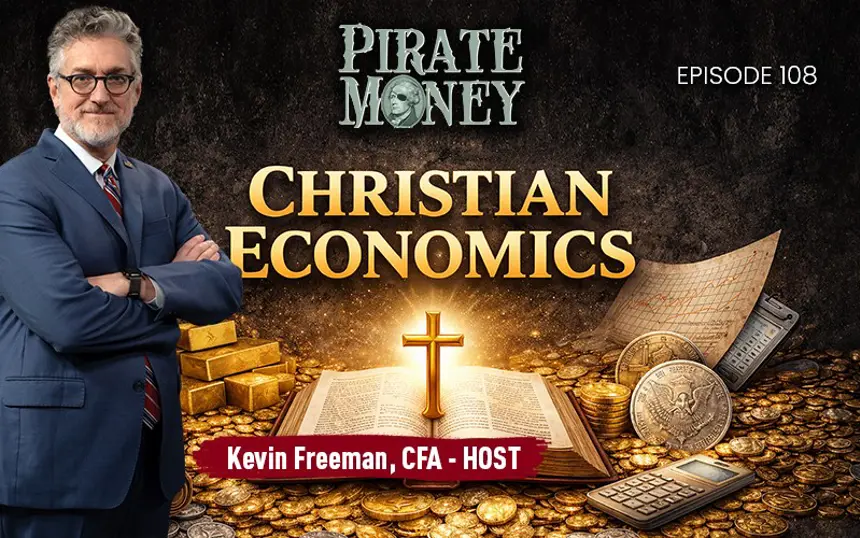
Kevin Freeman: There's a major Texas Senate race featuring two Christian candidates
Kevin Freeman: You know, we have a major political race going on here in Texas. The Democrat candidate is a pastor running for the Senate. He's very much in the camp of compassionate socialism, even though he's not that open about saying socialism. In fact, candidate James Tallarico calls it the friendship agenda. Some people call it socialism in a suit. Tallarico is a pastor, but he promotes a very progressive brand of Christianity. He makes it a point to contrast himself with conservative traditional beliefs. he claims the God who made everything male and female. You look around, you see bugs are male and female. You see male and female, just about everything. But he says that, you know, God and the Bible, they're actually non binary. And he favors state involvement in the economy and personal affairs. He's funded by, you know, some people would say radicals and atheists. but he's not openly proclaimed socialism like Zoram Mandani in NewSong York. But even as one who is Muslim, that's Mamdani. And one who is a Christian pastor, that's Talarico. I bet they agree on a whole host of things. They certainly seem to be supported by the same kind of people. Some would say they are radical people. Now, the reason I bring this up is in order to discuss a Christian view of economics. You know, with Mamdani, it's easy. He's Muslim and he's pro socialism. But with Talarico, he says he's Christian and he promotes socialist policies. So I want to talk about that. And joining me after a long absence for travel is my great friend, co host, the amazing Mike Carter. Welcome back, Mike.
Mike Carter: It is great to be back. Great to be back home. Great to be back at the Liberty Hawk Ranch. And, it, looks like you found a way, as I was gone here to make economics exciting. We're going to compare economics and how that relates to socialism and free markets. I'm excited about the show.
Kevin Freeman: I don't know if most people will think it's exciting. I bet you're barred for exciting, though, with these travels. To get to sleep at home in your own bed is exciting, right?
Mike Carter: It is. And we've had some nice legislative whims out there, so we're excited about that. but yeah, I'm excited about this show today and what's going on. It's interesting how, the Christian worldview can be so different depending on who you talk to nowadays.
Kevin Freeman: Yeah, yeah. And so what I'M going to do is contrast from a Christian perspective, contrasting socialism versus free markets, which is more Christian, which works better, which is more successful. And notice I did not say socialism versus Capitalism. That's because. Did you know this Karl Marx was a capitalist?
Mike Carter: Well, m. I'm a little interested in how you're going to get to that narrative, but, I'm open to your explanation.
All economic systems use capital
Kevin Freeman: All right, you've heard it here first. we're going to talk from an economist's perspective. You know, people say capitalists, they mean free market generally. but all economic systems use capital. Capital is equipment, money, intellectual property. It's buildings. You know, really, there are three factors of production. If you ask most economists. There are three fact of production. Really, there's four. But I'll tell you the three main ones in mainstream thinking. Land, labor, and capital. And land would include the resources, the energy that you pull out of the land. That would be land. Labor is what we. Our personal sweat, effort. And capital is the third one, which would be buildings, equipment, money, intellectual property.
Mike Carter: Okay, I'm with you on this then. I'm with you on that.
Kevin Freeman: Karl Marx did not say that you don't use capital. That would be insane. So, okay.
Mike Carter: Just other peoples, right?
Kevin Freeman: Yeah. Well, Karl Marx, what he said would be, it's not a matter of whether or not you use capital. It's who owns the capital. M. He wanted it to be universal, communal ownership. That's where we get the term communist.
Mike Carter: Yeah. And we know how well that works. We can go back to the pilgrim days when we should have learned our lesson early on. And the fact that it keeps coming up over and over again, is amazing.
Kevin Freeman: Yeah. All right, so the only real argument then, though, is not land, labor, and capital. Of course, we all agree on those. The fourth one, by the way, is entrepreneurship. That is the fourth factor of production for an enlightened economist who understands that you really need that spark of innovation. And yet the communists don't talk about that because they don't have entrepreneurs. Because why would you risk everything if you don't get any more than the same share as everybody else.
Mike Carter: Exactly, exactly. And we all know that entrepreneurial lifestyle is always so steady and predictable.
Kevin Freeman: Now it's completely risky and it's chaotic, and if you succeed, you want to be Elon Musk. Yeah, so that's. That's. All right. So it's about who owns things, who owns your capital, who owns the land. And here's the big one. Who owns the labor. And nobody thinks about this when you're talking about communism. Ownership is in common. That's communism or socialism. It's for the benefit of society. So who owns the capital? Oh, everybody should own the capital in common, huh? I disagree. But all right, who owns the land? Everybody. That's the big argument. It's like, you don't own this land, America. So don't put borders up because you all are usurpers being here. It should belong to everybody until somebody goes onto their property. And then all of a sudden they put a wall up right in Hollywood, all those stars that believe.
Mike Carter: All right, but just look at operational excellence. If there's an owner involved, it's at a different level. You can see these franchises when they're corporate owned franchises, a whole different level of performance at those retail stores. And you look at a Chick Fil a example where you got an owner operator that participates in the revenue. They have some ownership in that they have the most operationally efficient models out
Kevin Freeman: there and the best customers generating nine
Mike Carter: to $10 million a year per unit, blowing everything away. That's the difference between, well, everybody owns it and free markets.
Under socialism you don't own the product of your labor
Kevin Freeman: All right, well, I want to take it to a whole different level because we're talking about ownership of capital or ownership, of the building and the land and so forth. Here's big one. Who owns your labor?
Mike Carter: Who owns my labor? Yeah, well, if I, I'm m hopeful
Kevin Freeman: you're going to say your wife and kids do. Actually, my wife and kids own my labor.
Mike Carter: That's the best answer.
Kevin Freeman: Yeah, but, but no. Who owns the labor? Allen West. He's a former congressman, good friend of this program, retired lieutenant colonel. He once shared with me that under socialism you don't own the product of your labor. it belongs to society that is controlled by the government. This, he said, is economic slavery. Now for a black man to sit on the economic war room and say socialism is nothing other than slavery. And I'm like, whoa, you know, if I said that. Well, he said that, made a very strong point of it. And you know what? He's right. If you don't even own your own output of product, then the paycheck comes in and you see a big amount goes off to the government already. But what if 100% went to the government?
Mike Carter: Yeah, yeah, It'd be hard to get out of bed in the morning.
Kevin Freeman: It would be hard to work.
Mike Carter: Except you'd be scared to death of what would happen to you because you don't even own your life at that point.
Kevin Freeman: That's right, you don't You're a slave. so communism is essentially the abolition of private property. It's the abolition of personal property you don't even own yourself. And in fact, under communism in the communist, ussr, in their constitution it says if any man shall not work, neither shall he eat. That is also found in the Bible, which is interesting, but it was also something that was said on the plantation. You're not working, you're not eating, in fact you get beaten. And so this is basically the problem with economics is that people don't stop and think through the logical end of what they're doing. And here let's start with a few basic definitions. Economics, we're talking economics. Economics is the study of scarcity and how to allocate scarce resources. That's according to the American Economic association. Not from a Christian standpoint. By the way. Economics should be stewardship. God owns everything and I should be steward of everything. If you're going to be a slave to anything, be a slave to God and to do his will and to fulfill his purpose, because he is a wonderful, wonderful owner of everything. But communism says the government owns everything and you are a slave of the government. Don't like that. but the traditional earthly academic, study of economics is the study of scarcity. No wonder they call it the dismal science.
Mike Carter: Yes, well thanks for being an optimist though Kevan. You're going to find some optimism in this in terms of what the real solution is.
Kevin Freeman: Well, yeah, but when I was going to school in the 60s and 70s, I was grew up in the 60s and 70s', went to college in the late 70s, early 80s, the prominent economists of that day were basically telling us it's all over, you're all going to die. And not in a nice way like hitting age 92, surrounded by your loved. Instead. Paul Ehrlich, who was well known economist, just passed away recently in his 90s. he wrote the book the Population Bomb. It says while you're reading these words, five people, mostly children, have died of starvation and 40 more babies have been born. And he basically said he was pretty sure of himself. He basically said we're all going to die because we're going to run out of everything and that's the end of everything. And he was a complete pessimist. So he made a famous bet. Julian Simon, a free market economist, he was more on the communist side. But the free market economist Julian Simon said I'll bet you in 10 years the price of any 10 commodities, or I think it was five commodities that you Pick. The price is going to be lower, not higher. Guess who won the bet.
Mike Carter: prices were lower and not higher.
Kevin Freeman: That's right. Ronald Reagan got elected. We had supply side economics. We started doing free market approaches to things. And the prices of all those commodities, every one of them went down. And Julian, Simon won the bet from Paul Ehrlich. Paul just died recently and they're writing in the Wall Street Journal about how he lost the bet. He was wrong. Free market economics is not the study of scarcity. It is actually a study of stewardship because it's God's principle, God's way to do economics.
Mike Carter: And I'm guessing Paul didn't die of starvation at 92.
Kevin Freeman: No, he was surrounded by loving friends and family because we had free market economics. all right, we're going to have to take a break. When we come back, I want to dig deeper into this question. Which is better, communism or free markets? We'll have an answer for you right after this break.
There are good historical examples comparing free markets versus communism
Mike Carter: Welcome back to Pirate Money Radio with your host Kevan Freeman.
Kevin Freeman: And I'm joined by the great Mike Carter. And we're talking about which is better, communism or free markets. In free markets, you get choices. And one of the things you get to choose is what you do with your money. And there are only three things you can do with your money. You can give it, you can spend it, you can invest it. Here at Pirate Money Radio, we work to explain solutions that support all three areas in a way that promotes liberty, security and values. Patriot Mobile, it's a mobile phone company. They support the Pirate Money Radio program. Patriot Mobile uses US carriers, including AT&T, Verizon and T Mobile, and operates on both Apple and Android phones. More information about the economic war room and Patriot Mobile is [email protected] AFR that's PirateMoneyRadio.com AFR now that's the beautiful thing about America. You get choices. Under communism, you have the state run telephone and they don't serve you all that well. And you don't get to move from one company to another. You can't have a choice between Apple and Android. You get the commiphone and that's it. Maybe we should call it the red phone. but anyway, so we're facing, in America, we have freedom. and we were talking in the first, block, we were talking about the factors of production and who owns them, Individuals or the government? Who owns your own labor. Who do you have money that you can make free market choices with? And m, you were Sharing about Chick Fil A. One of the things that makes America, great is that if you don't like Chick Fil A, you can go to Burger King or you can go to any other fast food.
Mike Carter: Absolutely. Free markets create competition which forces people to say, how do I do this better? And that's so different than any type of government operation where you might be on hold for hours and trying to get to the right people to work through these things. And we're getting more efficient in our government. But there's no one there. There's no checks and balances there. If you're dealing with the irs, you're dealing with the irs.
Kevin Freeman: Yeah, but if you. For example, I just stayed at a Marriott property in San Diego and I wasn't being served there, I could have gone to a Hilton property or any of a dozen others. But if there's one state run hotel company, there's, you know, they're not working for you as the customer. They're working for the state. And you know, anyway, so let's compare. There's good historical examples comparing free markets versus communism. One of them I want to bring up is Poland and Venezuela. Poland, really was invaded by Hitler and the Germans and then put behind the Iron Curtain and forced into communism. The people from Poland are tremendous people, but they were forced into communism. By contrast, Venezuela was once, on a per capita basis, the fourth wealthiest country on planet Earth with the largest oil reserves. More oil reserves than Saudi Arabia, America or any anywhere else.
Mike Carter: Nice if you own them land, I guess, in that case. Right.
Kevin Freeman: Yeah, but, but they went and Poland was freed from the Iron Curtain when the Berlin Wall fell. And they've experienced, they've, they've joined the free market approach. And Venezuela in the 1990s voted in, Hugo Chavez and they became a socialist country voluntarily, and they voted it in. And you can look at the economic growth for Poland compared to Venezuela.
Mike Carter: Yeah, Poland's been an amazing success story. I know my daughter's getting ready to travel there, this next month. And I'm like, well, be careful in Europe. She goes, dad, I'm going to Poland. It's one of the safe places. So great testament.
Kevin Freeman: It is, it's a phenomenal country. And Venezuela is a phenomenal country too. But when Chavez got elected, everybody cheered. All of Hollywood was out there saying, look, finally we're going to do socialism right? We have a good man and he's got a good purpose and good intention. And so he had a lot of help from his, Hollywood friends. To get into power. But you know what? Once he got into power, here's what they did. They literally rigged the elections. After Chavez died, two things happened. When Nicolas Maduro was appointed as the leader, he got elected. He got elected, like, 98% election. How did he do it? He literally.
Mike Carter: Amazing how that happens.
Kevin Freeman: Rigged the elections. And it's not me saying that. That's Antony Blinken, Secretary of State under Joe Biden. We, the whole world knows they rigged the election using.
Mike Carter: Can you imagine 8% on, an election anywhere?
Kevin Freeman: No, no, no, no. That's not possible. We all know that they rigged the election. and in fact, the State Department condemned them for doing it. Here's the problem. You can vote yourself into socialism, but once they get power, they will try and retain the power, and you can't vote yourself out. Then. The second thing that I just want to point out that's shocking, is when Hugo Chavez ran for president, he was completely poor, a man of the people. And he was going to be a man of the people and he was going to spread the wealth around. And when he died, he left $4.2 billion to his daughter.
Mike Carter: Billion.
Kevin Freeman: Billion. The richest woman, richest person in Venezuela and one of the richest women in the world. That's what socialism does. Once they grab power, it's like Animal Farm. They keep power and they put you down. We'll be right back with more.
Mike Carter: Pirate Money Radio, helping you give, spend and invest in ways that align with liberty, security and values.
Mike Carter shares his thoughts on George Orwell's Animal Farm
Welcome back with your host, Kevan Freeman,
Kevin Freeman: and joined by Mike Carter. Mike, did you have to read Animal Farm in high school?
Mike Carter: I did, and I don't know if I really appreciated it. at the time, as a young kid, I wasn't quite the economic, genius that you were back then, so it was more of a Chuck Lips.
Kevin Freeman: You mean you had a real life and had girlfriends and fun and drove fast cars and things like that?
Mike Carter: I just remembered I had to write a book report on it. And I was like, it was kind of tedious for me, but, as I understand it today, it's a much more meaningful book than as I understood it in probably seventh or eighth grade.
Kevin Freeman: Well, here's the thing about it. Animal Farm was the farm. animals were being oppressed by the farmer, and so they decided to have a revolt. And it was led by the pigs, and the pigs then became in charge, and they were going to make everything equal and everything fair. And then at the end of the book, it says, all animals are equal, but some animals are more equal. Than others. The pigs essentially took control and they still oppressed the rest of the farm animals. And so the argument has always been. And by the way, the author, George Orwell wasn't antisocialism, he was a socialist. He just said, yeah, but you got to have good people. If you let pigs run everything, this is what's going to happen. That's always the argument.
Mike Carter: I didn't realize that. Actually, that's an interesting part of the story there. So he was still pro socialism and he still believed it just wasn't done right. So that was the purpose of his book.
Kevin Freeman: That was the purpose of his book. So the argument, I would have gotten
Mike Carter: an A on my book report if I would have included that in sight.
Kevin Freeman: Well, the argument then becomes, what if good people did it? And so I'm wondering, good people, from a Christian standpoint, who would be good people? How about people who loved God more than they cared for their own life, that were willing to sacrifice everything to be able to express and share their faith with others, who would be willing to cross traverse, in perilous times like on the Mayflower and come to America? How about the Pilgrims? Wouldn't they make it work?
Mike Carter: You would think that would be the right person that could actually make it work, the right team that came together to make it work.
Zoram Mamdani wants to abolish private property in New York
Kevin Freeman: All right, so I'm going to read from the diary. This is a Heritage foundation published this, about the Pilgrims and Bradford. Governor William Bradford writing the diary of the dire economic straits and self destructive behavior that consumed fellow puritans shortly after their arrival. Well, these are good people. They're Christians. Governor William Bradford painted a picture of death. Destitute settlers selling their clothes and bed coverings for food, while others became servants to the Indians. They get there and it's like, I'll do anything. Cutting wood and fetching water in exchange for a cap full of corn. The most desperate among them starved, the Bradfords, recounting how one settler and gathering shellfish along the shore was so weak he stuck fast in the mud and was found dead in his place. Colony leaders identified the source of their problem as a particularly vile form of what Bradford called communism. Property in Plymouth Colony, he observed, was communally owned and cultivated. The system taking away the private property and bringing it into a commonwealth bred confusion and discontent and retarded much employment that would have been to the settlers benefit. So what did they do? They ended communism. They went to private property ownership. And guess what? They prospered so much that the next winter as they were entering it, they Had a big Thanksgiving.
Mike Carter: Amen.
Mike Carter: Amen.
Kevin Freeman: Communism never works. It doesn't matter if the people are good or bad. The system is terrible, and it's not God's way. We cannot abolish private property. And yet that's what Zoram Mamdani is wanting to do in NewSong York. That's what the World Economic Forum says. You'll own nothing by the year 2030 and be happy. What is that? Other than the abolition of private property?
Mike Carter: Exactly. And I see Mamdame with all of his ideas, he's having a little problem operating things efficiently already. And I see he needs to raise some more taxes.
Kevin Freeman: And it's not just on the rich. He's raising taxes on everybody. And he's. He's taking over property. It really. NewSong York is going to be another case study. And the sad thing is, I'm sorry, Zoram Mamdani is not a Puritan. He is not. He is not a pilgrim. He is not any of the greatness of those things. He doesn't even know the Lord Jesus Christ. He is a Muslim. And so he certainly doesn't serve the truth of the Bible, like the Pilgrims did. It's going to fail miserably. Yeah.
Mike Carter: Yeah. And, you know, to be fair, Trump gave him a fair shake, though. He's like, well, let's see what happens. Let's see. I hope this works.
Kevin Freeman: Yeah, well, private property does work. Free markets work. Communism doesn't work. That's why when they wrote 250 years ago, Thomas Jefferson wrote, life, liberty, and the pursuit of happiness. And government should be instituted to preserve those individual rights, as opposed to this whole notion of having everything in common. Because eventually, when you have everything in common, you're going to have a king who's the king of the Commonwealth, and they're going to control you, and you won't even control your own labor. In other words, you will be entered into slavery. This is existential for America. We have a choice, and we need to make the right one. We'll be right back after this break.
Mike Carter discusses the difference between free markets and communism on Pirate Money Radio
Mike Carter: Welcome to Pirate Money Radio with your host, Kevan Freeman, helping you unpack the economic headlines and providing real money solutions.
Kevin Freeman: Yeah. And we're talking with Mike Carter, and we're talking about the difference between free markets and communism, which is more Christian, which is more successful. We've already covered the fact that free markets work and communism, never does work, but which is biblical. What does God want from us? That's an important question.
Mike Carter: I like what you said earlier. Life, liberty and pursuit of happiness. That's got a ring to it. What a great philosophy there.
Kevin Freeman: Life, liberty and pursuit of happiness is a complete rip off that Thomas Jefferson did. And I'm not saying he stole or that he was a political plagiarist, but literally. Jon Locke, the economist, wrote life, liberty and property.
Mike Carter: life, liberty and property.
Kevin Freeman: So private ownership, Private ownership is the basis for the pursuit of happiness. If you think about it, if you're just a cog in the wheel and this is what you have to do and you're going to do it, you're a drone, you're a slave, and there's no pursuit of happiness. There's no idea. I'm going to build dream accomplishments. That's what they can say. And the goal was, Jon Wesley had the goal is make all you can save, all you can, and give all you can earn all you can, I think is what he said. But the idea is I want to make and build and do and dream so I can share it. Who do you want to share with?
Mike Carter: Who do I want to share with?
Kevin Freeman: Yeah.
Mike Carter: my loved ones, first of all. But those that are in need, if I see a need, it's fulfilling to me to be able to help somebody at the same time.
Kevin Freeman: And that brings happiness. Right. If you make sure your kids are well taken care of, that they get a good education that they've got, that makes you, you see grandkids and grandkids. I want to bless them, I want to provide for them, or you see somebody in need. That's how you find happiness. Right? That's the pursuit of happiness. Jefferson understood that. It's interesting. World Economic Forum does the opposite of that. They say that you can have happiness by owning nothing. Does that sound right to you?
Mike Carter: It definitely sounds wrong to me. But it's amazing how inverse it is of the principles we stand for. So if you're going to say, what's the opposite? Or how do I take down this model that's been working? I try and convince people the exact opposite. So you will own nothing and be happy. You'll eat bugs and be happy. Do any of those sound like they make sense?
Kevin Freeman: That bug one is the one that bothers you?
Mike Carter: It does get me.
Kevin Freeman: Because the World Economic Forum. 10 predictions or our eight predictions.
Mike Carter: I'm having a hard time eating healthy vegetables. Now you're going to tell me I got to eat bugs? Come on.
Kevin Freeman: Yeah, I get that. And they literally said, you'll eat less meat. And what they meant by that is, you'll Eat more bugs. And they started promoting that. But world economic forums putting this out. Your point is a good one, though. they tell you the opposite. You'll own nothing and be happy. By the way, a family. A, ah, mom and a dad. No. A male and a female. No. well, God made them male and female. No. God created the heavens and earth. No. No. They deny everything that we know to be true. And they try and put the opposite in place. A family is, you know, two men and two, dogs or something. It's ridiculous.
Mike Carter: It kind of shows you the playbook of who's behind communism, really. It's not a godly thing.
Kevin Freeman: Oh, and that's a good point. We've got on the bookshelf behind us the devil and Karl Marx. it really. He literally did, serve Satan. I mean, he admitted it. It's pretty clear in there, see, by no means is it Christian. So I asked, AI, I think it was Grok.
The Bible strongly affirms the concept of private property through both explicit commands
What does the Bible say about the concept of private property? Is it for it or against it? And here's the answer. The Bible strongly affirms the concept of private property through both explicit commands and underlying assumptions throughout the Old and NewSong Testaments, while God is the ultimate owner of all creation. Psalm, 22:24:1. The earth is the Lord's and everything in it, the world and all who live in it. He delegates stewardship and ownership rights to individuals and families, expecting them to manage property responsibly, productively and generously. And I think a couple of things. One, the Ten Commandments, Thou shalt not steal. If there's no private property, is it possible to steal if it's everything owned in common?
Mike Carter: Good point, good point. And I thought of that one that way.
Kevin Freeman: And not only is it against stealing, it's against thinking about stealing. Thou shalt not covet. I got that one from Rod Martin. It's like coveting targets legitimately what belongs to another person, reinforcing that personal property. Right. As protected. That's the Old Testament. What about the concept of property in the NewSong Testament? Well, it's very clear. Jesus, when he handed out the talents, the master owned it, representing God. And he said, this is yours to do with as you will, and then report back to me how you've done done with it. That's not a communist notion.
Mike Carter: No, no. all these woke pastors that are teaching socialism, you're kind of messing up their theology a little bit right now.
Kevin Freeman: Well, their theology is not messed up by me. It's messed up by The Bible. Here's another one. I'll pull up Acts 51 4. Remember, everybody was going to share everything in common. And the socialists point to that, and they say, no, God. God wants you to share in common. You know, that didn't last very long in the church because it's not very successful. It's just like the Pilgrim's experiment that failed. But here's the clear passage. Ananias and his wife said they sold their property and they brought the money in. They said, here it is. It's all here. We're putting it all in. And Ananias was there first. And they said, is that all of it? And he said, yep, that's it. All of it. Well, he'd held some of it back. And it says, Peter confronts him and says, while it remained unsold, did it not remain your own? And after it was sold, was it not at your disposal? They lied and said they put everything they had in. That was a lie to the Holy Spirit. And of course, tragically, he died. But the point is this. Absolute clarity. It was his property to do with as he wanted. M. Now, giving. God wants us to be a cheerful giver. That's very plain where he says, God wants giving to be voluntary, and he wants us to be cheerful givers. If someone shows up at your house with a gun, knocks on your door, you answer their gun, and says, give me all your money, are you cheerful about that?
Mike Carter: Not at all.
Kevin Freeman: If it's the government and says, give me all your money because we'll do good things with it, are you cheerful about that? No, nobody's cheerful. That's why April 15 is not considered one of the happy days in America.
Mike Carter: Are you sure the government hasn't already come to my door and said, give me all your money? Because it certainly feels that way while
Kevin Freeman: looking at the check book. It feels that way too, sometimes. But the point is, the Bible is very clear about the notion of private property. And you can go through all of it. There's example after example. Deuteronomy 19:14 says, you shall not move your neighbor's boundary mark. Well, hey, wait. Why does he have a boundary mark? Unless it's private property. Well, I'm going to move it and take some. No, that's theft, and you shall not do that. The point being being over and over and over where, there was a case where a king says, I want that. And he killed the owner and took the property. And God punished him for that completely wrong thing to do. Not even kings are allowed to do that. So you go all the way through. And there's example sharing in Acts 2, 44, 45 and 4, 32, 37 was voluntary. It was not coerced. It was not, not communal ownership by mandate. Now, if people want to come together and say, look, we're going to share this in common, it's your property. If that's what you want to do with it, you can't. It should just not be forced.
Mike Carter: Exactly.
Kevin Freeman: And we do that all the time. Families. You know, when our kids were little, how much did they contribute to the family checkbook?
Mike Carter: Yeah.
Kevin Freeman: How much did they take from the family checkbook?
Mike Carter: It is. But, you know, as Christians, we also recognize that we're really stewards of what God gave us. And so while we have things, we also recognize this comes from above. And I think that gives us that extra encouragement to also say, all right, how do I be generous with what I have at the same time?
Kevin Freeman: And that's the important thing. Because what is the flaw? What's the flaw? What's Mamdani pushing at when he says we gotta go to socialism or capitalism? The flaw is that we have this massive wealth gap. The rich have gotten richer, the poor seem to not be gaining ground at all and so forth. Although historically, let me point out, those people who live in abject poverty are what? we've got a chart coming up here. you know, less than 10% of the population of the world, whereas before free markets came along, it was like 90% of the population of the world. Free markets have really lifted people out of poverty. But the problem is you have a wealth gap, and so people complain. How come Elon Musk is so wealthy and I barely. Volume scraping by? That's not fair. And the government's corrupt and everything's corrupt. That's the one flaw of what we call capitalism. Really?
Mike Carter: And we put the word crony in front of that, don't we? In that case, a little crony capitalism creates those unfair markets.
Kevin Freeman: Yes, because what you have is billionaires that then buy off the government. And I get that it's not necessarily
Mike Carter: all free all the time.
Kevin Freeman: In NewSong York, there was a mayor, his name was Bloomberg, and he was a very wealthy multi billionaire. He got into power, and the first thing he wanted to do was control everybody's everything. How much soda you were allowed to drink. Do you remember that?
Mike Carter: I remember that. That was the first shock I got to, socialism or government control. And then went from that to bugs. So eating bugs.
Kevin Freeman: You'll have to eat.
Mike Carter: We're on a very bad path here. We've got to help people understand what you're talking about today.
Kevin Freeman: Yeah, no, and I'll tell you that those who are the pigs of Animal Farm, they ate what they wanted to eat. They didn't eat what everybody else had to eat. And that's true for Hugo Chavez's daughter. It's true everywhere. When people enforce communism, they're really creating a slave society where they're the masters and the rest of us are slaves. But under free markets, you have the opportunity to pursue your own happiness, to find what makes you happy and to build and grow. And if you add value to the world, you'll make a lot of money. But it creates a wealth gap and that's what we're going to have to address. And we'll talk about how do we fix the wealth gap from a Christian view right after this break.
People are worried about America's widening wealth gap
Mike Carter: Welcome back to Pirate Money Radio with your host Kevan Freeman.
Kevin Freeman: I'm joined by co host Mike Carter. Mike, you've been traveling across the country, you've been meeting real people, and in beautiful American states. We've been to Idaho together, we've been to Florida and Georgia, and man, you've been all over. and people are worried about this wealth gap, aren't they?
Mike Carter: Yeah, no matter where you're at, people are feeling the pressures of inflation. They're seeing, those that have, have, have a lot. And others are saying, how am I ever going to be able to afford to buy a house out there? the wealth gap is real and we want to fix that. And certainly one of those solutions is what we've been working on with transactional gold. And the legislation has been being passed there and being rolled out this year, which is exciting. but, yeah, it's something we need to address and it's something that, you know, we're seeing bipartisan support on, sometimes more from the Democrats than Republicans. But they say, hey, we understand there's a wealth gap and this is a chance where people can, can start to get something that holds value, keeps, its value, and maybe accumulate some more property or some wealth at some point versus I've got something saved. They keep printing more and more of it. It's worth less and less. So I'm working nonstop just to figure out how to pay the bills. We've got some opportunities in America still.
Kevin Freeman: We do, and we should be able to pursue happiness. The solution to the wealth gap is not to implement socialism, communism, because that's just going to solidify and permanentize it like it did in Venezuela. but Jesus told us, the poor you'll always have with you in Matthew 26:11, when he was allowing the extravagant perfume to be poured on his feet. And he said that should be sold and given to the poor. And he said, the poor you'll always have with you. And it's a statement a lot of times that people take out of context, saying that, well, just neglect, poverty. No, no, it's actually the opposite. He was quoting Deuteronomy 15:11, which says, for the poor will never cease from the land, therefore I command you, saying, you shall open your hand wide to your brother, to your poor, and to your needy in your land. In other words, Jesus was saying, yeah, we're going to always have the poor with us. That's a truth from the scripture. The good news is the poor in America are better off than the wealthy 100 years ago. Right. we really are.
Mike Carter: We all, no matter what our income, we pretty much all have our phones now. We've all got our TVs, we've got, and, for the most part, air conditioning and electricity. That's plumbing that works. That's a big deal.
Kevin Freeman: It is. But we still have a wealth gap and we want to address it. And one of the ways to address it is very clear. You shall open your hand to your brother, to your poor and your needy in your land. You individually shall open your hand. And the only way you can do that is to do what Jon Wesley said. Make all you can, save all you can, give all you can. Human generosity, scriptural stewardship, where we're sharing with those the least of us. That's a biblical approach to solving the wealth gap. That's number one. Private generosity from a stewardship perspective, not a government takeover of everything. God loves a cheerful giver, according to 2 Corinthians 9, 7. And we're not cheerful paying our taxes. So that's the first solution. The second solution is free markets that we've been talking about. Less regulation and more opportunity. Remember we did this show on economic war room. The average American home would be earning over $300,000 a year if we didn't have all the regulations that we've layered on. And, practical sense. I was just in California, I was talking to some home builders and they said, yeah, the cost of building a house is so much higher because we can't put in a gas powered stove. We have to put in an electric stove and we have to meet all these requirements. So houses are Too expensive for the average person.
Mike Carter: Development costs, the regulations, all that that are in place just to get the land ready makes, it prohibitive, pricing, wise. And so you're seeing a big challenge there in terms of how do you get entry level homes built if there's not the margin there by time, you add the regulation, all the restrictions, you build everything in, people saying, I can't afford to buy a home anymore.
Kevin Freeman: So we've, we've contrasted Poland and Venezuela. How about contrasting Argentina and Argentina? Okay, Argentina before Melee was elected. He says, I'm going to end the socialism and start free markets. Guess what's happened in Argentina since he took over.
Mike Carter: It's getting better.
Kevin Freeman: The miracle, they call it an economic miracle. Vindicating free markets. And guess what? Poverty is declining where you've taken socialism out in Argentina. It's a perfect test case. We can look at that. And it's like it was worsening and the society was about to collapse. He comes in with free market solutions. And guess what they called Argentina's miracle? Vindicating free markets. And that's from the Jon Locke Foundation. Jon Locke, of course, we quoted Life, liberty, property earlier. but it's happening around the world. The greater the freedom, the greater the prosperity. That's true. How many times?
Mike Carter: Every time.
Kevin Freeman: Every time. And the greater the slavery, the greater the impoverishment, the greater the wealth gap. That's true also. Every time. Those are two big solutions to the wealth gap. But the third one you brought up at the beginning of the segment, we're going to dive in detail on honest wait and measures. God's solution for the free markets.
Mike Carter: Pirate Money Radio, helping you give, spend and invest in ways that align with liberty, security and values. Welcome back. With your host Kevan Freeman, I'm joined
Kevin Freeman: by Mike Carter and we're talking about free markets versus communism. And literally the only problem I can see with free markets is the wealth gap. That it's true some people get wealthy and other people struggle in the economy. And solution for the wealth gap, number one, we just covered it, is private generosity from a stewardship perspective. Solution two is free market. Free markets actually tend when you have less regulation, you have more opportunity to actually tend to even out that wealth gap. And solution number three is honest weights and measures. We call it pirate money. And bottom line is gold, silver and copper are biblical money. God made them, God owns them. Haggai28 says that over time, though unbacked paper money, something not contemplated in the scripture, Actually it is. It loses value due to inflation. 1 Corinthians 3, 12, 13. I'm going to read it. It says now, if any man upon this foundation, gold, silver, precious metals, wood, hay, or stubble, every man's work will be made manifest for the day shall declare it, because it is revealed by fire. And the fire shall try every man's work of what sort it is. Fire, when you come into trials and challenges and difficulties, burns up wood, hay and stubble, which is what paper money is made out of. And gold and silver get purified. And literally, I think the fire that we're facing is inflation. inflation lets rich people make money from poor people. It's called the Cantillon effect, and it creates a wealth gap. But God hates unjust weights and measures, wants everyone treated fairly. We have a solution, Mike, for gold and silver to where the average person can own it. It's $5,000 an ounce, but I can only own $100 worth. But it works.
Mike Carter: It does, it does. And it's exciting. We've, seen some nice legislative wins already this year. Year. but what we're really starting to see is states say, all right, how do we implement this now? How does this get going? And the ability to be able to take a little bit of money that you make and be able to buy gold and silver, put it in a depository and have a debit card to be able to spend that if you need to spend it to give you liquidity, that's not been there before with gold. But with gold at $5,000 an ounce, there's not many of us that can afford to have a $5,000 coin just sitting around and say, well, if I need to use it, I can go somewhere, sell it, wait for my money to come back, and so forth. But if I can have gold that I can spend anywhere when I need to spend it, if I can have my own rainy day fund, if I can be able to buy gold at $5, as low as $5 increments, $100 a month in a year, I've got $1,200 in gold that keeps up with inflation. I've got that steady store of value now.
Kevin Freeman: And the ability to save money in the form of gold allows you to maybe get your house a little quicker. And houses priced in gold have not gone up in price, They've gone down. So it makes life more affordable. If we could switch or give you a personal optional gold and silver standard from six states now and soon to be 26 states as we hit, but Arkansas, Florida, Texas, Louisiana, Missouri, And Utah. That's a big chunk of states. And even if you're in another state soon, we'll be able to get your Florida card or your Arkansas card and be able to use it and hold a. And spend gold. You'll learn more about that, from the book Pirate Money. But I think this is one of the big solutions for the wealth gap. And by the way, support for this program comes from Glint. That's a financial technology service offering exactly what he was talking about. A debit card and a mobile app for enabling users to access gold holdings for everyday purchases. With Glint, users maintain ownership of allocated physical gold, which is stored in a managed vault at the time of a transaction when you need to spend it. Gold is sold real time to cover the purchase amount in local currency. Glint offers an alternative way to store and use the value. Combining gold and silver with modern payment infrastructure, Glint clients can monitor their goal balance, view transaction history, and manage their account through the Glint app, available on major mobile platforms. More details about how vaulted physical gold can be used as money are [email protected] Gold2,47 that's glentpay.com Gold247 Glent provides access to gold for modern spending.
Mike Carter: Yeah, and Kevan, we've got a solution now. I mean, my gold is in Switzerland. I, want it in the states that we live in. And as we move forward with this legislation, we see also tremendous advantages where now, it's functional currency that might be able to get rid of capital gains tax, but you got a trust factor, you got, all kinds of benefits. As this moves from state to state, we're getting people on the radio, calling us and saying, if I live in California, can I do this? Yes, as these states ruled out, you can do it. You can do it today. But, your gold will be in Switzerland, not in the United States.
Kevin Freeman: We're making gold and silver money again under the biblical truth. Learn more from piratemoneybook.com all right, some of you may be leaving us now, and for those we say God bless you from Kevan Freeman and Mike Carter and Pirate Money Radio. You know, we love our audience. We've got a broad audience across multiple platforms. But if you're following us on podcast or if you're following us on American Family Radio, you need to stay tuned. We've got one more segment, a little bit more time with Mike Carter, and for you. We'll be right back after the break.
Mike Carter: Foreign,
Mike Carter: radio with your host, Kevan Freeman.
Mike Carter has traveled the country to bring pirate money to the states
Kevin Freeman: We're talking with the great Mike Carter, who's traveled the country to bring pirate money to the states across America. You spent a lot of time really, laying the groundwork, making a lot of progress. We got advanced in committees, we got out of the Senate in Georgia and other places, just real Tennessee. We're seeing great, huge advances. And most importantly, you help them implement the rules in Florida. You help them at least testify, here's what it should look like and so forth. I want you to wrap up with some encouragement about people waking up to pirate money. What are the people when you meet them, what do they say?
Mike Carter: anywhere I go in about a three to four minute conversation, I can quickly say, hey, how about if I pay for this in gold? And they look at first a little bit curiously and then they get it and they understand it. I was getting a rental car and afterwards it was busy. The guy like fist bumped me like, this is great. How do I learn more about this? How do I do this? I was getting a meal at a fast food restaurant. The same thing. No matter what demographic, profile you might fit out there, what income out there, people understand this, they get it. They see this as a big idea. It's part of that wealth gap of how do I make sure I've got something. Just at least set aside my rainy day me for fund that I know is going to hold some value out there over time. And gold can go up and down over short term. So this is a long term play. But over time it's been a steady store of value. and to have that optionality with the liquidity that this provides, and as the states step up and get more and more involved, the trust, and other potential benefits that come from that, from making sure there's another event like in the 1930s where Roosevelt took the people's gold. you don't have to worry about this whole another layer of protection from that, from the taking and then potentially on the taxes. But I've never seen an idea and I've worked in a lot of consumer products and done disruptive businesses, to where you see just people get so excited and like a light comes on, it's like, oh, there is a solution that this is the solution I've been
Kevin Freeman: looking for and it's an optional solution. One of the things that communism is you don't get any choices. You can have any questions. A car in any color you want, as long as it's black. Right? That's a communist approach.
Mike Carter: Well, Ford did that a little bit over efficiency, but that was definitely more that way.
Kevin Freeman: Why is Ford doing it now?
Mike Carter: Not at all. No.
Kevin Freeman: No, because they realize that it doesn't work. They believe in a free market. And that's the reality of it is, is that people want choices. Choices bring more freedom, it brings more opportunity, it brings innovation, it brings more prosperity. And that's what we've been talking about from the beginning of this program, is that communism, where you have no choice, you're essentially a slave versus free markets, where you have lots of choices. Free markets are better for the gospel because you can share the truth of eternal wealth and share the truth of knowing Jesus. And share the truth from having a home in heaven and taking others with you to heaven. It's not about the money here. This is just an opportunity for us with free choices to save as many souls as possible, to bring the light of the gospel to as many places. Places as possible. All right, if you've got questions or prayer needs or comments, we want you to email [email protected] we love those questions, don't we, Mike?
Mike Carter: No, we do, we do. And, it's encouraging for us just to hear from audience members and asking and learning more. thank you so much for our listening audience out there. And for those of you that are helping to make this movement happen across America, shout out to Senator Marty Harbin, make Georgia gold again. We're still working on it. We're going to get it done probably this next session.
Kevin Freeman: Amen. All right, so pray for America. Pray for the world to return to God's principles this year. Decree God's word over this earth. Listen wherever you get your podcasts, Apple, Spotify, etc. This is Kevan Freeman, joined by Mike Carter for Pirate Money Radio.
Kevin Freeman: There's a major Texas Senate race featuring two Christian candidates
Kevin Freeman: You know, we have a major political race going on here in Texas. The Democrat candidate is a pastor running for the Senate. He's very much in the camp of compassionate socialism, even though he's not that open about saying socialism. In fact, candidate James Tallarico calls it the friendship agenda. Some people call it socialism in a suit. Tallarico is a pastor, but he promotes a very progressive brand of Christianity. He makes it a point to contrast himself with conservative traditional beliefs. he claims the God who made everything male and female. You look around, you see bugs are male and female. You see male and female, just about everything. But he says that, you know, God and the Bible, they're actually non binary. And he favors state involvement in the economy and personal affairs. He's funded by, you know, some people would say radicals and atheists. but he's not openly proclaimed socialism like Zoram Mandani in NewSong York. But even as one who is Muslim, that's Mamdani. And one who is a Christian pastor, that's Talarico. I bet they agree on a whole host of things. They certainly seem to be supported by the same kind of people. Some would say they are radical people. Now, the reason I bring this up is in order to discuss a Christian view of economics. You know, with Mamdani, it's easy. He's Muslim and he's pro socialism. But with Talarico, he says he's Christian and he promotes socialist policies. So I want to talk about that. And joining me after a long absence for travel is my great friend, co host, the amazing Mike Carter. Welcome back, Mike.
Mike Carter: It is great to be back. Great to be back home. Great to be back at the Liberty Hawk Ranch. And, it, looks like you found a way, as I was gone here to make economics exciting. We're going to compare economics and how that relates to socialism and free markets. I'm excited about the show.
Kevin Freeman: I don't know if most people will think it's exciting. I bet you're barred for exciting, though, with these travels. To get to sleep at home in your own bed is exciting, right?
Mike Carter: It is. And we've had some nice legislative whims out there, so we're excited about that. but yeah, I'm excited about this show today and what's going on. It's interesting how, the Christian worldview can be so different depending on who you talk to nowadays.
Kevin Freeman: Yeah, yeah. And so what I'M going to do is contrast from a Christian perspective, contrasting socialism versus free markets, which is more Christian, which works better, which is more successful. And notice I did not say socialism versus Capitalism. That's because. Did you know this Karl Marx was a capitalist?
Mike Carter: Well, m. I'm a little interested in how you're going to get to that narrative, but, I'm open to your explanation.
All economic systems use capital
Kevin Freeman: All right, you've heard it here first. we're going to talk from an economist's perspective. You know, people say capitalists, they mean free market generally. but all economic systems use capital. Capital is equipment, money, intellectual property. It's buildings. You know, really, there are three factors of production. If you ask most economists. There are three fact of production. Really, there's four. But I'll tell you the three main ones in mainstream thinking. Land, labor, and capital. And land would include the resources, the energy that you pull out of the land. That would be land. Labor is what we. Our personal sweat, effort. And capital is the third one, which would be buildings, equipment, money, intellectual property.
Mike Carter: Okay, I'm with you on this then. I'm with you on that.
Kevin Freeman: Karl Marx did not say that you don't use capital. That would be insane. So, okay.
Mike Carter: Just other peoples, right?
Kevin Freeman: Yeah. Well, Karl Marx, what he said would be, it's not a matter of whether or not you use capital. It's who owns the capital. M. He wanted it to be universal, communal ownership. That's where we get the term communist.
Mike Carter: Yeah. And we know how well that works. We can go back to the pilgrim days when we should have learned our lesson early on. And the fact that it keeps coming up over and over again, is amazing.
Kevin Freeman: Yeah. All right, so the only real argument then, though, is not land, labor, and capital. Of course, we all agree on those. The fourth one, by the way, is entrepreneurship. That is the fourth factor of production for an enlightened economist who understands that you really need that spark of innovation. And yet the communists don't talk about that because they don't have entrepreneurs. Because why would you risk everything if you don't get any more than the same share as everybody else.
Mike Carter: Exactly, exactly. And we all know that entrepreneurial lifestyle is always so steady and predictable.
Kevin Freeman: Now it's completely risky and it's chaotic, and if you succeed, you want to be Elon Musk. Yeah, so that's. That's. All right. So it's about who owns things, who owns your capital, who owns the land. And here's the big one. Who owns the labor. And nobody thinks about this when you're talking about communism. Ownership is in common. That's communism or socialism. It's for the benefit of society. So who owns the capital? Oh, everybody should own the capital in common, huh? I disagree. But all right, who owns the land? Everybody. That's the big argument. It's like, you don't own this land, America. So don't put borders up because you all are usurpers being here. It should belong to everybody until somebody goes onto their property. And then all of a sudden they put a wall up right in Hollywood, all those stars that believe.
Mike Carter: All right, but just look at operational excellence. If there's an owner involved, it's at a different level. You can see these franchises when they're corporate owned franchises, a whole different level of performance at those retail stores. And you look at a Chick Fil a example where you got an owner operator that participates in the revenue. They have some ownership in that they have the most operationally efficient models out
Kevin Freeman: there and the best customers generating nine
Mike Carter: to $10 million a year per unit, blowing everything away. That's the difference between, well, everybody owns it and free markets.
Under socialism you don't own the product of your labor
Kevin Freeman: All right, well, I want to take it to a whole different level because we're talking about ownership of capital or ownership, of the building and the land and so forth. Here's big one. Who owns your labor?
Mike Carter: Who owns my labor? Yeah, well, if I, I'm m hopeful
Kevin Freeman: you're going to say your wife and kids do. Actually, my wife and kids own my labor.
Mike Carter: That's the best answer.
Kevin Freeman: Yeah, but, but no. Who owns the labor? Allen West. He's a former congressman, good friend of this program, retired lieutenant colonel. He once shared with me that under socialism you don't own the product of your labor. it belongs to society that is controlled by the government. This, he said, is economic slavery. Now for a black man to sit on the economic war room and say socialism is nothing other than slavery. And I'm like, whoa, you know, if I said that. Well, he said that, made a very strong point of it. And you know what? He's right. If you don't even own your own output of product, then the paycheck comes in and you see a big amount goes off to the government already. But what if 100% went to the government?
Mike Carter: Yeah, yeah, It'd be hard to get out of bed in the morning.
Kevin Freeman: It would be hard to work.
Mike Carter: Except you'd be scared to death of what would happen to you because you don't even own your life at that point.
Kevin Freeman: That's right, you don't You're a slave. so communism is essentially the abolition of private property. It's the abolition of personal property you don't even own yourself. And in fact, under communism in the communist, ussr, in their constitution it says if any man shall not work, neither shall he eat. That is also found in the Bible, which is interesting, but it was also something that was said on the plantation. You're not working, you're not eating, in fact you get beaten. And so this is basically the problem with economics is that people don't stop and think through the logical end of what they're doing. And here let's start with a few basic definitions. Economics, we're talking economics. Economics is the study of scarcity and how to allocate scarce resources. That's according to the American Economic association. Not from a Christian standpoint. By the way. Economics should be stewardship. God owns everything and I should be steward of everything. If you're going to be a slave to anything, be a slave to God and to do his will and to fulfill his purpose, because he is a wonderful, wonderful owner of everything. But communism says the government owns everything and you are a slave of the government. Don't like that. but the traditional earthly academic, study of economics is the study of scarcity. No wonder they call it the dismal science.
Mike Carter: Yes, well thanks for being an optimist though Kevan. You're going to find some optimism in this in terms of what the real solution is.
Kevin Freeman: Well, yeah, but when I was going to school in the 60s and 70s, I was grew up in the 60s and 70s', went to college in the late 70s, early 80s, the prominent economists of that day were basically telling us it's all over, you're all going to die. And not in a nice way like hitting age 92, surrounded by your loved. Instead. Paul Ehrlich, who was well known economist, just passed away recently in his 90s. he wrote the book the Population Bomb. It says while you're reading these words, five people, mostly children, have died of starvation and 40 more babies have been born. And he basically said he was pretty sure of himself. He basically said we're all going to die because we're going to run out of everything and that's the end of everything. And he was a complete pessimist. So he made a famous bet. Julian Simon, a free market economist, he was more on the communist side. But the free market economist Julian Simon said I'll bet you in 10 years the price of any 10 commodities, or I think it was five commodities that you Pick. The price is going to be lower, not higher. Guess who won the bet.
Mike Carter: prices were lower and not higher.
Kevin Freeman: That's right. Ronald Reagan got elected. We had supply side economics. We started doing free market approaches to things. And the prices of all those commodities, every one of them went down. And Julian, Simon won the bet from Paul Ehrlich. Paul just died recently and they're writing in the Wall Street Journal about how he lost the bet. He was wrong. Free market economics is not the study of scarcity. It is actually a study of stewardship because it's God's principle, God's way to do economics.
Mike Carter: And I'm guessing Paul didn't die of starvation at 92.
Kevin Freeman: No, he was surrounded by loving friends and family because we had free market economics. all right, we're going to have to take a break. When we come back, I want to dig deeper into this question. Which is better, communism or free markets? We'll have an answer for you right after this break.
There are good historical examples comparing free markets versus communism
Mike Carter: Welcome back to Pirate Money Radio with your host Kevan Freeman.
Kevin Freeman: And I'm joined by the great Mike Carter. And we're talking about which is better, communism or free markets. In free markets, you get choices. And one of the things you get to choose is what you do with your money. And there are only three things you can do with your money. You can give it, you can spend it, you can invest it. Here at Pirate Money Radio, we work to explain solutions that support all three areas in a way that promotes liberty, security and values. Patriot Mobile, it's a mobile phone company. They support the Pirate Money Radio program. Patriot Mobile uses US carriers, including AT&T, Verizon and T Mobile, and operates on both Apple and Android phones. More information about the economic war room and Patriot Mobile is [email protected] AFR that's PirateMoneyRadio.com AFR now that's the beautiful thing about America. You get choices. Under communism, you have the state run telephone and they don't serve you all that well. And you don't get to move from one company to another. You can't have a choice between Apple and Android. You get the commiphone and that's it. Maybe we should call it the red phone. but anyway, so we're facing, in America, we have freedom. and we were talking in the first, block, we were talking about the factors of production and who owns them, Individuals or the government? Who owns your own labor. Who do you have money that you can make free market choices with? And m, you were Sharing about Chick Fil A. One of the things that makes America, great is that if you don't like Chick Fil A, you can go to Burger King or you can go to any other fast food.
Mike Carter: Absolutely. Free markets create competition which forces people to say, how do I do this better? And that's so different than any type of government operation where you might be on hold for hours and trying to get to the right people to work through these things. And we're getting more efficient in our government. But there's no one there. There's no checks and balances there. If you're dealing with the irs, you're dealing with the irs.
Kevin Freeman: Yeah, but if you. For example, I just stayed at a Marriott property in San Diego and I wasn't being served there, I could have gone to a Hilton property or any of a dozen others. But if there's one state run hotel company, there's, you know, they're not working for you as the customer. They're working for the state. And you know, anyway, so let's compare. There's good historical examples comparing free markets versus communism. One of them I want to bring up is Poland and Venezuela. Poland, really was invaded by Hitler and the Germans and then put behind the Iron Curtain and forced into communism. The people from Poland are tremendous people, but they were forced into communism. By contrast, Venezuela was once, on a per capita basis, the fourth wealthiest country on planet Earth with the largest oil reserves. More oil reserves than Saudi Arabia, America or any anywhere else.
Mike Carter: Nice if you own them land, I guess, in that case. Right.
Kevin Freeman: Yeah, but, but they went and Poland was freed from the Iron Curtain when the Berlin Wall fell. And they've experienced, they've, they've joined the free market approach. And Venezuela in the 1990s voted in, Hugo Chavez and they became a socialist country voluntarily, and they voted it in. And you can look at the economic growth for Poland compared to Venezuela.
Mike Carter: Yeah, Poland's been an amazing success story. I know my daughter's getting ready to travel there, this next month. And I'm like, well, be careful in Europe. She goes, dad, I'm going to Poland. It's one of the safe places. So great testament.
Kevin Freeman: It is, it's a phenomenal country. And Venezuela is a phenomenal country too. But when Chavez got elected, everybody cheered. All of Hollywood was out there saying, look, finally we're going to do socialism right? We have a good man and he's got a good purpose and good intention. And so he had a lot of help from his, Hollywood friends. To get into power. But you know what? Once he got into power, here's what they did. They literally rigged the elections. After Chavez died, two things happened. When Nicolas Maduro was appointed as the leader, he got elected. He got elected, like, 98% election. How did he do it? He literally.
Mike Carter: Amazing how that happens.
Kevin Freeman: Rigged the elections. And it's not me saying that. That's Antony Blinken, Secretary of State under Joe Biden. We, the whole world knows they rigged the election using.
Mike Carter: Can you imagine 8% on, an election anywhere?
Kevin Freeman: No, no, no, no. That's not possible. We all know that they rigged the election. and in fact, the State Department condemned them for doing it. Here's the problem. You can vote yourself into socialism, but once they get power, they will try and retain the power, and you can't vote yourself out. Then. The second thing that I just want to point out that's shocking, is when Hugo Chavez ran for president, he was completely poor, a man of the people. And he was going to be a man of the people and he was going to spread the wealth around. And when he died, he left $4.2 billion to his daughter.
Mike Carter: Billion.
Kevin Freeman: Billion. The richest woman, richest person in Venezuela and one of the richest women in the world. That's what socialism does. Once they grab power, it's like Animal Farm. They keep power and they put you down. We'll be right back with more.
Mike Carter: Pirate Money Radio, helping you give, spend and invest in ways that align with liberty, security and values.
Mike Carter shares his thoughts on George Orwell's Animal Farm
Welcome back with your host, Kevan Freeman,
Kevin Freeman: and joined by Mike Carter. Mike, did you have to read Animal Farm in high school?
Mike Carter: I did, and I don't know if I really appreciated it. at the time, as a young kid, I wasn't quite the economic, genius that you were back then, so it was more of a Chuck Lips.
Kevin Freeman: You mean you had a real life and had girlfriends and fun and drove fast cars and things like that?
Mike Carter: I just remembered I had to write a book report on it. And I was like, it was kind of tedious for me, but, as I understand it today, it's a much more meaningful book than as I understood it in probably seventh or eighth grade.
Kevin Freeman: Well, here's the thing about it. Animal Farm was the farm. animals were being oppressed by the farmer, and so they decided to have a revolt. And it was led by the pigs, and the pigs then became in charge, and they were going to make everything equal and everything fair. And then at the end of the book, it says, all animals are equal, but some animals are more equal. Than others. The pigs essentially took control and they still oppressed the rest of the farm animals. And so the argument has always been. And by the way, the author, George Orwell wasn't antisocialism, he was a socialist. He just said, yeah, but you got to have good people. If you let pigs run everything, this is what's going to happen. That's always the argument.
Mike Carter: I didn't realize that. Actually, that's an interesting part of the story there. So he was still pro socialism and he still believed it just wasn't done right. So that was the purpose of his book.
Kevin Freeman: That was the purpose of his book. So the argument, I would have gotten
Mike Carter: an A on my book report if I would have included that in sight.
Kevin Freeman: Well, the argument then becomes, what if good people did it? And so I'm wondering, good people, from a Christian standpoint, who would be good people? How about people who loved God more than they cared for their own life, that were willing to sacrifice everything to be able to express and share their faith with others, who would be willing to cross traverse, in perilous times like on the Mayflower and come to America? How about the Pilgrims? Wouldn't they make it work?
Mike Carter: You would think that would be the right person that could actually make it work, the right team that came together to make it work.
Zoram Mamdani wants to abolish private property in New York
Kevin Freeman: All right, so I'm going to read from the diary. This is a Heritage foundation published this, about the Pilgrims and Bradford. Governor William Bradford writing the diary of the dire economic straits and self destructive behavior that consumed fellow puritans shortly after their arrival. Well, these are good people. They're Christians. Governor William Bradford painted a picture of death. Destitute settlers selling their clothes and bed coverings for food, while others became servants to the Indians. They get there and it's like, I'll do anything. Cutting wood and fetching water in exchange for a cap full of corn. The most desperate among them starved, the Bradfords, recounting how one settler and gathering shellfish along the shore was so weak he stuck fast in the mud and was found dead in his place. Colony leaders identified the source of their problem as a particularly vile form of what Bradford called communism. Property in Plymouth Colony, he observed, was communally owned and cultivated. The system taking away the private property and bringing it into a commonwealth bred confusion and discontent and retarded much employment that would have been to the settlers benefit. So what did they do? They ended communism. They went to private property ownership. And guess what? They prospered so much that the next winter as they were entering it, they Had a big Thanksgiving.
Mike Carter: Amen.
Mike Carter: Amen.
Kevin Freeman: Communism never works. It doesn't matter if the people are good or bad. The system is terrible, and it's not God's way. We cannot abolish private property. And yet that's what Zoram Mamdani is wanting to do in NewSong York. That's what the World Economic Forum says. You'll own nothing by the year 2030 and be happy. What is that? Other than the abolition of private property?
Mike Carter: Exactly. And I see Mamdame with all of his ideas, he's having a little problem operating things efficiently already. And I see he needs to raise some more taxes.
Kevin Freeman: And it's not just on the rich. He's raising taxes on everybody. And he's. He's taking over property. It really. NewSong York is going to be another case study. And the sad thing is, I'm sorry, Zoram Mamdani is not a Puritan. He is not. He is not a pilgrim. He is not any of the greatness of those things. He doesn't even know the Lord Jesus Christ. He is a Muslim. And so he certainly doesn't serve the truth of the Bible, like the Pilgrims did. It's going to fail miserably. Yeah.
Mike Carter: Yeah. And, you know, to be fair, Trump gave him a fair shake, though. He's like, well, let's see what happens. Let's see. I hope this works.
Kevin Freeman: Yeah, well, private property does work. Free markets work. Communism doesn't work. That's why when they wrote 250 years ago, Thomas Jefferson wrote, life, liberty, and the pursuit of happiness. And government should be instituted to preserve those individual rights, as opposed to this whole notion of having everything in common. Because eventually, when you have everything in common, you're going to have a king who's the king of the Commonwealth, and they're going to control you, and you won't even control your own labor. In other words, you will be entered into slavery. This is existential for America. We have a choice, and we need to make the right one. We'll be right back after this break.
Mike Carter discusses the difference between free markets and communism on Pirate Money Radio
Mike Carter: Welcome to Pirate Money Radio with your host, Kevan Freeman, helping you unpack the economic headlines and providing real money solutions.
Kevin Freeman: Yeah. And we're talking with Mike Carter, and we're talking about the difference between free markets and communism, which is more Christian, which is more successful. We've already covered the fact that free markets work and communism, never does work, but which is biblical. What does God want from us? That's an important question.
Mike Carter: I like what you said earlier. Life, liberty and pursuit of happiness. That's got a ring to it. What a great philosophy there.
Kevin Freeman: Life, liberty and pursuit of happiness is a complete rip off that Thomas Jefferson did. And I'm not saying he stole or that he was a political plagiarist, but literally. Jon Locke, the economist, wrote life, liberty and property.
Mike Carter: life, liberty and property.
Kevin Freeman: So private ownership, Private ownership is the basis for the pursuit of happiness. If you think about it, if you're just a cog in the wheel and this is what you have to do and you're going to do it, you're a drone, you're a slave, and there's no pursuit of happiness. There's no idea. I'm going to build dream accomplishments. That's what they can say. And the goal was, Jon Wesley had the goal is make all you can save, all you can, and give all you can earn all you can, I think is what he said. But the idea is I want to make and build and do and dream so I can share it. Who do you want to share with?
Mike Carter: Who do I want to share with?
Kevin Freeman: Yeah.
Mike Carter: my loved ones, first of all. But those that are in need, if I see a need, it's fulfilling to me to be able to help somebody at the same time.
Kevin Freeman: And that brings happiness. Right. If you make sure your kids are well taken care of, that they get a good education that they've got, that makes you, you see grandkids and grandkids. I want to bless them, I want to provide for them, or you see somebody in need. That's how you find happiness. Right? That's the pursuit of happiness. Jefferson understood that. It's interesting. World Economic Forum does the opposite of that. They say that you can have happiness by owning nothing. Does that sound right to you?
Mike Carter: It definitely sounds wrong to me. But it's amazing how inverse it is of the principles we stand for. So if you're going to say, what's the opposite? Or how do I take down this model that's been working? I try and convince people the exact opposite. So you will own nothing and be happy. You'll eat bugs and be happy. Do any of those sound like they make sense?
Kevin Freeman: That bug one is the one that bothers you?
Mike Carter: It does get me.
Kevin Freeman: Because the World Economic Forum. 10 predictions or our eight predictions.
Mike Carter: I'm having a hard time eating healthy vegetables. Now you're going to tell me I got to eat bugs? Come on.
Kevin Freeman: Yeah, I get that. And they literally said, you'll eat less meat. And what they meant by that is, you'll Eat more bugs. And they started promoting that. But world economic forums putting this out. Your point is a good one, though. they tell you the opposite. You'll own nothing and be happy. By the way, a family. A, ah, mom and a dad. No. A male and a female. No. well, God made them male and female. No. God created the heavens and earth. No. No. They deny everything that we know to be true. And they try and put the opposite in place. A family is, you know, two men and two, dogs or something. It's ridiculous.
Mike Carter: It kind of shows you the playbook of who's behind communism, really. It's not a godly thing.
Kevin Freeman: Oh, and that's a good point. We've got on the bookshelf behind us the devil and Karl Marx. it really. He literally did, serve Satan. I mean, he admitted it. It's pretty clear in there, see, by no means is it Christian. So I asked, AI, I think it was Grok.
The Bible strongly affirms the concept of private property through both explicit commands
What does the Bible say about the concept of private property? Is it for it or against it? And here's the answer. The Bible strongly affirms the concept of private property through both explicit commands and underlying assumptions throughout the Old and NewSong Testaments, while God is the ultimate owner of all creation. Psalm, 22:24:1. The earth is the Lord's and everything in it, the world and all who live in it. He delegates stewardship and ownership rights to individuals and families, expecting them to manage property responsibly, productively and generously. And I think a couple of things. One, the Ten Commandments, Thou shalt not steal. If there's no private property, is it possible to steal if it's everything owned in common?
Mike Carter: Good point, good point. And I thought of that one that way.
Kevin Freeman: And not only is it against stealing, it's against thinking about stealing. Thou shalt not covet. I got that one from Rod Martin. It's like coveting targets legitimately what belongs to another person, reinforcing that personal property. Right. As protected. That's the Old Testament. What about the concept of property in the NewSong Testament? Well, it's very clear. Jesus, when he handed out the talents, the master owned it, representing God. And he said, this is yours to do with as you will, and then report back to me how you've done done with it. That's not a communist notion.
Mike Carter: No, no. all these woke pastors that are teaching socialism, you're kind of messing up their theology a little bit right now.
Kevin Freeman: Well, their theology is not messed up by me. It's messed up by The Bible. Here's another one. I'll pull up Acts 51 4. Remember, everybody was going to share everything in common. And the socialists point to that, and they say, no, God. God wants you to share in common. You know, that didn't last very long in the church because it's not very successful. It's just like the Pilgrim's experiment that failed. But here's the clear passage. Ananias and his wife said they sold their property and they brought the money in. They said, here it is. It's all here. We're putting it all in. And Ananias was there first. And they said, is that all of it? And he said, yep, that's it. All of it. Well, he'd held some of it back. And it says, Peter confronts him and says, while it remained unsold, did it not remain your own? And after it was sold, was it not at your disposal? They lied and said they put everything they had in. That was a lie to the Holy Spirit. And of course, tragically, he died. But the point is this. Absolute clarity. It was his property to do with as he wanted. M. Now, giving. God wants us to be a cheerful giver. That's very plain where he says, God wants giving to be voluntary, and he wants us to be cheerful givers. If someone shows up at your house with a gun, knocks on your door, you answer their gun, and says, give me all your money, are you cheerful about that?
Mike Carter: Not at all.
Kevin Freeman: If it's the government and says, give me all your money because we'll do good things with it, are you cheerful about that? No, nobody's cheerful. That's why April 15 is not considered one of the happy days in America.
Mike Carter: Are you sure the government hasn't already come to my door and said, give me all your money? Because it certainly feels that way while
Kevin Freeman: looking at the check book. It feels that way too, sometimes. But the point is, the Bible is very clear about the notion of private property. And you can go through all of it. There's example after example. Deuteronomy 19:14 says, you shall not move your neighbor's boundary mark. Well, hey, wait. Why does he have a boundary mark? Unless it's private property. Well, I'm going to move it and take some. No, that's theft, and you shall not do that. The point being being over and over and over where, there was a case where a king says, I want that. And he killed the owner and took the property. And God punished him for that completely wrong thing to do. Not even kings are allowed to do that. So you go all the way through. And there's example sharing in Acts 2, 44, 45 and 4, 32, 37 was voluntary. It was not coerced. It was not, not communal ownership by mandate. Now, if people want to come together and say, look, we're going to share this in common, it's your property. If that's what you want to do with it, you can't. It should just not be forced.
Mike Carter: Exactly.
Kevin Freeman: And we do that all the time. Families. You know, when our kids were little, how much did they contribute to the family checkbook?
Mike Carter: Yeah.
Kevin Freeman: How much did they take from the family checkbook?
Mike Carter: It is. But, you know, as Christians, we also recognize that we're really stewards of what God gave us. And so while we have things, we also recognize this comes from above. And I think that gives us that extra encouragement to also say, all right, how do I be generous with what I have at the same time?
Kevin Freeman: And that's the important thing. Because what is the flaw? What's the flaw? What's Mamdani pushing at when he says we gotta go to socialism or capitalism? The flaw is that we have this massive wealth gap. The rich have gotten richer, the poor seem to not be gaining ground at all and so forth. Although historically, let me point out, those people who live in abject poverty are what? we've got a chart coming up here. you know, less than 10% of the population of the world, whereas before free markets came along, it was like 90% of the population of the world. Free markets have really lifted people out of poverty. But the problem is you have a wealth gap, and so people complain. How come Elon Musk is so wealthy and I barely. Volume scraping by? That's not fair. And the government's corrupt and everything's corrupt. That's the one flaw of what we call capitalism. Really?
Mike Carter: And we put the word crony in front of that, don't we? In that case, a little crony capitalism creates those unfair markets.
Kevin Freeman: Yes, because what you have is billionaires that then buy off the government. And I get that it's not necessarily
Mike Carter: all free all the time.
Kevin Freeman: In NewSong York, there was a mayor, his name was Bloomberg, and he was a very wealthy multi billionaire. He got into power, and the first thing he wanted to do was control everybody's everything. How much soda you were allowed to drink. Do you remember that?
Mike Carter: I remember that. That was the first shock I got to, socialism or government control. And then went from that to bugs. So eating bugs.
Kevin Freeman: You'll have to eat.
Mike Carter: We're on a very bad path here. We've got to help people understand what you're talking about today.
Kevin Freeman: Yeah, no, and I'll tell you that those who are the pigs of Animal Farm, they ate what they wanted to eat. They didn't eat what everybody else had to eat. And that's true for Hugo Chavez's daughter. It's true everywhere. When people enforce communism, they're really creating a slave society where they're the masters and the rest of us are slaves. But under free markets, you have the opportunity to pursue your own happiness, to find what makes you happy and to build and grow. And if you add value to the world, you'll make a lot of money. But it creates a wealth gap and that's what we're going to have to address. And we'll talk about how do we fix the wealth gap from a Christian view right after this break.
People are worried about America's widening wealth gap
Mike Carter: Welcome back to Pirate Money Radio with your host Kevan Freeman.
Kevin Freeman: I'm joined by co host Mike Carter. Mike, you've been traveling across the country, you've been meeting real people, and in beautiful American states. We've been to Idaho together, we've been to Florida and Georgia, and man, you've been all over. and people are worried about this wealth gap, aren't they?
Mike Carter: Yeah, no matter where you're at, people are feeling the pressures of inflation. They're seeing, those that have, have, have a lot. And others are saying, how am I ever going to be able to afford to buy a house out there? the wealth gap is real and we want to fix that. And certainly one of those solutions is what we've been working on with transactional gold. And the legislation has been being passed there and being rolled out this year, which is exciting. but, yeah, it's something we need to address and it's something that, you know, we're seeing bipartisan support on, sometimes more from the Democrats than Republicans. But they say, hey, we understand there's a wealth gap and this is a chance where people can, can start to get something that holds value, keeps, its value, and maybe accumulate some more property or some wealth at some point versus I've got something saved. They keep printing more and more of it. It's worth less and less. So I'm working nonstop just to figure out how to pay the bills. We've got some opportunities in America still.
Kevin Freeman: We do, and we should be able to pursue happiness. The solution to the wealth gap is not to implement socialism, communism, because that's just going to solidify and permanentize it like it did in Venezuela. but Jesus told us, the poor you'll always have with you in Matthew 26:11, when he was allowing the extravagant perfume to be poured on his feet. And he said that should be sold and given to the poor. And he said, the poor you'll always have with you. And it's a statement a lot of times that people take out of context, saying that, well, just neglect, poverty. No, no, it's actually the opposite. He was quoting Deuteronomy 15:11, which says, for the poor will never cease from the land, therefore I command you, saying, you shall open your hand wide to your brother, to your poor, and to your needy in your land. In other words, Jesus was saying, yeah, we're going to always have the poor with us. That's a truth from the scripture. The good news is the poor in America are better off than the wealthy 100 years ago. Right. we really are.
Mike Carter: We all, no matter what our income, we pretty much all have our phones now. We've all got our TVs, we've got, and, for the most part, air conditioning and electricity. That's plumbing that works. That's a big deal.
Kevin Freeman: It is. But we still have a wealth gap and we want to address it. And one of the ways to address it is very clear. You shall open your hand to your brother, to your poor and your needy in your land. You individually shall open your hand. And the only way you can do that is to do what Jon Wesley said. Make all you can, save all you can, give all you can. Human generosity, scriptural stewardship, where we're sharing with those the least of us. That's a biblical approach to solving the wealth gap. That's number one. Private generosity from a stewardship perspective, not a government takeover of everything. God loves a cheerful giver, according to 2 Corinthians 9, 7. And we're not cheerful paying our taxes. So that's the first solution. The second solution is free markets that we've been talking about. Less regulation and more opportunity. Remember we did this show on economic war room. The average American home would be earning over $300,000 a year if we didn't have all the regulations that we've layered on. And, practical sense. I was just in California, I was talking to some home builders and they said, yeah, the cost of building a house is so much higher because we can't put in a gas powered stove. We have to put in an electric stove and we have to meet all these requirements. So houses are Too expensive for the average person.
Mike Carter: Development costs, the regulations, all that that are in place just to get the land ready makes, it prohibitive, pricing, wise. And so you're seeing a big challenge there in terms of how do you get entry level homes built if there's not the margin there by time, you add the regulation, all the restrictions, you build everything in, people saying, I can't afford to buy a home anymore.
Kevin Freeman: So we've, we've contrasted Poland and Venezuela. How about contrasting Argentina and Argentina? Okay, Argentina before Melee was elected. He says, I'm going to end the socialism and start free markets. Guess what's happened in Argentina since he took over.
Mike Carter: It's getting better.
Kevin Freeman: The miracle, they call it an economic miracle. Vindicating free markets. And guess what? Poverty is declining where you've taken socialism out in Argentina. It's a perfect test case. We can look at that. And it's like it was worsening and the society was about to collapse. He comes in with free market solutions. And guess what they called Argentina's miracle? Vindicating free markets. And that's from the Jon Locke Foundation. Jon Locke, of course, we quoted Life, liberty, property earlier. but it's happening around the world. The greater the freedom, the greater the prosperity. That's true. How many times?
Mike Carter: Every time.
Kevin Freeman: Every time. And the greater the slavery, the greater the impoverishment, the greater the wealth gap. That's true also. Every time. Those are two big solutions to the wealth gap. But the third one you brought up at the beginning of the segment, we're going to dive in detail on honest wait and measures. God's solution for the free markets.
Mike Carter: Pirate Money Radio, helping you give, spend and invest in ways that align with liberty, security and values. Welcome back. With your host Kevan Freeman, I'm joined
Kevin Freeman: by Mike Carter and we're talking about free markets versus communism. And literally the only problem I can see with free markets is the wealth gap. That it's true some people get wealthy and other people struggle in the economy. And solution for the wealth gap, number one, we just covered it, is private generosity from a stewardship perspective. Solution two is free market. Free markets actually tend when you have less regulation, you have more opportunity to actually tend to even out that wealth gap. And solution number three is honest weights and measures. We call it pirate money. And bottom line is gold, silver and copper are biblical money. God made them, God owns them. Haggai28 says that over time, though unbacked paper money, something not contemplated in the scripture, Actually it is. It loses value due to inflation. 1 Corinthians 3, 12, 13. I'm going to read it. It says now, if any man upon this foundation, gold, silver, precious metals, wood, hay, or stubble, every man's work will be made manifest for the day shall declare it, because it is revealed by fire. And the fire shall try every man's work of what sort it is. Fire, when you come into trials and challenges and difficulties, burns up wood, hay and stubble, which is what paper money is made out of. And gold and silver get purified. And literally, I think the fire that we're facing is inflation. inflation lets rich people make money from poor people. It's called the Cantillon effect, and it creates a wealth gap. But God hates unjust weights and measures, wants everyone treated fairly. We have a solution, Mike, for gold and silver to where the average person can own it. It's $5,000 an ounce, but I can only own $100 worth. But it works.
Mike Carter: It does, it does. And it's exciting. We've, seen some nice legislative wins already this year. Year. but what we're really starting to see is states say, all right, how do we implement this now? How does this get going? And the ability to be able to take a little bit of money that you make and be able to buy gold and silver, put it in a depository and have a debit card to be able to spend that if you need to spend it to give you liquidity, that's not been there before with gold. But with gold at $5,000 an ounce, there's not many of us that can afford to have a $5,000 coin just sitting around and say, well, if I need to use it, I can go somewhere, sell it, wait for my money to come back, and so forth. But if I can have gold that I can spend anywhere when I need to spend it, if I can have my own rainy day fund, if I can be able to buy gold at $5, as low as $5 increments, $100 a month in a year, I've got $1,200 in gold that keeps up with inflation. I've got that steady store of value now.
Kevin Freeman: And the ability to save money in the form of gold allows you to maybe get your house a little quicker. And houses priced in gold have not gone up in price, They've gone down. So it makes life more affordable. If we could switch or give you a personal optional gold and silver standard from six states now and soon to be 26 states as we hit, but Arkansas, Florida, Texas, Louisiana, Missouri, And Utah. That's a big chunk of states. And even if you're in another state soon, we'll be able to get your Florida card or your Arkansas card and be able to use it and hold a. And spend gold. You'll learn more about that, from the book Pirate Money. But I think this is one of the big solutions for the wealth gap. And by the way, support for this program comes from Glint. That's a financial technology service offering exactly what he was talking about. A debit card and a mobile app for enabling users to access gold holdings for everyday purchases. With Glint, users maintain ownership of allocated physical gold, which is stored in a managed vault at the time of a transaction when you need to spend it. Gold is sold real time to cover the purchase amount in local currency. Glint offers an alternative way to store and use the value. Combining gold and silver with modern payment infrastructure, Glint clients can monitor their goal balance, view transaction history, and manage their account through the Glint app, available on major mobile platforms. More details about how vaulted physical gold can be used as money are [email protected] Gold2,47 that's glentpay.com Gold247 Glent provides access to gold for modern spending.
Mike Carter: Yeah, and Kevan, we've got a solution now. I mean, my gold is in Switzerland. I, want it in the states that we live in. And as we move forward with this legislation, we see also tremendous advantages where now, it's functional currency that might be able to get rid of capital gains tax, but you got a trust factor, you got, all kinds of benefits. As this moves from state to state, we're getting people on the radio, calling us and saying, if I live in California, can I do this? Yes, as these states ruled out, you can do it. You can do it today. But, your gold will be in Switzerland, not in the United States.
Kevin Freeman: We're making gold and silver money again under the biblical truth. Learn more from piratemoneybook.com all right, some of you may be leaving us now, and for those we say God bless you from Kevan Freeman and Mike Carter and Pirate Money Radio. You know, we love our audience. We've got a broad audience across multiple platforms. But if you're following us on podcast or if you're following us on American Family Radio, you need to stay tuned. We've got one more segment, a little bit more time with Mike Carter, and for you. We'll be right back after the break.
Mike Carter: Foreign,
Mike Carter: radio with your host, Kevan Freeman.
Mike Carter has traveled the country to bring pirate money to the states
Kevin Freeman: We're talking with the great Mike Carter, who's traveled the country to bring pirate money to the states across America. You spent a lot of time really, laying the groundwork, making a lot of progress. We got advanced in committees, we got out of the Senate in Georgia and other places, just real Tennessee. We're seeing great, huge advances. And most importantly, you help them implement the rules in Florida. You help them at least testify, here's what it should look like and so forth. I want you to wrap up with some encouragement about people waking up to pirate money. What are the people when you meet them, what do they say?
Mike Carter: anywhere I go in about a three to four minute conversation, I can quickly say, hey, how about if I pay for this in gold? And they look at first a little bit curiously and then they get it and they understand it. I was getting a rental car and afterwards it was busy. The guy like fist bumped me like, this is great. How do I learn more about this? How do I do this? I was getting a meal at a fast food restaurant. The same thing. No matter what demographic, profile you might fit out there, what income out there, people understand this, they get it. They see this as a big idea. It's part of that wealth gap of how do I make sure I've got something. Just at least set aside my rainy day me for fund that I know is going to hold some value out there over time. And gold can go up and down over short term. So this is a long term play. But over time it's been a steady store of value. and to have that optionality with the liquidity that this provides, and as the states step up and get more and more involved, the trust, and other potential benefits that come from that, from making sure there's another event like in the 1930s where Roosevelt took the people's gold. you don't have to worry about this whole another layer of protection from that, from the taking and then potentially on the taxes. But I've never seen an idea and I've worked in a lot of consumer products and done disruptive businesses, to where you see just people get so excited and like a light comes on, it's like, oh, there is a solution that this is the solution I've been
Kevin Freeman: looking for and it's an optional solution. One of the things that communism is you don't get any choices. You can have any questions. A car in any color you want, as long as it's black. Right? That's a communist approach.
Mike Carter: Well, Ford did that a little bit over efficiency, but that was definitely more that way.
Kevin Freeman: Why is Ford doing it now?
Mike Carter: Not at all. No.
Kevin Freeman: No, because they realize that it doesn't work. They believe in a free market. And that's the reality of it is, is that people want choices. Choices bring more freedom, it brings more opportunity, it brings innovation, it brings more prosperity. And that's what we've been talking about from the beginning of this program, is that communism, where you have no choice, you're essentially a slave versus free markets, where you have lots of choices. Free markets are better for the gospel because you can share the truth of eternal wealth and share the truth of knowing Jesus. And share the truth from having a home in heaven and taking others with you to heaven. It's not about the money here. This is just an opportunity for us with free choices to save as many souls as possible, to bring the light of the gospel to as many places. Places as possible. All right, if you've got questions or prayer needs or comments, we want you to email [email protected] we love those questions, don't we, Mike?
Mike Carter: No, we do, we do. And, it's encouraging for us just to hear from audience members and asking and learning more. thank you so much for our listening audience out there. And for those of you that are helping to make this movement happen across America, shout out to Senator Marty Harbin, make Georgia gold again. We're still working on it. We're going to get it done probably this next session.
Kevin Freeman: Amen. All right, so pray for America. Pray for the world to return to God's principles this year. Decree God's word over this earth. Listen wherever you get your podcasts, Apple, Spotify, etc. This is Kevan Freeman, joined by Mike Carter for Pirate Money Radio.
Kevin Freeman and Mike Carter contrast free markets with communism through history, scripture, and real-world case studies from Poland, Venezuela, and Argentina. They unpack private property, stewardship, entrepreneurship, and the biblical basis for honest weights and measures. The conversation addresses the wealth gap with practical, voluntary solutions—generosity, reduced regulation, and gold-based spending tools. Discover how choice, competition, and principled money support liberty, security, and values.
 Live
Live
Did you know American Family Radio is listener-supported? Your monthly financial support will allow us to continue upholding Godly values through our numerous channels, like American Family Radio, One Million Moms, The Stand magazine, and many more.
Become a Great Commission Partner TODAY to help AFR transform culture by rebuilding the family. When you donate today, you’ll get access to: