Kevin Freeman: Ahoy, mates. Welcome aboard another voyage of Pirate Money Radio, the show that sails against fiat tyranny, cultural confusion and counterfeit ideas to chart a course toward liberty, security, and values built on biblical truth. I'm your captain, Kevan Freeman, coming to you from the heart of Texas.
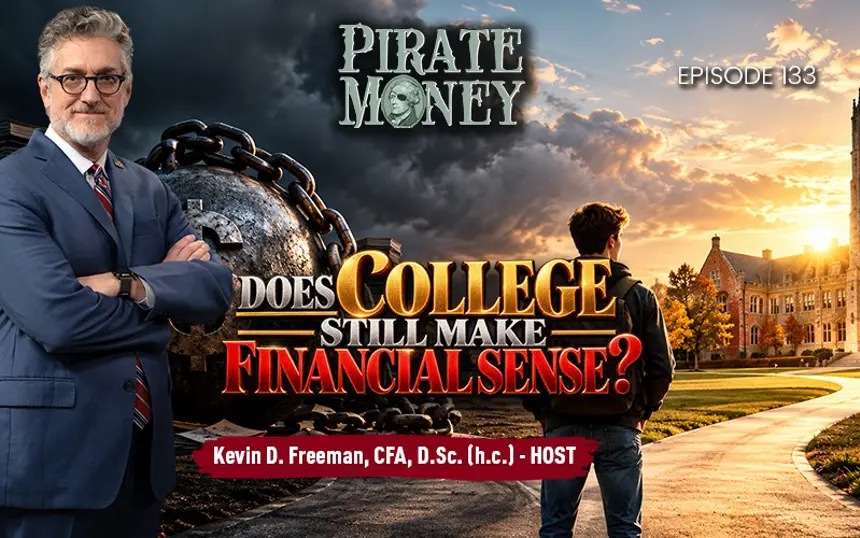
Mike Carter: And I'm Mike Carter. Uh, Kevan, looking at the show notes today, does college still make sense? S E I S E N M S E And I'm like, really? It's kind of does college still make sense? C E N T S with some of the majors people are picking there. We're going to have a tuition test today. We're going to talk about. So if you're a parent, a grandparent, you got kids ready for the test. Uh, is college still worth it today? It'd be a fun show.
Kevin Freeman: Yeah. Well, sense, yes, but pennies, no. Uh, we're talking more Benjamins and really many, many Benjamins. Uh, as we look for, you know, for a long time, the answer was automatic. People would say, yeah, four years of cost and then a lifetime of higher earnings that more than pay it back. That bargain was real for a lot of families, but it's no longer automatic. Tuition and fees ran away from wages for a generation. Loans got easy, degrees got vague, and a machine that writes memos is now bidding on the brochure promised. That means AI is coming straight after those college educated, uh, jobs.
Mike Carter: Yeah, yeah. And it's amazing what it can do. And you look at what you do in an entry level job, you know, you're writing memos, you're maybe creating slides, whatever that might be. Those are all things that are happening in a fraction of a second now with AI So you better pick the right major.
Kevin Freeman: Oh, yeah, no, the right major matters. I don't know if any major is going to survive in the longer term, but, uh, let's look at the college sticker for this, uh, past past year, 2025 to 2026, public in state tuition and fees. Now, this isn't room and board. This isn't, you know, it says it fees. This seems light to me.
Mike Carter: Yeah.
Kevin Freeman: Uh, but this is according to the College board, it's 11,950. That would be the average and private nonprofit. Now, this is more like what, What? I guess my kids went to private schools, but $45,000 just tuition and fees. And that's not the highest college.
Mike Carter: Yeah, yeah, same with mine. And it's interesting you start to look at tuition, oh, maybe I can do that. But they're like, oh, but then there's room and then there's board, and then, oh, you better consider travel costs to and from. It adds up in a hurry.
Kevin Freeman: It does. And a lot of, you know, your kids might be earning money when they're at home. They're not earning money when they're at school. They're spending money. And then, of course, there's all sorts of things where you'll get a call. Dad, dad, did you get a few of those calls?
Mike Carter: I feel those. Oh, I was blessed. Um, I have one daughter that's very independent and the other one that, uh, doesn't spend a lot. So it worked well.
Kevin Freeman: Yeah. So you look at the website price and the check, they're not actually the same. What you're actually writing is actually could be higher, it could be lower. Because the sticker price is not necessarily what you end up paying. There are a lot of discounts that they throw on to entice students. So I remember that when I was on the board of Oklahoma Westland. Right. So we would say, what's our discount? Um, my first board meeting, they said, let's vote on what our discount's going to be. I said, what are you talking about, discount? And they said, well, I think, uh, maybe our discount should be 35%. I was like, what is this, a car dealership? And yet that's true across the board.
Mike Carter: But that's a key insight. And so if you're a parent, uh, starting to look at colleges today, understand that there is some negotiation in there, or maybe there's some extra scholarships they can get in. But if you go in and just pay, uh, retail price or sticker price, it's like going and buying a car and say, I'm gonna buy it at sticker. And there is room to potentially, um, ask. Ask for help. Say, we need a little bit here and there. And it's not like a straight up negotiation, but there are ways to say, I need a little help. What else do you guys have that can make this possible?
Kevin Freeman: Yes. And if they want your student, they will find ways. We, you know, they stack sometimes scholarships, they'll say, oh, these are stackable. And sometimes they're mutually exclusive. Like, our daughter got two different scholarships, one in dance and one in creative writing. And, oh, those aren't stackable. You get one or the other. Uh, one helps cover it. And I was like, wait a minute. So we negotiated and they found extra money for her because they really Wanted her.
Mike Carter: No. That's a beautiful thing. And uh, I was blessed to have both daughters got scholarships. Uh, one got scholarships on top of scholarships. I was like, we don't really even need this one yet. It still cost us money.
Kevin Freeman: Yeah, it does. All right, so if you're looking at public out of state tuition is about 31,880. That is according to the college Board, uh, in State is 11,950. So there's a benefit uh, to staying in state. Community college is a lot cheaper. $4,150. And there are a lot of tricks you can do. Like first two years you take at the community college, transfer the credits in the last two years.
Mike Carter: Yeah, because you look at some of those entry level courses, it's not like you need the best professor to be teaching, uh, those Intro 101 courses that are out there. And a community college, your school, you can get that associate degree. It can be a partial step and then go to the next, next level out there. Uh, but it makes sense to save some on housing costs potentially. You've got uh, your uh, child student can be working easily. They know people in that community and it might be a way for that child to mature just a little bit. Depend. Each child's a little bit different, uh, but it might be a way for them to mature a little bit before they step into the completely on their own. And uh, who knows what's going to happen.
Kevin Freeman: That's true. But college costs alone. Uh, let's look at this because I want to compare. We do this all the time. August 15, 1971, that fateful day that ought to be etched into your head. Now if you've been listening to this
Mike Carter: program, that's the day we closed the gold window.
Kevin Freeman: That's right. No more backing of the US dollar by gold. And you can trace so many changes in American life. Societal. We overall have become much wealthier since then. But the average person has lost ground relative to the top.
Mike Carter: It depends on how you define wealth I guess. But uh, it feels harder and harder to get ahead and I, gosh, I'd hate to be uh, a student graduating today that picks a one off major, spends a ton of money on college and then can't find a job.
Kevin Freeman: Yeah, yeah. All right, so looking back to 1971 which is before my time, believe it or not, uh, but not incredibly, within a decade I was in college, uh, but a public four year degree then tuition, fees, room and board degree degree, not a semester, not a year. A degree was $5,640. The full degree.
Mike Carter: Four years.
Kevin Freeman: Yes. Which was about 130 ounces of gold. Now a public four year budget is now about $124,000. Right. Priced in gold, though. Uh, gold, it's. The price has come down substantially because gold in August 2026 this year was about $4,400. So 28 ounces of gold today will buy you a full four year degree, whereas before it was 130 ounces.
Mike Carter: So price great. If I bought that gold in 1971, if I'm paying for it today. 123. This is a public school. $124,000 for a four year education. And that doesn't include room and board or it doesn't include.
Kevin Freeman: It does include it.
Mike Carter: So do I have disposable income as a parent? $123,000. That can feel overwhelming for a parent.
Kevin Freeman: Of course it can. Yeah. But if your kids are elite enough to get into Harvard and you're earning 100,000 or less, they will find scholarship for everything. But only one out of a billion people that applies to Harvard actually gets in. And only another, you know, and you
Mike Carter: got to meet the scorecard that they have had in the past. But I guess they're working to get
Kevin Freeman: rid of that out. The ESG scorecard? The DEI scorecard. No, it's still there. Is still there. So anyway, Brookings says that, uh, if a student finishes in a field that pays, they can still come out ahead by their mid-20s by going to college. And they come out and they say, look, a, uh, typical graduate is going to break even by age 26 or age 27. And they say the lifetime edge, you'll earn more than a million dollars more if you go to college than you don't if you pick the right degree. Uh, and basically, you know, that's still true. It used to be true for just about everybody.
Mike Carter: I believe that. I mean the opportunity and the things you learn in college besides just the academics, but you're also learning a lot of life skills out there. And then to be able to start in a job and get that first career booster can, uh, make a significant difference because that sets the base and you keep building on that going forward.
Kevin Freeman: It can be true. All right, we're going to look in a future. We're going to take a break in a minute here, but we're going to look at that. Which is better? Starting and going to college even with the right degree or taking the money you would have spent on college and investing it and See which one wins that race.
Mike Carter: Another test. This is another tuition test.
Mike Carter: Huh?
Mike Carter: Huh. Little math involved in that one.
Kevin Freeman: Yep. And I've got a dorm room story I want to share about. That kind of ties into that, and I'll tell it after the break. Um, but what we're talking about is money. Ah. And there are only three things you can do with your money. You can give it, you can spend it, or you can invest it. Here at Pirate Money Radio, we work to explain solutions that support all three areas in a way that promotes liberty, security, and values. Patriot Mobile, it's a mobile phone company, supports the Pirate Money radio program. Patriot Mobile uses US carriers, including AT&T, Verizon and T Mobile, and operates on both Apple and Android phones. More information about the economic war room and Patriot Mobile is [email protected] AF that's PirateMoneyRadio.com AFR and you know, Mike, I'm thinking of mobile phones. We didn't have those when we were in college.
Mike Carter: No. I remember having to split the landline with my roommate, uh, which determined who made what call. And breaking all that out and paying those bills. It was a good life lesson.
Kevin Freeman: It was a good life lesson. We've got some more life lessons here from our time, uh, in life. We're going to share with you some of the things I learned, including a dorm story. You won't want to miss this. There's a very famous character character that I'll be sharing about when we come back right after this break.
Mike Carter: Welcome back to Pirate Money Radio with your host, Kevan Freeman.
Kevin Freeman: And I'm back with the great Mike Carter. And we're talking about the mid-1980s. Remember those, Mike?
Mike Carter: Oh, those are great times. They were still relatively carefree. I was in college and had my sports car and was just enjoying life. And the reality of real world hadn't quite hit yet.
Kevin Freeman: Yeah, well, this is just after I graduated. I was invited to a association, um, of Collegiate Entrepreneurs meeting. It was in Chicago and Association of Collegiate Entrepreneurs and Young Entrepreneurs organization were founded by a friend, Verne Harnish. Ah, Vern, if you're listening. Hello. It's been a while since I've talked to Vern, but Professor Fran Jabbar of Wichita State. And I was speaking, I was invited because I was just about to launch the Personal Capitalist newsletter. I was talking about the power of public markets because not everybody can be an entrepreneur, but everybody can invest in entrepreneurs.
Mike Carter: Right?
Kevin Freeman: And that was, that was the message.
Mike Carter: And you. And you did, you started out as an entrepreneur right out of college. I mean, you started that personal capitalist newsletter and that little investment club. And then that led to another big career step out there. But that's the other track, right? You got the corporate one. And then can you create a business where you can really create some value as well?
Kevin Freeman: And I've done a little of both or a lot of both, given my age. But in this, at this particular moment, we're talking 1984. I graduated in 83, something like that.
Mike Carter: I remember I had an internship then, and IBM, we were, we still had typewriters and we were launching computers.
Kevin Freeman: Yeah, speaking of computers, I gave this talk in Chicago. My dad went with me. You know, I was young enough to say, hey, dad, come with me. Because I was a little scared to be in Chicago, uh, fresh out of school and all that. And so I gave a talk and I had a young man walk up. You know, I was a young man, but even younger than me, not a whole lot. But, uh, he came up and asked if it made sense to quit college. And he wanted to know if he'd start a little side hustle business in his dorm. And, uh, he was at UT Austin, and he was building and selling computers, because you mentioned computers from the dorm room. And I encouraged him. I said, investors might want to back something like that. And, uh, company with real customers can always find help from the public markets. And my dad was there. And later in life, you know, when we went to see him, he remembered. He said, I remember that you remember when you met Micah Dell.
Mike Carter: Wow.
Kevin Freeman: And Micah Dell wasn't Micah. He wasn't famous at the time. He certainly wasn't a billionaire. And I did, I encouraged him.
Mike Carter: So wait a second. Let me just clarify this. You encouraged Micah Dell to drop out?
Kevin Freeman: I encouraged Micah. He asked if it would be okay if he had a thriving business if he didn't get a college degree. Uh, and I said, yes, that was my feeling.
Mike Carter: And you know, Kevan, that was wisdom on your part because, you know, at the time, you know, I think every parent said, oh, well, you know, it's only two more years. Just go ahead and stick it out. But that might have created a gap for him. He was obviously ready to do it
Kevin Freeman: and missed that opportunity. It was the right time in the computer field. Had he waited two more years? He left in May of 1984. He left, um, UT Austin and started PCs Limited. He was a freshman, pre med and his PC. His parents wanted him in class, but the business was already real. He was already making money.
Mike Carter: It reminds Me, I was, uh, talking to someone the other day that, uh, was one of the first, uh, uh, employees for, uh, Steve Jobs. And this guy was an ex Marine and came in and Steve Jobs asked, describe yourself. And he said, I'm a Marine, sir. And he said, did you go to college? No, sir. And that was Steve Jobs. Like that. Because he said, sometimes people in college are too full of themselves and they don't really know how to drive and make things happen. So skill sets you learn everywhere in life. Get both of them. You, uh, might be superstar, you might not need it.
Kevin Freeman: Yeah, well, Bill Gates left Harvard. Steve Jobs himself left college. Charlie Kirk spent years telling students the credential is not the same thing as an education or a calling. And none of that is a rule that people have to go to college or shouldn't go to college. It's proof that the rule was never you must, uh, what I was actually sharing with Micah Dell that day still stands. Capital markets exist to find ideas and to fund them. Entrepreneurs are sometimes better served not going to college than going to college. And the rare exception was Fran Jabara at Wichita State, where they actually taught entrepreneurship. Everything I learned in business school was about getting a job at a big corporation. Uh, nothing at all about starting your own company or what that looked like.
Mike Carter: Uh, and starting a business is not easy. And raising money, if you got to do that, is not easy. So it's for certain individuals. And everybody has a different career path. God has a different design for each person.
Kevin Freeman: But a college age person is one uniquely suited because if you make a mistake, you have an entire lifetime to correct it. Uh, and so no, that's, uh. All right, we're going to take another break. When we come back, we're going to talk about degrees that used to guarantee a job and the hour billing work that AI is already pricing. We're watching AI take those jobs. We need to discuss it after the break.
Mike Carter: Pirate Money Radio. Helping you give, spend and invest in ways that align with liberty, security and values. Welcome back with your host, Kevan Friedman,
Kevin Freeman: and I'm talking with Mike Carter. We're talking about college and whether it still makes sense. Mike?
Mike Carter: Yeah. Or dollars. We want to make sure college still makes dollars, right?
Kevin Freeman: Hundreds of dollars, thousands of dollars.
Mike Carter: You know, it all comes back to that degree question. What type of degree? I remember when I was going to school, uh, maybe I was a little bit nerdish. Uh, I don't know if quite nearly
Kevin Freeman: as nerdy as I was.
Mike Carter: I went through. You had to go to the library. Then I went to. I started looking up jobs and expected salary ranges and incomes and everything else. I wanted to pick a job that I was going to make money at. If I'm going to work, I got to make sure I'm making some money here. I don't think that's happening enough today.
Kevin Freeman: Oh, no. Oh, no. I mean, it used to be to get a job. Engineering, nursing, accounting, teaching, um, those are important professions. But what about gender studies?
Mike Carter: Yeah, that's probably not going to be a great career path. I'd hate to spend 120 to $150,000 on that.
Kevin Freeman: Or here's one. Uh, puppet arts at the University of Connecticut. That is a real degree. Now, I imagine if you're going to work at Sesame street, you might want a puppet arts degree. But then again, is that really the best way to learn to be a puppet master?
Mike Carter: I like this one at, uh, Bowling Greene. Uh, is it Bowling Greene? No. Uh, the Boeing Industry Management at Venice's, uh, was real for decades and was cut in 2020. A Boeing Industry manager. So, you know, I don't see a lot of bowling eyes cropping up out there now. There are some new entertainment venues, but that's a pretty tightly defined degree.
Kevin Freeman: Who wants to be a. I went to college. Why'd you go to college? So I could manage a bowling alley. I mean, that's it.
Mike Carter: You know, One of my daughters is an engineer, uh, and she did very well in school, very smart. And she asked about my major and I was like, well, I was business and marketing and, uh, um, she. Dad. I mean, but did you really learn anything? I'm like, hey, hey, let's get a little personal now. But it paid off.
Kevin Freeman: She went to engineering. That's it.
Mike Carter: She was engineering. She was playing. She was thinking it through.
Kevin Freeman: Not bagpipe performance at Carnegie Mellon, Bagpipe, comedic arts at Emerson and DePaul. Popular culture Bowling Greene. See, Bowling Greene should have the bowling manuscript.
Mike Carter: That's what I was like. Yeah, I want to make. Maybe makes sense.
Kevin Freeman: Yeah. So AI is disrupting a lot of the jobs that you normally would come out. So here is job, uh, market. Who's hiring, um, by the year 2035. You know what is at the top of that list?
Mike Carter: Well, I'm experiencing this now a little bit. Is this the healthcare workers?
Kevin Freeman: It is, yeah.
Mike Carter: Uh, you know, they look at that number home, specifically home and personal care aids. And, uh, my father in law had a tragic fall and his paralysis was turned down. And we got to get some extra care for him. And it is a uh, hot demand topic. Right. Then some of the days come in and say, well, my minimum hourly rate is $40 an hour. Well, that adds up in a hurry.
Kevin Freeman: That doesn't necessarily require a degree, but, like, nursing certainly does. But down the list, stockers and order fillers, fast food workers. Then you get registered nurses. Then you get operations managers, software developers, restaurant cooks, health services managers, nurse practitioners, construction laborers. You know, we're running down this list. These are not the typical things you go to college for. Nursing, of course, yes, but most of the rest of them not.
Mike Carter: It's still a short nurses, but this is a good list for, uh, any parent out there. What's the source of this? Here's a quick view of different professions out there and what they typically pay. So look at your daughter, son or daughter. Look at their experiences. Uh, maybe help guide them to where their passions are. Because we want to know if you find that job where, uh, you love doing it, you never feel like you're working again. Man, if you can help your student find that, your son or daughter find that, that's powerful.
Kevin Freeman: Yeah. So this is from Visual Capitalist Job Market, who's hiring by 2035. And it's got the wage tiers, so you can see they're color coded by wage tiers. And, uh, home and personal care aides is at the top of the list with, you know, unfortunately not the highest pay. Uh, you gotta go.
Mike Carter: And that's not glamorous.
Kevin Freeman: It's not glamorous work. It's. It's hard work. Now, our daughter's generation were told professional degrees or computer jobs were the safe path. But a lot of that office work, a lot of it is with the new tools. AI uh, it's not necessary anymore. A plumber, a welder, they're still being hired because we need the work done. And to this point, AI Cannot fix your plumbing.
Mike Carter: Yeah, the robot's got to get a lot more, uh, ambidextrous. Ambidextrous, doctor, they can't say the word ambidextrous. Ambidextrous. Uh, before they're doing that work. Uh, and, uh, you know, things we got to consider.
Kevin Freeman: All right, we're going to take another break. After the break, we're going to talk about the math of investing your tuition instead of going to college. And we'll cover whether or not who wins this race after the break.
Mike Carter: Welcome to Pirate Money Radio with your host, Kevan Freeman, helping you unpack the economic headlines and providing real money solutions.
Kevin Freeman: And I'm back with Mike Carter. We're talking about, does college still make sense? And we've found that you can get some jobs, and according to Brookings, you'll actually have a million dollars more in earnings if you go to college than if you don't go to college. But that's only half the equation.
Mike Carter: Yeah, that's powerful, and it's important. Kevan. Um, everyone understands. You know, we're kind of educating on what's happening here and what we're seeing in the latest trends. Uh, we're not telling the family what to do with their child or their money. Parents know best.
Kevin Freeman: That's true. And you need to pray about it. See what the Lord has. Who knows? If you go to college, you meet your future mate, or as, uh, one of my daughters did, or you go to college, you get a relationship. Like, you went to Oral Roberts University and you've got a lot of good contacts that are paying off, even as entrepreneurs, you see pay, contact. But let's look at just the pure math of this. Four years of college, public versus private. Public is much less expensive. Private is much more expensive. Right, We've talked about that. Um, and then we talked about what happens if you invest instead of going to college. You take that same year amount of money and you put it aside and put it in investment accounts.
Mike Carter: I'm looking at those numbers, and it becomes very interesting because that private nonprofit, four year total, $261,880. That's a lot of money. That's a lot of money to invest or that startup for a business, if you're sure that person is right for the business. I know somebody, uh, in my hometown, uh, whose daughter just wasn't. School wasn't for her, but she wanted to start up a coffee shop. This is in the world of Starbucks and everything else. She's thrived, got three or four stores, and that market owns the market, uh, and been very successful. They took the college money and they put it in the business. Mine helped her a little bit, but
Kevin Freeman: she invested in herself. What if you just invest it in the stock market at an 8% return? You say, I'm not an entrepreneur. It's the whole Micah Dell story. I mean, there's Micah Dell and then there's the people who would invest with him who became very wealthy. Also. I invested early on in Apple, and I invested early on in Microsoft and saw good gains. And by the way, I'm not saying every investment I made, many were dismally poor in outcome. But if you invest in the public markets and you got an 8% return. So you're investing in other entrepreneurs, your potential. That $261,880 that you invested is $9.8 million by the time you reach age 65.
Mike Carter: Wow. Uh, that makes me rethink some things. Uh, maybe I need to go back in time and rethink some things. That's a lot of money.
Kevin Freeman: That is a lot.
Mike Carter: M. 8.9 million.
Kevin Freeman: Is that what, 9.8 million?
Mike Carter: Okay.
Kevin Freeman: All right. That is if you took the private, uh, school and you paid. Now, that's full tuition. A lot of people get scholarships, and so it wouldn't be that much. Um, but public school, even public school, you invest it, and it's 4.6 million.
Mike Carter: Wow.
Kevin Freeman: By the time you reach, um, age 65. So it makes a huge. Literally, you have.
Mike Carter: Kevan. I'd kind of like to have the 9.8 million right now.
Kevin Freeman: Yeah, well, you're. You're not there yet.
Mike Carter: No, I'm not quite there.
Kevin Freeman: You've got a few months. You're gonna have to get some great returns.
Mike Carter: There'll be some big Social Security boosters coming up.
Kevin Freeman: Yeah. So. So when you look at it and. And you really calculate it now. So let's. Let's walk through this, um, how it is. Same three uses of money. You can give it, spend it, or invest it. Tuition is spending. The school says it's an investment. A family should test that claim before they sign the loan. Right. Because they're borrowing money. And this does not include the interest that you might have to pay on that student debt.
Mike Carter: Correct.
Kevin Freeman: All right, so round numbers on purpose. Four years of public in state tuition at the $11,950 sticker is 48,000 before room and board. Four years of private tuition fees at the $45,000 sticker is about 180,000 before room and board. If a family put that sum to work instead. A rough rule of thumb is the rule of 72. We talk about that. You divide 72 by the yearly rate. 8% means your money doubles every nine years. At 10%, it doubles every seven years. Over 40 years, it's a large pile of money. And that's just the power of compound interest.
Mike Carter: Yeah, but that's. If the markets continue. There's no geopolitical crisis or so forth that's out there. So investing in yourself and building skill sets is always a great thing to do. But these really are great, uh, kind of fact checkers. Okay. What are we really doing here? And how are we making the best decision, uh, for our Son or daughter's career.
Kevin Freeman: Okay. Georgetown center on Education and the workforce 2021. Uh, regarding full time workers age 25 to 64, the high school diploma gets you about 1.6 million of lifetime earnings. The bachelor's degree about 2.8 million. The difference of 1.2 million. According to Georgetown center on Education. You'll earn that much more. Money does not offset the amount of money if you took your college funds and invested them instead. It doesn't offset it. Investing in yourself via education is not always the best answer.
Mike Carter: Yeah, well, uh, making sure that, uh, you've got the right skill sets in life is the answer. Uh, and nobody's better at helping guide their son or daughter than a parent.
Kevin Freeman: And it's not all about the money is the least valuable. Uh, of relationships, health, money. Money's the least valuable. It comes in handy though.
Mike Carter: It does. Uh, and just to have the pressure of not worrying about how you're going to pay those bills, to be able to have one, uh, less distraction in life is a valuable thing. But we all know it's about what God's called that individual to do and making sure they find what their real calling is in life.
Kevin Freeman: Yeah, but I don't want to miss this. As one who sat on the board of a college, I want to tell you, find out what's the right thing for your student, pray over it. Uh, pray with them, see where their heart lies. Because can you imagine if you said to your kids, I will cover all your expenses, your room, your board, every expense. And I want you to work for four years even at a reasonably low paying job. And I want you to put that aside. And I'm going to add to it what I would have paid in tuition. So your room and board are covered. Their work plus your tuition funds invested for their lifetime could be as much as $10 million when they, um, hit 65.
Mike Carter: Well, definitely things to consider. But then I go back to that common thing. You know, I've had several jobs in my own businesses and jobs at the companies. Uh, but when I found that one sweet spot where this is what I love doing, I don't feel like I'm working anymore. That's where I was in my prime happy state, I guess. You know, it was awesome. It doesn't happen often, but help your student, help your son or daughter find that.
Kevin Freeman: Yeah, just. It is no longer an automatic. That's all I'm saying. It's no longer automatic. Oh, they automatically have to go to college. Charlie Kirk would argue otherwise. And the data Argues otherwise.
Mike Carter: And I feel better about that if my son or daughter is just a superstar IQ and really, you know, has their act together. Um, that's not for everybody.
Kevin Freeman: No, it's not for everybody, but it is for some and many. And schools are going to have to adjust and a lot of colleges are going to be shut down. AI is going to put a lot of colleges out of business. Business. Because you can acquire information a lot easier. And these gender studies programs and a lot of those crazy, uh, uh, you know, majors, they make zero sense. You graduate and you don't even find a job not in your field. And most people that graduate don't tend to get a job in their own field. So be choose very carefully. Now, my sister's family, they're all engineers and they all got jobs immediately. They're great jobs. Uh, they're brilliant. My nieces and nephews, and she's got a bunch of them. Ah, they are brilliant, um, people entering the workforce and having lots of kids themselves, which is great. It's great for America. It's great for society, and I'm grateful for that.
Mike Carter: But I'd rather see a young person learn a trade or own a piece of a real company than borrow from a major that doesn't hire. So getting that right mix there is critical. Uh, and sending your kid to the right school, that's important as well, because you can spend a lot of money to get your kid messed up.
Kevin Freeman: Yeah, no, and we're going to talk about that. Is it good for your kids to go to school? Do they keep their biblical worldview and so forth? We'll talk about that coming up. But I do want to point this out. College is way more expensive than when you and I went unless it's priced in gold, which we talked about in the last segment. And here's the reality of it. College costs have gone up, yes, but it's really because the dollar's gone down in purchasing power.
Mike Carter: Same old story we hear again and again. There is a solution though, right?
Kevin Freeman: Yeah. As you're preparing for it, if you have a new baby, maybe start saving, uh, for their college in gold rather than in US Dollars. Um, full disclosure, we've invested in a solutions provider that allows just that. Support for this program comes from Glint. It's a financial technology service offering with a debit card and a mobile app that enables users to add access their gold holdings for everyday purchases. With Glint, users maintain ownership of allocated physical gold, which is stored in a managed vault. And at the time of a transaction, gold is Sold in real time to cover the purchase amount in local currency. Glint offers an alternative way to store and use the value. Combining gold and silver with modern payment infrastructure, Glint clients can monitor their gold balance, view transaction history and manage their accounts through the Glenn app, available on major mobile platforms. More details about how vaulted physical gold and can be used as money are [email protected] Gold247 and you know, Mike, if we could do that as a baby, you start putting some money aside and keeping it in gold. By the time they hit 18, they might have enough for tuition or maybe to start their own first business. We're going to take another break. When we come back, we're going to talk about what it's like, life on campus, what college was founded to do, Is it doing it? We'll be right back after this break.
Mike Carter: Welcome back to Pirate Buddy Radio with your host Kevan Freeman.
Kevin Freeman: I'm joined by Mike Carter. We're here, two men on the radio here talking about college. But college is, is no longer just for men. And primarily it's not for men as much as it is for women these days.
Mike Carter: Yeah. Ah, demographics seem to be changing or admission standards are changing. I'm not sure what that is, but so are colleges. Many of these colleges were founded for one purpose and there's been, uh, a, uh, mission creep that's taken them off course.
Kevin Freeman: Yeah. Women are 58% of undergraduates among 18 to 24 year olds. About 43% of women are enrolled in about 34% of men. Uh, so that means, you know, 43, nearly half of every woman in this country in college age is enrolled in college. Um, but only about a third of the men. Now that might be a reason we were talking about what are good reasons to go to college. If you're a young man and you're a Christian looking for a beautiful woman in your life, that might be a good reason to go to college because that's where the women are.
Mike Carter: But, uh, some campuses are not where maybe a Christian family wants to send their son. That's for sure.
Kevin Freeman: That's true. A lot of young men aren't in college. Some campuses are not the place. Um, and look, we're not claiming a secret admissions plot, you know, let's plot against the men and only allow women in college. No, it's just demographically, I think that's what's just been happening is that women are getting their more and better scholarships for women. They're trying to level the economic playing field. And I get it. And colleges are Generally progressive in this sense. And so it's not some secret hidden plot, um, but it is a real statistic. It's something we're seeing happen.
Mike Carter: Yeah, unfortunately, my fear is that the guys are home addicted to video games and not even thinking about school or girls nowadays.
Kevin Freeman: That's true.
Mike Carter: Might be a little off. That's true.
Kevin Freeman: I see some of that and, you know, another reason. And this is a very much more recent change, but it used to be I grew up, and I was, you know, I grew up in Oklahoma. OU was the big football school in Oklahoma with Barry Switzer, and the Sooners were winning national championships. And so a lot of kids say, I want to. They were OU fans. I want to go to that school so I can be part of that team. But now, you know, uh, with this nil name, image, likeness, and the portal allowing people to jump from schools, that loyalty to a sports, ah, team, a college sports team, has diminished.
Mike Carter: Oh, the whole sense of community. I mean, we can do everything online now. I can take school online, I can order online and never have to go out. We're losing that sense of community. Uh, and I think that was one of the powers of the university experience, being able to have that camaraderie, to have teams you cheered for together, to have, like, mind, uh, interests. Uh, that's an important part of life. And growing up.
Kevin Freeman: It is. And you went to Oral Roberts University, which is a great school. Not a football school, but it was
Mike Carter: a great school till they changed the, uh, salary rules. And, uh, now you gotta play millions to get the best athletes out there,
Kevin Freeman: which is, again, that's what I'm talking about. It's changed the way we view college.
Mike Carter: Yeah.
Kevin Freeman: All right, here's the thing. Harvard was founded in 1636 by the Massachusetts Bay Colony dreading to leave an illiterate ministry to the churches. So they were thinking, the churches are too woke. And so Harvard is going to give proper ministry education now.
Mike Carter: Harvard. So Harvard. And this is so much the problem with so many schools was a Christian university. Now they have, what, an endowment of almost $57 billion. And what's happened? Are they a Christian university today? They can have a hard time saying that.
Kevin Freeman: No, distributing $2.5 billion, 37% of operating revenue. Uh, but Harvard, for all of their money, is not supporting the faith. They're denying the faith. Uh, every time you run into Harvard, it doesn't appear like it's, you know, good. Uh, friend. Kelly Kohlberg Finding God at Harvard was a best seller because she had to search to see if God was even mentioned there. And it's not just Harvard. Look at right in our own backyard. Baylor University stirs anger as it opens the door for a first LGBTQ student group.
Mike Carter: Yeah, that one surprised me. I mean, I know that, you know, Baylor's a Baptist school, but I know they're also kind of lenient in how they approach that when they're in admissions. But, uh, LGBTQ seems like it's really crossing the line.
Kevin Freeman: And this is a big challenge for you if you're going to pay one hundred and some thousand dollars for your kid to go to college and you find that the vast majority of them lose their faith later in their 20s. And Barna found 59% of young adults with a Christian background disconnected from church in their 20s. Wow. That was 59%. They later updated 64%. One in nine left the faith entirely. Parents do not need, uh, to spend that much money, watch their kids walk away from their faith. Now, you were blessed. You went to Oral Roberts, and there are a lot of good Christian schools. I'm not hammering those, but you got to be careful with where you let your kids go to college. You don't want them losing their faith. All right, we're going to cover this and more when we come back right after this break, we'll be talking about college.
Mike Carter: Pirate Money Radio, helping you give, spend and invest in ways that align with liberty, security, and values. Welcome back with your host, Kevan Freeman.
Kevin Freeman: Mike Carter is joining me. And Mike, we've been talking about where college doesn't make sense. You know, if you're spending too much money, if you could invest it, if your kid really wants this weird degree, if it's a secular college and it's going to purposely, I mean, I went to college and they tried to destroy my faith. In fact, one professor said, you will not believe in Jesus. Here I am in the middle of the buckle of the Bible belt and I'm going to break you down. You're not going to. It was just like that God's not dead story for me.
Mike Carter: And, you know, and if you're a student, if your son or daughter is strong in their walk, uh, maybe it's not a bad thing. You know, I went to a two year school before I went to oru. Uh, and during that time, I was president of the student body. I was dealing with all different types of diversity, all different types of diverse opinions. I was challenged, and I would say I probably actually grew more because of that being challenged. But you better make sure that your son or daughter is grounded in their faith because there is temptations and there's distractions everywhere. And that's a key part that you want to work through. Uh, for others, it's definitely the right fit, get them in the right school, that's going to help guide them along the way with a good system and
Kevin Freeman: Christian path, with the right support. All right, so sometimes college makes sense. The degree is really the differentiator. Is it medicine, nursing, engineering, accounting, law, a license the state still requires. Um, if the net price is low, if scholarship, family cash or a public in state bill you can pay without paying, borrowing a lot of money and decade of interest, the student's likely to finish. Um, if you drop out though, and you have debt, it's disaster. And it can be a lifetime of disaster. This is why you have to pray over what is best for your student. And we're not trying to give you, uh, you know, any solid answers here. We're trying to drive you to your knees to ask about your student and what's the best. Exactly. So look for places that you can afford. Look for places where the worldview matches the family or the student's already strong enough in their faith, uh, that the college isn't going to destroy it. That's what we're saying basically, right?
Mike Carter: Yeah. Yeah. And again, uh, most 19 year olds aren't going to be the Micah Dells out there, uh, so you don't have to pretend that they are. Uh, but don't look at that brochure or borrow tons of money thinking that that brochure loan is going to take care of them. Well, I'm going to do my part. I'm going to pay for four years of college and they're going to be set and we're done. No, you're still helping to guide that student, uh, on a path that the Lord wants for them, on a path that's going to drive them to success.
Kevin Freeman: Parenting is for a lifetime. My parents told me that and I was like, oh, come on, I'm on my own. And now I realize with our adult children that parenting is for a lifetime. And God's given us stewardship role there. And at some point my kids will take care of me like I took care of my dad. But here are things. Great schools. Uh, I had a daughter graduate from Liberty, uh, Hillsdale. I used to manage a piece of their endowment. Regent. They gave me an honorary doctorate, Oklahoma Wesleyan.
Mike Carter: I would say you earned that, doctor. They didn't give it to you. You earned that one.
Kevin Freeman: Oklahoma Wesleyan. Where I sat on their college board for a decade. Oral Roberts, uh, where you went, Mike and Belhaven, where. Another doctor. There are many good schools out there. It's worth it. And you walk away having a lifetime of experience, preparation, um, yeah, and the
Mike Carter: friendships, the networks that I developed. I had a business partner that was a Yale grad, and as we were doing, uh, different, uh, business ventures and projects, he's like, I went to Yale. We're supposed to be the most networked out there. But I'm amazed at your friends that come alongside. That will help, that will get together. Those are relationships that were built. Uh, or he was a school where you make no little plans here. And that mentality has helped shape my life. But it was also about going into all the world with the good news. And those principles are key. I mean, if you can set that system and framework in your student to where they're going to have success in life and look to the Lord, that's what you want to accomplish.
Kevin Freeman: It's not just about the money, although it can be disastrous if the money is spent wrongly. The wrong degree. And then there's a dropout or whatever. But here are the things you need to weigh for a child or grandchild. Write this down. The gate. Which gate are they going through? Which major are they going through? The price are they going to finish? What worldview will they carry when they leave? Then you can decide. And if you want to write to us, afrpiratemoneyradio.com, tell us what you're choosing for your kids. We love comments and we're getting lots of them. I spoke at a group of young people, uh, counteract in northwest Arkansas, and I can't tell you how many parents and, and young people came up and talked to me and said, I heard you on American Family Radio. So that, that is, that made me feel really good and it made me also focus. We've got to talk about college. It's an important part of Pirate Money.
Mike Carter: Pirate Money. Uh, and thankfully, we've got another system that's going to maybe eventually help you pay that. And fair weights and measure.
Kevin Freeman: That's right. All right, thank you to our real life audience. Stay faithful, stay free. But, but if you're following on podcast or on American Family Radio, all I gotta say to you is stay tuned.
Mike Carter: Welcome back to Pirate Money Radio with your host, Kevan Freeman.
Kevin Freeman: Yeah. For American Family Radio and the podcast crew. Thank you. Uh, the old bargain on college, that was real, but it's not automatic. You know, the, uh, notion that you Go to college and you get a higher income as a result of it. You know, that happened. It still happens today. But you got to be in the right college degree as a welder or getting a license or starting a company in a dorm room. You got to figure out what's best for you as a student or as a parent, uh, what makes the most sense from God's perspective. And these are all American answers.
Mike Carter: Yeah, yeah. So this is ultimately that tuition test that we talked about at the beginning of the show. You know, there's not any one right answer on this thing, but, uh, it belongs in the conversation. Is it ownership credential? Is it an education? Uh, what's the best career path for your son or daughter out there? What's the right spiritual path? And making sure you find that school that really stands for and reinforces, uh, the message of the Lord. If you can get that is awesome. Uh, and that's going to make a difference out there.
Kevin Freeman: You know, like most things in life, I wish I could open up and find the specific verse that says, thou shalt go to college or thou shalt not go to college. Or if your name is Kevan Freeman, you should do this. I would love that. But it's not gonna, you're gonna have to learn the principles of God's word. One of them is don't go into debt or heavy debt. Uh, another of them is train up a child the way they should go, find their bent and train up a child in the way they should go. In many cases means find what is right for them and then when they're old, they won't depart from it. It's to give them guidance all the way through and don't abandon them. Woo hoo. They're off at college. We're going to take a four year vacation. No, no, you're still parent, you still need to be involved. We want to train up and educate the next generation of believers to carry on the faith.
Mike Carter: Be a parent, but have that conversation. Uh, you know, I remember my daughter, one of my daughters, both of them. But I'll share this one story because of time, uh, she was not going to go to the school her mom and dad went to. Absolutely not. Uh, and if we would have said, oh yes you are, uh, it would not have been a good experience, I can tell you. So we traveled the country, we looked at what was important to her, we looked at different schools, and eventually she made the decision based upon her experience of what she saw and where she felt the Lord was leading her. And that led to a much more pleasant experience. And we said, nope, this is what you got to do.
Kevin Freeman: Yeah, but you did get her to go to your school, which is kind of cool. All right, we're going to, uh, need to pray over this, everybody. So let's pray. Father, give parents wisdom that's not fear, not pride. Guard sons and daughters from debt that masquerades his destiny, and from teaching that unmakes of faith. Bless the work of our hands. Lord, bless the classroom that tells the truth and the trade that keeps a house standing. Father, we pray for parents and we pray for students alike. In Jesus name, amen.
Mike Carter: Amen.
Kevin Freeman: All right, if you got questions, prayer needs, or comments, email us@afritemoneyradio, uh, dot com. That's afriratemoneyradio.com and we need to be praying for America. We need to pray for America to return to God's principles this year and next. We've got an election coming up. We need to follow biblical wisdom with our money. And you can follow us by listening wherever you get your podcasts, Apple, Spotify and the rest. Uh, more about this can be [email protected] this is Kevan Freeman, joined this week by Mike Carter for Pirate Money Radio.
Tuition soared, AI is disrupting entry-level careers, and not every degree delivers a return. Kevin and Mike put higher education through The Tuition Test—comparing college costs, lifetime earnings, trades, investing the difference, and the hidden cost of worldview. Before your family signs the loan, ask: Is the degree really worth the price?
 Live

Did you know American Family Radio is listener-supported? Your monthly financial support will allow us to continue upholding Godly values through our numerous channels, like American Family Radio, One Million Moms, The Stand magazine, and many more.
Become a Great Commission Partner TODAY to help AFR transform culture by rebuilding the family. When you donate today, you’ll get access to: