Food security, food independence, homesteading
Kevin Freeman: ahoy, mates. Welcome aboard another voyage of Pirate Money Radio, the show that sails against the storms of fiat tyranny, cultural confusion and counterfeit ideas to chart a course toward liberty, security and values business built on biblical truth. I'm your captain, Kevan Freeman, coming to you from the heart of Texas, joined today by my good friend and co host, Mike Carter.
Mike Carter: Kevan, good to be back on the ship. I've been out for a few weeks, but, looking at the topics today, excited about today, we're dealing with in politics, they talk about those kitchen table issues. You hit a really hot kitchen table topic, I think today. So I'm excited to talk more about this.
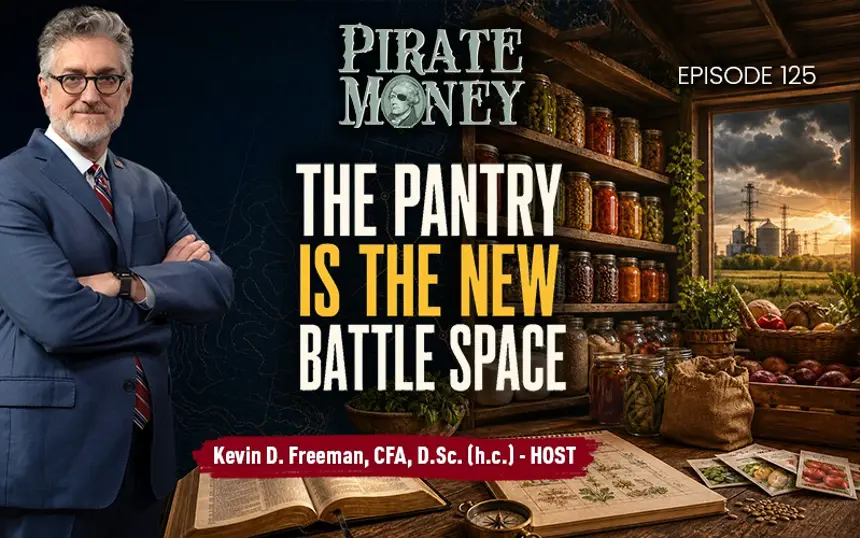
Kevin Freeman: Yeah, we're actually talking about the pantry, which is the new battle space. Food security, food independence, homesteading. Not as some Instagram fantasy of perfect raised beds and sourdough starters, but as practical Christian stewardship. In our recent economic war room episode. You remember that one, Mike? food is energy. That was 409. We showed how tightly modern food production is tied to energy. And fertilizer is made from natural gas and we have the straight of Hormuz. And so there's a little impact on our grocery shelves coming up.
Mike Carter: Yeah. And people are definitely feeling it. I went to the grocery store the other day, was picking up some stuff, and what I noticed is I started buy stuff off the shelf. Usually my wife does it. and I'm so thankful I realized how much of a service that is. Appreciate that weekly grocery shopping. But everything I pulled off the shelf was $5. $5, $5. I'm like, my gosh, this is adding up in a hurry. And you know, I looked at the receipt and it was magically like 5, 5, 5, 5. And a few things in between there. But what's happening? We're seeing the Washington Post did an article. People are paying for it with their credit cards. And a lot of people have done that, but you pay it off at the end of the month. Now people are doing it and saying, I'm just going to let it roll a little bit more. let's wait and pay that off a little bit later. And we see people starting to pay with revolving debt. That's concerning. That's a table topic, that we need to address and we need to be prepared for.
Kevin Freeman: Well, you understand that. I mean, you did the P and G and you know what the shelves look like and they're hitting a $5. Because they know that people don't think that's too much, but that's the maximum they can get. And they're reducing the size to fit that five DOL.
Mike Carter: Yeah, they're hitting the 497, 479. So it's not quite five. And as we've talked before in the show, what consumer product companies do is they have to make sure that they're tailoring the product to what people can afford. So when you see the packages, the boxes, same size, but maybe the packages inside getting smaller, they're driving to a price point that the customer can afford. And that's a scary point to be where we see those packages getting smaller and smaller.
Kevin Freeman: It's hitting young people a lot too. young people are used to having you talked about going to the grocery store. Young people are used to having their grocery store groceries delivered. They like them, somebody going shopping for them. And this Bill Maher pointed it out. He said, you know, the $20 burrito is what people are complaining about because they'd show a receipt. I just paid $20 for a burrito. And Bill Maher says, yeah, and you had it delivered by Uber and you ordered it from the fancy burrito. You can still buy a two dollar burrito if you go to the grocery. But it is impacting people. and we're not here, we're seeing a serious warning light. and we're not here to stir up panic. Panic's the opposite of faith. We're here to talk kind of preparation that we can do as families to develop resilience. We're talking about how we can look at our food pantry and maybe go back to some old timey things that, help produce that resilience, through a little bit of hard work.
Mike Carter: Yeah, and that's wise. I mean, In Proverbs, Proverbs 6, it's go to the ant, O Sluggard, consider her ways and be wise without having any chief officer or ruler. She prepares her bread in the summer and gathers her food in the harvest so the ant doesn't wait for a crisis. Kind of a weird analogy. I'm not sure I would have picked that, but God knows best. but, it's about being prepared. It's not about being fearful.
Kevin Freeman: I've never had ant bread. What is ant bread?
Mike Carter: I have a new respect for the Marvel superhero Ant man now, I guess. but anyhow, gather when you can not out of fear, have foresight, be prepared. And you know, we've Talked about grid issues, we've talked about supply chain issues. It was back in the late 80s, early 90s, the consumer products industry stepped back and looked at grocery retailers, said, all right, we can help you be more productive. They work on very small margins, 1 to 2%. So something called efficient consumer response was all about just on time delivery, not carrying too much inventory, having just enough on hand. That's setting us up today that if anything happens that changes that algorithm. You've seen it before, grocery shelves are gone. There's no backroom inventory, no backroom stock. Even the warehouses, it's just in time, delivered and out to the customer.
Kevin Freeman: And that works great if every in the supply chain works. But you have a bad harvest, you have a bad storm, you have, power outages, you have strain, of hormones closed, things like that.
Mike Carter: And energy is food, as you said before. And I think a lot of people aren't connecting those dots.
Kevin Freeman: Yeah, well, Genesis 2:15 tells us the Lord God took man and put him in the Garden of Eden to work it and keep it. We, were given dominion, but it was never permission to exploit and walk away. It was a call to tend and to keep. Now, we used to have a lot of farmers in this nation, and, you know, we all had relatives that were farmers. Now they've just been all gobbled up in these big conglomerates. And so again, just in time, inventory, all of these things, provide for really, a dependence that we have on something that may not be permanently stable.
Mike Carter: Yeah, yeah. And, you know, my grandpa and grandma, I remember Grandma canning. I remember the food, I remember them having extra groceries in the basement, all that kind of stuff. I don't think people are thinking that way today.
There's a whole movement on homesteading, which we'll talk about today
And I know you're going to hit on something that's pretty personal here. This Trail of Tears. And this is really intriguing to me. Seeds that go back to the original, not genetically modified. These are original seeds that the Cherokee tribe has had a food bank, a seed bank somewhere.
Kevin Freeman: Oh, yeah. and we'll cover this next week. I'm going to have Madison, our daughter come in, Marnie's and my daughter come in and be our guest host next week. but, yeah, the trail, Trail of Tears. Everybody knows that. You've heard this, about how the Cherokee Nation was forced out of the east coast into Oklahoma, which is how my family got to Oklahoma. Well, they carried with them seeds and their original heirloom seeds, and they've been growing them continuously, since the 1830s and actually before that and so these are very special things, and they do provide for Cherokee citizens. Every year I've got the letter from Chief Hoskin and Deputy Chief Warner right here. when they send me. Every year, they send me. And you've got artichoke seeds. They call them sunchoke. You've got corn and tobacco there. I've got a few others here. I've got pumpkin, and corn and tobacco on this. I mentioned tobacco twice, didn't I?
Mike Carter: The corn's got my attention because, you know, the corn has been genetically modified so much. Everything I've seen on that. I'm really curious to see what corn was originally like. Yeah, it might be worth trying to grow a stalk.
Kevin Freeman: We're definitely going to grow some and prepare it. And yeah, this is about. The Cherokee Nation has done this to preserve. Preserve our heritage. But I'm suggesting all Americans should do this to preserve their family. Right. There's so much that comes from learning by growing, planting. My grandparents had a massive garden.
Mike Carter: My, wife's grandparents did. I remember we tried it as a kid in the 70s. We had a farm field next to us, and we lived in a suburban neighborhood. And someone had the idea, let's create little 10 by 10 plots, and everybody can have their own little garden on this farm field. At the edge of the farm field, I remember planting radish. I remember putting all the stuff in there. I was so excited. And then I saw the weeds come up, like, ah, this is a lot of work. And then I had to water it. And I'm like, ah, I love the miracle of a grocery store. But that was the. Everybody used to do it. And we. It looks like we might get back to time where it makes sense to do it again.
Kevin Freeman: It does seem to make sense. And there's a whole movement on homesteading, which we're going to talk about, today. So the goal is to develop resilience, if there's a reason where food goes down for a while, to potentially save money to increase your health, for spiritual growth, and also to strengthen the family. There's something about a family working together. I remember from my grandma, we have to snap the beans and we have to peel the new potatoes, and we have to get everything ready. And nothing tasted better than when we prepared the food grown in her garden. So we want to do all five of those. All are godly. They really give you a break from the world systems. And it gives you an opportunity, to make an impact in your family in a positive way. So that's what we'll be talking about today. And I like that one. The save money thing. Once, you set the garden up, you save money. I'm not sure initially when you're buying all the equipment and everything that you're going to save money, but saving money is important, and there are only three things you can do with your money. You can give it, you can spend it, you can invest it. Here at Pirate Money Radio, we work to explain solutions to problems that support all three areas in a way that promotes liberty, security and values. Patriot Mobile is a mobile phone company, supports the Pirate Money radio program. Patriot Mobile uses US carriers, including AT&T, Verizon and T Mobile, and operates on both Apple and Android phones. More information about the economic war room and Patriot Mobile is [email protected] AFR that's PirateMoneyRadio.com AFR and maybe we should be creating Patriot Gardens or Liberty Gardens in our backyard, buy some seeds and, and see what happens.
Mike Carter: It sounds nostalgic, but it kind of sounds cool now. And, you know, we have new technologies, too, that make it easier. they got these garden beds that are raised up on tables and all that kind of stuff. So if you're older, you can do that kind of stuff. So I think it's an intriguing idea.
Kevin Freeman: And YouTube videos.
Mike Carter: There you are.
Kevin Freeman: I remember looking at that garden and like, how do you do this? And now you can get 100 different people that'll tell you how to do it.
Mike Carter: The secret to getting rid of weeds. That's what I want.
Kevin Freeman: Yeah. And one of them is Dr. Robert Malone, which is interesting. And we're going to look at some of something he's written in his sub stack on homesteading. Homesteading is a great new way that you can bring fun and adventure to your family, maybe save a little money and maybe provide some food security. So we're going to cover that and more when we come back right after this break. We'll be right back.
More Americans are buying groceries on credit
Mike Carter: M. Welcome back to Pirate Money Radio with your host, Kevan Freeman.
Kevin Freeman: And I'm talking with the great Mike Carter. You're a father I admire. You've got an incredible family. I've watched you and Jane and your family, you know, through the years. And you, you took on a little property and you do a little bit of, brush hogging and all sorts of things. but right now we're looking at, that's to keep your property looking nice. Now we're talking about maybe getting some food out of it. Why does this seem so urgent that people are beginning to go back to homesteading.
Mike Carter: Well, I think, you know, there's the economic piece, which we talked about a little bit earlier, but, I think there's also the natural food piece. And what am I really getting out there today? There's that whole maha movement going on, and maybe there's a chance for the family to say, hey, this is something we can do together. This is something where we can bond together over. Although it's hard to do because I'm in the air conditioning with my tech and my social media, and it's like, hey, let's go out and do the garden. I had all these great visions even when I had my land, and the kids wanted to, let's move here, dad. and you start to realize that's a lot of work doing this stuff. But if you can be smart about how you do it, if you can be efficient, if you can have the water system set up and so forth, it can also be really rewarding. And you're going to get a better tasting food. You can't taste the difference with that homegrown freshness.
Kevin Freeman: You know, it's interesting because Dr. Malone was writing about blueberries and how plump they are now, and they're sweet, but they don't have much flavor. And he said they've been genetically modified. I guess they've been modified in some way grown so that there'll be lots of sugar, but they don't t at all like blueberries. When I was a kid, they had a little more tart flavor to them and they had intense flavor. And they don't have that today.
Mike Carter: Yeah, no. Again, Grandma used to have. She won the canning contest in the state fair. I saw an old article on her back in the 19, probably 19 early 30s or something like that. So, that heritage, though, of the canning and having food there, it's natural, it's not full of preservatives. it's healthy. it's not been modified, it's not been hit with all kinds of, pick the chemical of the day to get rid of the weeds around it. there's something to be said for having great, healthy food. and if there's a way to do it and bring families together and get them intrigued, I'll be interested, when you have Madison next week to see if she's excited about, getting out there in the garden and getting dirty. She's got that polished look. I don't know. We'll have to See what she says on that?
Kevin Freeman: Well, she actually learns how to do stuff. And then she does it. She does it her way. And it's amazing how good it turns out. But I was looking at this article. You brought it up in the last segment, about more Americans are buying groceries on credit. And that's in the Washington Post. That's a little scary. It says one in three working age adults used credit cards to buy groceries, and many of them had trouble paying them off. Now I'll use credit cards to buy groceries because you go into an Aldi or something and it's just tap to pay and you're done. But then you want to pay it off at the end of the month. If you're eating your line of credit, you'll go through it pretty fast.
Mike Carter: Yeah, the buy now, pay later. I remember seeing that for things like, oh, you want to buy this jewelry for your girlfriend, or you want to, buy something on credit. That makes sense. But, my hamburger, I don't know. And you look at what's changing in payment systems today, Kevan. We're seeing this as we look at transactional gold and what's going on there. People no longer get paid. A, lot of people no longer want to get paid every other week or once a month. They want to get paid by the day now. And so payment systems are changing where, okay, I need my money today. I want to be paid today. And that's setting up. That's either saying, okay, this wealth gap is getting bigger and bigger, but they're setting up a problem to say, do they really need that money today? Are they that day to day living?
Kevin Freeman: As an economist, that's a red warning light. It's something you're really scared of when you see, people, I need to get paid today. That's a day laborer. Right. That's not building a great society that is having day laborers that show up and all right, and you and you come work with me. That is not a healthy sign for the. And here's another unhealthy, sign for the economy is that we have gone so far the other direction that we've ended up with a very big, farm system that doesn't have any little guys in it. And in fact, local zoning restrictions are telling people, oh, you can't grow your own food. That's making us dependent on a big system. It seems very communist to me.
Mike Carter: Yeah, I mean, and I grew up in the Midwest, some of the most beautiful farmland you can imagine. And you can see what's happened where farms used to be, 40 acres. And you can see the farmhouses, and you can see these great traditional old barns that are dilapidated, but massive timbers and stuff. And it's all sitting there unused because corporations have bought farm after farm and farm, they've assembled it, and now they're farming thousands of acres, delmounting and so forth. And you still have very successful independent farmers.
Kevin Freeman: But it's, it's creating a massive dependence on a vulnerable chain, and it's something that we as Americans need to address. And we'll talk about how you address it when we come back right after this break. We'll be right back.
Mike Carter: Pirate Money Radio, helping you give, spend and invest in ways that align with liberty, security and values.
Kevin Freeman: We all need to become farmers again
Welcome back with your host, Kevan Freeman.
Kevin Freeman: Yeah, we're talking about food, production. And when I was a kid, when you were a kid, Mike, a lot of people grew their own food or had a meaningful input to their food. Then it became that it was just a little fashionable thing that you could do, and you might get two carrots a year or something. And now it's just like nobody even thinks in those terms. Food is something. When you open up your, Uber Eats app and click on something, food shows up. That's how you get the $20 burrito.
Mike Carter: Yeah, yeah. And it used to be food was. I remember my uncle, he had a big garden, and we got the green beans from the garden. It's like, oh, these are the good beans. These are the good carrots. and that's what's interesting about what Robert Malone put together in his article Homesteading. We all need to become farmers again. He writes that every suburban yard, urban plot, small acreage can contribute victory, gardens. You know that term. I drove as I was driving to the studio today, I drove past a mall. It was called Victory Mall. I'm like, huh? Is that what we've gone to instead of a victory garden? let's go to the Victory Mall and I'll just pick up my food. But victory gardens, kitchen gardens, community plots that all serve the same purpose. And he goes on, you don't have to serve the whole family from day one, but you start producing something that actually ends up on the table. And that kind of changes your perspective of how you see the grocery store moves you from a pure consumer to a partial consumer. And let's say something does happen. Wouldn't it be wonderful to say, well, things have gotten really bad and it looks like it's gonna be bad for the next week or Two, but I've got some things here I can pull out of the ground or something here that we can live off of or as a community.
Kevin Freeman: I mean one of the reasons people say that, ah, nobody's gonna ever invade the United States is we have a second amendment. And so every family has ah, some resilience in the form of a firearm. And you don't wann door to door in Texas, because they've got a firearm. Well, what about food resilience? What if they said, let's not even bother attacking America's food chain because everybody's growing their own food. So I remember as a kid the funny TV show was Greene Acres and how they laughed at the guy who wanted to go back to nature and grow food and so forth, Oliver Wendell Douglas, the lawyer. And they laughed at him for wanting to do that. But now it's actually becoming a thing. And when you've got Robert Malone writing, I mean this guy's a doctor that was involved in the creation of the mRNA. He apologizes for that, by the way, but he's kind of a hero doctor from the pandemic. He's writing Homesteading for Health One Family Farm Family's Guide to Food, Land and Self Sufficiency. And he writes it. Dr. Robert Malone with Dr. Jill Malone, his wife. They're both doctors.
Mike Carter: Well, and that idea of how do you start? Simple and what, which he's talking about. I touched on this a little bit earlier, but you've got designer, stores, out now selling these garden tables, ways that you can start to do things. I mean you can start with a tomato plant in a pot, right? And those tomatoes, I guarantee you are going to taste better than the tomatoes you'll be able to buy at the grocery store out there. So just starting with some of these small things, things that are easy to grow, the leafy greens, you can, you know, cut them multiple times, you get the herbs. Jane's got a little herb garden, that she works out there. Zucchini squash, zucchini bre. I kind of like the zucchini bread. So if you don't like to maybe the raw vegetable, some of the output of that could be fantastic. you can add compost bin for scraps, which is free fertilizer instead of trash. I'd rather have some free fertilizer from compost than the latest chemical from, your big corporation out there.
Kevin Freeman: Yeah, it really is a return to nature in a lot of ways. It's become a popular thing and I think that's really important is if you take a biblical perspective and God created this whole process of growing food, it's something really about it that hits the soul in a powerful way. And then you apply some of the modern knowledge that we have. And like I said, you can get YouTube videos that'll teach you about canning and mason jars and dehydrators and fermentation and all of those things. I think this is a way that we can build resilience and maybe start with a year one garden where you're to going just growing some tomato plants or some green beans or some herbs or lettuce or whatever. I think we can build something, great in America that will actually heal our soul at the same time providing good food for our lives.
Mike Carter: It's amazing what nature can do out there. So I think you're absolutely right. And you know, preservation, there's a multiplier to that work. Mason jars, we have freezers, which are great hydrators, simple ways to, have winter meals from what we do out there. There. this is all common two generations ago. And Proverbs 27 tells us the condition of our flocks. Give attention to our herds, for riches do not last forever. That simple principle applies to the garden and the pantry. and that's about consistency and attention more than perfection. you don't have to do it all at once. This is something that can be an easy next step for folks.
Kevin Freeman: Amen. And the Lord talked about, we want to get back to the Garden of Eden. I mean, that's what we'd like to get ho. Get back to perfection. Perfection was a garden that we were tending and taking care of. Look at Genesis 2:15. That is God's prescription for actually bliss and happiness. We're going to cover more of this when we come back right after this break.
Mike Carter: Foreign.
What is a realistic first year path for growing a garden
Welcome to Pirate Money Radio with your host, Kevan Freeman, helping you unpack the economic headlines and providing real money solutions.
Kevin Freeman: All right, Mike, let's. We've been hinting around at it about growing a garden. Let's get specific. What is a realistic first year path actually look like? And how does the local food layer fit in it?
Mike Carter: You know, we got a graphic up right now. Start here, your year one garden. That one looks manageable to me. Even if it's 106 degrees outside like it is today. It's about a 4 by 4 wood square with dirt compost in it. and it looks like we got some tomatoes, tomato plants. Like I said, those are the easy ones to do. And you can definitely taste the difference with that. the lettuce, leafy green. You know, there's been that lettuce scare out there. Wouldn't it be nice to say I don't have to worry about that. I'm to going, just going to pull some fresh lettuce out of my yard here. the basil and herbs, green, beans on a trellis or bush, but that's manageable. And I can even weed that pretty easily and I can water that easily. But that, I think people would be surprised at the economic output, the production output of something even as small as that.
Kevin Freeman: Yeah. All right. So whether a suburban or small lot, you start with the soil you have, simply amend it with compost. Then you add one or two raised beds like you were talking large containers. Get at least six hours of sun, prioritize crop that give high return for the space and effort. Salad greens you can cut multiple times. Herbs that transform ordinary meals. Maybe, some, cherry tomatoes or bush beans, zucchini, summer squash. You keep it in a simple, compass system going. So you learn to water it consistently rather than perfectly. That alone will teach you more than a dozen books. And Robert Malone said, the fundamentals are straightforward and once learned, they tend to stick. You learn this and you're like, oh, that worked. That didn't work. So that's the kind of thing you could put it at the edge of your lot. So you gotta check your local rules. Many towns allow small, you know, small flocks like chickens and things, or gardening in certain ways. The key is starting with what the rules allow and your time allows. And you don't try to build the perfect homestead in year one. You build just the next step.
Mike Carter: Yeah, you know, chickens are intriguing, but they're a little more work than they appear to be. I've seen that with some of my neighbors. But, you know, we have Vanliere here. He's mad. Mustard it.
Kevin Freeman: Yeah, no, we get the Fitzgerald Farms chicken eggs that we get.
Mike Carter: He built a chicken house that most people would like to live in. But eggs are fantastic.
Kevin Freeman: That's right. They are great.
Mike Carter: You know, but you get to some of the bigger, bigger properties. You know, the ranch out here is a more rural area. there's things that we can be doing on a little bit larger scale if we want to take that one on when the timing is right. You know, you got a little more space, you can do rotational ideas. you got a lot of preservation capacity, seed saving. I'm intrigued to really try. I really want to try that Cherokee, corn, because getting back to the original corn just sounds intriguing to me.
Kevin Freeman: My guys that own the cigar shop want me to plant the tobacco.
Mike Carter: I could see that.
Kevin Freeman: I thought it was an apocalypse. I could trade tobacco seeds for something. That's why I've never smoked in my life. But I thought, well, maybe. And although tobacco is considered very medicinal to the Cherokee people, and apparently unadulterated tobacco has some value to it that I'll have to research that forward.
Mike Carter: But any idea on, the type of usage or uptake that the Cherokee, people are using this right now?
Kevin Freeman: Well, we actually did a Cherokee garden at the Cherokee community of North Texas. And I was a speaker at the time, which now it's called the Chair. We've gotten so sophisticated. We were the speaker and the deputy speaker. And now it's the chair of the board, because we have a board of
Mike Carter: directors, the chair for Cherokee. It's a little branding thing.
Kevin Freeman: I, the chair emeritus of the board. But, yeah, we built a garden. And these seeds, great, they work great. They grow beautifully. They don't need a whole lot of, extra fertilizer or support or whatever. Now we've got the seeds that the big corporation has that are resilient to Roundup and things like that. Monsanto produces them, but those are like, copywritten or. What's the term that you try used for that?
Mike Carter: Genetically modified padded study.
Kevin Freeman: You're not allowed to use those unless you have the license right to them. These Cherokee seeds, and a lot of good seeds, you don't have that problem. They're ancient and they're valuable.
Mike Carter: Well, you know, Epic Times had a story on the freedom movement the other day. People seeking direct relationships with regenerative farms. Raw milk, where it's legal, pasteurized meat, eggs, the ability for small producers to sell. You know, we have farmer's markets. I mean, that's another easy next step. where you can go to Frisco or Keller in the suburbs around here, and there's actually a farmer's market where the farmers that are coming out doing this stuff bring it to you. And that's a whole other source.
Kevin Freeman: I would suggest, as the economist, I would suggest go and overpay for farmers market produce. Get to know, have conversations, get to know those people. if it's a front and they're just, you know, running around doing that as a front to sell grocery store vegetables, figure it out. But find the real genuine farmers, build a relationship, actually have dinner with them or something, take them out to dinner.
Having a relationship with a farmer is a very good thing
Get to, because that is a form of resilience, too. You'll get access to the good vegetables. You'll learn growing techniques. having a relationship with a farmer is a very good thing.
Mike Carter: It is, it is. And I think that's a genius idea and an easy way to do it. I mean, you can look at all those farmers markets and find the foods and so forth that you like best, or maybe someone you can connect with and that starts the whole relationship and
Kevin Freeman: you can share the gospel. If they're Christians, then you can fellowship with them. If they're not, you can share the gospel with them. It's a great opportunity to build a relationship with somebody that's not just typing on a computer all day for a living.
Mike Carter: You never know what's going to happen. So a, little one off story. It's not, in the research here. I got a goat today.
Kevin Freeman: You what?
Mike Carter: I got a goat today.
Kevin Freeman: You got a goat today.
Mike Carter: Not the greatest of all time, physically. I wake up and I look out, out, and there's a goat on the retaining wall. And I'm like, ah, no, that's
Kevin Freeman: better than the bobcat on the retaining wall we saw here a couple of weeks ago.
Mike Carter: So, no, my daughter, that's probably all on her because she, she's been playing the goats came to kind of clean out some brush that the neighbor had, and she said, oh, this is awesome, Dad. I was praying that God would bring some animals here.
Kevin Freeman: This is a wild feral goat. This is not a domesticated goat that. That wandered off?
Mike Carter: No, it is a domesticated goat that wandered off. So the goats that came to clear the land, the farmer came and took those, but this one ran off. And the farmer's like, ah. So I called the neighbor said, there's a goat. He goes, oh, yeah, do you want the goat? I was like, I don't know if I want the goat, but I don't want to leave it there. And, he's like, ah. Well, the farmer that had it said, yeah, take it. It's your goat. Eat it. Do whatever you want with it. I'm not messing with it. I'm not eating it. Believe me, I'm not eating it. And my daughter would be horrified. But, anyhow, we have a baby goat that's growing, that's on its own right now that's wandering the land. It's eating the grass.
Kevin Freeman: You can get some goat milk out of this. Goat's milk is good stuff. It's like, good for those that have allergies. To cows.
Mike Carter: I don't think I'm going that far. But it was just one of those things you wake up, you do a little.
Kevin Freeman: Yeah, well, check to make sure it's a female before you go for the milk.
Mike Carter: Yeah, good point. All right, enough off the track there. But I woke up in the morning, a little prayer time. I look like, huh? There's a. Literally a goat out there by itself looking at me on this retaining wall. I'm like, what's that mean? So maybe that's a sign.
Kevin Freeman: This is hidden home right here. Homesteading right here. So maybe you need to pray and say, God, send me a goat or a chicken or whatever. I need what you want to do.
Mike Carter: I'm going to change Christiana's prayers from sending me a goat to something, something else. Like, let's just think a little bigger. Not an animal. Not an animal.
Kevin Freeman: well, maybe not. Yeah, right. Stewardship at the household level actually strengthens American America. Think about that. Robert Alone is calling for everyone to become not a full time farmer, but the way our grandparents were or great grandparents. for a lot of our listeners, we need to stop thinking of food production as something only professionals do. Every yard can contribute something. Every kitchen can learn one preservation skill. Every family can support one local producer and maybe a family can adopt one grow goat.
Mike Carter: Yeah, I'm not sure what's going to happen to the goat, but, anyhow, it looks like more work than chickens, but maybe not. So that stewardship at the household level is really what creates the bigger picture here. Malone's calling not us all to become full time farmers, but that we stop thinking about as food production. Let's just let somebody else do it. It's so easy. Let's let whataburger do it. Let's let this person do it. And we're eating food. That's not.
Kevin Freeman: That's how it gets unhealthy. That's how it gets problematic. That's how, you know big. And there's nothing wrong with big food companies, unless they're the monopoly and there's no alternative. Yeah, Economists always believe in competition. And one way to get competition, you want better food produced by large farms. Produce good food at small farms and they'll have to keep up. And if they realize there's a premium, that's how they got into organic. They realized the little guy was doing the organic and all of a sudden now they're doing organic. Organic, that's how it works.
Mike Carter: But you can have a tiny lot. This is the Encouraging part, because in Texas, we got all these master plan developments. You can have a tiny lot and still have your food garden and get healthy food. And it's something there just as a backup or something. Say, hey, let's treat myself to something that's a little more wholesome today.
Kevin Freeman: Yep. All right, so here's the year one, homestead ladder containers, Number one, raised beds. Number two, compost, Number three, hens getting some chickens. Number four, preservation, canning and so forth. Number five, and saving your seeds. Number six.
Mike Carter: Six.
Kevin Freeman: Those are small steps everyone can do.
Glint provides access to gold for modern spending through debit card and mobile app
All right. Speaking of small steps, you can do that with your money, too. And support for this program comes from Glint, a financial technology service offering a debit card and mobile app that enables users to access gold holdings, their gold holdings for everyday purchases. With Glint, users maintain ownership of allocated physical gold, which is stored in a managed vault. At the time of a transaction. Gold is sold in real time to cover the purchase amount in local currency. Glint offers an alternative way to store and use the value. Combining gold and silver with modern payment infrastructure, Glint clients can monitor their gold balance, view transaction history, and manage their account through the Glint app, available on major mobile platforms. More details about how vaulted physical gold can be used as money are [email protected] Gold247GlintPay.com Gold247Glint providing access to gold for modern spending. And it's a small way to start a gold holding. All right, we'll be talking more about food when we come back right after this break. We'll be right back.
Kevin Freeman: Start your own victory garden or Patriot Garden this fall
Mike Carter: Welcome back to Pirate Money Radio with your home host, Kevan Freeman.
Kevin Freeman: Yeah, we're talking about starting your own victory garden or Patriot Garden, or just getting the family into a project together. so, bottom line, for the family at the kitchen table, what are the practical first steps we could be doing here? Mike?
Mike Carter: Well, my first question as I started thinking about this garden, can you grow cookies in a garden? Because, you know, I do like those, but. All right, well, we can. It's the audit, the pantry. I'm like, ah, there's the cookie part, though. All right, let's look at the weekly grocery list. Identify five items you can realistically grow source more locally in the next 12 months. you start with one bed or three large containers this fall or spring. I'd probably recommend this fall because it's nice to do. Spring gets hot quick here in Texas, depending on where you live out there. Fall is a great time to grow things. and, look at the season that fits your zone best. But Keep it simple. Learn the preservation skills. Ah, water bath canning tomatoes or pickles in a classic low risk entry point. Freezing is even simpler for many people. That's probably the route that I would go find. the local farm, the farmer's market, some of those ideas we talked about earlier. but talk it around the table with your family. What would the kids like to see grown? What would they like, to grow? Because the food that you grow is the one you get most excited about. I remember as a kid I, grew watermelon. and it was in the backyard. I would go out there and water it and water it. And I saw this little plant, plant. And then one day I went out there and there was a giant watermelon there. And it was the best watermelon I ever had in my life. It wasn't until 40 years later, mom and dad told me that I didn't actually grow the watermelon. They put it there after that. So do things like that to get your kids inspired. And know that if your parents do something like that, it's because they loved you.
Kevin Freeman: All right. The cost does not have to be high. Carb cardboard and free mulch for sheet mulching. Kitchen scraps for compost. Seeds from exchanges are saved from previous seasons. Used jars, you can reuse them. The bigger investment is attention and consistency over time. First Timothy 5, 8 is not only about money, it's about providing. And providing for your household includes the quiet work of preparation. You do not need a perfect setup. You need a starting point and the willingness to stay with it.
Mike Carter: Willingness to stay with it. that's the key. So we went through all the first steps. Genesis 8, 22, is foundational. After the flood, God makes a promise. While the earth remains, seedtime and harvest shall not cease. He's saying the cycle he built in creation still holds. Our job is to participate in that.
Kevin Freeman: Yeah. All right. And Genesis 1:28, God bless him, said to him, be fruitful and multiply. I mean, there's something to this biblically where we're connected to the soil. We're connected to. I mean, we came from the soil. God created man from the soil, if you believe the Bible. And there's something connection about growing something in the ground. Genesis 1:28, Be fruitful, multiply, Fill the earth and subdue it, and have dominion over the fish of the sea, over the birds of the heavens, over every living thing that moves on the earth. That's our opportunity here. That's an invitation.
Mike Carter: Yeah. Yeah. And we start this season. Right. Can start now. Get it done. I think there's some more Bible verses that, you pulled up here was Galatians 6. let's see. And Paul picks up from 8, 20, whatever one sows that he will also reap. And let us not now grow weary of doing good, for in due season we will reap if we do not give up the due season. Language is important. You plant one season and you wait. Faithfulness includes patience. We all learn patience. But I think that's a key part there is. Don't give up.
Kevin Freeman: Yeah, don't give up. And you also need to sow. Sow generously. 2 Corinthians 9, 6. Whoever sows sparingly reaps sparingly. Whoever sows bountifully will reap bountifully. This isn't a prosperity for me. It's a stewardship principle. This is an opportunity for you to sow into your family. Yes. It may cost a little more initially. You can't look at it from a pure, economic standpoint and say, well, you know, I hope you're enjoying that five dollar cucumber I grew for you, or fifty dollar cucumber or whatever. You learn the principles. You're literally paying it forward into families for the future.
Mike Carter: Yeah, yeah. And for the days when it feels hard. Psalm, 126 is a gift for those who sow in tears shall reap with shouts of joy. Sometimes the work of preparation feels slow or costly. God sees it and he multiplies it. That's so much about the great part where we live kind of in the country, cities coming in, right? You see God's miracles every day. You see the birds, you see the things that are happening. And you realize God's way bigger than anything that's going on in the world today.
Kevin Freeman: Make it a part of our prayer lives. I like this. I put it in the show note, and here's a prayer. Lord, I'm going to put some seed in the ground this year with my time, my yard, my kitchen, my kids. And I'm trusting you for the harvest.
Mike Carter: I like that.
Kevin Freeman: That's an opportunity for you to learn. Trust in God to see the miracle. Because look at the this. I mean, in this, there are a bunch of little seeds that can grow a massive amount of tomatoes. There's so much to be learned from that, from the spirit of God, from the truth of God, from the word of God. Seed, time and harvest, faithfulness in little things. God is Lord of all of that. All right, we're going to take another break, but we'll be right back and we'll come, cover more.
Mike Carter: Pirate money Radio, helping you give, spend, and invest in ways that align with liberty, security, and values.
Kevin Freeman: Growing food is biblical and it strengthens our country
Welcome back with your host, Kevan Freeman.
Kevin Freeman: Yeah, we say give, spend, we. We also can say plant and harvest and eat.
Mike Carter: Amen.
Kevin Freeman: Mike, thanks for walking through this with us. the pantry is becoming a strategic space. We're just starting on this, and we're going to have to cover more of this, not out of fear, but out of faithfulness and good stewardship. I mean, this is something that Christian families ought to be doing because it's biblical, but it also strengthens our country.
Mike Carter: Yeah, yeah. And it's easy for anyone can take that first step. Step start small, stay consistent, build from there, God multiplies what we place in his hands. So it's kind of fun project. We have the young kids planning, letting them see something grow. The miracle of God's creation there. And, then being able to harvest and see the production from that. Those are great life lessons.
Kevin Freeman: And there's a big pirate money connection here. I mean, we talk about the reason for pirate money is it's real, it's tangible. You can weigh it and measure it. And God hates dishonest weights and measures, but he loves honest weights and measures. But in the Bible, it's not just about gold and silver. It applies to our food that comes to our table. Right. so much oil, so much. It's all done by weight and measure.
Mike Carter: and if you're starving, what's worth more?
Kevin Freeman: The food you can't eat? Gold.
Mike Carter: Exactly.
Kevin Freeman: When the monetary system loses value, groceries get more expensive. Building resilience in the pantry is the same spirit as building resilience with sound money, stewardship, independence, and values that hold when the system is stressed.
Mike Carter: amen. Well, I'm ready to go out and start. that little 4x4 garden, looked kind of appealing to me. I've got a lot of acreage, but it feels overwhelming sometimes. Those fences create freedom. And I think the genius of this idea is you start with something small, and you say, hey, I can manage this. I'm successful. And then you start to reap the rewards of that production. And you say, I'm going to make it a little bit bigger. I'm going to find a way. I might be able to grow cookies, but I can probably find some other fruits or things that I like that I'm like, I'm going to try this next.
Kevin Freeman: Yeah, maybe you can grow some wheat and eventually turn it into cookies. I don't know. Let me see you grow chocolate chips. That's what I'm. I'd be impressed. All right. But rising grocery bills make this, you know, a little more practical than it was. It doesn't change anything in this respect. From a spiritual standpoint, learning to grow something, seed time and harvest teaches us about God, draws a family together. It builds resilience. I've got a great book here, from Robert, Dee's Resilience God Style. It's an opportunity for us to build our family together, build resilience. But for a nation, a nation that grows its own food, that is a major difference differentiator in the world. You want to see America last another 250 years? Start, canning some food, and that will be your small step. Never despise the day of small beginnings. And combined all of us doing little steps together. So I think one of the most practical things was go start at the farmer's market, maybe find Saturday morning, get the family up, go out there, take the dog, and go to the farmer's market, check out the fruits and vegetables grown in your area, find the real farmers, build a relationship, and then start growing. Gardening, it's not that hard.
Mike Carter: Yeah. And ask the farmers how we can do it. They know the dirts, they know, the weather patterns. They know how to grow things. they can give you the tips on best timing to do those types of activities out there.
Kevin Freeman: And you can go back next week and say, hey, this is what I mean. Think of it as almost a mentoring relationship. That's why I say just overpay a little bit for the vegetables. It's like, well, it's $5 for that. And you say, well, I'm going to give you 10 because I really appreciate what you're doing. I hope you'll come back next week. Next week. Build a relationship with people who know how to grow food. That's a very smart thing to do. Yeah.
Mike Carter: And an easy, practical way to do it. I think you're right. That is the big idea. Because, you know, it's going to take me a little while to get my garden growing. but it takes me getting, out of bed next Saturday and going to the farmer's market and getting started.
Kevin Freeman: I went, I took the family, I had a birthday recently, took the family. We all went out to dinner, and then we went out to the movie. And the combined for the six of us was, at least $400. And I'm like, I could have dropped that 400. Now people will complain. I spent $400 building a garden. And it's like, that's nothing, man. I mean, you'll drop that in an afternoon. The entertainment, the value it'll bring to your family is overwhelmingly beneficial. so this is an opportunity for stewardship over fear, to have resilience in the pantry. Resilience with sound money, honest weights and measures, faithful provisions. And it's an opportunity for all of us to grow together as families and communities and make America a lot stronger.
Mike Carter: Yeah. Yeah. And one. One little trade secret. I, was able to buy cookies at the farmer's market.
Kevin Freeman: All right.
Mike Carter: All right.
Kevin Freeman: If you're watching on Real Life Network, hey, I just want to say, until next time, stay faithful, stay free. But if you're listening on AFR or to one of our podcasts, stay tuned. We've got one. One more segment, and we'll be right back for you after the race.
Mike Carter: Welcome back to Pirate Money Radio with your host, Kevan Freeman.
Kevin Freeman: Right, Mike. The new owner of a goat. Any final word before we close?
Mike Carter: No. I look at the graphic we got up there, Hope with dirt under its fingernails. you know, it's sometimes good to feel a little bit, dirty with the earth out there. You feel productive. I'll be doing out working on some of the acreage out there, and you can see the production of what you've done and what you've accomplished. Accomplished. Sometimes ideas. We work here. You're working and working, and you're like, well, what's it really producing here? You can actually see the fruits of your work and your labor. I think that's such an important lesson for our kids, especially to learn. Say, okay, this is actually what you're building and producing out there.
Kevin Freeman: Yeah. No, it gets back to really basic things in the scripture, and the idea that God gave us seed time and harvest. He gave us seed. Seeds are perfect examples, like these tobacco seeds that I've got from the Cherokee Nation. They are so tiny, and yet they can grow. I mean, the energy packed into one tiny seed shows the power of who God is.
Mike Carter: Yeah. Yeah. That's the miracle of God and the miracle of what that water does. That's equivalent to may you never thirst in the Bible. If you've got the spiritual gifting there and the Lord in you water, what that does to grow things. it's a great circle of life lesson for every family out there.
Kevin Freeman: Yeah. All right, so next week, we're going to cover Mike you pointed out we're going to have a special guest host, Marnie's and our daughter, Madison. And we're going to go deeper into cultural and agricultural resilience, including my Cherokee heritage that brought the heirloom seeds, carefully preserved and shared, seeds that I can receive every year as a citizen. They have a lottery now. They're so popular. You have to win the lottery to get the seeds. But a lot of citizens do. And that story, it's pure living history. It's a powerful example of stewardship under pressure. It ties everything we're talking about here today, Mike, to a real people who refuse to let the seed die, and they refuse to let their heritage die, despite the Trail of Tears and everything else.
Mike Carter: Well, I can't wait till you have Madison on next week. And I want to see the dirt under her fingernails. I'd, like that graphic up there saying you've started this production at home.
Kevin Freeman: No problem. I've never known her, her whole life. She has no problem getting dirt under their fingers now. She will, quickly afterwards, schedule the manicurist appointment.
Mike Carter: It's going to cost you a lot of money.
Kevin Freeman: Cleaned out. Yeah. She's remarkable. I'm so proud of her. Marnie and I are so proud of her. She's a remarkable, adult lady now. I mean, it's phenomenal. That's the other thing. To watch the kids grow. That is another miracle of God that we take for granted to our often. And now someday we'll talk about the designer babies and going on. Don't do that. That just sounds just disgusting.
Kevin and Mike Carter thank God for provision and wisdom in this episode
All right. If this episode stirred anything in you, write us. @afriratemoneyradio.com we read every note that's sent to us, and I want to close with a prayer. Father, we thank you for your provision, the wisdom to steward it. Well, you're the God who fed Israel with manna and who taught Joseph to store grain in the years of abundance. Teach us the same wisdom. Give us the strength for the quiet work of tending what you have placed in our hands. Hands. Protect our farmers and our food systems. Strengthen our families who are seeking greater independence. Give wisdom to our leaders, bring peace to Israel, care for our veterans, and restore a, love of truth and honest dealing in our land. In Jesus name, amen. You can find Pirate Money Radio on all the major podcast platforms and piratemoneyradio.com supporting materials, full economic war room library are there as well. This is Kevan and Mike Carter for Pirate Money Radio.
Food security, food independence, homesteading
Kevin Freeman: ahoy, mates. Welcome aboard another voyage of Pirate Money Radio, the show that sails against the storms of fiat tyranny, cultural confusion and counterfeit ideas to chart a course toward liberty, security and values business built on biblical truth. I'm your captain, Kevan Freeman, coming to you from the heart of Texas, joined today by my good friend and co host, Mike Carter.
Mike Carter: Kevan, good to be back on the ship. I've been out for a few weeks, but, looking at the topics today, excited about today, we're dealing with in politics, they talk about those kitchen table issues. You hit a really hot kitchen table topic, I think today. So I'm excited to talk more about this.
Kevin Freeman: Yeah, we're actually talking about the pantry, which is the new battle space. Food security, food independence, homesteading. Not as some Instagram fantasy of perfect raised beds and sourdough starters, but as practical Christian stewardship. In our recent economic war room episode. You remember that one, Mike? food is energy. That was 409. We showed how tightly modern food production is tied to energy. And fertilizer is made from natural gas and we have the straight of Hormuz. And so there's a little impact on our grocery shelves coming up.
Mike Carter: Yeah. And people are definitely feeling it. I went to the grocery store the other day, was picking up some stuff, and what I noticed is I started buy stuff off the shelf. Usually my wife does it. and I'm so thankful I realized how much of a service that is. Appreciate that weekly grocery shopping. But everything I pulled off the shelf was $5. $5, $5. I'm like, my gosh, this is adding up in a hurry. And you know, I looked at the receipt and it was magically like 5, 5, 5, 5. And a few things in between there. But what's happening? We're seeing the Washington Post did an article. People are paying for it with their credit cards. And a lot of people have done that, but you pay it off at the end of the month. Now people are doing it and saying, I'm just going to let it roll a little bit more. let's wait and pay that off a little bit later. And we see people starting to pay with revolving debt. That's concerning. That's a table topic, that we need to address and we need to be prepared for.
Kevin Freeman: Well, you understand that. I mean, you did the P and G and you know what the shelves look like and they're hitting a $5. Because they know that people don't think that's too much, but that's the maximum they can get. And they're reducing the size to fit that five DOL.
Mike Carter: Yeah, they're hitting the 497, 479. So it's not quite five. And as we've talked before in the show, what consumer product companies do is they have to make sure that they're tailoring the product to what people can afford. So when you see the packages, the boxes, same size, but maybe the packages inside getting smaller, they're driving to a price point that the customer can afford. And that's a scary point to be where we see those packages getting smaller and smaller.
Kevin Freeman: It's hitting young people a lot too. young people are used to having you talked about going to the grocery store. Young people are used to having their grocery store groceries delivered. They like them, somebody going shopping for them. And this Bill Maher pointed it out. He said, you know, the $20 burrito is what people are complaining about because they'd show a receipt. I just paid $20 for a burrito. And Bill Maher says, yeah, and you had it delivered by Uber and you ordered it from the fancy burrito. You can still buy a two dollar burrito if you go to the grocery. But it is impacting people. and we're not here, we're seeing a serious warning light. and we're not here to stir up panic. Panic's the opposite of faith. We're here to talk kind of preparation that we can do as families to develop resilience. We're talking about how we can look at our food pantry and maybe go back to some old timey things that, help produce that resilience, through a little bit of hard work.
Mike Carter: Yeah, and that's wise. I mean, In Proverbs, Proverbs 6, it's go to the ant, O Sluggard, consider her ways and be wise without having any chief officer or ruler. She prepares her bread in the summer and gathers her food in the harvest so the ant doesn't wait for a crisis. Kind of a weird analogy. I'm not sure I would have picked that, but God knows best. but, it's about being prepared. It's not about being fearful.
Kevin Freeman: I've never had ant bread. What is ant bread?
Mike Carter: I have a new respect for the Marvel superhero Ant man now, I guess. but anyhow, gather when you can not out of fear, have foresight, be prepared. And you know, we've Talked about grid issues, we've talked about supply chain issues. It was back in the late 80s, early 90s, the consumer products industry stepped back and looked at grocery retailers, said, all right, we can help you be more productive. They work on very small margins, 1 to 2%. So something called efficient consumer response was all about just on time delivery, not carrying too much inventory, having just enough on hand. That's setting us up today that if anything happens that changes that algorithm. You've seen it before, grocery shelves are gone. There's no backroom inventory, no backroom stock. Even the warehouses, it's just in time, delivered and out to the customer.
Kevin Freeman: And that works great if every in the supply chain works. But you have a bad harvest, you have a bad storm, you have, power outages, you have strain, of hormones closed, things like that.
Mike Carter: And energy is food, as you said before. And I think a lot of people aren't connecting those dots.
Kevin Freeman: Yeah, well, Genesis 2:15 tells us the Lord God took man and put him in the Garden of Eden to work it and keep it. We, were given dominion, but it was never permission to exploit and walk away. It was a call to tend and to keep. Now, we used to have a lot of farmers in this nation, and, you know, we all had relatives that were farmers. Now they've just been all gobbled up in these big conglomerates. And so again, just in time, inventory, all of these things, provide for really, a dependence that we have on something that may not be permanently stable.
Mike Carter: Yeah, yeah. And, you know, my grandpa and grandma, I remember Grandma canning. I remember the food, I remember them having extra groceries in the basement, all that kind of stuff. I don't think people are thinking that way today.
There's a whole movement on homesteading, which we'll talk about today
And I know you're going to hit on something that's pretty personal here. This Trail of Tears. And this is really intriguing to me. Seeds that go back to the original, not genetically modified. These are original seeds that the Cherokee tribe has had a food bank, a seed bank somewhere.
Kevin Freeman: Oh, yeah. and we'll cover this next week. I'm going to have Madison, our daughter come in, Marnie's and my daughter come in and be our guest host next week. but, yeah, the trail, Trail of Tears. Everybody knows that. You've heard this, about how the Cherokee Nation was forced out of the east coast into Oklahoma, which is how my family got to Oklahoma. Well, they carried with them seeds and their original heirloom seeds, and they've been growing them continuously, since the 1830s and actually before that and so these are very special things, and they do provide for Cherokee citizens. Every year I've got the letter from Chief Hoskin and Deputy Chief Warner right here. when they send me. Every year, they send me. And you've got artichoke seeds. They call them sunchoke. You've got corn and tobacco there. I've got a few others here. I've got pumpkin, and corn and tobacco on this. I mentioned tobacco twice, didn't I?
Mike Carter: The corn's got my attention because, you know, the corn has been genetically modified so much. Everything I've seen on that. I'm really curious to see what corn was originally like. Yeah, it might be worth trying to grow a stalk.
Kevin Freeman: We're definitely going to grow some and prepare it. And yeah, this is about. The Cherokee Nation has done this to preserve. Preserve our heritage. But I'm suggesting all Americans should do this to preserve their family. Right. There's so much that comes from learning by growing, planting. My grandparents had a massive garden.
Mike Carter: My, wife's grandparents did. I remember we tried it as a kid in the 70s. We had a farm field next to us, and we lived in a suburban neighborhood. And someone had the idea, let's create little 10 by 10 plots, and everybody can have their own little garden on this farm field. At the edge of the farm field, I remember planting radish. I remember putting all the stuff in there. I was so excited. And then I saw the weeds come up, like, ah, this is a lot of work. And then I had to water it. And I'm like, ah, I love the miracle of a grocery store. But that was the. Everybody used to do it. And we. It looks like we might get back to time where it makes sense to do it again.
Kevin Freeman: It does seem to make sense. And there's a whole movement on homesteading, which we're going to talk about, today. So the goal is to develop resilience, if there's a reason where food goes down for a while, to potentially save money to increase your health, for spiritual growth, and also to strengthen the family. There's something about a family working together. I remember from my grandma, we have to snap the beans and we have to peel the new potatoes, and we have to get everything ready. And nothing tasted better than when we prepared the food grown in her garden. So we want to do all five of those. All are godly. They really give you a break from the world systems. And it gives you an opportunity, to make an impact in your family in a positive way. So that's what we'll be talking about today. And I like that one. The save money thing. Once, you set the garden up, you save money. I'm not sure initially when you're buying all the equipment and everything that you're going to save money, but saving money is important, and there are only three things you can do with your money. You can give it, you can spend it, you can invest it. Here at Pirate Money Radio, we work to explain solutions to problems that support all three areas in a way that promotes liberty, security and values. Patriot Mobile is a mobile phone company, supports the Pirate Money radio program. Patriot Mobile uses US carriers, including AT&T, Verizon and T Mobile, and operates on both Apple and Android phones. More information about the economic war room and Patriot Mobile is [email protected] AFR that's PirateMoneyRadio.com AFR and maybe we should be creating Patriot Gardens or Liberty Gardens in our backyard, buy some seeds and, and see what happens.
Mike Carter: It sounds nostalgic, but it kind of sounds cool now. And, you know, we have new technologies, too, that make it easier. they got these garden beds that are raised up on tables and all that kind of stuff. So if you're older, you can do that kind of stuff. So I think it's an intriguing idea.
Kevin Freeman: And YouTube videos.
Mike Carter: There you are.
Kevin Freeman: I remember looking at that garden and like, how do you do this? And now you can get 100 different people that'll tell you how to do it.
Mike Carter: The secret to getting rid of weeds. That's what I want.
Kevin Freeman: Yeah. And one of them is Dr. Robert Malone, which is interesting. And we're going to look at some of something he's written in his sub stack on homesteading. Homesteading is a great new way that you can bring fun and adventure to your family, maybe save a little money and maybe provide some food security. So we're going to cover that and more when we come back right after this break. We'll be right back.
More Americans are buying groceries on credit
Mike Carter: M. Welcome back to Pirate Money Radio with your host, Kevan Freeman.
Kevin Freeman: And I'm talking with the great Mike Carter. You're a father I admire. You've got an incredible family. I've watched you and Jane and your family, you know, through the years. And you, you took on a little property and you do a little bit of, brush hogging and all sorts of things. but right now we're looking at, that's to keep your property looking nice. Now we're talking about maybe getting some food out of it. Why does this seem so urgent that people are beginning to go back to homesteading.
Mike Carter: Well, I think, you know, there's the economic piece, which we talked about a little bit earlier, but, I think there's also the natural food piece. And what am I really getting out there today? There's that whole maha movement going on, and maybe there's a chance for the family to say, hey, this is something we can do together. This is something where we can bond together over. Although it's hard to do because I'm in the air conditioning with my tech and my social media, and it's like, hey, let's go out and do the garden. I had all these great visions even when I had my land, and the kids wanted to, let's move here, dad. and you start to realize that's a lot of work doing this stuff. But if you can be smart about how you do it, if you can be efficient, if you can have the water system set up and so forth, it can also be really rewarding. And you're going to get a better tasting food. You can't taste the difference with that homegrown freshness.
Kevin Freeman: You know, it's interesting because Dr. Malone was writing about blueberries and how plump they are now, and they're sweet, but they don't have much flavor. And he said they've been genetically modified. I guess they've been modified in some way grown so that there'll be lots of sugar, but they don't t at all like blueberries. When I was a kid, they had a little more tart flavor to them and they had intense flavor. And they don't have that today.
Mike Carter: Yeah, no. Again, Grandma used to have. She won the canning contest in the state fair. I saw an old article on her back in the 19, probably 19 early 30s or something like that. So, that heritage, though, of the canning and having food there, it's natural, it's not full of preservatives. it's healthy. it's not been modified, it's not been hit with all kinds of, pick the chemical of the day to get rid of the weeds around it. there's something to be said for having great, healthy food. and if there's a way to do it and bring families together and get them intrigued, I'll be interested, when you have Madison next week to see if she's excited about, getting out there in the garden and getting dirty. She's got that polished look. I don't know. We'll have to See what she says on that?
Kevin Freeman: Well, she actually learns how to do stuff. And then she does it. She does it her way. And it's amazing how good it turns out. But I was looking at this article. You brought it up in the last segment, about more Americans are buying groceries on credit. And that's in the Washington Post. That's a little scary. It says one in three working age adults used credit cards to buy groceries, and many of them had trouble paying them off. Now I'll use credit cards to buy groceries because you go into an Aldi or something and it's just tap to pay and you're done. But then you want to pay it off at the end of the month. If you're eating your line of credit, you'll go through it pretty fast.
Mike Carter: Yeah, the buy now, pay later. I remember seeing that for things like, oh, you want to buy this jewelry for your girlfriend, or you want to, buy something on credit. That makes sense. But, my hamburger, I don't know. And you look at what's changing in payment systems today, Kevan. We're seeing this as we look at transactional gold and what's going on there. People no longer get paid. A, lot of people no longer want to get paid every other week or once a month. They want to get paid by the day now. And so payment systems are changing where, okay, I need my money today. I want to be paid today. And that's setting up. That's either saying, okay, this wealth gap is getting bigger and bigger, but they're setting up a problem to say, do they really need that money today? Are they that day to day living?
Kevin Freeman: As an economist, that's a red warning light. It's something you're really scared of when you see, people, I need to get paid today. That's a day laborer. Right. That's not building a great society that is having day laborers that show up and all right, and you and you come work with me. That is not a healthy sign for the. And here's another unhealthy, sign for the economy is that we have gone so far the other direction that we've ended up with a very big, farm system that doesn't have any little guys in it. And in fact, local zoning restrictions are telling people, oh, you can't grow your own food. That's making us dependent on a big system. It seems very communist to me.
Mike Carter: Yeah, I mean, and I grew up in the Midwest, some of the most beautiful farmland you can imagine. And you can see what's happened where farms used to be, 40 acres. And you can see the farmhouses, and you can see these great traditional old barns that are dilapidated, but massive timbers and stuff. And it's all sitting there unused because corporations have bought farm after farm and farm, they've assembled it, and now they're farming thousands of acres, delmounting and so forth. And you still have very successful independent farmers.
Kevin Freeman: But it's, it's creating a massive dependence on a vulnerable chain, and it's something that we as Americans need to address. And we'll talk about how you address it when we come back right after this break. We'll be right back.
Mike Carter: Pirate Money Radio, helping you give, spend and invest in ways that align with liberty, security and values.
Kevin Freeman: We all need to become farmers again
Welcome back with your host, Kevan Freeman.
Kevin Freeman: Yeah, we're talking about food, production. And when I was a kid, when you were a kid, Mike, a lot of people grew their own food or had a meaningful input to their food. Then it became that it was just a little fashionable thing that you could do, and you might get two carrots a year or something. And now it's just like nobody even thinks in those terms. Food is something. When you open up your, Uber Eats app and click on something, food shows up. That's how you get the $20 burrito.
Mike Carter: Yeah, yeah. And it used to be food was. I remember my uncle, he had a big garden, and we got the green beans from the garden. It's like, oh, these are the good beans. These are the good carrots. and that's what's interesting about what Robert Malone put together in his article Homesteading. We all need to become farmers again. He writes that every suburban yard, urban plot, small acreage can contribute victory, gardens. You know that term. I drove as I was driving to the studio today, I drove past a mall. It was called Victory Mall. I'm like, huh? Is that what we've gone to instead of a victory garden? let's go to the Victory Mall and I'll just pick up my food. But victory gardens, kitchen gardens, community plots that all serve the same purpose. And he goes on, you don't have to serve the whole family from day one, but you start producing something that actually ends up on the table. And that kind of changes your perspective of how you see the grocery store moves you from a pure consumer to a partial consumer. And let's say something does happen. Wouldn't it be wonderful to say, well, things have gotten really bad and it looks like it's gonna be bad for the next week or Two, but I've got some things here I can pull out of the ground or something here that we can live off of or as a community.
Kevin Freeman: I mean one of the reasons people say that, ah, nobody's gonna ever invade the United States is we have a second amendment. And so every family has ah, some resilience in the form of a firearm. And you don't wann door to door in Texas, because they've got a firearm. Well, what about food resilience? What if they said, let's not even bother attacking America's food chain because everybody's growing their own food. So I remember as a kid the funny TV show was Greene Acres and how they laughed at the guy who wanted to go back to nature and grow food and so forth, Oliver Wendell Douglas, the lawyer. And they laughed at him for wanting to do that. But now it's actually becoming a thing. And when you've got Robert Malone writing, I mean this guy's a doctor that was involved in the creation of the mRNA. He apologizes for that, by the way, but he's kind of a hero doctor from the pandemic. He's writing Homesteading for Health One Family Farm Family's Guide to Food, Land and Self Sufficiency. And he writes it. Dr. Robert Malone with Dr. Jill Malone, his wife. They're both doctors.
Mike Carter: Well, and that idea of how do you start? Simple and what, which he's talking about. I touched on this a little bit earlier, but you've got designer, stores, out now selling these garden tables, ways that you can start to do things. I mean you can start with a tomato plant in a pot, right? And those tomatoes, I guarantee you are going to taste better than the tomatoes you'll be able to buy at the grocery store out there. So just starting with some of these small things, things that are easy to grow, the leafy greens, you can, you know, cut them multiple times, you get the herbs. Jane's got a little herb garden, that she works out there. Zucchini squash, zucchini bre. I kind of like the zucchini bread. So if you don't like to maybe the raw vegetable, some of the output of that could be fantastic. you can add compost bin for scraps, which is free fertilizer instead of trash. I'd rather have some free fertilizer from compost than the latest chemical from, your big corporation out there.
Kevin Freeman: Yeah, it really is a return to nature in a lot of ways. It's become a popular thing and I think that's really important is if you take a biblical perspective and God created this whole process of growing food, it's something really about it that hits the soul in a powerful way. And then you apply some of the modern knowledge that we have. And like I said, you can get YouTube videos that'll teach you about canning and mason jars and dehydrators and fermentation and all of those things. I think this is a way that we can build resilience and maybe start with a year one garden where you're to going just growing some tomato plants or some green beans or some herbs or lettuce or whatever. I think we can build something, great in America that will actually heal our soul at the same time providing good food for our lives.
Mike Carter: It's amazing what nature can do out there. So I think you're absolutely right. And you know, preservation, there's a multiplier to that work. Mason jars, we have freezers, which are great hydrators, simple ways to, have winter meals from what we do out there. There. this is all common two generations ago. And Proverbs 27 tells us the condition of our flocks. Give attention to our herds, for riches do not last forever. That simple principle applies to the garden and the pantry. and that's about consistency and attention more than perfection. you don't have to do it all at once. This is something that can be an easy next step for folks.
Kevin Freeman: Amen. And the Lord talked about, we want to get back to the Garden of Eden. I mean, that's what we'd like to get ho. Get back to perfection. Perfection was a garden that we were tending and taking care of. Look at Genesis 2:15. That is God's prescription for actually bliss and happiness. We're going to cover more of this when we come back right after this break.
Mike Carter: Foreign.
What is a realistic first year path for growing a garden
Welcome to Pirate Money Radio with your host, Kevan Freeman, helping you unpack the economic headlines and providing real money solutions.
Kevin Freeman: All right, Mike, let's. We've been hinting around at it about growing a garden. Let's get specific. What is a realistic first year path actually look like? And how does the local food layer fit in it?
Mike Carter: You know, we got a graphic up right now. Start here, your year one garden. That one looks manageable to me. Even if it's 106 degrees outside like it is today. It's about a 4 by 4 wood square with dirt compost in it. and it looks like we got some tomatoes, tomato plants. Like I said, those are the easy ones to do. And you can definitely taste the difference with that. the lettuce, leafy green. You know, there's been that lettuce scare out there. Wouldn't it be nice to say I don't have to worry about that. I'm to going, just going to pull some fresh lettuce out of my yard here. the basil and herbs, green, beans on a trellis or bush, but that's manageable. And I can even weed that pretty easily and I can water that easily. But that, I think people would be surprised at the economic output, the production output of something even as small as that.
Kevin Freeman: Yeah. All right. So whether a suburban or small lot, you start with the soil you have, simply amend it with compost. Then you add one or two raised beds like you were talking large containers. Get at least six hours of sun, prioritize crop that give high return for the space and effort. Salad greens you can cut multiple times. Herbs that transform ordinary meals. Maybe, some, cherry tomatoes or bush beans, zucchini, summer squash. You keep it in a simple, compass system going. So you learn to water it consistently rather than perfectly. That alone will teach you more than a dozen books. And Robert Malone said, the fundamentals are straightforward and once learned, they tend to stick. You learn this and you're like, oh, that worked. That didn't work. So that's the kind of thing you could put it at the edge of your lot. So you gotta check your local rules. Many towns allow small, you know, small flocks like chickens and things, or gardening in certain ways. The key is starting with what the rules allow and your time allows. And you don't try to build the perfect homestead in year one. You build just the next step.
Mike Carter: Yeah, you know, chickens are intriguing, but they're a little more work than they appear to be. I've seen that with some of my neighbors. But, you know, we have Vanliere here. He's mad. Mustard it.
Kevin Freeman: Yeah, no, we get the Fitzgerald Farms chicken eggs that we get.
Mike Carter: He built a chicken house that most people would like to live in. But eggs are fantastic.
Kevin Freeman: That's right. They are great.
Mike Carter: You know, but you get to some of the bigger, bigger properties. You know, the ranch out here is a more rural area. there's things that we can be doing on a little bit larger scale if we want to take that one on when the timing is right. You know, you got a little more space, you can do rotational ideas. you got a lot of preservation capacity, seed saving. I'm intrigued to really try. I really want to try that Cherokee, corn, because getting back to the original corn just sounds intriguing to me.
Kevin Freeman: My guys that own the cigar shop want me to plant the tobacco.
Mike Carter: I could see that.
Kevin Freeman: I thought it was an apocalypse. I could trade tobacco seeds for something. That's why I've never smoked in my life. But I thought, well, maybe. And although tobacco is considered very medicinal to the Cherokee people, and apparently unadulterated tobacco has some value to it that I'll have to research that forward.
Mike Carter: But any idea on, the type of usage or uptake that the Cherokee, people are using this right now?
Kevin Freeman: Well, we actually did a Cherokee garden at the Cherokee community of North Texas. And I was a speaker at the time, which now it's called the Chair. We've gotten so sophisticated. We were the speaker and the deputy speaker. And now it's the chair of the board, because we have a board of
Mike Carter: directors, the chair for Cherokee. It's a little branding thing.
Kevin Freeman: I, the chair emeritus of the board. But, yeah, we built a garden. And these seeds, great, they work great. They grow beautifully. They don't need a whole lot of, extra fertilizer or support or whatever. Now we've got the seeds that the big corporation has that are resilient to Roundup and things like that. Monsanto produces them, but those are like, copywritten or. What's the term that you try used for that?
Mike Carter: Genetically modified padded study.
Kevin Freeman: You're not allowed to use those unless you have the license right to them. These Cherokee seeds, and a lot of good seeds, you don't have that problem. They're ancient and they're valuable.
Mike Carter: Well, you know, Epic Times had a story on the freedom movement the other day. People seeking direct relationships with regenerative farms. Raw milk, where it's legal, pasteurized meat, eggs, the ability for small producers to sell. You know, we have farmer's markets. I mean, that's another easy next step. where you can go to Frisco or Keller in the suburbs around here, and there's actually a farmer's market where the farmers that are coming out doing this stuff bring it to you. And that's a whole other source.
Kevin Freeman: I would suggest, as the economist, I would suggest go and overpay for farmers market produce. Get to know, have conversations, get to know those people. if it's a front and they're just, you know, running around doing that as a front to sell grocery store vegetables, figure it out. But find the real genuine farmers, build a relationship, actually have dinner with them or something, take them out to dinner.
Having a relationship with a farmer is a very good thing
Get to, because that is a form of resilience, too. You'll get access to the good vegetables. You'll learn growing techniques. having a relationship with a farmer is a very good thing.
Mike Carter: It is, it is. And I think that's a genius idea and an easy way to do it. I mean, you can look at all those farmers markets and find the foods and so forth that you like best, or maybe someone you can connect with and that starts the whole relationship and
Kevin Freeman: you can share the gospel. If they're Christians, then you can fellowship with them. If they're not, you can share the gospel with them. It's a great opportunity to build a relationship with somebody that's not just typing on a computer all day for a living.
Mike Carter: You never know what's going to happen. So a, little one off story. It's not, in the research here. I got a goat today.
Kevin Freeman: You what?
Mike Carter: I got a goat today.
Kevin Freeman: You got a goat today.
Mike Carter: Not the greatest of all time, physically. I wake up and I look out, out, and there's a goat on the retaining wall. And I'm like, ah, no, that's
Kevin Freeman: better than the bobcat on the retaining wall we saw here a couple of weeks ago.
Mike Carter: So, no, my daughter, that's probably all on her because she, she's been playing the goats came to kind of clean out some brush that the neighbor had, and she said, oh, this is awesome, Dad. I was praying that God would bring some animals here.
Kevin Freeman: This is a wild feral goat. This is not a domesticated goat that. That wandered off?
Mike Carter: No, it is a domesticated goat that wandered off. So the goats that came to clear the land, the farmer came and took those, but this one ran off. And the farmer's like, ah. So I called the neighbor said, there's a goat. He goes, oh, yeah, do you want the goat? I was like, I don't know if I want the goat, but I don't want to leave it there. And, he's like, ah. Well, the farmer that had it said, yeah, take it. It's your goat. Eat it. Do whatever you want with it. I'm not messing with it. I'm not eating it. Believe me, I'm not eating it. And my daughter would be horrified. But, anyhow, we have a baby goat that's growing, that's on its own right now that's wandering the land. It's eating the grass.
Kevin Freeman: You can get some goat milk out of this. Goat's milk is good stuff. It's like, good for those that have allergies. To cows.
Mike Carter: I don't think I'm going that far. But it was just one of those things you wake up, you do a little.
Kevin Freeman: Yeah, well, check to make sure it's a female before you go for the milk.
Mike Carter: Yeah, good point. All right, enough off the track there. But I woke up in the morning, a little prayer time. I look like, huh? There's a. Literally a goat out there by itself looking at me on this retaining wall. I'm like, what's that mean? So maybe that's a sign.
Kevin Freeman: This is hidden home right here. Homesteading right here. So maybe you need to pray and say, God, send me a goat or a chicken or whatever. I need what you want to do.
Mike Carter: I'm going to change Christiana's prayers from sending me a goat to something, something else. Like, let's just think a little bigger. Not an animal. Not an animal.
Kevin Freeman: well, maybe not. Yeah, right. Stewardship at the household level actually strengthens American America. Think about that. Robert Alone is calling for everyone to become not a full time farmer, but the way our grandparents were or great grandparents. for a lot of our listeners, we need to stop thinking of food production as something only professionals do. Every yard can contribute something. Every kitchen can learn one preservation skill. Every family can support one local producer and maybe a family can adopt one grow goat.
Mike Carter: Yeah, I'm not sure what's going to happen to the goat, but, anyhow, it looks like more work than chickens, but maybe not. So that stewardship at the household level is really what creates the bigger picture here. Malone's calling not us all to become full time farmers, but that we stop thinking about as food production. Let's just let somebody else do it. It's so easy. Let's let whataburger do it. Let's let this person do it. And we're eating food. That's not.
Kevin Freeman: That's how it gets unhealthy. That's how it gets problematic. That's how, you know big. And there's nothing wrong with big food companies, unless they're the monopoly and there's no alternative. Yeah, Economists always believe in competition. And one way to get competition, you want better food produced by large farms. Produce good food at small farms and they'll have to keep up. And if they realize there's a premium, that's how they got into organic. They realized the little guy was doing the organic and all of a sudden now they're doing organic. Organic, that's how it works.
Mike Carter: But you can have a tiny lot. This is the Encouraging part, because in Texas, we got all these master plan developments. You can have a tiny lot and still have your food garden and get healthy food. And it's something there just as a backup or something. Say, hey, let's treat myself to something that's a little more wholesome today.
Kevin Freeman: Yep. All right, so here's the year one, homestead ladder containers, Number one, raised beds. Number two, compost, Number three, hens getting some chickens. Number four, preservation, canning and so forth. Number five, and saving your seeds. Number six.
Mike Carter: Six.
Kevin Freeman: Those are small steps everyone can do.
Glint provides access to gold for modern spending through debit card and mobile app
All right. Speaking of small steps, you can do that with your money, too. And support for this program comes from Glint, a financial technology service offering a debit card and mobile app that enables users to access gold holdings, their gold holdings for everyday purchases. With Glint, users maintain ownership of allocated physical gold, which is stored in a managed vault. At the time of a transaction. Gold is sold in real time to cover the purchase amount in local currency. Glint offers an alternative way to store and use the value. Combining gold and silver with modern payment infrastructure, Glint clients can monitor their gold balance, view transaction history, and manage their account through the Glint app, available on major mobile platforms. More details about how vaulted physical gold can be used as money are [email protected] Gold247GlintPay.com Gold247Glint providing access to gold for modern spending. And it's a small way to start a gold holding. All right, we'll be talking more about food when we come back right after this break. We'll be right back.
Kevin Freeman: Start your own victory garden or Patriot Garden this fall
Mike Carter: Welcome back to Pirate Money Radio with your home host, Kevan Freeman.
Kevin Freeman: Yeah, we're talking about starting your own victory garden or Patriot Garden, or just getting the family into a project together. so, bottom line, for the family at the kitchen table, what are the practical first steps we could be doing here? Mike?
Mike Carter: Well, my first question as I started thinking about this garden, can you grow cookies in a garden? Because, you know, I do like those, but. All right, well, we can. It's the audit, the pantry. I'm like, ah, there's the cookie part, though. All right, let's look at the weekly grocery list. Identify five items you can realistically grow source more locally in the next 12 months. you start with one bed or three large containers this fall or spring. I'd probably recommend this fall because it's nice to do. Spring gets hot quick here in Texas, depending on where you live out there. Fall is a great time to grow things. and, look at the season that fits your zone best. But Keep it simple. Learn the preservation skills. Ah, water bath canning tomatoes or pickles in a classic low risk entry point. Freezing is even simpler for many people. That's probably the route that I would go find. the local farm, the farmer's market, some of those ideas we talked about earlier. but talk it around the table with your family. What would the kids like to see grown? What would they like, to grow? Because the food that you grow is the one you get most excited about. I remember as a kid I, grew watermelon. and it was in the backyard. I would go out there and water it and water it. And I saw this little plant, plant. And then one day I went out there and there was a giant watermelon there. And it was the best watermelon I ever had in my life. It wasn't until 40 years later, mom and dad told me that I didn't actually grow the watermelon. They put it there after that. So do things like that to get your kids inspired. And know that if your parents do something like that, it's because they loved you.
Kevin Freeman: All right. The cost does not have to be high. Carb cardboard and free mulch for sheet mulching. Kitchen scraps for compost. Seeds from exchanges are saved from previous seasons. Used jars, you can reuse them. The bigger investment is attention and consistency over time. First Timothy 5, 8 is not only about money, it's about providing. And providing for your household includes the quiet work of preparation. You do not need a perfect setup. You need a starting point and the willingness to stay with it.
Mike Carter: Willingness to stay with it. that's the key. So we went through all the first steps. Genesis 8, 22, is foundational. After the flood, God makes a promise. While the earth remains, seedtime and harvest shall not cease. He's saying the cycle he built in creation still holds. Our job is to participate in that.
Kevin Freeman: Yeah. All right. And Genesis 1:28, God bless him, said to him, be fruitful and multiply. I mean, there's something to this biblically where we're connected to the soil. We're connected to. I mean, we came from the soil. God created man from the soil, if you believe the Bible. And there's something connection about growing something in the ground. Genesis 1:28, Be fruitful, multiply, Fill the earth and subdue it, and have dominion over the fish of the sea, over the birds of the heavens, over every living thing that moves on the earth. That's our opportunity here. That's an invitation.
Mike Carter: Yeah. Yeah. And we start this season. Right. Can start now. Get it done. I think there's some more Bible verses that, you pulled up here was Galatians 6. let's see. And Paul picks up from 8, 20, whatever one sows that he will also reap. And let us not now grow weary of doing good, for in due season we will reap if we do not give up the due season. Language is important. You plant one season and you wait. Faithfulness includes patience. We all learn patience. But I think that's a key part there is. Don't give up.
Kevin Freeman: Yeah, don't give up. And you also need to sow. Sow generously. 2 Corinthians 9, 6. Whoever sows sparingly reaps sparingly. Whoever sows bountifully will reap bountifully. This isn't a prosperity for me. It's a stewardship principle. This is an opportunity for you to sow into your family. Yes. It may cost a little more initially. You can't look at it from a pure, economic standpoint and say, well, you know, I hope you're enjoying that five dollar cucumber I grew for you, or fifty dollar cucumber or whatever. You learn the principles. You're literally paying it forward into families for the future.
Mike Carter: Yeah, yeah. And for the days when it feels hard. Psalm, 126 is a gift for those who sow in tears shall reap with shouts of joy. Sometimes the work of preparation feels slow or costly. God sees it and he multiplies it. That's so much about the great part where we live kind of in the country, cities coming in, right? You see God's miracles every day. You see the birds, you see the things that are happening. And you realize God's way bigger than anything that's going on in the world today.
Kevin Freeman: Make it a part of our prayer lives. I like this. I put it in the show note, and here's a prayer. Lord, I'm going to put some seed in the ground this year with my time, my yard, my kitchen, my kids. And I'm trusting you for the harvest.
Mike Carter: I like that.
Kevin Freeman: That's an opportunity for you to learn. Trust in God to see the miracle. Because look at the this. I mean, in this, there are a bunch of little seeds that can grow a massive amount of tomatoes. There's so much to be learned from that, from the spirit of God, from the truth of God, from the word of God. Seed, time and harvest, faithfulness in little things. God is Lord of all of that. All right, we're going to take another break, but we'll be right back and we'll come, cover more.
Mike Carter: Pirate money Radio, helping you give, spend, and invest in ways that align with liberty, security, and values.
Kevin Freeman: Growing food is biblical and it strengthens our country
Welcome back with your host, Kevan Freeman.
Kevin Freeman: Yeah, we say give, spend, we. We also can say plant and harvest and eat.
Mike Carter: Amen.
Kevin Freeman: Mike, thanks for walking through this with us. the pantry is becoming a strategic space. We're just starting on this, and we're going to have to cover more of this, not out of fear, but out of faithfulness and good stewardship. I mean, this is something that Christian families ought to be doing because it's biblical, but it also strengthens our country.
Mike Carter: Yeah, yeah. And it's easy for anyone can take that first step. Step start small, stay consistent, build from there, God multiplies what we place in his hands. So it's kind of fun project. We have the young kids planning, letting them see something grow. The miracle of God's creation there. And, then being able to harvest and see the production from that. Those are great life lessons.
Kevin Freeman: And there's a big pirate money connection here. I mean, we talk about the reason for pirate money is it's real, it's tangible. You can weigh it and measure it. And God hates dishonest weights and measures, but he loves honest weights and measures. But in the Bible, it's not just about gold and silver. It applies to our food that comes to our table. Right. so much oil, so much. It's all done by weight and measure.
Mike Carter: and if you're starving, what's worth more?
Kevin Freeman: The food you can't eat? Gold.
Mike Carter: Exactly.
Kevin Freeman: When the monetary system loses value, groceries get more expensive. Building resilience in the pantry is the same spirit as building resilience with sound money, stewardship, independence, and values that hold when the system is stressed.
Mike Carter: amen. Well, I'm ready to go out and start. that little 4x4 garden, looked kind of appealing to me. I've got a lot of acreage, but it feels overwhelming sometimes. Those fences create freedom. And I think the genius of this idea is you start with something small, and you say, hey, I can manage this. I'm successful. And then you start to reap the rewards of that production. And you say, I'm going to make it a little bit bigger. I'm going to find a way. I might be able to grow cookies, but I can probably find some other fruits or things that I like that I'm like, I'm going to try this next.
Kevin Freeman: Yeah, maybe you can grow some wheat and eventually turn it into cookies. I don't know. Let me see you grow chocolate chips. That's what I'm. I'd be impressed. All right. But rising grocery bills make this, you know, a little more practical than it was. It doesn't change anything in this respect. From a spiritual standpoint, learning to grow something, seed time and harvest teaches us about God, draws a family together. It builds resilience. I've got a great book here, from Robert, Dee's Resilience God Style. It's an opportunity for us to build our family together, build resilience. But for a nation, a nation that grows its own food, that is a major difference differentiator in the world. You want to see America last another 250 years? Start, canning some food, and that will be your small step. Never despise the day of small beginnings. And combined all of us doing little steps together. So I think one of the most practical things was go start at the farmer's market, maybe find Saturday morning, get the family up, go out there, take the dog, and go to the farmer's market, check out the fruits and vegetables grown in your area, find the real farmers, build a relationship, and then start growing. Gardening, it's not that hard.
Mike Carter: Yeah. And ask the farmers how we can do it. They know the dirts, they know, the weather patterns. They know how to grow things. they can give you the tips on best timing to do those types of activities out there.
Kevin Freeman: And you can go back next week and say, hey, this is what I mean. Think of it as almost a mentoring relationship. That's why I say just overpay a little bit for the vegetables. It's like, well, it's $5 for that. And you say, well, I'm going to give you 10 because I really appreciate what you're doing. I hope you'll come back next week. Next week. Build a relationship with people who know how to grow food. That's a very smart thing to do. Yeah.
Mike Carter: And an easy, practical way to do it. I think you're right. That is the big idea. Because, you know, it's going to take me a little while to get my garden growing. but it takes me getting, out of bed next Saturday and going to the farmer's market and getting started.
Kevin Freeman: I went, I took the family, I had a birthday recently, took the family. We all went out to dinner, and then we went out to the movie. And the combined for the six of us was, at least $400. And I'm like, I could have dropped that 400. Now people will complain. I spent $400 building a garden. And it's like, that's nothing, man. I mean, you'll drop that in an afternoon. The entertainment, the value it'll bring to your family is overwhelmingly beneficial. so this is an opportunity for stewardship over fear, to have resilience in the pantry. Resilience with sound money, honest weights and measures, faithful provisions. And it's an opportunity for all of us to grow together as families and communities and make America a lot stronger.
Mike Carter: Yeah. Yeah. And one. One little trade secret. I, was able to buy cookies at the farmer's market.
Kevin Freeman: All right.
Mike Carter: All right.
Kevin Freeman: If you're watching on Real Life Network, hey, I just want to say, until next time, stay faithful, stay free. But if you're listening on AFR or to one of our podcasts, stay tuned. We've got one. One more segment, and we'll be right back for you after the race.
Mike Carter: Welcome back to Pirate Money Radio with your host, Kevan Freeman.
Kevin Freeman: Right, Mike. The new owner of a goat. Any final word before we close?
Mike Carter: No. I look at the graphic we got up there, Hope with dirt under its fingernails. you know, it's sometimes good to feel a little bit, dirty with the earth out there. You feel productive. I'll be doing out working on some of the acreage out there, and you can see the production of what you've done and what you've accomplished. Accomplished. Sometimes ideas. We work here. You're working and working, and you're like, well, what's it really producing here? You can actually see the fruits of your work and your labor. I think that's such an important lesson for our kids, especially to learn. Say, okay, this is actually what you're building and producing out there.
Kevin Freeman: Yeah. No, it gets back to really basic things in the scripture, and the idea that God gave us seed time and harvest. He gave us seed. Seeds are perfect examples, like these tobacco seeds that I've got from the Cherokee Nation. They are so tiny, and yet they can grow. I mean, the energy packed into one tiny seed shows the power of who God is.
Mike Carter: Yeah. Yeah. That's the miracle of God and the miracle of what that water does. That's equivalent to may you never thirst in the Bible. If you've got the spiritual gifting there and the Lord in you water, what that does to grow things. it's a great circle of life lesson for every family out there.
Kevin Freeman: Yeah. All right, so next week, we're going to cover Mike you pointed out we're going to have a special guest host, Marnie's and our daughter, Madison. And we're going to go deeper into cultural and agricultural resilience, including my Cherokee heritage that brought the heirloom seeds, carefully preserved and shared, seeds that I can receive every year as a citizen. They have a lottery now. They're so popular. You have to win the lottery to get the seeds. But a lot of citizens do. And that story, it's pure living history. It's a powerful example of stewardship under pressure. It ties everything we're talking about here today, Mike, to a real people who refuse to let the seed die, and they refuse to let their heritage die, despite the Trail of Tears and everything else.
Mike Carter: Well, I can't wait till you have Madison on next week. And I want to see the dirt under her fingernails. I'd, like that graphic up there saying you've started this production at home.
Kevin Freeman: No problem. I've never known her, her whole life. She has no problem getting dirt under their fingers now. She will, quickly afterwards, schedule the manicurist appointment.
Mike Carter: It's going to cost you a lot of money.
Kevin Freeman: Cleaned out. Yeah. She's remarkable. I'm so proud of her. Marnie and I are so proud of her. She's a remarkable, adult lady now. I mean, it's phenomenal. That's the other thing. To watch the kids grow. That is another miracle of God that we take for granted to our often. And now someday we'll talk about the designer babies and going on. Don't do that. That just sounds just disgusting.
Kevin and Mike Carter thank God for provision and wisdom in this episode
All right. If this episode stirred anything in you, write us. @afriratemoneyradio.com we read every note that's sent to us, and I want to close with a prayer. Father, we thank you for your provision, the wisdom to steward it. Well, you're the God who fed Israel with manna and who taught Joseph to store grain in the years of abundance. Teach us the same wisdom. Give us the strength for the quiet work of tending what you have placed in our hands. Hands. Protect our farmers and our food systems. Strengthen our families who are seeking greater independence. Give wisdom to our leaders, bring peace to Israel, care for our veterans, and restore a, love of truth and honest dealing in our land. In Jesus name, amen. You can find Pirate Money Radio on all the major podcast platforms and piratemoneyradio.com supporting materials, full economic war room library are there as well. This is Kevan and Mike Carter for Pirate Money Radio.
As grocery bills climb and fragile supply chains face new pressure, the pantry becomes a frontline of freedom. Discover how simple steps—growing food, preserving the harvest, supporting local farmers and saving heirloom seeds—can build resilience, strengthen families and turn biblical stewardship into practical hope. Start small. Stay faithful. Grow stronger.
(00:00) Food security, food independence, homesteading
(06:05) There's a whole movement on homesteading, which we'll talk about today
(10:56) More Americans are buying groceries on credit
(17:00) Kevin Freeman: We all need to become farmers again
(22:37) What is a realistic first year path for growing a garden
(27:53) Having a relationship with a farmer is a very good thing
(32:25) Glint provides access to gold for modern spending through debit card and mobile app
(33:42) Kevin Freeman: Start your own victory garden or Patriot Garden this fall
(39:29) Kevin Freeman: Growing food is biblical and it strengthens our country
(48:01) Kevin and Mike Carter thank God for provision and wisdom in this episode
 Live
Live
Did you know American Family Radio is listener-supported? Your monthly financial support will allow us to continue upholding Godly values through our numerous channels, like American Family Radio, One Million Moms, The Stand magazine, and many more.
Become a Great Commission Partner TODAY to help AFR transform culture by rebuilding the family. When you donate today, you’ll get access to: