Kevin Freeman: Welcome aboard Pirate Money Radio, the show that sails against fiat tyranny
Kevin Freeman: Ahoy, mates. Welcome aboard another voyage of Pirate Money Radio, the show that sails against the storms of fiat tyranny, cultural confusion and counterfeit ideas to chart a course toward the liberty, security and values based on biblical truth. I'm your captain, Kevan Freeman, coming to you from the heart of Texas. And I'm joined by my beautiful co host, the blue eyed bombshell, my wife, Marnie.
Marnie Freeman: Okay, I don't even know how to answer that. I was going to say Ahoy May,
Kevin Freeman: but Marnie, today we're looking at three men whose public leadership was forged long before cameras or crowds, under extreme pressure, in loneliness and through quiet faithfulness.
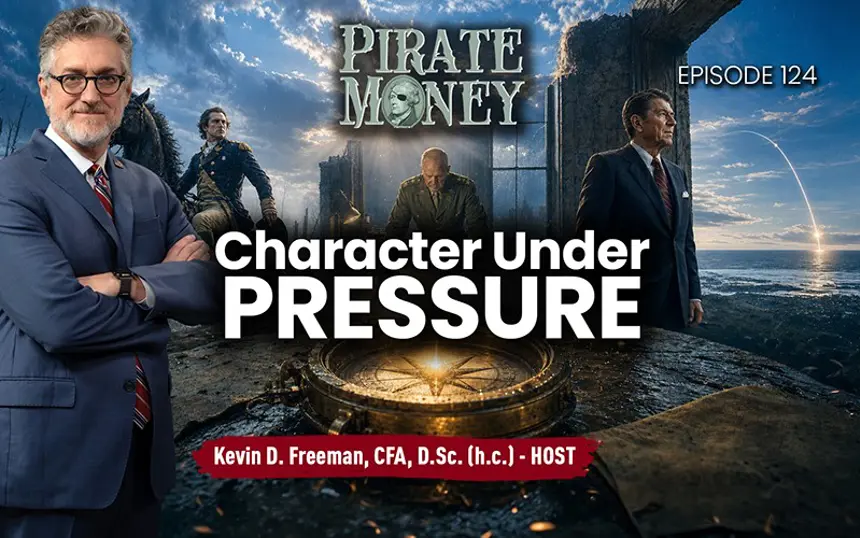
Today's topic is character under extreme pressure
Marnie Freeman: Okay, so today's topic is character under that extreme pressure. Washington, Reagan and Eisenhower.
Kevin Freeman: That's right, historically. Washington, Eisenhower and Reagan.
Marnie Freeman: Yes, we'll put them in order.
Kevin Freeman: Yeah, and we're using three films as cultural entry points. The new Young Washington film, which has stayed in the theaters a lot longer.
Marnie Freeman: So good.
Kevin Freeman: Pressure, which is about Eisenhower and the D Day decision and is now out on streaming services. And then the Brink of War, which is a film that's coming out from Angel Studios about Reagan at Reykjavik.
Marnie Freeman: It's not out yet, right?
Kevin Freeman: It's not out, but it will be soon. These are rarely told, underappreciated stories of how character is formed when almost no one is watching. And then they put it before a broad movie audience. Right, but no one was watching at the time.
Marnie Freeman: Well, it wouldn't be put before a broad movie audience if there hadn't been character formed.
Kevin Freeman: That's correct. And the difference in the quiet, we're comparing confidence to true character, and discussing the loneliness of high stakes decisions, the quiet preparation that makes public courage possible. And Young Washington. That's a great story. It tells about George Washington, the hero that we know, the first president. but he was a man, as a young man under tremendous fire.
Marnie Freeman: This is, feels so timely. And, I think a lot of our listeners are under their own pressures right now, like family, business, definitely culture. And where do we start with this?
Kevin Freeman: All right, let's start with truth and pattern recognition from decades of briefing national security leaders that I've done, and studying economic warfare. I've seen men and women who've held theirs under fire. Sometimes the loneliest, sometimes the loudest, sometimes the most self assured, sometimes the ones questioning and fighting and struggling with it. but those who are tested in the hidden places and pass the test, they're great people of character. And Marnie, you and I look at this as believers. Let's look encouraging, thoughtful, hopeful. but we'll be serious about it, where it needs to be. But we don't want to be heavy handed. We just want to study this great moments of history and really see the impact.
Marnie Freeman: Oh, absolutely. And there's a lot to dive in. I don't think we're going to have enough time to do it all.
Kevin Freeman: Well, we'll do our best.
What's the difference between youthful confidence and the kind of character that can carry nation
Okay, here's a discussion question. What's the difference between youthful confidence and the kind of character that can later carry a nation? Take it to young Washington. Do you see that?
Marnie Freeman: Well, in our youth, I think we're a little over exuberant. We can think we're all that in a bag of chips. Right. To put it mildly. But as Washington had failures, he learned from that. He learned from his mentors, he learned from, I mean even all the characters in all these movies, they learned ah, from those mentors. Eventually he did have some big failures.
Kevin Freeman: He did have failures. young Washington, you know, he wants to be the hero. like, he wants to be the hero like all the other people around him. He wants to serve the king and all that. And he goes and literally begs for a command and an opportunity. and his, his brother was, Lawrence
Marnie Freeman: was his, his half brother. He mentored him.
Kevin Freeman: He mentored, but he was also well respected, well appreciated. You know, he, he, that's where I started.
Marnie Freeman: He taught him civility.
Kevin Freeman: Mount Vernon, where we've been so many times, was really, actually I highly recommend
Marnie Freeman: people going to Mount Vernon. It's incredible.
Kevin Freeman: Yes. But George Washington did not create Mount Vernon.
Marnie Freeman: No, he did not.
Kevin Freeman: He grew up around it and there. And his brother Lawrence owned it.
Marnie Freeman: Well, going back to Washington's mom, she said failure as a tutor sent by God. If you don't learn from it, you fail twice. If you do learn from it, you've earned wisdom. That's really powerful.
Kevin Freeman: Yeah. And you know what's exciting about the movie is when I saw it, everywhere I looked, said that it's historically accurate. I asked David Barton and Bill Federer and they said it's accurate.
Marnie Freeman: Even the archivists of the Smithsonians, I don't know which entity, but they were, they said it was accurate.
Kevin Freeman: And even one of the complaints on Rotten Tomatoes, I mean they've complained about a lot of things. When you find a good movie and you like it and you're like the Reagan movie, I loved it. And the crowd, the regular people loved it, but the critics hated it. One of the critics criticisms was well, young Washington is too factually correct. It's too historical. I was like yeah, they wanted to make it up. They wanted him chopping down a cherry tree. I mean what is it that they were after?
Marnie Freeman: The story that actually happened.
Kevin Freeman: Yes.
Marnie Freeman: Is fantastic.
Kevin Freeman: It's well documented.
Marnie Freeman: That's what God ordained and did through Washington.
Kevin Freeman: And it tells battles. A, combined force of French and Native American warriors ambushed British general Edward Braddock's army near present day Pittsburgh. The British lines collapsed into chaos. Nearly every officer on horseback was killed or wounded. And a 23 year old Lt. Col. George Washington was rode back and forth across the battlefield for hours acting as a courier to coordinate a retreat. Afterward he discovered just how close he'd come to death. He had two horses shot out from under him. He found four bullet holes ripped through his coat. He escaped without a single scratch or flesh wound. Nine days later he wrote a letter to his brother, Jon Augustine Washington, explicitly attributing his survival to God. He wrote, by the all powerful dispensations of providence, I have been protected beyond all human probability or expectation, yet escaped unhurt, although death was leveling my companions on every side.
Marnie Freeman: How could you get better than that in a movie? Take that. Rotten tomatoes.
Kevin Freeman: Yeah, take that rotten. And then it tells the story also of the legend. Fifteen years later in 1770, according to records, Washington's closest friend and companion, Dr. James Craik Washington traveled back to the Ohio country and encountered an elderly native leader, Native American leader who had fought against him in that battle. And through an interpreter. Can you read what the chief told Washington?
Marnie Freeman: He was an expert marksman and had personally targeted Washington.
Kevin Freeman: Okay, so I'm a great shot and I shot at you.
Marnie Freeman: Yeah, I shot at you. He fired his rifle at Washington 11 to 17 times and ordered his warriors to do the same. But all shots, these were expert marksmen, miraculously missed him and concluded that the young officer Washington was shielded by the Great Spirit. The chief ordered his men to stop firing, predicting that Washington was destined to become the Chief of Nations. And this extraordinary escape firmly established Washington's lifelong conviction that divine providence was actively preserving his life for a grander historical purpose.
Kevin Freeman: Where would Washington have been had he gone in the ego of his youth and not been tried under fire and not known that God had preserved him for something greater? That was the moment that he became clicked General Washington that could go through many defeats of the revolution and emerge victorious. And then President Washington, who could be the father of this country.
Marnie Freeman: That's right.
Kevin Freeman: That's where our nation was birthed, right there.
Marnie Freeman: I mean, it's just so powerful.
Patriot Mobile is a mobile phone company that supports the Pirate Money radio program
And the cinematography on this movie is stunning. And you see the depth of character being built. You see his suffering, in failure. And you see his. He's still very humble servant in his success.
Kevin Freeman: He realizes his success would not have happened except for the hand of God. He called it the hand of Providence, but we know what that means, you know, and he dedicated his life, he dedicated more than just. He dedicated his estate. He was a wealthy man because of his brother Lawrence and because of his prominence. and he dedicated his money. And there are only three things you can do with your money. You can give it, you can spend it, or you can invest it. Here at Pirate Money Radio, we work to explain solutions that support all three areas. Giving, spending, investing in, in a way that promotes liberty, security and values. Patriot Mobile, it's a mobile phone company, supports the Pirate Money radio program. Patriot Mobile uses US carriers including AT&T, Verizon and T Mobile, and operates on both Apple and Android phones. More information about the economic war room and Patriot Mobile is [email protected] AFR that's PirateMoneyRadio.com AFR and the reason Patriot Mobile is called Patriot Mobile is they're reflecting people like General George Washington.
Marnie Freeman: That's right. And they attributed their success to God and being trying to be a servant to their customers.
Kevin Freeman: Right, right, right. And I would imagine if we went back to 1776, that we would find many of the founding fathers were carrying Patriot Mobile phones, if such a thing existed.
Marnie Freeman: That's true.
Kevin Freeman: Here's the thing, is that General Washington was first Major Washington, then Lieutenant Colonel Washington. And the major command was pretty hefty command to have been given so young in life. At 23, he was a lieutenant colonel.
Marnie Freeman: 23.
Kevin Freeman: And that his character was forged in trial by fire. And that's what we're talking about, character under pressure. That's how God creates diamonds. He takes coal, puts it under pressure. That's how an oyster produces a pearl. And we're under pressure. Some of you listening may be under severe pressure. Hang in there, God's with you and he's going to produce something remarkable in your character. We'll be right back.
The film Young Washington focuses on George Washington's mistakes before the revolution
Mike Carter: Welcome back to Pirate Money Radio with
Kevin Freeman: your host, Kevan Freeman, talking with my beautiful wife Marnie. And we're talking about, before he was the father of our country, young George Washington was a 20something officer and he made a lot of Very public mistakes.
Marnie Freeman: He did. He did. I mean, I would say that we all fail. And failure does not define us. and if it did, we'd be lost to eternity. Seriously. So think about that. But the film Young Washington leans into that. In Jubanville, Glenn, for necessity. The wilderness, loneliness, all of it. And you see it portrayed very well.
Kevin Freeman: Yeah. Well, you see young Washington filled with ambition. He wanted to be a, true hero, a patriot like his brother. then you see it colliding with reality. A disastrous campaign he had. Shame. The long, quiet work of learning from his failure before the revolution ever began. Character was being formed when almost no one was watching. And what I love about this movie combined with the other one that I. Another one that I really like, which was the Great Awakening, you see, I
Marnie Freeman: said that was fantastic.
Kevin Freeman: Young, ambitious Ben Franklin. And then you see the wisdom later in life. In fact, you see Ben Franklin and George Washington at the Constitutional Convention, both having come from very different paths to reach the same, point where they are establishing our nation.
Marnie Freeman: Yeah. I mean, younger, more stubborn, more overly confident, older with wisdom.
Kevin Freeman: Yep. you mentioned Jumonville Glen, which is the historic site in Pennsylvania famous for Washington's first military battle. And the opening skirmish of the French and Indian war started on May 28, 1754. My father was born on May 28. And so that's a day that's memorable to me.
Marnie Freeman: But it's another day of infamy.
Kevin Freeman: Yeah. 181 years before he was born, the French and Indian War started. I didn't realize this until I watched the movie. I may have forgotten it. But George Washington was responsible, literally his skirmishes that caused the French and Indian War, that set up the American Revolution. And also that's where Davy Crockett came from. And so many different things, you know, I guess it wasn't Davy Crockett.
Marnie Freeman: No, no.
Kevin Freeman: But so many different things came through that French and Indian War.
Marnie Freeman: Well, he learned a lot. He learned a lot of lessons that he actually could then take back to, the Continental army and those type of things. So, ah, it was a. I, would say gross, historic, rough time that he faced. And he wasn't listening to people around him. He wasn't taking advice. He wasn't listening to his mentors.
Kevin Freeman: Well, and there were 40 soldiers and they ambushed a small camp of 29 to 35 French Canadian troops. And it got out of hand. And when it got out of hand, the French commander, Ensign Joseph Calun, was killed during the brief 15 minute fight. He was Killed by the Mingo chief, the native that was with him, sparking an international controversy. And it really ignited a seven year war that was the First World War. now Washington, not World War I, but before World War I, the actual first true global conflict.
Marnie Freeman: Now, Washington led them to surround that camp, but we don't know, and it's portrayed in the movie, who did that first shot and caused a whole bunch of just the domino that the French Indian War became.
Kevin Freeman: Yeah. And that led directly to French retaliation. Washington had to surrender at Fort Necessity, a fort that he built up. and you can see it at the Fort Necessity national battlefield. It's something you can go visit today. And Washington built that up. He built it poorly, unwisely, put it in the wrong location, built it to the wrong height. He did all sorts of things wrong. And he was forced to surrender. And that surrender is what started the, literally started the war because he took responsibility in the surrender on behalf of the king.
Marnie Freeman: And part of it was because he couldn't understand the language is what he said.
Kevin Freeman: He didn't, he didn't understand the language. He had good interpretation. Right. So how does a man go from the impulsive young major who almost started a world war to the restrained commander of the Continental army who knew when to retreat? What role did mentors, books and quiet reflection play in all of that? These are questions that you can ask as you're facing challenges today.
Marnie Freeman: Well, I mean, have you ever had a season where that failure felt final and later realized that it was only the furnace that you were in the
Kevin Freeman: fire God using the furnace. It's painful. All. what is it? Discipline, seems painful at the moment, but in the end, it produces the peaceful fruit of righteousness. That's the scriptural truth. The testing of character produces endurance. That's James. One, two, four. And that's our first president. All right, we're going to take a break. When we come back, we're going to jump all the way from the first president to the 34th president. And you can see this in the movies, too. It's an incredible movie called Pressure. And we'll be talking about Eisenhower's burden of command. When we come back,
Mike Carter: Pirate Money Radio, helping you give, spend and invest in ways that align with liberty, security and values.
The film Pressure centers on the 72 final hours before D day with conflicting weather forecasts
Welcome back with your host, Kevan Freeman.
Kevin Freeman: And I'm joined by Marnie, my wife. And we're talking about movies we've seen recently, or, two of them we've seen, One of them we have not yet to see. We've seen Trailers for it. I'm looking forward to it.
Marnie Freeman: Not yet.
Kevin Freeman: I know personally people were involved in that third one. but let's jump from Washington's early formation to Dwight David Eisenhower's solitary burden. Now Eisenhower was born a Texan, but they claim him in Kansas because he grew up in Kansas. but he was a great man, great president, and he was a warrior general before he became president, just like Washington. And the film Pressure centers on the 72 final hours before D day with conflicting weather forecasts, the loneliness of the decision he has to make, and tens of thousands of lives in the balance.
Marnie Freeman: Okay, I did not know of this story. Please go see it, learn of it. It's incredible. So he had advisors, but the final call was his alone in calling. The timing of that advancement.
Kevin Freeman: Yep, confidence can be loud. Character listens, weighs and decides. The quiet years of staff work and moral formation prepared then General Eisenhower for the very moment that he was facing. So here's a question. How does a leader distinguish between the loudest voice in the room and the right course? Because there was a very loud voice in that room, a weather forecaster saying, nope, it's going to be like this.
Marnie Freeman: So they brought in. Do you want me to tell, Can I tell? There's just a little bit. Yeah. There was competing voices and meteorologists and so he had to figure out which one was accurate because they were competitive, they weren't even on the same course.
Kevin Freeman: Right. And one of them had an incredible track record. He'd relied on him. General Washington or General Eisenhower relied on him over and over and over and he had m. An incredible track record. But then there was another guy who had reasoning and he was the British and he had a different perspective and his different perspective may, or may not turn out to be right. And you have to make the hard decision with so many lives.
Marnie Freeman: You see him just almost, ah, just sweating and wrestling because you know, a bad accident happened before that and he's dealing with, I'm dealing with lives.
Kevin Freeman: I did not know this, but there was a D Day practice invasion known as Exercise Tiger. It was a disastrous full scale rehearsal that suffered from friendly fire and a surprise German attack. And 749Americans lost their lives in a practice run that was supposed to be without casualty. It was just a practice.
Marnie Freeman: General Eisenhower, you'll see here, takes his handwriting, he takes full responsibility for it.
Kevin Freeman: Yeah, actually this is a message that he wrote. It's his D Day failure message. Had things gone wrong on June 5th, 1944. He wrote the Words that said, I bear full responsibility. It wasn't the kernel underneath him. That was the meteorologist, by the way. I think it's interesting that later he was asked, why did the Allies win? And his answer was, we had better meteorologists.
Marnie Freeman: Right. They had to rely on meteorology to take that next step. And so they had to. They had to predict it. What was the weather going to do? And this is fascinating from start to finish.
Kevin Freeman: I do think there's a contrast here, though, because I note that in this case, they could choose the day of, their invasion. On D Day, he gets to pick his day. It's got to be the right tides. The Germans have to be in certain positions. The weather has to be. But they could choose that. By contrast, another movie that I love, which is Darkest Hour or Dunkirk, Churchill was faced with a. You don't have a choice on the weather. You don't get to choose what the weather is. There are 350,000 men trapped on a French beach town. You have to get them off. It doesn't matter the weather. But they took a different approach. They prayed.
Marnie Freeman: That's right, he prayed.
Kevin Freeman: They went not to the meteorologists predicting what the weather would be. They went to the God of all eternity in heaven, all the weather, and asked him to make the weather pleasant. And God created a fog over Flanders so they couldn't take planes off. And he created a smooth, calm English Channel so they could get men out. So it's two contrasts, one retreat, one invasion. But it's interesting, the thread is God, wants to have faithful stewards who are doing the right thing. And Eisenhower in this movie, pressure. You can see all of the tumult he goes through. but you also see his faith, you see his failure, you see his success, and you see God working his hand. And history was changed because of the weather.
Marnie Freeman: That's right.
Kevin Freeman: All right, we're going to study more. We're going to go to another point in history with President Ronald Reagan in the Cold War, and we have some personal connection to this, and we'll share it right after this break.
Three pivotal moments in American history where presidents took responsibility
Mike Carter: Welcome to Pirate Money Radio with your host, Kevan Freeman, helping you unpack the economic headlines and providing real money solutions.
Kevin Freeman: Yeah. And I'm joined by Marnie, and we're talking about three moments of history where character was formed under the most extreme pressure by great men who were presidents of the United States at one point in their careers. We did Young Washington, and that was setting the prelude up to make Us a nation. And then we talked about General Eisenhower and he was at that crucial moment in World War II where the United States went from being one nation of many to being the premier superpower on the planet. And it really started with a very tough decision that he had to make in the Crucible, for the D Day invasion.
Marnie Freeman: Right. And he had just come off of losing 749 lives, a terrible failure. So he had a mental, he had to come over, overcome mental, you know, just I've got to get back in the game.
Kevin Freeman: And challenges. I'm certain Montgomery went to Churchill and said, Eisenhower's not fit. I should be Supreme Allied Command. That guy just lost 749, in a practice exercise, and friendly fire and all of that. And there's explanation for all of it. But he took responsibility. And that was one of the key shining moments for both Washington and for Eisenhower. They took responsibility.
There's a new movie about President Reagan confronting Soviet leader Mikhail Gorbachev
Now I want to turn to one of the greatest presidents of my lifetime, the one that I first voted. I got to vote for him. My first vote was for President Ronald Wilson Reagan. when I turned 18, I was able to vote, and we're going to fast forward in his life. He's already president. And we saw the great movie Reagan and we were just re screened, we just saw it again with Mark Joseph, the producer and we saw the director's cut and I texted my, my friend Jon Voight and said I love the way you acted in that movie, the
Marnie Freeman: perspective of it and his acting. It was great.
Kevin Freeman: He called back. It was fun and, and everything but. But this was an existential cold war. It wasn't a shooting war, but it was a real war between the Soviet Union and the United States. And when I was in college they were telling me America will lose this war.
Marnie Freeman: Yes.
Kevin Freeman: And we looked weak. And then Reagan came on the scene and there's a new movie coming out called the Brink of War. It's about President Ronald Reagan at Reykjavik, Iceland, where he confronts Secretary Gorbachev. It's about moral clarity under an existing nuclear threat. This could have ended the world. Ah, had this gone terribly wrong, it could have ended the world. And we watched long form convictions begin to unfold in Ronald Reagan.
Marnie Freeman: Right. It's just decades of quiet preparation showed up in the room that you see coming out. This is the moment he's prepared for.
Kevin Freeman: Yeah. And confidence, could be negotiated away. But true character holds the line. And the loneliness of standing firm when advisors, history and the moment push you towards compromise. So I'm going to quote from the movie trailer. This is probably not Actually said. But it really does reflect the time Gorbachev, we're in there and he's. We are strong people. And we have learned that strength is how you win a war. You know, in this strong Russian accent, the strength is how you win a war. And Reagan responds, we're not trying to win a war, we're trying to end one. Because Reagan knew we were in a war and it was going to end in existential chaos. It was going to end with potential nuclear, weapons exchanges.
Marnie Freeman: Now, our country has been here several times before and this one shows, in all those times you see character, resolve, all of that show up strength.
Kevin Freeman: Yes. And to be bipartisan, for sure, Washington was not a Republican or a Democrat. clearly Eisenhower was a Republican, Reagan was a Republican. But you saw the same thing with Kennedy, Jon F. Kennedy on the brink of war also just a couple of decades earlier in the Cuban Missile crisis. So it's about character, not politics. Okay, so what they actually said, and they had a conversation at Hoffdi House, which is a very lonely but really cool looking house. Marnie, you'd buy this house if you could.
Marnie Freeman: Oh, I would.
Kevin Freeman: You would love it. It's very historical and it's out in
Marnie Freeman: the middle of the.
Kevin Freeman: It is. And they had highly technical, tense and exhausting conversation. But both men did voice sentiments that matched the philosophical spirit of the movie's dialogue. For example, Reagan shocked his own advisors when the man who said peace through strength looks at Gorbachev and says, what if we get rid of all nuclear weapons? That took. I mean, that's a negotiating tactic.
Marnie Freeman: Yes, he was shocked.
Kevin Freeman: Declassified transcripts showing Reagan telling Gorbachev that he truly wanted to eliminate the threat of nuclear weapons for future generations. Which is amazing because he was portrayed as the cowboy and that he wanted to blow things up and all that. That's the way he was portrayed in the press. But in reality, he actually wanted to bring true peace. Okay, so that was powerful. And then he mentioned what we call Star wars or sdi, the Strategic Defense Initiative. And we have friends who worked on that.
Marnie Freeman: Yes, we have a lot of friends that would have been in this movie or participated in some way, shape or form, which is exciting to see it all, how it all played out with our friends being involved.
Kevin Freeman: Yeah, well, we have these missile systems now that protect if there's incoming Patriot missiles and all that that we have. But Reagan talked about in space, what if we had lasers that shoot down the missiles as they're flying? And if we didn't actually have all that technology. But Gorbachev feared that we did. It brought a lot of strength to Reagan, and he said, look, we'll build it and we'll share it with you. Then everybody will be safe. And Gorbachev literally turned it down. So while he was trying, he didn't say, let's end a, war. He literally was trying to end the war. And using modern screenwriting, it did reflect actually how he felt. Now, I want to share with you, you know our friend Jon Lenchowski.
Marnie Freeman: Yes. Amazing leader.
Kevin Freeman: We need to have Jon very smart on the program. He's very tall, too.
Marnie Freeman: Oh, my gosh, he's so tall.
Kevin Freeman: And we've. I've known him 30 years.
Marnie Freeman: Yes.
Kevin Freeman: I've known him not, you know, so I get to know him first in 1996. So this, this goes back to just eight years after Reagan left office.
Marnie Freeman: He had a huge role in this.
Kevin Freeman: He did. He was Reagan's principal Soviet adviser from 1983 to 1987. So he was behind the scenes at the Reykjavik summit in Iceland. He was a National Security Council advisor. He was a hardline strategist, and he was an author of the SDI standoff. He really did have an important role. And Jon, his history and understanding, by the way, he loves peace. he believes in God firmly. He believes in Jesus firmly.
Marnie Freeman: He's a gentle giant.
Kevin Freeman: He wants peace, but he also understands that we can't let others take away our peace.
Marnie Freeman: So we also needed to talk about Frank Gaffney and Dannah Rohrabacher a little bit, who had roles also in this.
Kevin Freeman: Yeah, I don't know if Dannah will show up in this movie, the Brink of War.
Marnie Freeman: So he was the speechwriter, but he
Kevin Freeman: certainly was in the movie. Reagan and Dannah and I have exchanged notes afterwards. We've talked, we've had phone calls. He had me testify, in his China, in his congressional committee, when he's a congressman.
Marnie Freeman: But at this time is hilarious.
Kevin Freeman: He was kind of a hippie. And he was a speechwriter for Reagan. Mr. Gorbachev, tear down that wall. He didn't write those lines, but he was a part of the team that did. Yes. So, we talk about data, but let's talk about Frank for a second.
Marnie Freeman: He's a good man, Frank. Frank's a good egg.
Kevin Freeman: Frank has been on this program. Official declassified logistics and planning documents from the U.S. department of State, Office of the Historian, show that Frank was involved in the preparation and post summit National Security Council meetings in Washington. He wasn't at Reykjavik, but he was involved in those, preparations.
Marnie Freeman: Yes.
Kevin Freeman: He was the defense delegation on the ground. his boss, Richard Pearle, did travel to Reykjavik, but Frank stayed home in Washington. And the Washington Post traced how Richard Perl sat across from the Soviets during the late night sessions while his core DC team, which included Frank, Yes. Supported and monitored the policy. And then the Brookings Institution's oral histories and comprehensive retrospectives combined, compiled by the National Security Council Project via Brookings Institution Veterans Arms control negotiators confirmed who was in the room and explicitly mentioned Richard Pearle's presence and noted that Gaffney was the influential voice from his position back in Washington.
Marnie Freeman: That's crazy.
Kevin Freeman: He was intimately involved. They made a whole movie about stuff our friends did. I know I can't call President Reagan a friend, but I was so honored to meet him, so honored to spend time and give him an award. bottom line, though, we have men. This is documented. What happened there with President Reagan was real. It was intense. His character was forged there, and it literally beat the evil empire. All right, so that's important. And what's important is it's assured liberty, security and values, for you, for our families, for churches, for everything that happened because of the character formed in the. That man.
Marnie Freeman: Yeah.
Kevin Freeman: All right, I need to point out support for this program comes from Glint. It's a financial technology service offering a debit card and a mobile app, that enables users to access their gold holdings for everyday purchases. With Glint, users maintain ownership of allocated physical gold, which is stored in a managed vault. At the time of a transaction, gold is sold in real time to cover the purchase amounts and local currency. Glint offers an alternative way to store and use the value. Combining gold and silver with modern payment infrastructure, Glint clients can monitor their goal balance, view transaction history, and manage their account through the Glint app, available on major mobile platforms. More details about how vaulted physical gold can be used as money are [email protected] Gold24,7. That's glentpay.com Gold247. Glint provides access to gold for modern spending. All right, Marty, we've talked about, all three movies that teach about character. we need to see that quiet preparation in our leaders and in our own lives. And we need to understand the biblical truth. The man who builds his house on the rock, that's the house that stands. Let's build our house on the rock of Jesus Christ. We'll be right back.
Kevin Freeman: All three presidents were men of faith in divine providence
Mike Carter: Welcome back to Pirate Money Radio with
Kevin Freeman: your host, Kevan Freeman, and I'm joined by Marnie.
Marnie Freeman: I love.
Kevin Freeman: I Love sharing stories with you. I love seeing movies with you. I remember our early dates M. at movies. I remember, the Parent Trap is one that stands out.
Marnie Freeman: One of my favorites.
Kevin Freeman: And Armageddon stands out too. Bruce Willis. So we saw in our dating time.
Marnie Freeman: Well, and also an entrepreneur's life. We had to do a dollar movie, a dollar hot dog. And I mean, yeah, you know, one of the times we were struggling, we
Kevin Freeman: did, we did do that. And I love going to see great movies that inspire, with you all. Right. We've covered three stories. One pattern. Character is not confidence. It's not, oh, I'm so certain. It's formed through fire, through quiet faithfulness, tested in loneliness and revealed in high stakes moments, you know.
Marnie Freeman: And that same God who formed these men is still at work in the pressure of our listeners today.
Kevin Freeman: That's right. Exactly. Whatever season you're in, the furnace is not the end of the story. And all things, three of these, all three were men of faith.
Marnie Freeman: That's right.
Kevin Freeman: Like George Washington.
Marnie Freeman: Right. I don't know how we could do it without God. All three were men of faith in the one true God.
Kevin Freeman: That's right. Washington rooted in the concept of divine providence. He viewed the American Revolution and the birth of the United States not as mere human achievements, but as events guided by a protective divine hand. There's a guy who had his horse shot out from under him, bullet holes in his coat, had an expert marksman aiming at him 17 times and telling others to aim at him.
Marnie Freeman: Several expert marksmen.
Kevin Freeman: Yes. And they survived. Here's his direct quote. In his letter to Brigadier General Thomas Nelson, he wrote, the hand of providence has been so conspicuous in all of this that he must be worse than an infidel that lacks faith and more than wicked, that has not gratitude enough to acknowledge his obligations. And he put it out in the first National Thanksgiving Proclamation. Have you got that?
Marnie Freeman: Yeah. So the first National Thanksgiving Proclamation says, as his very first official act after being inaugurated as president, Washington issued a proclamation designating a national day of prayer and thanksgiving. He explicitly stated it was the duty of all nations to acknowledge the providence of almighty God, to obey his will, to be grateful for his benefits and humbly to implore his protection and favor. Humbly, that's right.
Kevin Freeman: And that was Washington. Eisenhower, the same way. He spoke frequently of the intersection of faith, democracy, human rights. He strongly believed that American democracy was a meaningless concept unless it's anchored in a deeply held religious faith. Have you got his quote?
Marnie Freeman: Yeah. Our form of government has no sense unless it is founded in a deeply felt religious faith. And I don't care what it is with us. Of course it is the Judeo Christian concept, but it must be a religion that all men are created in equal.
Kevin Freeman: That was his address at the Freedoms Foundation, December 22, 1952. I'll point out if any religion that says a woman has half the value of a man is not all men are created that meets that standard. Okay, now let's talk President Ronald Reagan. He possessed a deeply personal, optimistic Christian faith. He frequently spoke about his belief in the power of prayer and the idea that God had a specific sovereign plan for individuals and nations. You got his quote.
Marnie Freeman: Yes. If we ever forget that we're one nation under God, then we will be a nation gone under.
Kevin Freeman: Mrs. Freeman, you brought that quote to my attention when you put it on the poster, titled One Nation under God.
Marnie Freeman: Right.
Kevin Freeman: And we've distributed thousands of copies of that have gone out around the world. He gave that as an address at an ecumenical prayer breakfast in August of 1984. And then in the Evil Empire speech, in a historic address to the national association of Evangelicals, he framed the Cold War as a moral and spiritual struggle rather than a geopolitical dispute. He urged Americans not to ignore the facts of history and to openly confront the Soviet Union's state sponsored atheism, famously declaring that the Soviets had committed the sin of pride because they denied the existence of God.
Marnie Freeman: That's pretty prideful.
Kevin Freeman: That is, it's as prideful as you get. Atheists don't realize that they are among the most prideful people on Earth. Planet Earth.
Marnie Freeman: Yes.
So we should come up with one quiet practice of preparation to adopt this week
Kevin Freeman: So we should come up with one quiet practice of preparation to adopt this week so our characters ready when the pressure comes. What should we do? How do we do it? Quiet time. What do you suggest?
Marnie Freeman: I say pray. Pray, pray. Train, train, train. Just keep seeking God, seeking wisdom, getting mentors, finding out in solitude what God wants. But when you have to make the decision, it's solitude.
Kevin Freeman: And always do it from a biblical perspective. Keep that, Bible by hand to keep you realizing that there is a God in heaven and he's not you. And this God in heaven is bigger, greater, stronger. Everything about him is better than you. And if you think you're something really special or important, remember General Washington. Actually, Lieutenant Colonel Washington thought that and it didn't turn out so good. But when he realized God was in heaven, things turned out so much better. All right, we'll be back. We've got one more segment for real life and ah, we'll be talking about real, life ideas,
Mike Carter: Pirate money, radio, helping you give, spend and invest in ways that align with liberty, security and values.
Do we turn to God or away from God during difficult times
Welcome back with your host, Kevan Freeman.
Kevin Freeman: And thank you, Marnie Freeman, for being with me for this. I think it's an important conversation. I think families need to hear this, will air on AFR on Saturday mornings. It'll air on real life, on streaming and then, and then in their regular schedule. But I think it's, it's time, I
Marnie Freeman: think you should go to these movies and read these books and then you have deep discussions about, you can gain a lot of, knowledge, but also, you know, truth.
Kevin Freeman: Yeah.
Marnie Freeman: So lots of pressure, you know, that we're all facing in this day. And we just had another show on AI and that's a big pressure. But we can turn to God for the discernment and to his word for truth. So character under fire is still being formed in the hidden places. If you're lonely and in the wilderness, it's only for a time period. God is refining you in the fire. And the same God who held Washington, Eisenhower and Reagan holds each of us.
Kevin Freeman: yeah, the truth is we're not that special. God is that special, but he loves us. He does love us. In fact. That's the posted on my X account. That's the thing I've posted. I'm not that great, but God is that great. And if we remember that life will give us plenty of opportunity to be puffed up and it'll give us plenty of opportunity to be in mass despair just in everything's going wrong. The truth is in between. The real truth is, though God loves us and has a purpose for our lives, then you will know the truth and the truth will set you free. That's Jon 8:32. So do we learn to embrace the pressure before it forges us? Can we learn that?
Marnie Freeman: Yes, we should embrace it and ask the Lord what he has for us in it. And we have these real challenges even in our 250th birthday year, particularly now. So something from Jeremiah, 18, 7, 8, if any, if at any time I announce that a nation or kingdom is to be uprooted, torn down and destroyed. And if that nation, I warned, turns from its evil, then I will relent and not inflict on it the disaster I had planned.
Kevin Freeman: this is so important because we're looking. I mean, first off, I worked at the highest levels of national security. I was with the tops of the three letter agencies repeatedly and I was warning them and hearing warnings from Them and asked to evaluate problems. And I can tell you there are a lot of ways we could lose our country, from debt, from. From nuclear exchanges. I even wrote a chapter in a book on weapons of mass destruction for the Secretary of Defense. And I've written a new book coming out. Four Horsemen of the American Apocalypse and Our Six Trials by Fire.
Marnie Freeman: It's going to be really good hard topics.
Kevin Freeman: It's really good. It's a hard topic. And it's so easy to get caught up in this notion, for example, that, you know, maybe America's done for. Maybe our best days are behind us, and maybe we have no future or no hope. But when I see a movie like Young Washington, and I realize those were desperate times, too, they were out on the frontier, the Native Americans, which, you know, my history is Native American. But the Indians could have been. And the French could have been coming, and the British were coming, as Paul Revere told us. but the key is, in these hard times, do we turn to God or away from God?
Marnie Freeman: We turn to God.
Kevin Freeman: In Germany, when they had hard times, they turned away from God. Between the First World War and what became the Second World, and that's the rise of Hitler, they turned away from God and went into decadence and everything else. It's our chance, America. We can turn to God in our 250th year, pray for this nation, turn to God. We're a nation under pressure, just as Washington, Eisenhower and Reagan were. But we can have hope, and we do have a God who cares. And that passage you read in Jeremiah. Jeremiah is so depressing. It basically says, hey, you people, you, my people, the Hebrew people. I've called, you know, in the Kingdomnomics of Judah, the Kingdomnomics of Israel. Guess what? I'm going to send a foreign power in, and he's going to defeat you. And if you fight against him, you're going to lose.
Marnie Freeman: Right.
Kevin Freeman: terrible. And I'm going to drag you off because you haven't done the Sabbath and you haven't committed the Sabbath years, and you haven't done right before me, I'm going to drag you off. But at any time that I announce a nation or kingdom is about to be uprooted, torn down, or destroyed, if that nation that I warned turns from its evil, then I will relent and not inflict on it the disaster I had planned. That's Jeremiah 18, 7, 8. That's just as good as, Chronicles 7, 14. Yes, those twin towers of truth are fantastic. We're a nation under pressure. We need to Turn to God. We have a God who cares. We need to turn to God. If in your personal life you're facing challenges, this is your opportunity. As a nation, we are facing challenges, this is our opportunity. We need to make the focus to be form our courage under fire and our character under pressure. For those watching on Real Life Network, until next time, stay faithful, stay free. If you're listening on afr, what you need to do, you need to stay tuned because we'll be right back.
Fear God, not the pressure
Mike Carter: welcome back to Pirate Money Radio with your host Kevan Freeman.
Kevin Freeman: Talking with Morning Freeman, we're talking about three movies we've seen, well, two we've seen, one we're looking forward to seeing, that's coming out, about Washington, Eisenhower and Reagan and how their character was formed under pressure and really how our nation was formed under pressure, preserved under pressure and preserved again under pressure.
Marnie Freeman: Still being preserved under pressure.
Kevin Freeman: Very, very encouraging. So Marnie, do you have any final encouraging thought?
Marnie Freeman: I would say Fear God. He's not giving us a spirit of fear, but we need to fear him. Fear God, not the pressure. Use every trial, including the ones that we face personally and nationally for his glory. Characters formed in the fire. But the final chapter is already written. Jesus wins.
Kevin Freeman: You know, I must admit that I'm one of those who occasionally, if I'm reading a scary book, occasionally I will go to the back of the book and read the ending and then I can, with great confidence watch and you know I see that I watch a very scary, I admit I watch Star Trek Discovery episode and you're like, what is that you're watching? And I, I knew that there was Spock and there was Captain Kirk in this and it's a prequel before the regular Kirk and Spock. Well, I knew how it turned out. I knew that Spock and Kirk went on to the voyages of the starship Enterprise, who had a five year mission. I knew all that. So I could watch with confidence this very scary show knowing, because I admit. So I encourage you, turn to the back of the book. Read the encouraging chapters in the book of the Revelation, given to Jon on Patmos. Read the encouragement that Jesus comes back. There's a new heaven, there's a new Earth, we win, the devil loses, he goes into a lake of fire. Talk about pressure. And we are able to reign victorious with Jesus hereafter, forever and forever and forever. And it's just, it's a beautiful thing.
Marnie Freeman: Okay, so I have to laugh. as you're saying all that, I'm Like, I'm thinking of the Eisenhower quote. He says, well, as you're saying all this, I'm like, well, we just need a better. We need better meteorologists. You know, he says at the end of the movie, the Allies won because we had better meteorologists. Well, you know what? We know the best meteorologists ever. And the winds of war are all around us.
Kevin Freeman: Yes.
Marnie Freeman: And so I love the metaphors, Maureen.
Kevin Freeman: Winds of war. Love that. And the meteorologists, you're right, because we don't have the meteorologists. We've got the weather report after the day is finished.
Marnie Freeman: Exactly.
Kevin Freeman: To know exactly how it ends up. So that's a. That's a beautiful way to look at it. Mrs. Freeman, thank you.
Kevin Freeman and Marnie Freeman discuss character development
Well, thank you for sailing with me on this voyage, this pirate money voyage that we've had today to learn about how character is formed and the value of it. And what I'd like you to do is I'd like you to write [email protected], tell us what you're seeing in your life, how you're applying biblical wisdom under pressure. And here's a prayer. Father, give our leaders wisdom and courage under fire. Strengthen your people in the hidden places where character is formed. Protect the vulnerable and guard Israel. Bless our veterans, bless their families. Keep us faithful until you return in Jesus name. Amen.
Marnie Freeman: Amen. So good.
Kevin Freeman: It is good. All right, you can find us where you find any major podcast platform. You can get the full archives and find [email protected] if you want to learn more, you can go back and listen to all our episodes. We've had a wonderful time sailing today, Mrs. Freeman. This is Kevan Freeman and Marnie Freeman for Pirate Money Radio. Until next time,
Kevin Freeman: Welcome aboard Pirate Money Radio, the show that sails against fiat tyranny
Kevin Freeman: Ahoy, mates. Welcome aboard another voyage of Pirate Money Radio, the show that sails against the storms of fiat tyranny, cultural confusion and counterfeit ideas to chart a course toward the liberty, security and values based on biblical truth. I'm your captain, Kevan Freeman, coming to you from the heart of Texas. And I'm joined by my beautiful co host, the blue eyed bombshell, my wife, Marnie.
Marnie Freeman: Okay, I don't even know how to answer that. I was going to say Ahoy May,
Kevin Freeman: but Marnie, today we're looking at three men whose public leadership was forged long before cameras or crowds, under extreme pressure, in loneliness and through quiet faithfulness.
Today's topic is character under extreme pressure
Marnie Freeman: Okay, so today's topic is character under that extreme pressure. Washington, Reagan and Eisenhower.
Kevin Freeman: That's right, historically. Washington, Eisenhower and Reagan.
Marnie Freeman: Yes, we'll put them in order.
Kevin Freeman: Yeah, and we're using three films as cultural entry points. The new Young Washington film, which has stayed in the theaters a lot longer.
Marnie Freeman: So good.
Kevin Freeman: Pressure, which is about Eisenhower and the D Day decision and is now out on streaming services. And then the Brink of War, which is a film that's coming out from Angel Studios about Reagan at Reykjavik.
Marnie Freeman: It's not out yet, right?
Kevin Freeman: It's not out, but it will be soon. These are rarely told, underappreciated stories of how character is formed when almost no one is watching. And then they put it before a broad movie audience. Right, but no one was watching at the time.
Marnie Freeman: Well, it wouldn't be put before a broad movie audience if there hadn't been character formed.
Kevin Freeman: That's correct. And the difference in the quiet, we're comparing confidence to true character, and discussing the loneliness of high stakes decisions, the quiet preparation that makes public courage possible. And Young Washington. That's a great story. It tells about George Washington, the hero that we know, the first president. but he was a man, as a young man under tremendous fire.
Marnie Freeman: This is, feels so timely. And, I think a lot of our listeners are under their own pressures right now, like family, business, definitely culture. And where do we start with this?
Kevin Freeman: All right, let's start with truth and pattern recognition from decades of briefing national security leaders that I've done, and studying economic warfare. I've seen men and women who've held theirs under fire. Sometimes the loneliest, sometimes the loudest, sometimes the most self assured, sometimes the ones questioning and fighting and struggling with it. but those who are tested in the hidden places and pass the test, they're great people of character. And Marnie, you and I look at this as believers. Let's look encouraging, thoughtful, hopeful. but we'll be serious about it, where it needs to be. But we don't want to be heavy handed. We just want to study this great moments of history and really see the impact.
Marnie Freeman: Oh, absolutely. And there's a lot to dive in. I don't think we're going to have enough time to do it all.
Kevin Freeman: Well, we'll do our best.
What's the difference between youthful confidence and the kind of character that can carry nation
Okay, here's a discussion question. What's the difference between youthful confidence and the kind of character that can later carry a nation? Take it to young Washington. Do you see that?
Marnie Freeman: Well, in our youth, I think we're a little over exuberant. We can think we're all that in a bag of chips. Right. To put it mildly. But as Washington had failures, he learned from that. He learned from his mentors, he learned from, I mean even all the characters in all these movies, they learned ah, from those mentors. Eventually he did have some big failures.
Kevin Freeman: He did have failures. young Washington, you know, he wants to be the hero. like, he wants to be the hero like all the other people around him. He wants to serve the king and all that. And he goes and literally begs for a command and an opportunity. and his, his brother was, Lawrence
Marnie Freeman: was his, his half brother. He mentored him.
Kevin Freeman: He mentored, but he was also well respected, well appreciated. You know, he, he, that's where I started.
Marnie Freeman: He taught him civility.
Kevin Freeman: Mount Vernon, where we've been so many times, was really, actually I highly recommend
Marnie Freeman: people going to Mount Vernon. It's incredible.
Kevin Freeman: Yes. But George Washington did not create Mount Vernon.
Marnie Freeman: No, he did not.
Kevin Freeman: He grew up around it and there. And his brother Lawrence owned it.
Marnie Freeman: Well, going back to Washington's mom, she said failure as a tutor sent by God. If you don't learn from it, you fail twice. If you do learn from it, you've earned wisdom. That's really powerful.
Kevin Freeman: Yeah. And you know what's exciting about the movie is when I saw it, everywhere I looked, said that it's historically accurate. I asked David Barton and Bill Federer and they said it's accurate.
Marnie Freeman: Even the archivists of the Smithsonians, I don't know which entity, but they were, they said it was accurate.
Kevin Freeman: And even one of the complaints on Rotten Tomatoes, I mean they've complained about a lot of things. When you find a good movie and you like it and you're like the Reagan movie, I loved it. And the crowd, the regular people loved it, but the critics hated it. One of the critics criticisms was well, young Washington is too factually correct. It's too historical. I was like yeah, they wanted to make it up. They wanted him chopping down a cherry tree. I mean what is it that they were after?
Marnie Freeman: The story that actually happened.
Kevin Freeman: Yes.
Marnie Freeman: Is fantastic.
Kevin Freeman: It's well documented.
Marnie Freeman: That's what God ordained and did through Washington.
Kevin Freeman: And it tells battles. A, combined force of French and Native American warriors ambushed British general Edward Braddock's army near present day Pittsburgh. The British lines collapsed into chaos. Nearly every officer on horseback was killed or wounded. And a 23 year old Lt. Col. George Washington was rode back and forth across the battlefield for hours acting as a courier to coordinate a retreat. Afterward he discovered just how close he'd come to death. He had two horses shot out from under him. He found four bullet holes ripped through his coat. He escaped without a single scratch or flesh wound. Nine days later he wrote a letter to his brother, Jon Augustine Washington, explicitly attributing his survival to God. He wrote, by the all powerful dispensations of providence, I have been protected beyond all human probability or expectation, yet escaped unhurt, although death was leveling my companions on every side.
Marnie Freeman: How could you get better than that in a movie? Take that. Rotten tomatoes.
Kevin Freeman: Yeah, take that rotten. And then it tells the story also of the legend. Fifteen years later in 1770, according to records, Washington's closest friend and companion, Dr. James Craik Washington traveled back to the Ohio country and encountered an elderly native leader, Native American leader who had fought against him in that battle. And through an interpreter. Can you read what the chief told Washington?
Marnie Freeman: He was an expert marksman and had personally targeted Washington.
Kevin Freeman: Okay, so I'm a great shot and I shot at you.
Marnie Freeman: Yeah, I shot at you. He fired his rifle at Washington 11 to 17 times and ordered his warriors to do the same. But all shots, these were expert marksmen, miraculously missed him and concluded that the young officer Washington was shielded by the Great Spirit. The chief ordered his men to stop firing, predicting that Washington was destined to become the Chief of Nations. And this extraordinary escape firmly established Washington's lifelong conviction that divine providence was actively preserving his life for a grander historical purpose.
Kevin Freeman: Where would Washington have been had he gone in the ego of his youth and not been tried under fire and not known that God had preserved him for something greater? That was the moment that he became clicked General Washington that could go through many defeats of the revolution and emerge victorious. And then President Washington, who could be the father of this country.
Marnie Freeman: That's right.
Kevin Freeman: That's where our nation was birthed, right there.
Marnie Freeman: I mean, it's just so powerful.
Patriot Mobile is a mobile phone company that supports the Pirate Money radio program
And the cinematography on this movie is stunning. And you see the depth of character being built. You see his suffering, in failure. And you see his. He's still very humble servant in his success.
Kevin Freeman: He realizes his success would not have happened except for the hand of God. He called it the hand of Providence, but we know what that means, you know, and he dedicated his life, he dedicated more than just. He dedicated his estate. He was a wealthy man because of his brother Lawrence and because of his prominence. and he dedicated his money. And there are only three things you can do with your money. You can give it, you can spend it, or you can invest it. Here at Pirate Money Radio, we work to explain solutions that support all three areas. Giving, spending, investing in, in a way that promotes liberty, security and values. Patriot Mobile, it's a mobile phone company, supports the Pirate Money radio program. Patriot Mobile uses US carriers including AT&T, Verizon and T Mobile, and operates on both Apple and Android phones. More information about the economic war room and Patriot Mobile is [email protected] AFR that's PirateMoneyRadio.com AFR and the reason Patriot Mobile is called Patriot Mobile is they're reflecting people like General George Washington.
Marnie Freeman: That's right. And they attributed their success to God and being trying to be a servant to their customers.
Kevin Freeman: Right, right, right. And I would imagine if we went back to 1776, that we would find many of the founding fathers were carrying Patriot Mobile phones, if such a thing existed.
Marnie Freeman: That's true.
Kevin Freeman: Here's the thing, is that General Washington was first Major Washington, then Lieutenant Colonel Washington. And the major command was pretty hefty command to have been given so young in life. At 23, he was a lieutenant colonel.
Marnie Freeman: 23.
Kevin Freeman: And that his character was forged in trial by fire. And that's what we're talking about, character under pressure. That's how God creates diamonds. He takes coal, puts it under pressure. That's how an oyster produces a pearl. And we're under pressure. Some of you listening may be under severe pressure. Hang in there, God's with you and he's going to produce something remarkable in your character. We'll be right back.
The film Young Washington focuses on George Washington's mistakes before the revolution
Mike Carter: Welcome back to Pirate Money Radio with
Kevin Freeman: your host, Kevan Freeman, talking with my beautiful wife Marnie. And we're talking about, before he was the father of our country, young George Washington was a 20something officer and he made a lot of Very public mistakes.
Marnie Freeman: He did. He did. I mean, I would say that we all fail. And failure does not define us. and if it did, we'd be lost to eternity. Seriously. So think about that. But the film Young Washington leans into that. In Jubanville, Glenn, for necessity. The wilderness, loneliness, all of it. And you see it portrayed very well.
Kevin Freeman: Yeah. Well, you see young Washington filled with ambition. He wanted to be a, true hero, a patriot like his brother. then you see it colliding with reality. A disastrous campaign he had. Shame. The long, quiet work of learning from his failure before the revolution ever began. Character was being formed when almost no one was watching. And what I love about this movie combined with the other one that I. Another one that I really like, which was the Great Awakening, you see, I
Marnie Freeman: said that was fantastic.
Kevin Freeman: Young, ambitious Ben Franklin. And then you see the wisdom later in life. In fact, you see Ben Franklin and George Washington at the Constitutional Convention, both having come from very different paths to reach the same, point where they are establishing our nation.
Marnie Freeman: Yeah. I mean, younger, more stubborn, more overly confident, older with wisdom.
Kevin Freeman: Yep. you mentioned Jumonville Glen, which is the historic site in Pennsylvania famous for Washington's first military battle. And the opening skirmish of the French and Indian war started on May 28, 1754. My father was born on May 28. And so that's a day that's memorable to me.
Marnie Freeman: But it's another day of infamy.
Kevin Freeman: Yeah. 181 years before he was born, the French and Indian War started. I didn't realize this until I watched the movie. I may have forgotten it. But George Washington was responsible, literally his skirmishes that caused the French and Indian War, that set up the American Revolution. And also that's where Davy Crockett came from. And so many different things, you know, I guess it wasn't Davy Crockett.
Marnie Freeman: No, no.
Kevin Freeman: But so many different things came through that French and Indian War.
Marnie Freeman: Well, he learned a lot. He learned a lot of lessons that he actually could then take back to, the Continental army and those type of things. So, ah, it was a. I, would say gross, historic, rough time that he faced. And he wasn't listening to people around him. He wasn't taking advice. He wasn't listening to his mentors.
Kevin Freeman: Well, and there were 40 soldiers and they ambushed a small camp of 29 to 35 French Canadian troops. And it got out of hand. And when it got out of hand, the French commander, Ensign Joseph Calun, was killed during the brief 15 minute fight. He was Killed by the Mingo chief, the native that was with him, sparking an international controversy. And it really ignited a seven year war that was the First World War. now Washington, not World War I, but before World War I, the actual first true global conflict.
Marnie Freeman: Now, Washington led them to surround that camp, but we don't know, and it's portrayed in the movie, who did that first shot and caused a whole bunch of just the domino that the French Indian War became.
Kevin Freeman: Yeah. And that led directly to French retaliation. Washington had to surrender at Fort Necessity, a fort that he built up. and you can see it at the Fort Necessity national battlefield. It's something you can go visit today. And Washington built that up. He built it poorly, unwisely, put it in the wrong location, built it to the wrong height. He did all sorts of things wrong. And he was forced to surrender. And that surrender is what started the, literally started the war because he took responsibility in the surrender on behalf of the king.
Marnie Freeman: And part of it was because he couldn't understand the language is what he said.
Kevin Freeman: He didn't, he didn't understand the language. He had good interpretation. Right. So how does a man go from the impulsive young major who almost started a world war to the restrained commander of the Continental army who knew when to retreat? What role did mentors, books and quiet reflection play in all of that? These are questions that you can ask as you're facing challenges today.
Marnie Freeman: Well, I mean, have you ever had a season where that failure felt final and later realized that it was only the furnace that you were in the
Kevin Freeman: fire God using the furnace. It's painful. All. what is it? Discipline, seems painful at the moment, but in the end, it produces the peaceful fruit of righteousness. That's the scriptural truth. The testing of character produces endurance. That's James. One, two, four. And that's our first president. All right, we're going to take a break. When we come back, we're going to jump all the way from the first president to the 34th president. And you can see this in the movies, too. It's an incredible movie called Pressure. And we'll be talking about Eisenhower's burden of command. When we come back,
Mike Carter: Pirate Money Radio, helping you give, spend and invest in ways that align with liberty, security and values.
The film Pressure centers on the 72 final hours before D day with conflicting weather forecasts
Welcome back with your host, Kevan Freeman.
Kevin Freeman: And I'm joined by Marnie, my wife. And we're talking about movies we've seen recently, or, two of them we've seen, One of them we have not yet to see. We've seen Trailers for it. I'm looking forward to it.
Marnie Freeman: Not yet.
Kevin Freeman: I know personally people were involved in that third one. but let's jump from Washington's early formation to Dwight David Eisenhower's solitary burden. Now Eisenhower was born a Texan, but they claim him in Kansas because he grew up in Kansas. but he was a great man, great president, and he was a warrior general before he became president, just like Washington. And the film Pressure centers on the 72 final hours before D day with conflicting weather forecasts, the loneliness of the decision he has to make, and tens of thousands of lives in the balance.
Marnie Freeman: Okay, I did not know of this story. Please go see it, learn of it. It's incredible. So he had advisors, but the final call was his alone in calling. The timing of that advancement.
Kevin Freeman: Yep, confidence can be loud. Character listens, weighs and decides. The quiet years of staff work and moral formation prepared then General Eisenhower for the very moment that he was facing. So here's a question. How does a leader distinguish between the loudest voice in the room and the right course? Because there was a very loud voice in that room, a weather forecaster saying, nope, it's going to be like this.
Marnie Freeman: So they brought in. Do you want me to tell, Can I tell? There's just a little bit. Yeah. There was competing voices and meteorologists and so he had to figure out which one was accurate because they were competitive, they weren't even on the same course.
Kevin Freeman: Right. And one of them had an incredible track record. He'd relied on him. General Washington or General Eisenhower relied on him over and over and over and he had m. An incredible track record. But then there was another guy who had reasoning and he was the British and he had a different perspective and his different perspective may, or may not turn out to be right. And you have to make the hard decision with so many lives.
Marnie Freeman: You see him just almost, ah, just sweating and wrestling because you know, a bad accident happened before that and he's dealing with, I'm dealing with lives.
Kevin Freeman: I did not know this, but there was a D Day practice invasion known as Exercise Tiger. It was a disastrous full scale rehearsal that suffered from friendly fire and a surprise German attack. And 749Americans lost their lives in a practice run that was supposed to be without casualty. It was just a practice.
Marnie Freeman: General Eisenhower, you'll see here, takes his handwriting, he takes full responsibility for it.
Kevin Freeman: Yeah, actually this is a message that he wrote. It's his D Day failure message. Had things gone wrong on June 5th, 1944. He wrote the Words that said, I bear full responsibility. It wasn't the kernel underneath him. That was the meteorologist, by the way. I think it's interesting that later he was asked, why did the Allies win? And his answer was, we had better meteorologists.
Marnie Freeman: Right. They had to rely on meteorology to take that next step. And so they had to. They had to predict it. What was the weather going to do? And this is fascinating from start to finish.
Kevin Freeman: I do think there's a contrast here, though, because I note that in this case, they could choose the day of, their invasion. On D Day, he gets to pick his day. It's got to be the right tides. The Germans have to be in certain positions. The weather has to be. But they could choose that. By contrast, another movie that I love, which is Darkest Hour or Dunkirk, Churchill was faced with a. You don't have a choice on the weather. You don't get to choose what the weather is. There are 350,000 men trapped on a French beach town. You have to get them off. It doesn't matter the weather. But they took a different approach. They prayed.
Marnie Freeman: That's right, he prayed.
Kevin Freeman: They went not to the meteorologists predicting what the weather would be. They went to the God of all eternity in heaven, all the weather, and asked him to make the weather pleasant. And God created a fog over Flanders so they couldn't take planes off. And he created a smooth, calm English Channel so they could get men out. So it's two contrasts, one retreat, one invasion. But it's interesting, the thread is God, wants to have faithful stewards who are doing the right thing. And Eisenhower in this movie, pressure. You can see all of the tumult he goes through. but you also see his faith, you see his failure, you see his success, and you see God working his hand. And history was changed because of the weather.
Marnie Freeman: That's right.
Kevin Freeman: All right, we're going to study more. We're going to go to another point in history with President Ronald Reagan in the Cold War, and we have some personal connection to this, and we'll share it right after this break.
Three pivotal moments in American history where presidents took responsibility
Mike Carter: Welcome to Pirate Money Radio with your host, Kevan Freeman, helping you unpack the economic headlines and providing real money solutions.
Kevin Freeman: Yeah. And I'm joined by Marnie, and we're talking about three moments of history where character was formed under the most extreme pressure by great men who were presidents of the United States at one point in their careers. We did Young Washington, and that was setting the prelude up to make Us a nation. And then we talked about General Eisenhower and he was at that crucial moment in World War II where the United States went from being one nation of many to being the premier superpower on the planet. And it really started with a very tough decision that he had to make in the Crucible, for the D Day invasion.
Marnie Freeman: Right. And he had just come off of losing 749 lives, a terrible failure. So he had a mental, he had to come over, overcome mental, you know, just I've got to get back in the game.
Kevin Freeman: And challenges. I'm certain Montgomery went to Churchill and said, Eisenhower's not fit. I should be Supreme Allied Command. That guy just lost 749, in a practice exercise, and friendly fire and all of that. And there's explanation for all of it. But he took responsibility. And that was one of the key shining moments for both Washington and for Eisenhower. They took responsibility.
There's a new movie about President Reagan confronting Soviet leader Mikhail Gorbachev
Now I want to turn to one of the greatest presidents of my lifetime, the one that I first voted. I got to vote for him. My first vote was for President Ronald Wilson Reagan. when I turned 18, I was able to vote, and we're going to fast forward in his life. He's already president. And we saw the great movie Reagan and we were just re screened, we just saw it again with Mark Joseph, the producer and we saw the director's cut and I texted my, my friend Jon Voight and said I love the way you acted in that movie, the
Marnie Freeman: perspective of it and his acting. It was great.
Kevin Freeman: He called back. It was fun and, and everything but. But this was an existential cold war. It wasn't a shooting war, but it was a real war between the Soviet Union and the United States. And when I was in college they were telling me America will lose this war.
Marnie Freeman: Yes.
Kevin Freeman: And we looked weak. And then Reagan came on the scene and there's a new movie coming out called the Brink of War. It's about President Ronald Reagan at Reykjavik, Iceland, where he confronts Secretary Gorbachev. It's about moral clarity under an existing nuclear threat. This could have ended the world. Ah, had this gone terribly wrong, it could have ended the world. And we watched long form convictions begin to unfold in Ronald Reagan.
Marnie Freeman: Right. It's just decades of quiet preparation showed up in the room that you see coming out. This is the moment he's prepared for.
Kevin Freeman: Yeah. And confidence, could be negotiated away. But true character holds the line. And the loneliness of standing firm when advisors, history and the moment push you towards compromise. So I'm going to quote from the movie trailer. This is probably not Actually said. But it really does reflect the time Gorbachev, we're in there and he's. We are strong people. And we have learned that strength is how you win a war. You know, in this strong Russian accent, the strength is how you win a war. And Reagan responds, we're not trying to win a war, we're trying to end one. Because Reagan knew we were in a war and it was going to end in existential chaos. It was going to end with potential nuclear, weapons exchanges.
Marnie Freeman: Now, our country has been here several times before and this one shows, in all those times you see character, resolve, all of that show up strength.
Kevin Freeman: Yes. And to be bipartisan, for sure, Washington was not a Republican or a Democrat. clearly Eisenhower was a Republican, Reagan was a Republican. But you saw the same thing with Kennedy, Jon F. Kennedy on the brink of war also just a couple of decades earlier in the Cuban Missile crisis. So it's about character, not politics. Okay, so what they actually said, and they had a conversation at Hoffdi House, which is a very lonely but really cool looking house. Marnie, you'd buy this house if you could.
Marnie Freeman: Oh, I would.
Kevin Freeman: You would love it. It's very historical and it's out in
Marnie Freeman: the middle of the.
Kevin Freeman: It is. And they had highly technical, tense and exhausting conversation. But both men did voice sentiments that matched the philosophical spirit of the movie's dialogue. For example, Reagan shocked his own advisors when the man who said peace through strength looks at Gorbachev and says, what if we get rid of all nuclear weapons? That took. I mean, that's a negotiating tactic.
Marnie Freeman: Yes, he was shocked.
Kevin Freeman: Declassified transcripts showing Reagan telling Gorbachev that he truly wanted to eliminate the threat of nuclear weapons for future generations. Which is amazing because he was portrayed as the cowboy and that he wanted to blow things up and all that. That's the way he was portrayed in the press. But in reality, he actually wanted to bring true peace. Okay, so that was powerful. And then he mentioned what we call Star wars or sdi, the Strategic Defense Initiative. And we have friends who worked on that.
Marnie Freeman: Yes, we have a lot of friends that would have been in this movie or participated in some way, shape or form, which is exciting to see it all, how it all played out with our friends being involved.
Kevin Freeman: Yeah, well, we have these missile systems now that protect if there's incoming Patriot missiles and all that that we have. But Reagan talked about in space, what if we had lasers that shoot down the missiles as they're flying? And if we didn't actually have all that technology. But Gorbachev feared that we did. It brought a lot of strength to Reagan, and he said, look, we'll build it and we'll share it with you. Then everybody will be safe. And Gorbachev literally turned it down. So while he was trying, he didn't say, let's end a, war. He literally was trying to end the war. And using modern screenwriting, it did reflect actually how he felt. Now, I want to share with you, you know our friend Jon Lenchowski.
Marnie Freeman: Yes. Amazing leader.
Kevin Freeman: We need to have Jon very smart on the program. He's very tall, too.
Marnie Freeman: Oh, my gosh, he's so tall.
Kevin Freeman: And we've. I've known him 30 years.
Marnie Freeman: Yes.
Kevin Freeman: I've known him not, you know, so I get to know him first in 1996. So this, this goes back to just eight years after Reagan left office.
Marnie Freeman: He had a huge role in this.
Kevin Freeman: He did. He was Reagan's principal Soviet adviser from 1983 to 1987. So he was behind the scenes at the Reykjavik summit in Iceland. He was a National Security Council advisor. He was a hardline strategist, and he was an author of the SDI standoff. He really did have an important role. And Jon, his history and understanding, by the way, he loves peace. he believes in God firmly. He believes in Jesus firmly.
Marnie Freeman: He's a gentle giant.
Kevin Freeman: He wants peace, but he also understands that we can't let others take away our peace.
Marnie Freeman: So we also needed to talk about Frank Gaffney and Dannah Rohrabacher a little bit, who had roles also in this.
Kevin Freeman: Yeah, I don't know if Dannah will show up in this movie, the Brink of War.
Marnie Freeman: So he was the speechwriter, but he
Kevin Freeman: certainly was in the movie. Reagan and Dannah and I have exchanged notes afterwards. We've talked, we've had phone calls. He had me testify, in his China, in his congressional committee, when he's a congressman.
Marnie Freeman: But at this time is hilarious.
Kevin Freeman: He was kind of a hippie. And he was a speechwriter for Reagan. Mr. Gorbachev, tear down that wall. He didn't write those lines, but he was a part of the team that did. Yes. So, we talk about data, but let's talk about Frank for a second.
Marnie Freeman: He's a good man, Frank. Frank's a good egg.
Kevin Freeman: Frank has been on this program. Official declassified logistics and planning documents from the U.S. department of State, Office of the Historian, show that Frank was involved in the preparation and post summit National Security Council meetings in Washington. He wasn't at Reykjavik, but he was involved in those, preparations.
Marnie Freeman: Yes.
Kevin Freeman: He was the defense delegation on the ground. his boss, Richard Pearle, did travel to Reykjavik, but Frank stayed home in Washington. And the Washington Post traced how Richard Perl sat across from the Soviets during the late night sessions while his core DC team, which included Frank, Yes. Supported and monitored the policy. And then the Brookings Institution's oral histories and comprehensive retrospectives combined, compiled by the National Security Council Project via Brookings Institution Veterans Arms control negotiators confirmed who was in the room and explicitly mentioned Richard Pearle's presence and noted that Gaffney was the influential voice from his position back in Washington.
Marnie Freeman: That's crazy.
Kevin Freeman: He was intimately involved. They made a whole movie about stuff our friends did. I know I can't call President Reagan a friend, but I was so honored to meet him, so honored to spend time and give him an award. bottom line, though, we have men. This is documented. What happened there with President Reagan was real. It was intense. His character was forged there, and it literally beat the evil empire. All right, so that's important. And what's important is it's assured liberty, security and values, for you, for our families, for churches, for everything that happened because of the character formed in the. That man.
Marnie Freeman: Yeah.
Kevin Freeman: All right, I need to point out support for this program comes from Glint. It's a financial technology service offering a debit card and a mobile app, that enables users to access their gold holdings for everyday purchases. With Glint, users maintain ownership of allocated physical gold, which is stored in a managed vault. At the time of a transaction, gold is sold in real time to cover the purchase amounts and local currency. Glint offers an alternative way to store and use the value. Combining gold and silver with modern payment infrastructure, Glint clients can monitor their goal balance, view transaction history, and manage their account through the Glint app, available on major mobile platforms. More details about how vaulted physical gold can be used as money are [email protected] Gold24,7. That's glentpay.com Gold247. Glint provides access to gold for modern spending. All right, Marty, we've talked about, all three movies that teach about character. we need to see that quiet preparation in our leaders and in our own lives. And we need to understand the biblical truth. The man who builds his house on the rock, that's the house that stands. Let's build our house on the rock of Jesus Christ. We'll be right back.
Kevin Freeman: All three presidents were men of faith in divine providence
Mike Carter: Welcome back to Pirate Money Radio with
Kevin Freeman: your host, Kevan Freeman, and I'm joined by Marnie.
Marnie Freeman: I love.
Kevin Freeman: I Love sharing stories with you. I love seeing movies with you. I remember our early dates M. at movies. I remember, the Parent Trap is one that stands out.
Marnie Freeman: One of my favorites.
Kevin Freeman: And Armageddon stands out too. Bruce Willis. So we saw in our dating time.
Marnie Freeman: Well, and also an entrepreneur's life. We had to do a dollar movie, a dollar hot dog. And I mean, yeah, you know, one of the times we were struggling, we
Kevin Freeman: did, we did do that. And I love going to see great movies that inspire, with you all. Right. We've covered three stories. One pattern. Character is not confidence. It's not, oh, I'm so certain. It's formed through fire, through quiet faithfulness, tested in loneliness and revealed in high stakes moments, you know.
Marnie Freeman: And that same God who formed these men is still at work in the pressure of our listeners today.
Kevin Freeman: That's right. Exactly. Whatever season you're in, the furnace is not the end of the story. And all things, three of these, all three were men of faith.
Marnie Freeman: That's right.
Kevin Freeman: Like George Washington.
Marnie Freeman: Right. I don't know how we could do it without God. All three were men of faith in the one true God.
Kevin Freeman: That's right. Washington rooted in the concept of divine providence. He viewed the American Revolution and the birth of the United States not as mere human achievements, but as events guided by a protective divine hand. There's a guy who had his horse shot out from under him, bullet holes in his coat, had an expert marksman aiming at him 17 times and telling others to aim at him.
Marnie Freeman: Several expert marksmen.
Kevin Freeman: Yes. And they survived. Here's his direct quote. In his letter to Brigadier General Thomas Nelson, he wrote, the hand of providence has been so conspicuous in all of this that he must be worse than an infidel that lacks faith and more than wicked, that has not gratitude enough to acknowledge his obligations. And he put it out in the first National Thanksgiving Proclamation. Have you got that?
Marnie Freeman: Yeah. So the first National Thanksgiving Proclamation says, as his very first official act after being inaugurated as president, Washington issued a proclamation designating a national day of prayer and thanksgiving. He explicitly stated it was the duty of all nations to acknowledge the providence of almighty God, to obey his will, to be grateful for his benefits and humbly to implore his protection and favor. Humbly, that's right.
Kevin Freeman: And that was Washington. Eisenhower, the same way. He spoke frequently of the intersection of faith, democracy, human rights. He strongly believed that American democracy was a meaningless concept unless it's anchored in a deeply held religious faith. Have you got his quote?
Marnie Freeman: Yeah. Our form of government has no sense unless it is founded in a deeply felt religious faith. And I don't care what it is with us. Of course it is the Judeo Christian concept, but it must be a religion that all men are created in equal.
Kevin Freeman: That was his address at the Freedoms Foundation, December 22, 1952. I'll point out if any religion that says a woman has half the value of a man is not all men are created that meets that standard. Okay, now let's talk President Ronald Reagan. He possessed a deeply personal, optimistic Christian faith. He frequently spoke about his belief in the power of prayer and the idea that God had a specific sovereign plan for individuals and nations. You got his quote.
Marnie Freeman: Yes. If we ever forget that we're one nation under God, then we will be a nation gone under.
Kevin Freeman: Mrs. Freeman, you brought that quote to my attention when you put it on the poster, titled One Nation under God.
Marnie Freeman: Right.
Kevin Freeman: And we've distributed thousands of copies of that have gone out around the world. He gave that as an address at an ecumenical prayer breakfast in August of 1984. And then in the Evil Empire speech, in a historic address to the national association of Evangelicals, he framed the Cold War as a moral and spiritual struggle rather than a geopolitical dispute. He urged Americans not to ignore the facts of history and to openly confront the Soviet Union's state sponsored atheism, famously declaring that the Soviets had committed the sin of pride because they denied the existence of God.
Marnie Freeman: That's pretty prideful.
Kevin Freeman: That is, it's as prideful as you get. Atheists don't realize that they are among the most prideful people on Earth. Planet Earth.
Marnie Freeman: Yes.
So we should come up with one quiet practice of preparation to adopt this week
Kevin Freeman: So we should come up with one quiet practice of preparation to adopt this week so our characters ready when the pressure comes. What should we do? How do we do it? Quiet time. What do you suggest?
Marnie Freeman: I say pray. Pray, pray. Train, train, train. Just keep seeking God, seeking wisdom, getting mentors, finding out in solitude what God wants. But when you have to make the decision, it's solitude.
Kevin Freeman: And always do it from a biblical perspective. Keep that, Bible by hand to keep you realizing that there is a God in heaven and he's not you. And this God in heaven is bigger, greater, stronger. Everything about him is better than you. And if you think you're something really special or important, remember General Washington. Actually, Lieutenant Colonel Washington thought that and it didn't turn out so good. But when he realized God was in heaven, things turned out so much better. All right, we'll be back. We've got one more segment for real life and ah, we'll be talking about real, life ideas,
Mike Carter: Pirate money, radio, helping you give, spend and invest in ways that align with liberty, security and values.
Do we turn to God or away from God during difficult times
Welcome back with your host, Kevan Freeman.
Kevin Freeman: And thank you, Marnie Freeman, for being with me for this. I think it's an important conversation. I think families need to hear this, will air on AFR on Saturday mornings. It'll air on real life, on streaming and then, and then in their regular schedule. But I think it's, it's time, I
Marnie Freeman: think you should go to these movies and read these books and then you have deep discussions about, you can gain a lot of, knowledge, but also, you know, truth.
Kevin Freeman: Yeah.
Marnie Freeman: So lots of pressure, you know, that we're all facing in this day. And we just had another show on AI and that's a big pressure. But we can turn to God for the discernment and to his word for truth. So character under fire is still being formed in the hidden places. If you're lonely and in the wilderness, it's only for a time period. God is refining you in the fire. And the same God who held Washington, Eisenhower and Reagan holds each of us.
Kevin Freeman: yeah, the truth is we're not that special. God is that special, but he loves us. He does love us. In fact. That's the posted on my X account. That's the thing I've posted. I'm not that great, but God is that great. And if we remember that life will give us plenty of opportunity to be puffed up and it'll give us plenty of opportunity to be in mass despair just in everything's going wrong. The truth is in between. The real truth is, though God loves us and has a purpose for our lives, then you will know the truth and the truth will set you free. That's Jon 8:32. So do we learn to embrace the pressure before it forges us? Can we learn that?
Marnie Freeman: Yes, we should embrace it and ask the Lord what he has for us in it. And we have these real challenges even in our 250th birthday year, particularly now. So something from Jeremiah, 18, 7, 8, if any, if at any time I announce that a nation or kingdom is to be uprooted, torn down and destroyed. And if that nation, I warned, turns from its evil, then I will relent and not inflict on it the disaster I had planned.
Kevin Freeman: this is so important because we're looking. I mean, first off, I worked at the highest levels of national security. I was with the tops of the three letter agencies repeatedly and I was warning them and hearing warnings from Them and asked to evaluate problems. And I can tell you there are a lot of ways we could lose our country, from debt, from. From nuclear exchanges. I even wrote a chapter in a book on weapons of mass destruction for the Secretary of Defense. And I've written a new book coming out. Four Horsemen of the American Apocalypse and Our Six Trials by Fire.
Marnie Freeman: It's going to be really good hard topics.
Kevin Freeman: It's really good. It's a hard topic. And it's so easy to get caught up in this notion, for example, that, you know, maybe America's done for. Maybe our best days are behind us, and maybe we have no future or no hope. But when I see a movie like Young Washington, and I realize those were desperate times, too, they were out on the frontier, the Native Americans, which, you know, my history is Native American. But the Indians could have been. And the French could have been coming, and the British were coming, as Paul Revere told us. but the key is, in these hard times, do we turn to God or away from God?
Marnie Freeman: We turn to God.
Kevin Freeman: In Germany, when they had hard times, they turned away from God. Between the First World War and what became the Second World, and that's the rise of Hitler, they turned away from God and went into decadence and everything else. It's our chance, America. We can turn to God in our 250th year, pray for this nation, turn to God. We're a nation under pressure, just as Washington, Eisenhower and Reagan were. But we can have hope, and we do have a God who cares. And that passage you read in Jeremiah. Jeremiah is so depressing. It basically says, hey, you people, you, my people, the Hebrew people. I've called, you know, in the Kingdomnomics of Judah, the Kingdomnomics of Israel. Guess what? I'm going to send a foreign power in, and he's going to defeat you. And if you fight against him, you're going to lose.
Marnie Freeman: Right.
Kevin Freeman: terrible. And I'm going to drag you off because you haven't done the Sabbath and you haven't committed the Sabbath years, and you haven't done right before me, I'm going to drag you off. But at any time that I announce a nation or kingdom is about to be uprooted, torn down, or destroyed, if that nation that I warned turns from its evil, then I will relent and not inflict on it the disaster I had planned. That's Jeremiah 18, 7, 8. That's just as good as, Chronicles 7, 14. Yes, those twin towers of truth are fantastic. We're a nation under pressure. We need to Turn to God. We have a God who cares. We need to turn to God. If in your personal life you're facing challenges, this is your opportunity. As a nation, we are facing challenges, this is our opportunity. We need to make the focus to be form our courage under fire and our character under pressure. For those watching on Real Life Network, until next time, stay faithful, stay free. If you're listening on afr, what you need to do, you need to stay tuned because we'll be right back.
Fear God, not the pressure
Mike Carter: welcome back to Pirate Money Radio with your host Kevan Freeman.
Kevin Freeman: Talking with Morning Freeman, we're talking about three movies we've seen, well, two we've seen, one we're looking forward to seeing, that's coming out, about Washington, Eisenhower and Reagan and how their character was formed under pressure and really how our nation was formed under pressure, preserved under pressure and preserved again under pressure.
Marnie Freeman: Still being preserved under pressure.
Kevin Freeman: Very, very encouraging. So Marnie, do you have any final encouraging thought?
Marnie Freeman: I would say Fear God. He's not giving us a spirit of fear, but we need to fear him. Fear God, not the pressure. Use every trial, including the ones that we face personally and nationally for his glory. Characters formed in the fire. But the final chapter is already written. Jesus wins.
Kevin Freeman: You know, I must admit that I'm one of those who occasionally, if I'm reading a scary book, occasionally I will go to the back of the book and read the ending and then I can, with great confidence watch and you know I see that I watch a very scary, I admit I watch Star Trek Discovery episode and you're like, what is that you're watching? And I, I knew that there was Spock and there was Captain Kirk in this and it's a prequel before the regular Kirk and Spock. Well, I knew how it turned out. I knew that Spock and Kirk went on to the voyages of the starship Enterprise, who had a five year mission. I knew all that. So I could watch with confidence this very scary show knowing, because I admit. So I encourage you, turn to the back of the book. Read the encouraging chapters in the book of the Revelation, given to Jon on Patmos. Read the encouragement that Jesus comes back. There's a new heaven, there's a new Earth, we win, the devil loses, he goes into a lake of fire. Talk about pressure. And we are able to reign victorious with Jesus hereafter, forever and forever and forever. And it's just, it's a beautiful thing.
Marnie Freeman: Okay, so I have to laugh. as you're saying all that, I'm Like, I'm thinking of the Eisenhower quote. He says, well, as you're saying all this, I'm like, well, we just need a better. We need better meteorologists. You know, he says at the end of the movie, the Allies won because we had better meteorologists. Well, you know what? We know the best meteorologists ever. And the winds of war are all around us.
Kevin Freeman: Yes.
Marnie Freeman: And so I love the metaphors, Maureen.
Kevin Freeman: Winds of war. Love that. And the meteorologists, you're right, because we don't have the meteorologists. We've got the weather report after the day is finished.
Marnie Freeman: Exactly.
Kevin Freeman: To know exactly how it ends up. So that's a. That's a beautiful way to look at it. Mrs. Freeman, thank you.
Kevin Freeman and Marnie Freeman discuss character development
Well, thank you for sailing with me on this voyage, this pirate money voyage that we've had today to learn about how character is formed and the value of it. And what I'd like you to do is I'd like you to write [email protected], tell us what you're seeing in your life, how you're applying biblical wisdom under pressure. And here's a prayer. Father, give our leaders wisdom and courage under fire. Strengthen your people in the hidden places where character is formed. Protect the vulnerable and guard Israel. Bless our veterans, bless their families. Keep us faithful until you return in Jesus name. Amen.
Marnie Freeman: Amen. So good.
Kevin Freeman: It is good. All right, you can find us where you find any major podcast platform. You can get the full archives and find [email protected] if you want to learn more, you can go back and listen to all our episodes. We've had a wonderful time sailing today, Mrs. Freeman. This is Kevan Freeman and Marnie Freeman for Pirate Money Radio. Until next time,
What turns pressure into courage? Through the stories of George Washington, Dwight Eisenhower, and Ronald Reagan—and the films Young Washington, Pressure, and The Brink of War—discover how failure, faith, quiet preparation, and personal responsibility forged leaders ready for history’s hardest moments. Whatever trial you face, the furnace is not the end of your story.
(00:00) Kevin Freeman: Welcome aboard Pirate Money Radio, the show that sails against fiat tyranny
(00:58) Today's topic is character under extreme pressure
(03:31) What's the difference between youthful confidence and the kind of character that can carry nation
(08:37) Patriot Mobile is a mobile phone company that supports the Pirate Money radio program
(11:13) The film Young Washington focuses on George Washington's mistakes before the revolution
(17:00) The film Pressure centers on the 72 final hours before D day with conflicting weather forecasts
(22:37) Three pivotal moments in American history where presidents took responsibility
(23:59) There's a new movie about President Reagan confronting Soviet leader Mikhail Gorbachev
(33:42) Kevin Freeman: All three presidents were men of faith in divine providence
(38:05) So we should come up with one quiet practice of preparation to adopt this week
(39:29) Do we turn to God or away from God during difficult times
(45:01) Fear God, not the pressure
(47:47) Kevin Freeman and Marnie Freeman discuss character development
 Live
Live
Did you know American Family Radio is listener-supported? Your monthly financial support will allow us to continue upholding Godly values through our numerous channels, like American Family Radio, One Million Moms, The Stand magazine, and many more.
Become a Great Commission Partner TODAY to help AFR transform culture by rebuilding the family. When you donate today, you’ll get access to: